Qualcomm Raises Chip Prices on 1 September, and Pakistan Pays That Twice
Snapdragon prices rise by double digits from 1 September. Why Android phones get dearer here faster than the chip increase alone suggests.

Qualcomm's chief executive Cristiano Amon has confirmed that Snapdragon chips get more expensive from 1 September, by a double digit percentage. Qualcomm has written to hardware partners saying it can no longer absorb rising costs.
For Pakistan this matters more than the headline suggests, because a component increase does not arrive here at the same size it left the factory.
What Qualcomm actually said
Amon confirmed the increase on CNBC. The reason given is that input costs have risen across the whole production chain: wafer fabrication, assembly, test, advanced packaging, memory and other materials. A letter to hardware partners, reported by Bloomberg, said the company can no longer absorb those costs given supplier and component bottlenecks.
The word being used is double digit. The precise figure has not been published, and this article is not going to guess one. Anywhere quoting an exact percentage is inventing it.
Memory is worth singling out. Memory prices have been climbing across the industry, which is why this is not purely a Qualcomm problem and why it will not be a Qualcomm-only price rise.
Why the increase grows on the way to Pakistan
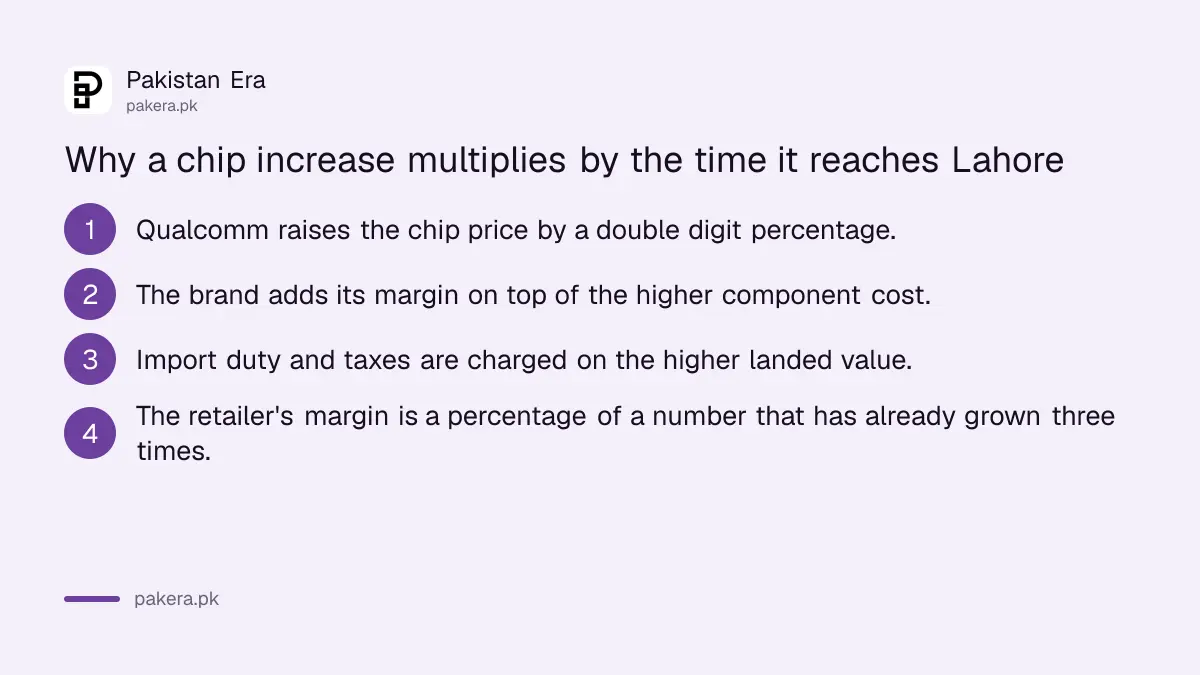
A ten per cent increase on a chip does not become a ten per cent increase on a phone. It becomes something else at each step.
- Qualcomm raises the chip price. A component increase, on one part of a bill of materials.
- The brand adds margin on top of the higher cost. Manufacturers price on a multiple of cost, so a cost increase gets multiplied rather than added.
- Duty and taxes are charged on the higher landed value. This is the step people miss. Import charges are a percentage of value, so a dearer phone attracts more tax in absolute terms, on top of being dearer.
- The retailer's margin is a percentage of a number that has already grown three times.
None of that is unique to Pakistan. What makes it sharper here is the tax layer on imported handsets, which our PTA tax checker puts numbers to, and the fact that the rupee price of an imported phone is already sensitive to the exchange rate before any of this.
What is in scope and what is not
| Product | Affected |
|---|---|
| Android flagships from Samsung, Xiaomi, OnePlus | Yes, these are the core Snapdragon customers |
| Mid range Android | Often, though many models use MediaTek instead |
| Smartwatches and wearables | Yes |
| Windows laptops on Arm | Yes |
| iPhone | Not directly. Apple designs its own silicon |
The iPhone exemption is narrower than it looks. Apple buys memory on the same market as everyone else, and memory is one of the inputs Qualcomm named. Not being a Snapdragon customer protects Apple from this specific increase, not from the conditions causing it.
MediaTek is the more interesting question for Pakistan, because a large share of what actually sells here in the Rs 30,000 to Rs 80,000 range runs MediaTek rather than Snapdragon. If MediaTek holds its pricing, the mid range could come out of this in better shape than the flagships. If it follows, which is what usually happens when a competitor moves first, the whole market moves together.
What this means if you are planning to buy
The increase takes effect on 1 September and reaches retail with a lag, because phones already built and shipped were made with chips bought at the old price.
That gives a window. Devices already on shelves and already imported are unaffected. Phones announced and priced before September are unaffected. What changes is the pricing of models designed and built after that date, which means the phones launching from late this year onward.
So the practical advice splits cleanly.
If you were going to buy in the next few months anyway, buying sooner is mildly better than buying later, and the current lists are the place to start: under Rs 50,000 and under Rs 100,000.
If you were not, this is not a reason to buy a phone. A double digit increase on one component is not a reason to spend six figures early, and the phone you own keeps working regardless.
The Azadi timing is a genuine opportunity
Retail discounts around 14 August fall in the window before any of this reaches shelves, on stock imported at the old cost base. That is a better than usual moment to buy if you were going to.
Our piece on this year's Azadi offers tracks what is actually announced rather than what is being recycled from last year, which matters more than usual this time.
The wider picture for phone prices here
Chip costs are one input among several, and in Pakistan they are rarely the biggest. Tax treatment of imported handsets, PTA tax on 5G devices and the exchange rate all move prices more than a component increase does.
The one structural counterweight is local assembly. Phones assembled in Pakistan avoid part of the import cost stack, which is exactly the layer that multiplies a component increase. If this hike lands as expected, locally assembled models should widen their price advantage rather than narrow it.
Questions readers are asking
When do Qualcomm's new chip prices take effect?
1 September 2026, confirmed by chief executive Cristiano Amon. The increase is described as double digit, but the exact percentage has not been published.
Why is Qualcomm raising prices?
Rising input costs across wafer fabrication, assembly, test, advanced packaging, memory and other materials, which the company says it can no longer absorb given supplier bottlenecks.
Will phone prices in Pakistan go up by the same percentage?
Almost certainly by more, because the chip increase passes through brand margin, then through duty and taxes charged on the higher landed value, then through retail margin. Each step is a percentage of an already larger number.
Does this affect iPhone prices?
Not directly, since Apple uses its own silicon. Apple is exposed to the same memory cost pressure that is part of the cause, so it is protected from this increase rather than from the underlying conditions.
Should I buy a phone before September?
Only if you were going to buy anyway. Stock already imported is unaffected, and the Azadi sale period falls inside that window, so it is a reasonable time to act on a purchase you had planned. It is not a reason to bring one forward by a year.
Will locally assembled phones be cheaper as a result?
Relatively, yes. Local assembly avoids part of the import cost stack, and it is that stack which multiplies a component increase, so the gap should widen rather than close.
About the author

Tax, Bills and Technology Writer
Ali Akhtar is a young and curious voice here at Pakistan Era. He is currently pursuing his A-Levels and has a growing interest in Pakistan’s changing industrial landscape and educational trends. Ali likes to write in a way that helps him explain and explore the world around him. His writing reflects the perspective of the new generation navigating the evolving trends of Pakistan where technology, youth innovation, and shifting opportunities are reshaping the country’s future.