Raast Handled 2.76 Billion Payments Worth Rs 80 Trillion in FY26, SBP Report Shows
SBP's full FY26 payments report shows Raast handled 2,755.2 million payments worth Rs 80,050.8 billion, up from 1,276.0 million. See merchant and P2P figures.
Short answer: Raast, Pakistan's instant payment system, carried 2,755.2 million payments worth Rs 80,050.8 billion in the year to June 2026. That is more than double the 1,276.0 million payments of the year before. The numbers sit in the full State Bank of Pakistan (SBP) payment systems report, not in its press release.
The SBP published its Annual Payment Systems Review for FY26 on 6 October 2026. Its press release gave the headline of 14.3 billion retail payments and a 92 per cent digital share, and we have already covered that digital share of retail payments. The release said nothing about Raast volumes. The 42 page report does, in Table A-15 and Table B-15.
We opened the full report on the SBP website on 12 October 2026 and read both tables. The report marks the FY26 figures "P", which means provisional, so the SBP may revise them later.
Raast payments more than doubled in one year
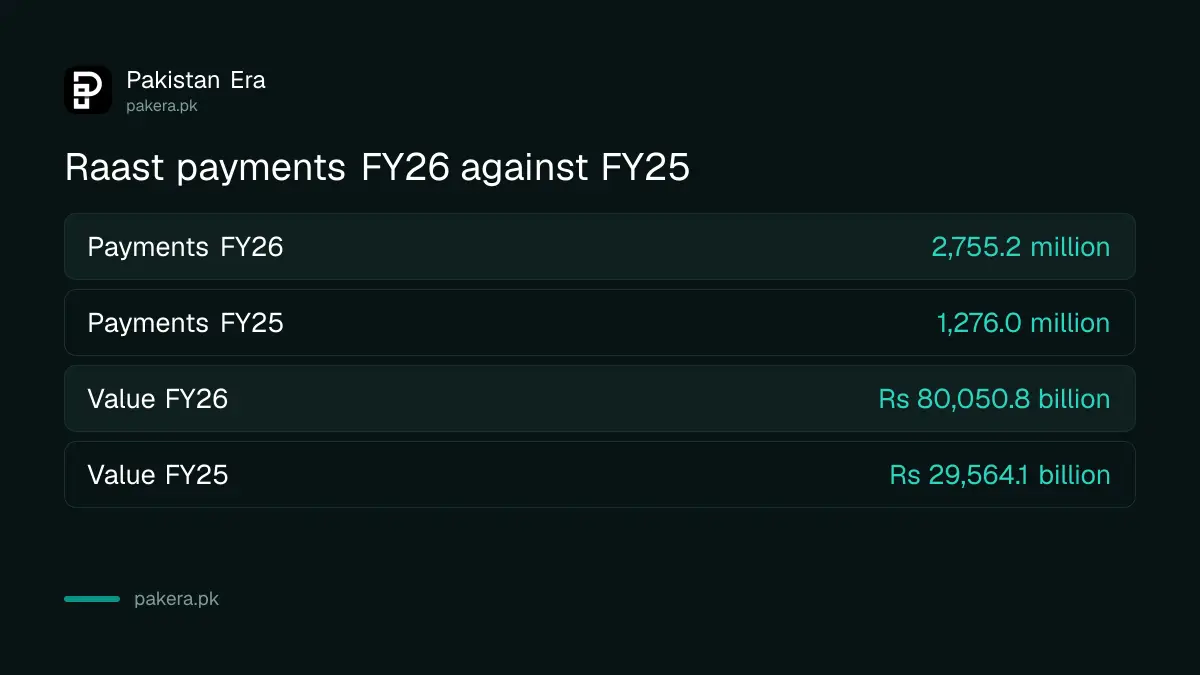
Raast handled 2,755.2 million payments in FY26 against 1,276.0 million in FY25, a rise of 116 per cent by our arithmetic. The value rose from Rs 29,564.1 billion to Rs 80,050.8 billion, up 171 per cent. Payments grew, and so did their size.
The average Raast payment in FY26 comes to about Rs 29,000, by our own division of value by volume. In FY25 it was about Rs 23,000. These are rough guides, because a few very large bulk transfers pull the average up.
| Measure | FY25 | FY26 (provisional) |
|---|---|---|
| All Raast payments | 1,276.0 million | 2,755.2 million |
| Value of all payments | Rs 29,564.1 billion | Rs 80,050.8 billion |
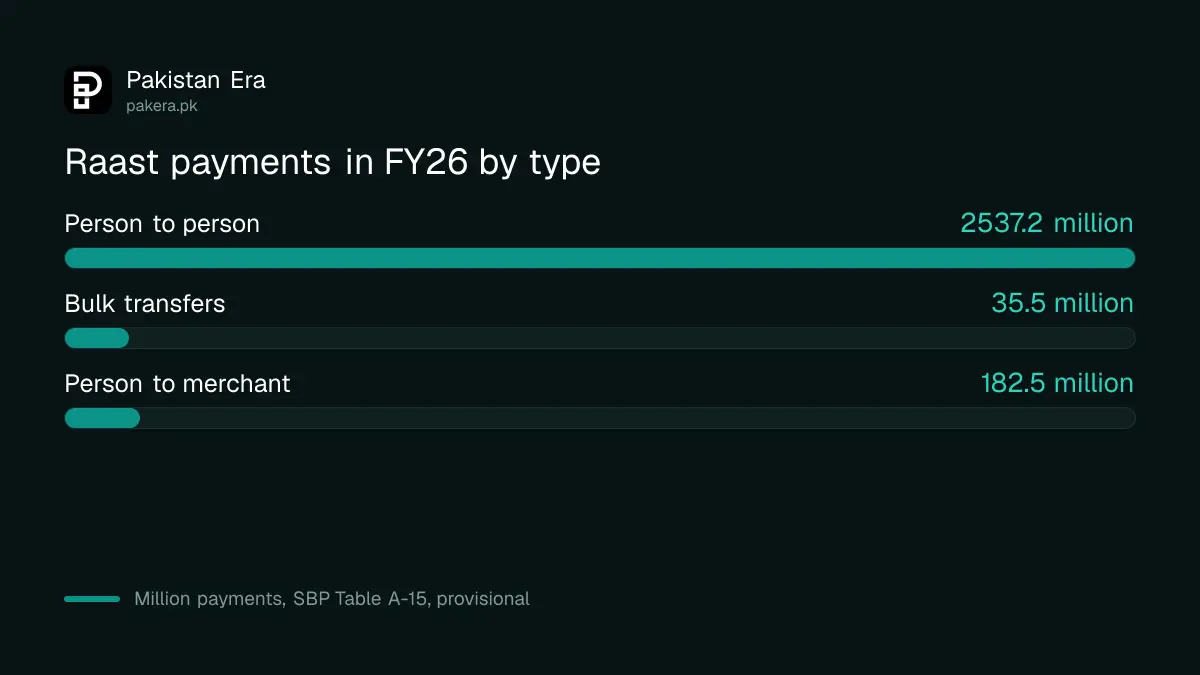
| Person to person (P2P) | 1,266.0 million | 2,537.2 million |
| Person to merchant (P2M) | 4.9 million | 182.5 million |
| Bulk transfers | 5.0 million | 35.5 million |
Payments to shops grew from 4.9 million to 182.5 million
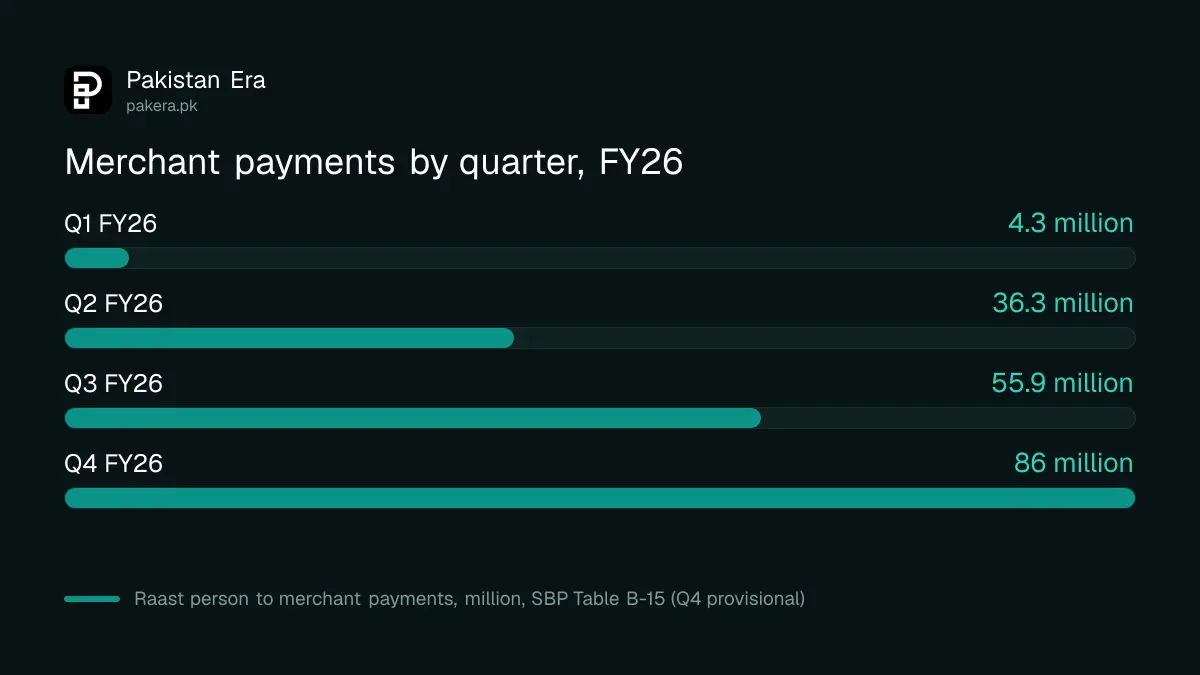
Person to merchant payments, the kind you make when you scan a shop's QR code, rose from 4.9 million in FY25 to 182.5 million in FY26. Their value rose from Rs 14.9 billion to Rs 994.4 billion. This is the fastest part of Raast.
The quarter by quarter table shows the climb. In the last quarter of FY25 there were 2.2 million merchant payments. By the last quarter of FY26 there were 86.0 million. The report ties this to the government's cashless initiative, which includes a subsidy on merchant QR payments.
Person to person transfers still make up most of Raast
P2P transfers were 2,537.2 million of the 2,755.2 million total, about 92 per cent by our arithmetic. They were worth Rs 68,898.2 billion. Most Raast use is still people sending money to other people, by phone number or Raast ID.
The report counts 49.2 million Raast P2P IDs. Our guide on creating a Raast ID and paying with it shows how one is made. The report counts IDs, not people, and does not say how many different people hold them.
Bulk transfers grew seven times, and the value is large
Bulk transfers, used for salaries and government payouts, rose from 5.0 million to 35.5 million payments. Their value jumped from Rs 1,848.2 billion to Rs 10,158.2 billion. A bulk transfer is one instruction that pays many people at once.
The report does not break bulk transfers down by sender, so we cannot say which payrolls or schemes drove the rise. It says Raast use grew "especially for merchants and government payments".
QR merchants rose from 1.1 million to 3.8 million
The number of QR enabled merchants registered with banks rose from 1,092,044 in FY25 to 3,836,522 in FY26, more than three times. The report also counts 3.6 million merchants registered on the Raast merchant alias. A QR enabled merchant is a shop that can take a payment by scanning a code.
The subsidy behind this has a stated end date. SBP PSP&OD Circular No. 03 of 2025 allocated Rs 3.5 billion for merchant QR payments made from 1 September 2025 to 30 June 2026. It paid 0.5 per cent of each payment or Rs 100, whichever is lower, to the banks involved. We could not find a notice extending it past 30 June 2026, so we cannot say whether it continues.
What this means if you pay or get paid in Pakistan
If you run a shop, registering a Raast QR for your shop is the first step. If you pay at shops, you can scan from most bank and wallet apps. The report counts rails, not your own fees, so check your provider's fee page before assuming a payment is free.
- Create a Raast ID in your bank or wallet app if you do not have one.
- Pay a shop by scanning its QR code, and read the merchant name on the confirm screen.
- Keep the payment receipt until the shop confirms it received the money.
- Report a payment that never arrived to your provider and quote the transaction reference.
Common questions
How many payments did Raast process in FY26?
Raast processed 2,755.2 million payments worth Rs 80,050.8 billion in FY26. The SBP marks the figure provisional, so it may change in a later revision.
Where can I read these Raast figures myself?
They are in Table A-15 and Table B-15 of the SBP Annual Payment Systems Review FY26, a PDF on the SBP website. The 6 October press release does not carry them.
Does Raast work outside Pakistan?
No. Raast is a domestic system. The SBP has said this in its own clarification, which we cover in our note on Raast working inside Pakistan only.
Is a Raast payment free?
The report does not give customer fees. Fees depend on your bank or wallet, so read your provider's current fee page before you send a large payment.
What does provisional mean in the report?
It means the SBP used the data it had at publication and may correct it later. The quarterly table marks earlier quarters as revised, so small changes do happen.
How we verified this
What we checked, where we read it, and what we could not confirm.
We read the full Annual Payment Systems Review FY26 and the 6 October 2026 press release on the SBP website on 12 October 2026, and SBP PSP&OD Circular No. 03 of 2025 on the same day. Read the full SBP report for the tables. Growth rates and averages are our own arithmetic on SBP figures. We did not find any Raast fee schedule, so this article states none.
About the author

Technology Journalist & Multimedia Producer
Ahmad Ali is a technology journalist and multimedia producer at Pakistan Era, joining the team in October 2026. He covers consumer technology and digital life for Pakistani readers, combining research with hands-on product testing.