How to Read PMD's Daily Rainfall Report in Pakistan: Rain, Wind and the Nullah Lai Level
PMD posts a daily PDF of rain in millimetres for the last 24 hours, plus wind and the Nullah Lai level. See how to read it, with the 14 October 2026 figures.

Short answer: Open weather.gov.pk, go to the Forecast menu and tap Rainfall Information. Each day PMD posts a one page PDF of rain in millimetres for the last 24 hours up to 8 am. It also lists the strongest wind and the water level of Nullah Lai. On 14 October 2026, Garhi Dopatta had the most rain, 24 mm.
A forecast tells you what may happen. This report tells you what did happen. If a storm hit your area last night, the number is here. We opened the Pakistan Meteorological Department, or PMD, rainfall page on 14 October 2026, downloaded the PDFs for 13 and 14 October and read them line by line.
The daily rainfall page lists one PDF for each morning
The Daily Rainfall page on weather.gov.pk shows a table with an issue date and a View link. Each link opens a one page PDF. When we read it, the list ran from 14 October back through 8 October 2026, one report per day.
The title of each PDF gives the exact window. The 14 October file reads "Total Rainfall (mm) last 24 hours on Wednesday 14-10-2026 at 0800 PST". So it covers 8 am on the 13th to 8 am on the 14th, in Pakistan Standard Time.
That timing matters. A downpour at 9 am today will not appear until tomorrow's report. For the day ahead, read the official PMD forecast instead.
The report groups rain by province and region
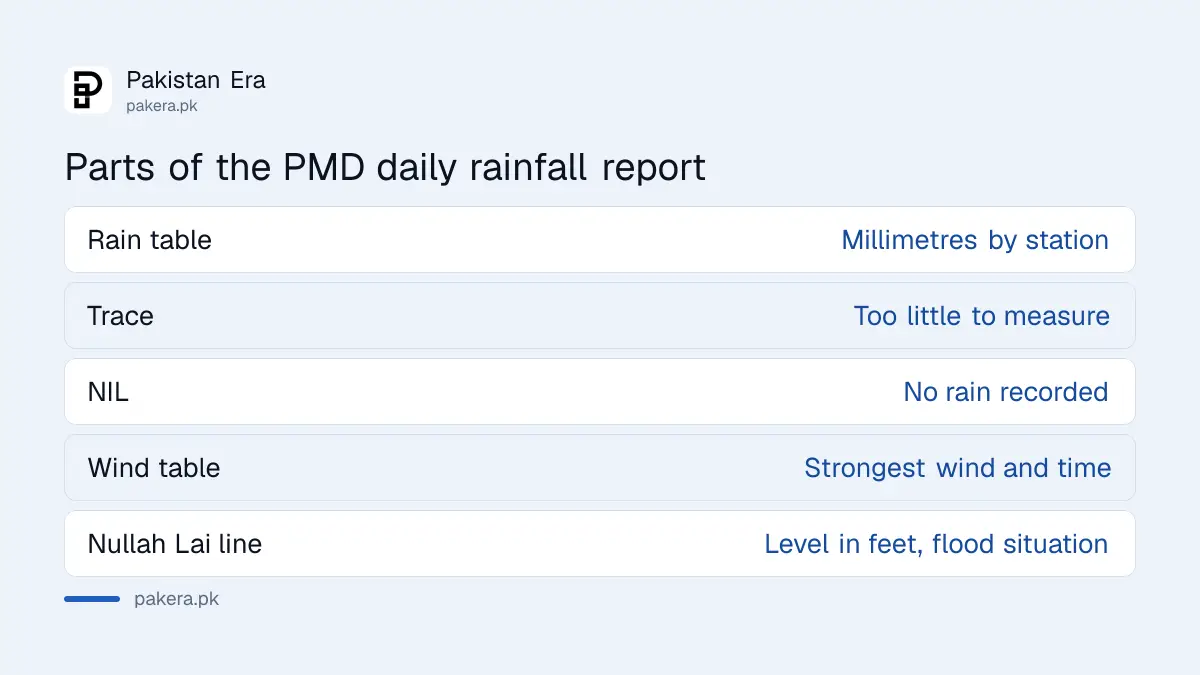
The PDF lists stations under Kashmir, Khyber Pakhtunkhwa, Gilgit-Baltistan, Punjab, Balochistan and Sindh, and gives rain in millimetres. A station with a very small amount shows "Trace". A region with none shows NIL. Where a city has two stations, both appear in brackets.
| Region | Highest on 14 October 2026 | Reading |
|---|---|---|
| Kashmir | Garhi Dopatta | 24 mm |
| Khyber Pakhtunkhwa | Balakot | 15 mm |
| Gilgit-Baltistan | Skardu | 9 mm |
| Punjab | Murree | 3 mm |
| Balochistan and Sindh | None | NIL |
Other readings that day included Muzaffarabad city 22 mm, Parachinar 14 mm, Takht Bai 13 mm, Peshawar city 12 mm and Upper Dir 9 mm. In Punjab, Islamabad Airport had 1 mm and Attock 1 mm. Lahore does not appear in that day's report.
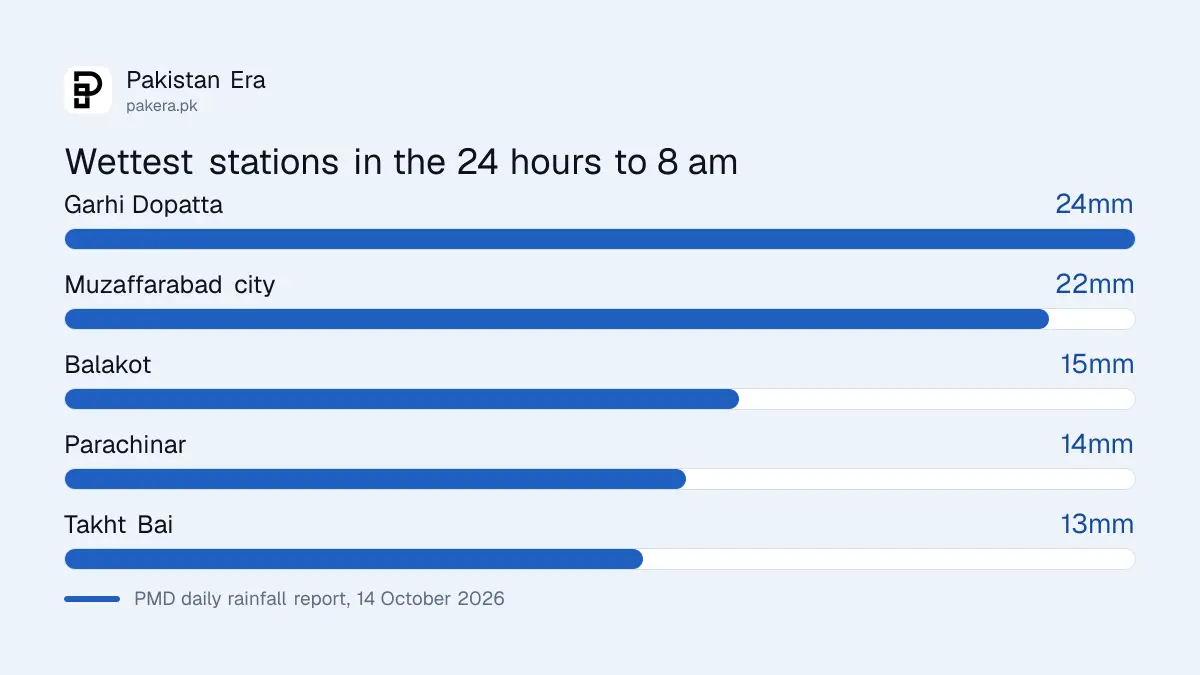
One mm of rain is one litre on a square metre. The previous day, 13 October, the report had Peshawar Airport at 16 mm, Kalam at 6 mm and Attock at 5 mm, so the wet spots move from day to day.
Wind and the Nullah Lai level sit at the foot of the page
Two small tables sit below the rain figures. One lists the strongest wind, in knots and km/h, with direction and time. The other gives the highest Nullah Lai level in feet and a flood situation, which read NORMAL on 14 October.
On 14 October the wind table read NIL. The 13 October report did record a gust: Islamabad Airport had 28 knots, which PMD gives as 52 km/h, from the north at 0035. A knot is one nautical mile an hour, about 1.85 km/h. A wind of 52 km/h can bring down branches, billboards and weak roofs.
Nullah Lai is the stream that runs through Rawalpindi, so heavy rain upstream matters to the city. The report gives the level and a plain word for the situation, but it does not list the levels that PMD treats as a warning, so we do not state them.
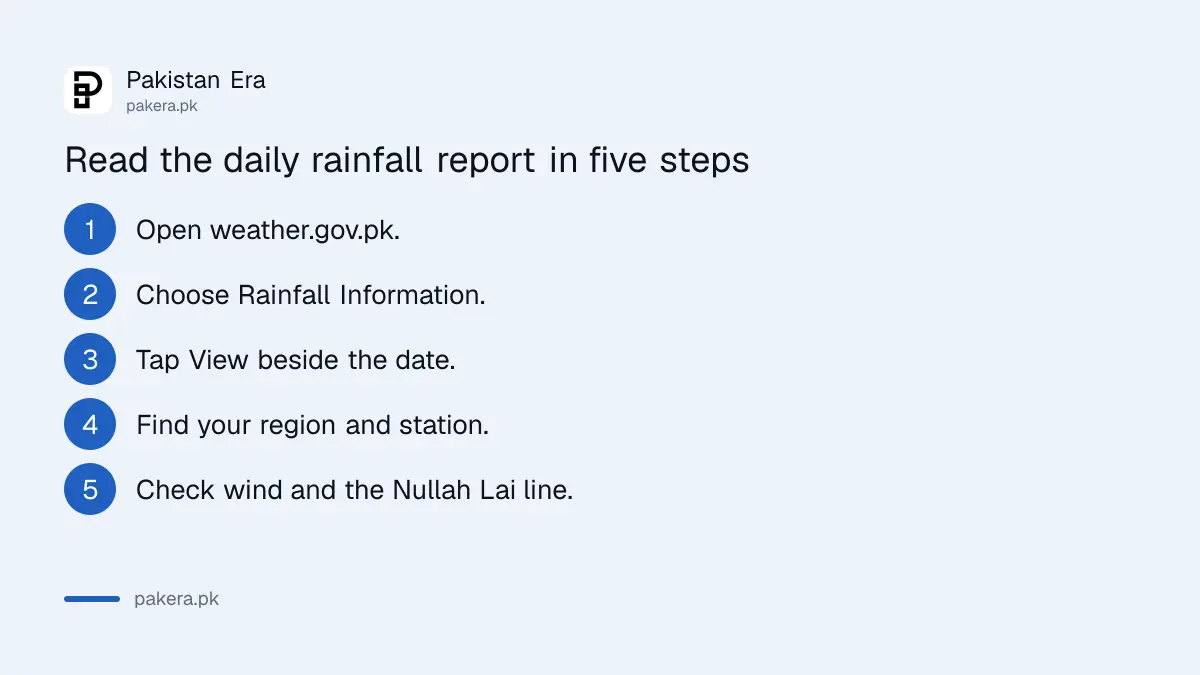
- Open weather.gov.pk and choose Rainfall Information in the Forecast menu.
- Tap View beside today's date.
- Read the title for the time window, 8 am to 8 am.
- Find your region, then your city or the nearest station.
- Check the wind table and the Nullah Lai line at the foot.
Use the report to check the forecast and your own rain gauge
The report is a record. Compare it with the forecast issued before the storm to see how well it did. On 14 October the daily forecast quoted the same past 24 hour totals, so you can find the figures in either place.
The maximum and minimum temperature pages sit beside it. The maximum temperature page, for example, lists stations with the highest daytime reading in the last 24 hours, with the date.
For a farmer, a record of 5 mm or 40 mm decides if a field needs water or drainage. For a driver, it hints at which hill roads saw rain. For anyone worried about a roof or a drain, it shows if the storm that passed was a heavy one. When rain is forecast for your night drive, read NDMA's road advice for hail and thunderstorms, and the lightning rules if you are outdoors.
The earlier forecast for the first half of the week is in the PMD night rain forecast for 12 and 13 October.
Common questions
Where is PMD's daily rainfall report?
On weather.gov.pk, in the Forecast menu under Rainfall Information. Each date has a PDF.
What time does the rainfall report cover?
The last 24 hours up to 8 am Pakistan Standard Time on the date shown in the title.
What does Trace mean?
A very small amount of rain that is too little to measure in millimetres. We could not find PMD's exact cut off, so we leave it at that.
What is Nullah Lai on the report?
A stream in Rawalpindi. The report gives its highest level in the last 24 hours in feet and a word such as NORMAL for the flood situation.
Does it include Lahore?
The report lists stations that recorded rain. Lahore did not appear in the 14 October report.
How we verified this
What we checked, where we read it, and what we could not confirm.
Last checked on 14 October 2026, Pakistan time. We read PMD's Daily Rainfall page and the PDFs for 13 and 14 October. We did not test older files, and the report does not state flood warning levels for Nullah Lai.
About the author

Tax, Bills and Technology Writer
Ali Akhtar is a young and curious voice here at Pakistan Era. He is currently pursuing his A-Levels and has a growing interest in Pakistan’s changing industrial landscape and educational trends. Ali likes to write in a way that helps him explain and explore the world around him. His writing reflects the perspective of the new generation navigating the evolving trends of Pakistan where technology, youth innovation, and shifting opportunities are reshaping the country’s future.