Stay Safe From Lightning in Pakistan: NDMA's 5 Rules for the 10 to 15 October Storms
NDMA's 9 October advisory lists five lightning rules: no trees or poles, avoid open fields, skip wired devices, keep off drains, get into a sturdy building.
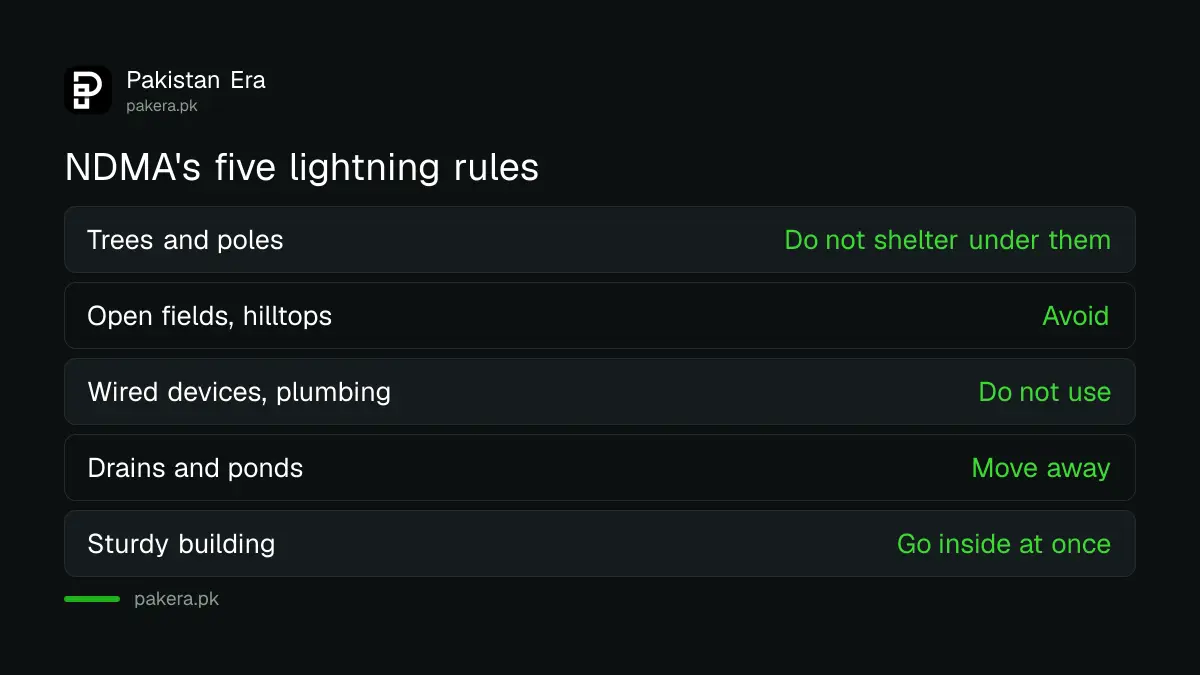
Short answer: NDMA's advisory of 9 October 2026 gives five lightning rules: do not shelter under trees or poles, keep away from open fields and hilltops, do not use wired electrical appliances or plumbing, stay away from drains and ponds, and get into a sturdy building at once.
When the first thunder rolls over a cricket ground or a wheat field, the instinct is to run for the nearest tree. That instinct is wrong, and NDMA says so in plain words. The tree is the first thing on its list of places to avoid.
We read NDMA's eight-page weather advisory dated 9 October 2026 on 12 October 2026. It warns of rain, wind and thunderstorms, with isolated hail, in upper and central Pakistan until 15 October. Lightning is part of the same system, so these rules apply now.
NDMA's five lightning rules come in one short list
The advisory's section on thunderstorm and lightning has five points. Each one names a place or a habit to avoid. Read them as a checklist you can run through in the time it takes the first drops to fall.
| NDMA rule | In plain words |
|---|---|
| Do not seek shelter under trees or poles | They attract lightning and do not protect well from hail |
| Avoid open fields and hilltops | They are more exposed to hail and lightning |
| Do not use electrical appliances | Avoid wired devices, plumbing and electronics in a thunderstorm |
| Move away from drainage canals and ponds | NDMA says standing near them attracts lightning |
| Seek shelter immediately | Go indoors, take cover in a sturdy building, or find a dry place |
Outdoors, get inside a sturdy building first
If you are outside, NDMA's last rule is the one that matters most: seek shelter immediately, in a sturdy building or a dry place. The other four rules tell you what not to pick as that shelter. A brick or concrete building is the target, not a shed or a tree.
The same advisory has hail rules that fit here. It says to stay away from windows, because hail can shatter glass, and to protect your head and neck if you are caught outside. If you are driving, it says to pull over somewhere safe, stay in the vehicle with your seatbelt on, and not drive in heavy hail. Our note on driving safely in hail and thunderstorm covers the road advice in more detail.
NDMA does not say how far to stay from a tree or pole, and it does not give a number of seconds to count between flash and thunder. We will not add numbers it does not give.
Indoors, stay off wired devices and plumbing
Indoors is not automatically safe. NDMA says to avoid wired devices, plumbing and electronics during a thunderstorm. In plain terms, do not run the washing machine, do not stand at a tap and do not use a plugged-in charger or computer through the worst of it.
The advisory has a separate line for rain and water: do not handle or repair electrical equipment, especially exposed lines, to avoid electrocution during rain and water pondage. If a wire is down or a pole is sparking, stay clear and report it. Our report on electrocution deaths in the monsoon shows how often water and live wires meet.
- When thunder is heard, go indoors or into a sturdy building.
- Stay away from windows and keep clear of drains, ponds and open ground on the way.
- Unplug sensitive devices if you have time, and stay off wired devices and taps.
- Do not touch fallen or exposed wires.
- Wait indoors until the storm has passed and local alerts give the all-clear.
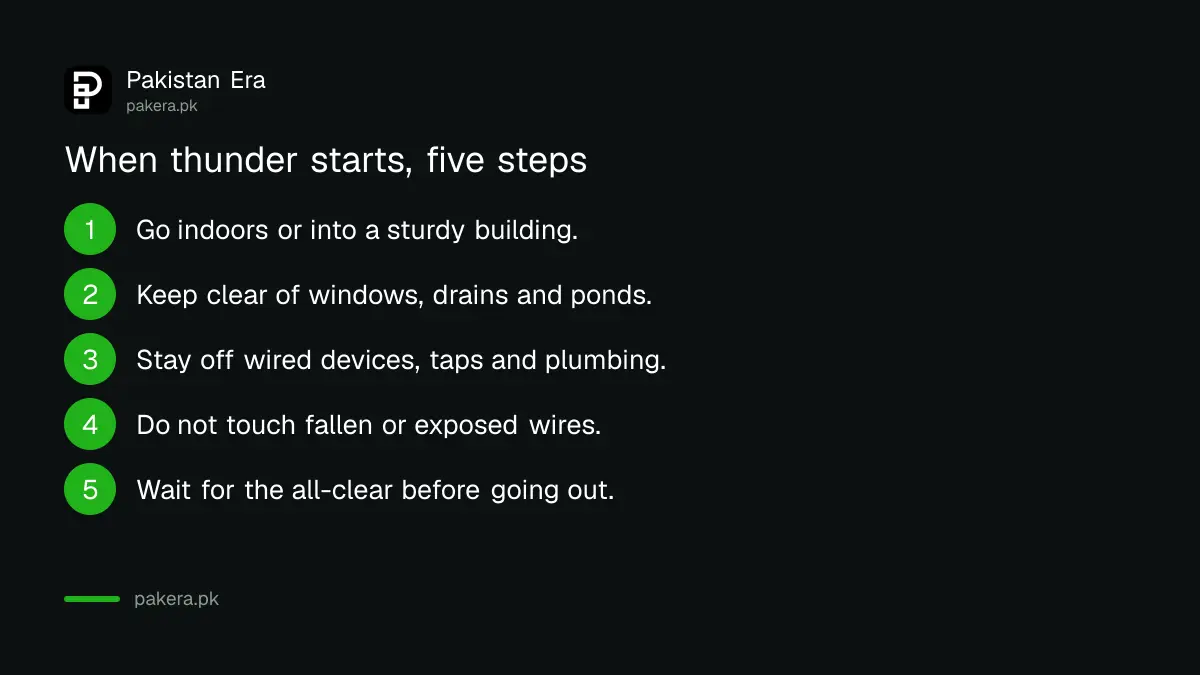
The step about unplugging is our reading of NDMA's "do not use electrical appliances". The advisory does not say "unplug" in those words.
The advisory names places and days for the storm
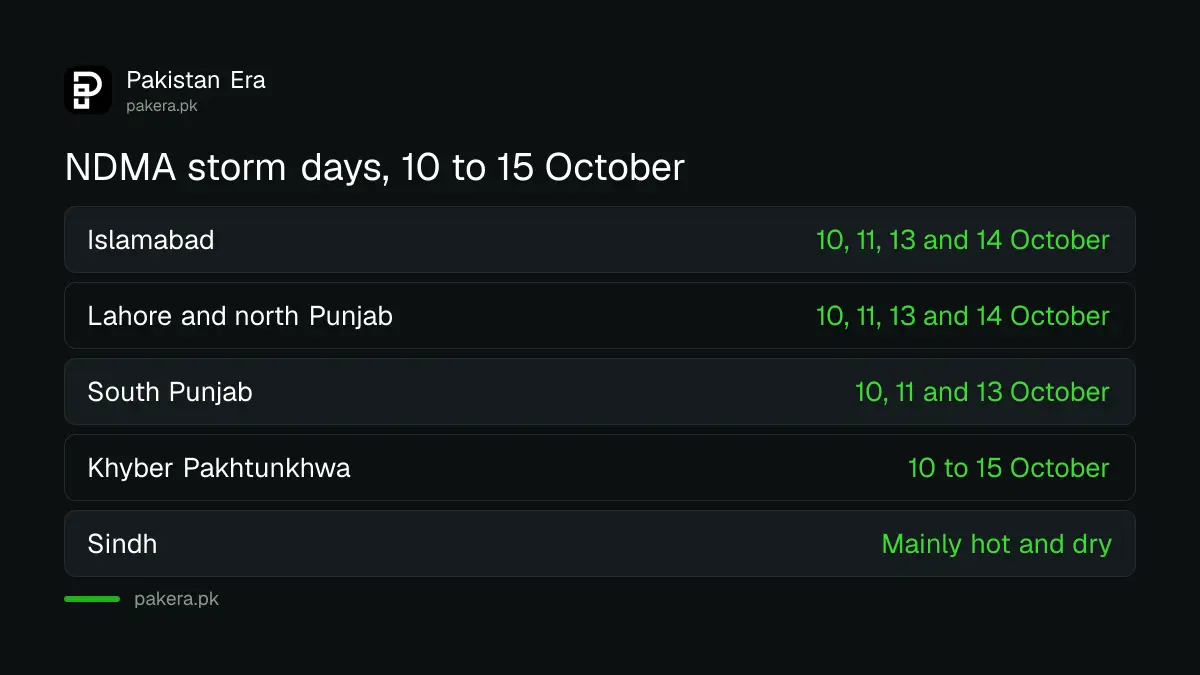
NDMA expects rain, wind and thunderstorm with isolated hail in Islamabad on 10, 11, 13 and 14 October. It names Lahore, Rawalpindi, Faisalabad and many more Punjab districts, and much of Khyber Pakhtunkhwa from 10 to 15 October. Sindh and most of Balochistan are mainly hot and dry.
The full list of districts and dates is in our report on the NDMA rain and hail alert for 10 to 15 October. For where to find new advisories, see how to get NDMA alerts.
Farmers and herders have extra things to protect
NDMA tells farmers to manage crop work in view of the weather and to look after livestock. It warns that hail may damage standing crops in the plains of Punjab and Khyber Pakhtunkhwa. It does not give separate lightning advice for fields, so the open-field rule is the one to follow.
Those working outdoors should keep an eye on the sky and move early. A crop loss from hail is a separate matter, and claiming crop loan insurance after flood, hail or drought explains the claim.
Common questions
Is it safe to shelter under a tree during a thunderstorm?
No. NDMA says not to shelter under trees or poles, because they attract lightning and do not protect well from hail.
Should I stay in an open field if I cannot find shelter?
NDMA lists open fields and hilltops as places to avoid. Its advice is to seek shelter immediately in a sturdy building or a dry place.
Can I use my phone charger or washing machine in a thunderstorm?
NDMA says not to use electrical appliances and to avoid wired devices, plumbing and electronics during an accompanying thunderstorm.
Why does NDMA say to stay away from drains and ponds?
The advisory says standing near drainage canals and ponds attracts lightning. Separately, it tells parents to keep children away from ponds, drains and potholes to avoid accidents.
Where can I read the NDMA advisory itself?
On the advisories page of NDMA's website, where each weather advisory is posted as a dated PDF.
How we verified this
What we checked, where we read it, and what we could not confirm.
We read the NDMA weather advisory dated 9 October 2026 on 12 October 2026. The advisory period ends on 15 October, so check the page for a newer one.
About the author

Public Services and Education Journalist
Fajr Riaz is a journalist and content writer at Pakistan Era, based in Lahore. She covers the questions people meet in everyday life in Pakistan: how a public service works, what a change in the rules means, and where to find a reliable answer.