How to Register a Divorce in Sindh: Talaq Notice, Khula Decree and the 90 Day Rule
Register a talaq or khula in Sindh: notice to the union council chairman, the 30 day arbitration council, the 90 day rule and how to get a divorce certificate.
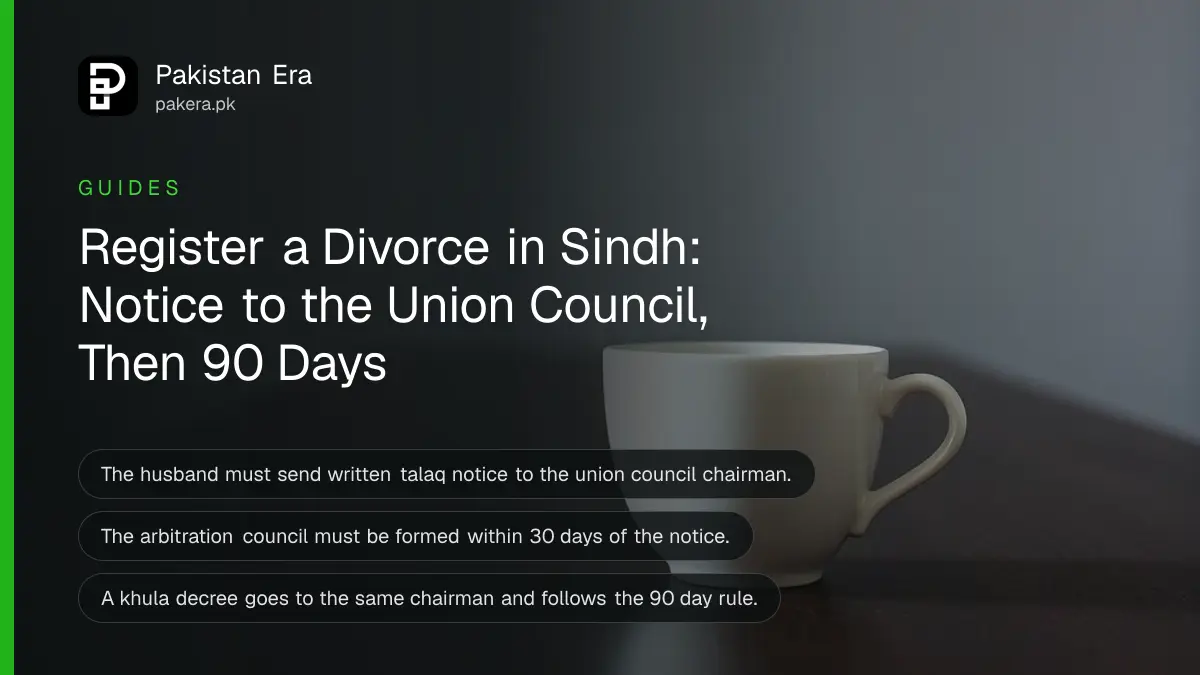
In Sindh, a divorce is registered at the union council. After talaq, the husband must send written notice to the union council chairman and give his wife a copy. The talaq takes effect 90 days after the chairman receives the notice. The council then registers it and issues the computerised divorce certificate. A khula decree goes to the same council.
This page covers the paperwork only. It does not advise on whether to end a marriage. A family lawyer or a district legal aid committee can help with that, and Sindh has free lawyers for people who cannot pay.
The union council chairman receives the talaq notice
Section 7 of the Muslim Family Laws Ordinance 1961 says a man who pronounces talaq, in any form, must give the chairman written notice as soon as he can, and give his wife a copy. In Sindh the chairman is the union council chairman for the area.
Skipping the notice is an offence. The Ordinance sets a punishment of up to one year of simple imprisonment, a fine of up to Rs 5,000, or both. The notice also starts the clock: without it, there is no date from which the 90 days can run.
Union councils handle this under the Sindh Local Government Act 2013. The Sindh Local Government Department lists the registration and computerisation of births, deaths, marriages and divorces among the functions of local councils. In towns, the town or municipal committee performs these duties.
The 90 days and the arbitration council
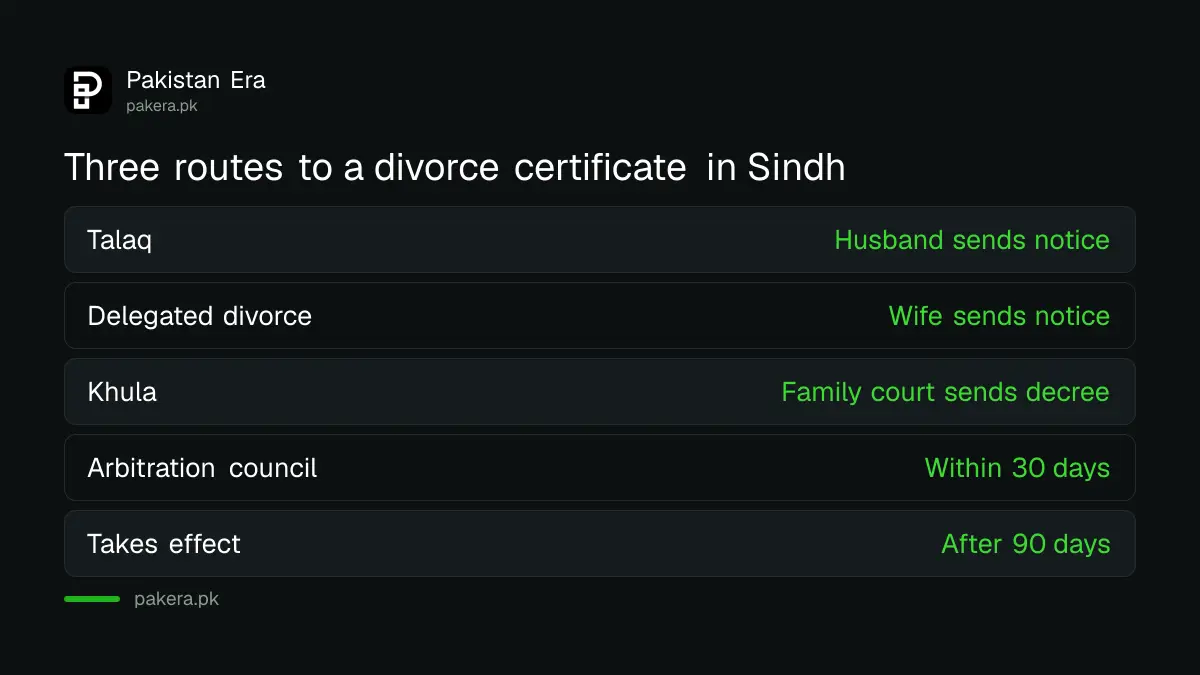
A talaq is not effective until 90 days after the chairman receives the notice, unless it is taken back sooner. Within 30 days of the notice, the chairman must form an arbitration council to try to bring the couple together. If the wife is pregnant, the talaq takes effect when the 90 days or the pregnancy ends, whichever is later.
The arbitration council has the chairman and one representative of each side. Both sides are sent a notice to name their representative. Attending is not a formality. It is the only stage where the council records an attempt at reconciliation, and the record is part of the file.
| Stage | Time | Who acts |
|---|---|---|
| Written talaq notice, copy to the wife | As soon as possible after talaq | Husband |
| Arbitration council formed | Within 30 days of the notice | Union council chairman |
| Talaq takes effect | 90 days after the chairman receives notice | By law, unless revoked |
| Pregnancy at the time of talaq | 90 days or end of pregnancy, whichever is later | By law |
| Divorce registered and certificate issued | After the talaq takes effect | Union council, in NADRA CRMS |
The full working of this period is in how a talaq takes effect in Pakistan.
Khula and delegated divorce follow the same route
A wife who ends the marriage, by khula through the family court or by using a right of divorce delegated to her in the nikah nama, goes through the same union council process. Section 8 of the Ordinance applies section 7 to every dissolution other than talaq.
For khula, the wife files a suit in the family court. Once the court passes the decree, it sends a certified copy to the union council chairman, who proceeds as if he had received a talaq notice. Keep your own certified copy too, and take it to the council yourself if the council has no record of it.
For a delegated divorce, called talaq-e-tafweez, the right must be written in column 18 of the nikah nama. The wife then gives the written notice to the chairman herself and sends a copy to the husband. The khula procedure in Pakistan explains the court stage in full.
How to get the divorce certificate in Sindh
Once the talaq or decree has taken effect, the union council enters the divorce into NADRA's Civil Registration Management System, CRMS, and prints a computerised divorce certificate. NADRA reads that entry to change marital status on the CNIC.
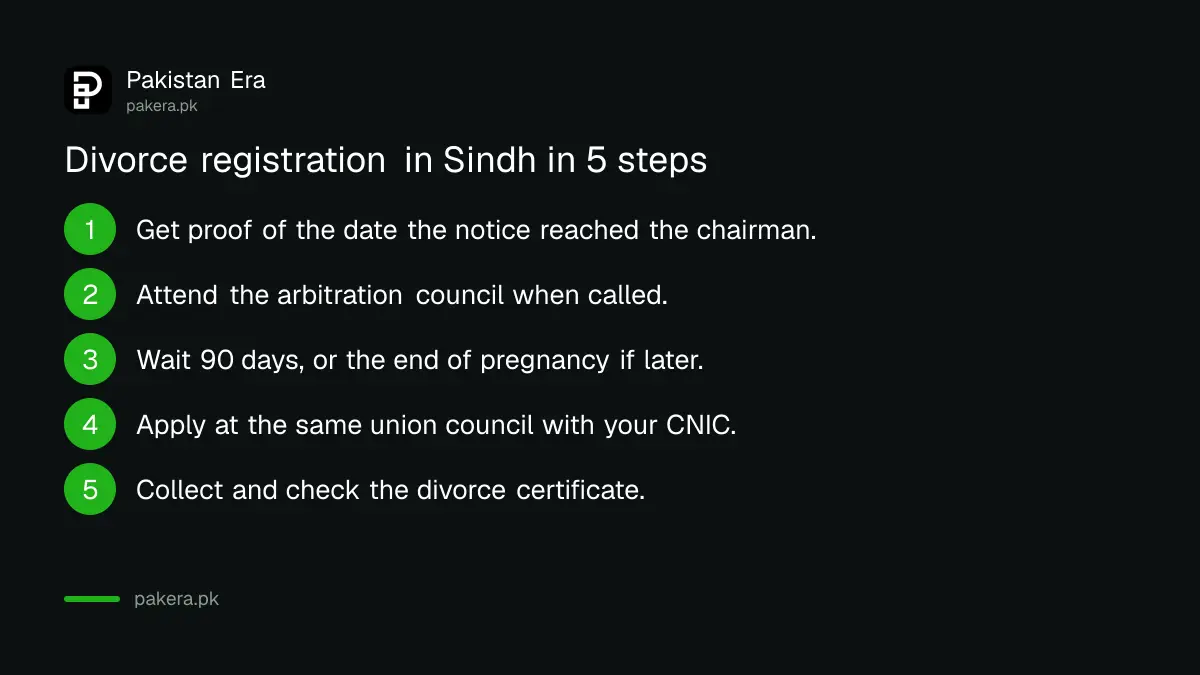
- Keep the date proof. Get a stamped copy or receipt showing when the notice or decree reached the chairman.
- Attend the arbitration council or send your representative when called.
- Wait out the 90 days, or the end of pregnancy if later.
- Apply at the same union council with your CNIC, the nikah nama and the notice or decree.
- Collect the computerised divorce certificate and check every name and date.
NADRA's Pak ID app offers union council registration of divorces in parts of Sindh. It began in Karachi East and Shaheed Benazirabad and reached Larkana and Tando Muhammad Khan in January 2026. The same certificate later updates the CNIC, as the NADRA divorce certificate page explains.
Problems and where to get help
The most common problem is a husband who says talaq but never sends the notice. The wife can give the chairman a written application with any proof she has, and ask the council to act. Where the facts are disputed, the family court decides, not the council.
- No notice sent. Write to the union council chairman yourself and keep a stamped copy. The husband's failure is an offence under section 7.
- Council has no record of the khula decree. Take a certified copy of the decree to the chairman and ask for receipt.
- Dower and maintenance unpaid. These are separate claims. The family court hears them, and the arbitration council can also hear a maintenance claim, as in claiming maintenance through the union council.
- No money for a lawyer. Sindh's district legal empowerment committees provide a free lawyer, set out in free legal aid in Sindh and Balochistan.
Common questions
Where is a talaq notice sent in Karachi?
To the chairman of the union council for the area, with a copy to the wife. In a town area, send it to the town or municipal committee that carries out the council's duties.
When does a talaq become final in Sindh?
90 days after the chairman receives the written notice, unless it is revoked earlier. If the wife is pregnant, it takes effect when the pregnancy or the 90 days ends, whichever is later.
Does a khula decree need to go to the union council?
Yes. The family court sends a certified copy to the chairman, who treats it like a talaq notice. The wife should keep her own certified copy and confirm the council has it.
What happens if the husband does not send the notice?
The Ordinance punishes it with up to one year of simple imprisonment, a fine of up to Rs 5,000, or both. The wife can write to the chairman herself.
Can the divorce be registered on the Pak ID app in Sindh?
In some districts. The service started in Karachi East and Shaheed Benazirabad and was extended to Larkana and Tando Muhammad Khan in January 2026.
Who issues the divorce certificate in Sindh?
The union council, or the town or municipal committee, after the divorce takes effect. It prints the computerised certificate from NADRA's CRMS system.
How we verified this
What we checked and where we read it.
We checked this guide on 15 November 2026. We read sections 7 and 8 of the Muslim Family Laws Ordinance 1961 on Pakistan Code, the Sindh Local Government Act 2013 and its 2021 amendment, and the functions page of the Sindh Local Government Department. The Pak ID app districts are from NADRA's January 2026 announcement. Pakistan Code carries the federal text of the Ordinance, including the 2021 amendment on Fiqh-e-Jafria, which sets separate divorce rules for Shia couples.
About the author

Public Services and Education Journalist
Fajr Riaz is a journalist and content writer at Pakistan Era, based in Lahore. She covers the questions people meet in everyday life in Pakistan: how a public service works, what a change in the rules means, and where to find a reliable answer.