How to Run a Generator Safely at Home in Pakistan: K-Electric's Rules and the Changeover Switch
Run a home generator safely in Pakistan: outdoors only, through a changeover switch, dry hands and rubber mat as K-Electric says. See the hourly fuel cost.
Run a home generator outdoors, never in a room, garage or stairwell, connect it through a proper changeover switch rather than a plug pushed into a wall socket, keep dry hands and a rubber mat around it, and have it serviced by a competent person. Those last three rules are K-Electric's own, from its electrical safety page, which we read on 19 October 2026. The first one is the rule that saves lives every winter, because the exhaust carries carbon monoxide, a gas you cannot see or smell.
Generators came back out of storerooms across Pakistan this October as load shedding returned. Most of the danger is not in the machine. It is in where it sits, how it is wired into the house and how the petrol is handled. This guide covers all three, and ends with what an hour of running actually costs at this week's petrol price.
Place the generator outside, with the exhaust pointing away from doors and windows
The exhaust of a petrol or diesel generator contains carbon monoxide. It is colourless and odourless, it builds up in any closed or half closed space, and it kills people in their sleep. Put the generator in the open air, several metres from the house, with the exhaust facing away from windows, doors and air conditioner inlets.
A balcony, a covered porch, a garage with the door open or the landing of a stairwell are not outside. Fumes pool in all of them and drift indoors. The same logic applies to gas heaters, whose winter rules are in the guide to using a gas heater or geyser safely: anything that burns fuel needs open air, and a room with the windows shut is the wrong place for it.
Rain is the other placement problem. A generator running wet is a shock risk, and K-Electric's advice on water and electricity is blunt: keep appliances away from moisture, and do not touch anything electrical with wet hands. A simple open sided canopy, with air on all four sides, keeps the rain off without trapping the exhaust.
K-Electric's rules: competent repair, dry hands and a rubber mat
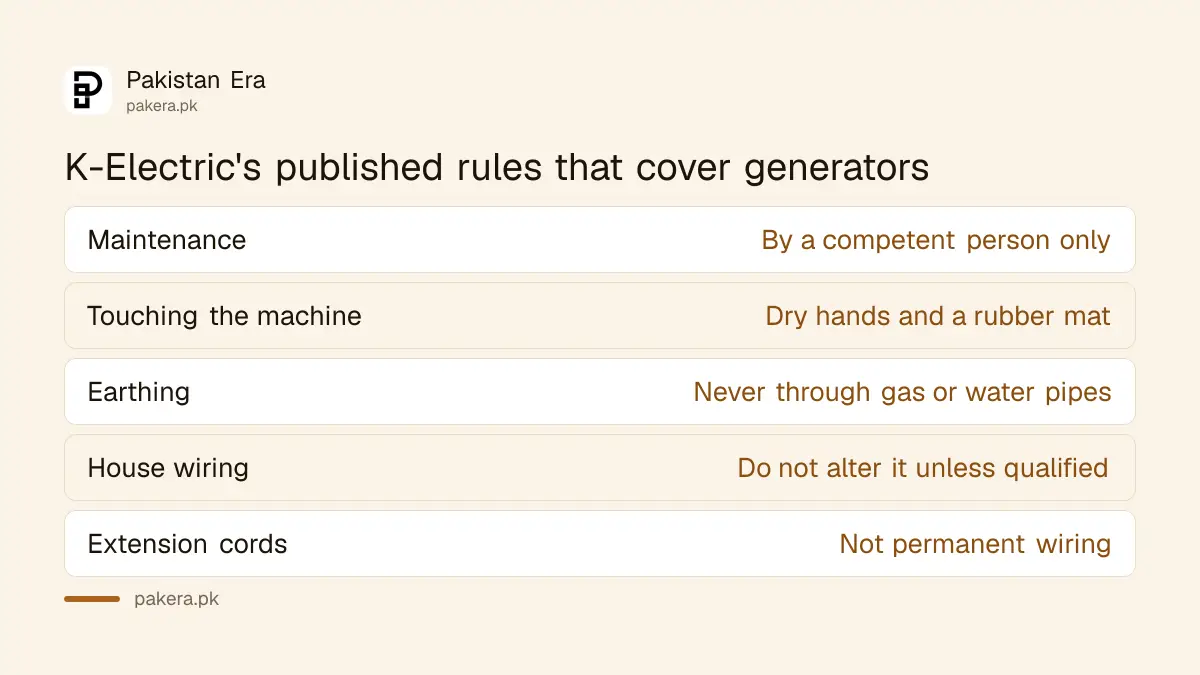
K-Electric's electrical safety page gives two instructions that name generators directly. "Always ensure repair/maintenance of water pumps/generators by competent person." And "Make sure your hands are dry before touching the generator/water pumps and use a rubber mat." It also tells consumers not to use gas or water pipelines for grounding, and never to use a kunda or illegal hook connection.
| K-Electric rule, as published | What it means for a generator |
|---|---|
| Repair and maintenance by a competent person | No roadside fixes to the alternator or wiring; use a trained mechanic or electrician |
| Dry hands and a rubber mat | Stand on rubber when you pull the starter or touch the frame, and never in rain |
| Do not use gas or water pipes for grounding | Earth the generator frame to a proper earth rod, not to the Sui gas line |
| Do not alter the building's electrical service unless qualified | The changeover switch is an electrician's job, not a weekend one |
| Never connect or disconnect an appliance under load | Switch loads off before you start or stop the generator |
| Extension cords are not permanent wiring | Do not run the whole house through a cord trailed in from the yard |
The page also lists what to do around a fallen line: stay at least 35 feet from a downed wire, and do not touch a shock victim who is still in contact with the source. Those rules are the subject of the guide to reporting a fallen wire or sparking pole, and they matter here because a badly wired generator can put a live current onto the street line outside your house.
A changeover switch stops your generator feeding the street line
The most dangerous mistake in Pakistan is the "suicide cord": a plug on both ends, one into the generator and one into a wall socket. It pushes power back through your meter into the neighbourhood line. A lineman working on a dead feeder can be electrocuted, and when the grid returns the two supplies collide and burn the generator.
A changeover switch, manual or automatic, connects the house to one source at a time. It isolates the grid before the generator comes on, so power cannot flow backwards. Have an electrician fit it at the main board, size it for the generator's output, and keep the generator's neutral and earth arrangement as the maker specifies.
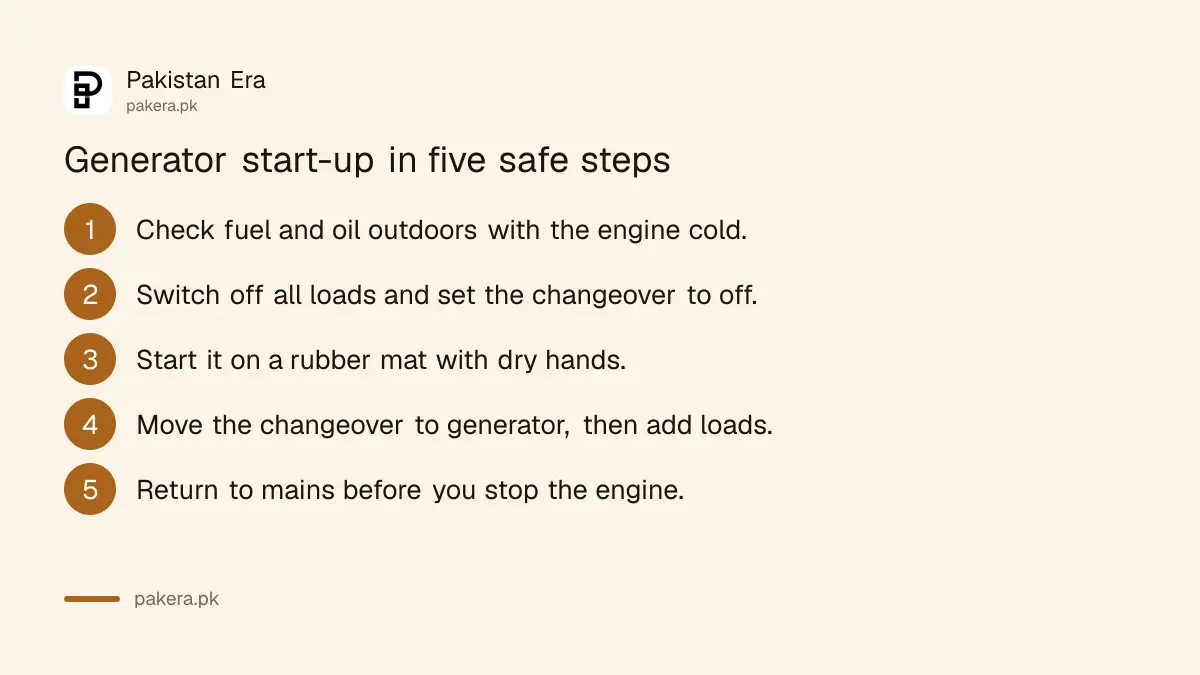
- Check the fuel and oil with the engine cold, outdoors, and wipe any spill before starting.
- Switch off every load in the house, and set the changeover to the off or neutral position.
- Stand on a rubber mat with dry hands, start the generator and let it settle for a minute.
- Move the changeover to the generator position, then switch loads on one at a time, biggest first.
- When the grid returns, switch loads off, move the changeover back to mains, and only then stop the engine.
- Let the engine cool before you refuel. Petrol on a hot exhaust ignites.
Electrocution deaths rise every monsoon, and the pattern is the same each year: wet conditions, improvised wiring and nobody isolating the supply. The figures are in the report on monsoon electrocution deaths. A generator adds a second live source to that mix, which is exactly why the changeover is not optional.
Store fuel in small amounts, in a metal can, away from the house
Keep only the petrol you need for a day or two, in a closed metal container made for fuel, in a shaded and ventilated spot away from the kitchen and any gas appliance. Petrol vapour is heavier than air and creeps along the floor to the nearest flame. Never store it indoors, and never decant it near a running engine.
Refuel only when the engine is cool and switched off. A spill on a hot muffler is the commonest way a home generator catches fire. Keep a dry powder extinguisher within reach, and keep children away from the machine while it runs; the exhaust and the frame get hot enough to burn.
An hour on petrol costs about Rs 386 at this week's price, and a UPS costs a fraction
Petrol is Rs 386.30 a litre from 17 October 2026 on OGRA's sheet. A small home generator that burns about a litre an hour at half load, a figure to read off your own machine's plate, therefore costs about Rs 386 an hour in fuel alone. Four hours a day for 30 days is 120 litres, or Rs 46,356.
| Running cost comparison, four hours a day | Per day | Per 30 days |
|---|---|---|
| Generator at 1 litre an hour, petrol Rs 386.30 | Rs 1,545.20 | Rs 46,356 |
| UPS carrying 300 W, recharged at Rs 33.10 a unit | about Rs 47 | about Rs 1,400 |
These are our calculations from stated assumptions: the fuel burn depends on the generator and its load, and the UPS figure uses the 201 to 300 unit home slab with charging losses included. The petrol figure moves daily, and the latest is in the report on the 17 October petrol price. The gap is wide enough that for fans and lights a correctly sized UPS wins every time; the method is in the guide to sizing a UPS and battery. A generator earns its keep only for loads a battery cannot carry, such as a water motor or an air conditioner.
Common questions about home generator safety
Can I run a generator on the balcony or in the garage?
No. Both trap exhaust and carbon monoxide, which drift indoors. The generator must be in open air with the exhaust pointing away from the house.
What does K-Electric say about generators?
Have repair and maintenance done by a competent person, keep your hands dry and use a rubber mat when touching the generator, and do not earth through gas or water pipes.
Do I need a changeover switch?
Yes. It keeps the generator from feeding power back into the street line, which can kill a lineman and destroy the generator when the grid returns.
How much petrol can I keep at home?
Keep as little as practical, in a sealed metal fuel can, outside the living space. We could not confirm a legal household limit on an official page, so treat small quantities as the rule.
What does a generator cost to run per hour?
About Rs 386 in fuel for a machine burning a litre an hour at the 17 October 2026 petrol price. Read your generator's plate for its own consumption.
Is a UPS cheaper than a generator?
For fans, lights and a TV, by a wide margin: about Rs 47 a day against about Rs 1,545 for four hours, on our arithmetic. For a motor or an AC, a generator or solar is needed.
How we verified this
What we checked, where we read it, and what we could not confirm.
Last checked 19 October 2026. The quoted safety rules come from K-Electric's electrical safety page at ke.com.pk/electrical-safety, which we read on 19 October 2026. The petrol price is from the OGRA price sheet effective 17 October 2026 on OGRA's price publications page. Carbon monoxide, back feeding and fuel storage guidance is standard safety practice stated without figures. The fuel burn of one litre an hour is an assumption for the example, not a measured figure, and all costs are our arithmetic. We could not find a household fuel storage limit on an official Pakistani page and have not stated one.
About the author

Senior Writer, Public Services and Technology
Shahid joined us in 2024 as an author. He is a senior contributor to Pakistan's leading technology websites. He writes detailed articles, mostly covering his expertise in the latest tech, mobiles, apps, gadgets, and step-by-step guides. His ideology is to help people understand the latest trends and explain complex methods through very easy-to-understand guides.