Section 7E Deemed Income Tax Is Abolished in Pakistan: What Property Owners Need to Know
The Finance Act 2026 omitted section 7E, the 1% a year deemed income tax on property above Rs 25 million. See the tax year gap and the 236C certificate rule.
Section 7E, the tax on "deemed income" from property, is gone. The Finance Act 2026 omitted section 7E of the Income Tax Ordinance, 2001 and the 20% rate in Division VIIIC of the First Schedule that went with it. FBR's own Circular No. 02 of 2026-27 says the tax "has been abolished". What the law does not say is which tax year the abolition starts from, and the registrar's duty to see a 7E certificate before a property transfer still sits in section 236C(2A).
For four years every resident filer with property worth more than Rs 25 million, beyond one home, paid an extra 1% of fair market value each year through this section. We read the consolidated Ordinance amended up to 30 June 2026 and the circular on the FBR website on 19 October 2026.
Section 7E charged 1% of fair market value on property above Rs 25 million
Section 7E, inserted by the Finance Act 2022, treated a resident person as having earned income equal to 5% of the fair market value of capital assets in Pakistan held on the last day of the tax year. Division VIIIC taxed that deemed income at 20%. Five per cent taxed at 20% is 1% of the value, every year, whether or not the property earned anything.
It did not touch everyone. Section 7E(2) excluded one capital asset of your choice, business premises used by a person on the active taxpayers' list, farmland actually farmed, property allotted to shaheed families, war-wounded and ex-servicemen, property whose rental income was already taxed, property bought in the year with section 236K tax paid, and any portfolio whose remaining value did not exceed Rs 25 million. Non-filers lost the one-home and Rs 25 million exclusions.
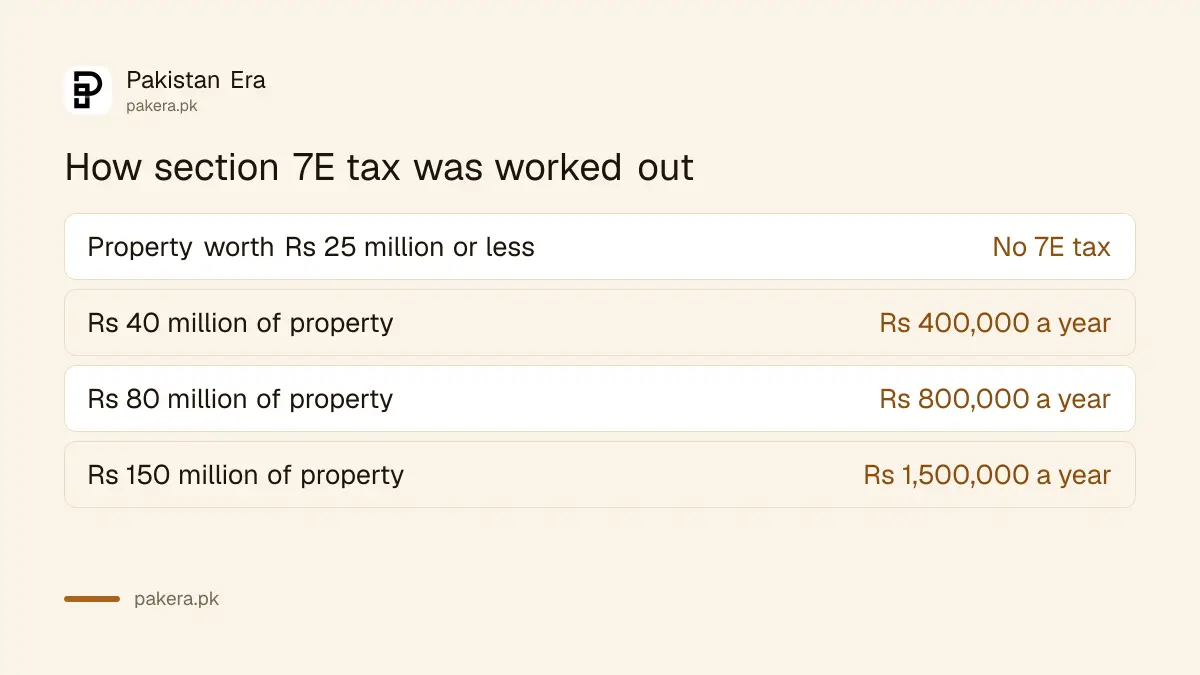
| Property held on 30 June | Deemed income at 5% | Section 7E tax at 20% |
|---|---|---|
| Rs 25 million (at or below the limit) | Nil | Nil |
| Rs 40 million | Rs 2,000,000 | Rs 400,000 |
| Rs 80 million | Rs 4,000,000 | Rs 800,000 |
| Rs 150 million | Rs 7,500,000 | Rs 1,500,000 |
The figures are our arithmetic on the rates in the omitted section, after the one excluded home and the other exclusions. Fair market value meant the FBR valuation table for the area, or the DC rate where FBR had none.
The Finance Act 2026 removed the section, the rate and the cross-references
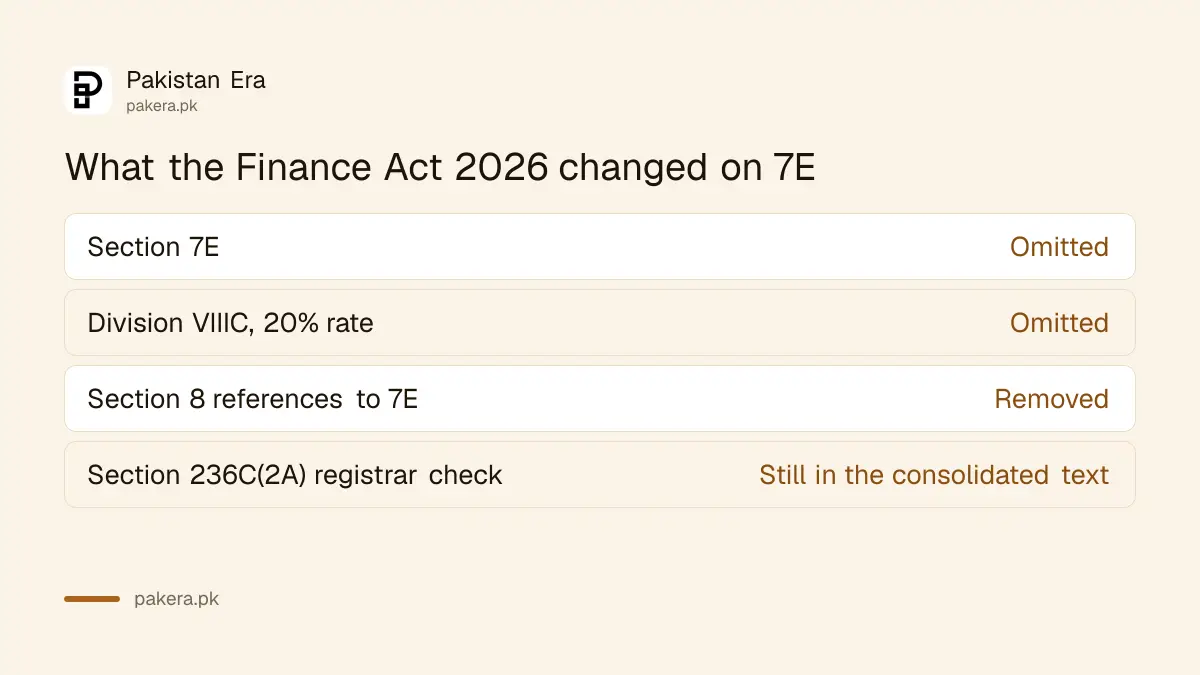
The consolidated Ordinance now shows section 7E as "omitted by the Finance Act, 2026", with the old text in a footnote, and the same for Division VIIIC. Item 9 of FBR's Circular No. 02 of 2026-27, dated 8 September 2026, says the tax on deemed income "has been abolished by omission of section 7E", that Division VIIIC was omitted as a consequence, and that section 8 was amended to drop references to 7E.
That is the whole of what FBR has published. There is no transition note, no refund rule for anyone who paid in advance, and no mention of tax year 2026, the year that ended on 30 June 2026 and whose returns are due by 31 October.
Which tax year the abolition covers is not stated anywhere
Section 7E charged tax on assets held "on the last day of tax year". For tax year 2026 that day was 30 June 2026. The Finance Act 2026 took effect on 1 July 2026, the first day of tax year 2027. Read strictly, the charge for tax year 2026 had already arisen before the section was removed. Read the way FBR's circular words it, the tax is simply gone.
We could not settle this from the published documents. The practical test is the return form on IRIS for tax year 2026: if the 7E computation and the "Form 7E" tab are absent, FBR has applied the abolition to this filing season; if they are present, it has not. We did not log in to a live return to check, and FBR has not said in a circular or press release which it is. Until it does, a filer with a large portfolio should budget for the 1% and keep the valuation workings.
Section 236C(2A) still asks the registrar for 7E evidence
Sub-section (2A) of section 236C, inserted in 2023, says no one responsible for registering or attesting a property transfer may do so "unless the seller or transferor has discharged its tax liability under section 7E" and has produced evidence in the prescribed form. In the consolidated Ordinance that sub-section is still there. The circular lists section 8 as the only place where 7E references were removed.
So a seller may still be asked for the 7E certificate or the IRIS payment evidence at the registrar's desk, at least for tax years up to 2025, when the liability existed. If you sold property after June 2026 and paid 7E for earlier years, keep those challans with the transfer file. The rest of the cost of a sale, the 2.75% advance tax on the seller and 1.25% on the buyer, is unchanged by this.
What property owners should do in this filing season
The abolition cuts the yearly cost of holding a second or third property, but it changes nothing about declaring it. Every property you own still goes in the wealth statement at cost, and the reconciliation still has to balance.
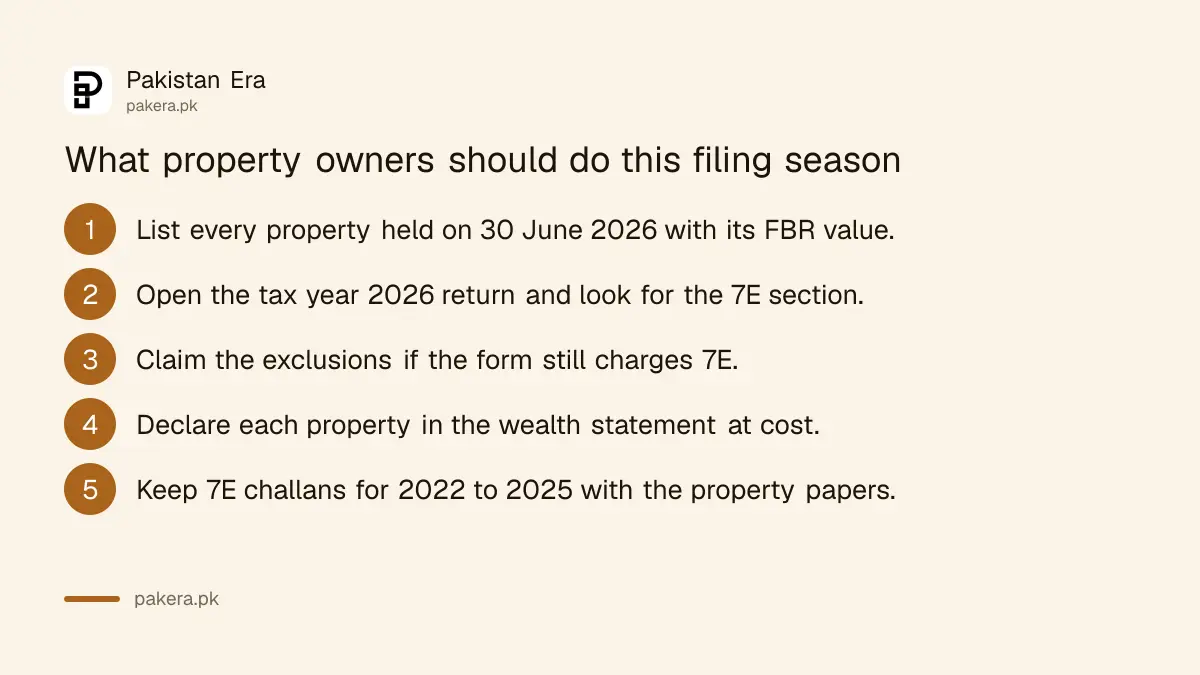
- List every property you held on 30 June 2026 and its FBR valuation, as you did for earlier years.
- Open the tax year 2026 return on IRIS and look for the 7E section; follow what the form asks for.
- If the form still charges 7E, choose your one excluded property and claim the other exclusions as before.
- Declare each property in the wealth statement at cost, with any 7E paid shown as tax paid.
- Keep 7E challans for 2022 to 2025 with the property papers for any future sale.
Rental income and capital gains on a sale are taxed under their own sections and are not affected by the omission.
Common questions
Is section 7E tax still payable in Pakistan?
The Finance Act 2026 omitted section 7E and its 20% rate, and FBR's circular says the tax has been abolished. Whether it still applies to tax year 2026, which ended on 30 June 2026, is not stated.
How much was the 7E tax?
Five per cent of the fair market value of property was deemed income, taxed at 20%, which is 1% of value a year, after excluding one home and portfolios up to Rs 25 million.
Do I still need a 7E certificate to sell property?
Section 236C(2A), which requires registrars to see evidence that 7E was discharged, is still in the consolidated Ordinance. Keep your 7E challans for 2022 to 2025 for any transfer.
Will FBR refund 7E paid earlier?
Nothing in the Finance Act 2026 or the circular provides a refund. The omission removes the charge going forward.
Does the abolition affect rental or capital gains tax?
No. Rental income under section 15 and capital gains under section 37 are separate and unchanged by this omission.
How we verified this
What we checked, where we read it, and what we could not confirm.
Last checked 19 October 2026. We read section 7E, Division VIIIC and section 236C(2A) in FBR's consolidated Income Tax Ordinance, 2001 amended up to 30 June 2026 and item 9 of Circular No. 02 of 2026-27 dated 8 September 2026 on the FBR website. The table figures are our arithmetic. We could not verify which tax year the abolition starts from, because neither the Act nor the circular says, and we did not open a live tax year 2026 return on IRIS to see whether the 7E tab remains.
About the author

Senior Writer, Public Services and Technology
Shahid joined us in 2024 as an author. He is a senior contributor to Pakistan's leading technology websites. He writes detailed articles, mostly covering his expertise in the latest tech, mobiles, apps, gadgets, and step-by-step guides. His ideology is to help people understand the latest trends and explain complex methods through very easy-to-understand guides.