Stop Your Electricity Company Rejecting an Application Without Notice in Pakistan
Under NEPRA's 2026 rules, a company cannot reject your connection, name, load or tariff request until it gives written reasons and time to fix them. Learn how.
Short answer: Under NEPRA's 2026 rules, an electricity company cannot reject your application for a connection, name change, load change, tariff change, shifting or reconnection until it has told you the exact reasons in writing. It must also give you reasonable time to fix them.
You submit the forms, wait three weeks, and hear that the file was "returned". No letter. No reason. The 2026 rules close that gap.
We downloaded and read the Performance Standards (Distribution) Regulations 2026 from nepra.org.pk on 14 October 2026. They were notified as SRO 1430(I)/2026 on 25 August 2026. We have not tested how any company applies this rule in practice.
A rejection needs written grounds first
Regulation 3 says no application may be refused or rejected unless the applicant was first told the specific grounds in writing. The company must then allow reasonable time to respond or correct the problem. Only after that can it make a final decision.
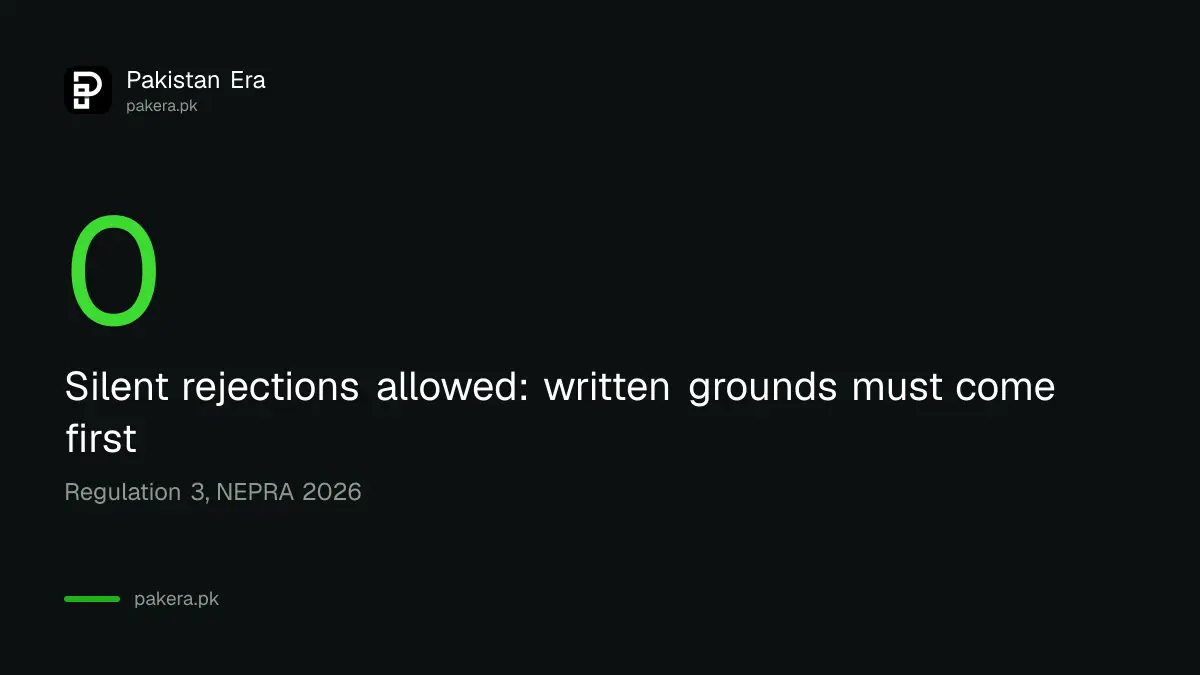
The rule is not about making the company say yes. It is about stopping a silent no. If your papers are wrong, you get a chance to fix them.
The rule covers most common requests
It applies to a new connection, temporary connection, load extension or reduction, change of name, change of tariff, shifting of site, temporary disconnection, reconnection and permanent disconnection. A separate clause gives new net billing connections the same protection.
| Your request | Written grounds required before rejection |
|---|---|
| New or temporary connection | Yes |
| Load extension or reduction | Yes |
| Change of name or tariff | Yes |
| Shifting, disconnection or reconnection | Yes |
| New net billing (solar) connection | Yes |
For the paperwork side of these requests, see how to apply for a new electricity connection, how to change the name on an electricity bill and how to extend your sanctioned load.
Late files must also come with written reasons
If the company misses the time set for your request, it must give you written reasons for each day of delay if you ask in writing. The delay does not release the company from finishing the work as fast as it can.
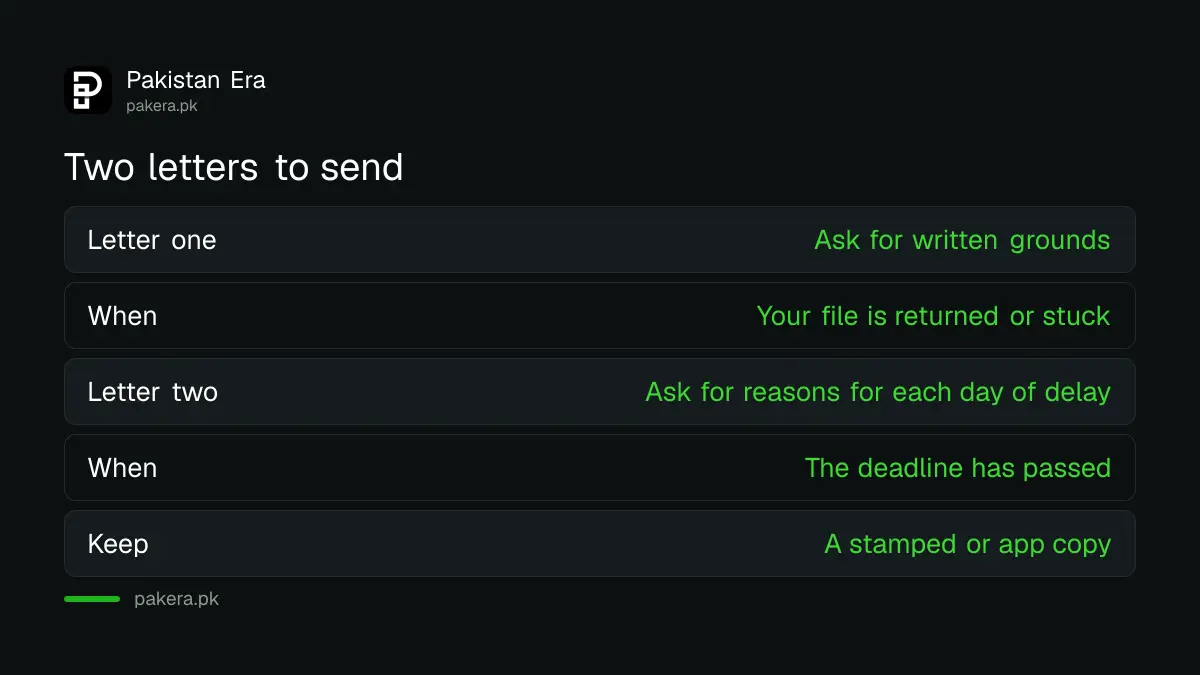
So use two letters. One asks for the written grounds if your file is stuck or returned. The other asks for the reasons for delay once the deadline has passed. Deadlines for each request are listed in our report on NEPRA's new deadlines.
How to ask for your reasons
Write a short dated letter to the sub-divisional office, quote your application or reference number, and ask for the specific grounds in writing. Keep a receiving copy. If the company answers, correct the problem. If it does not, escalate.
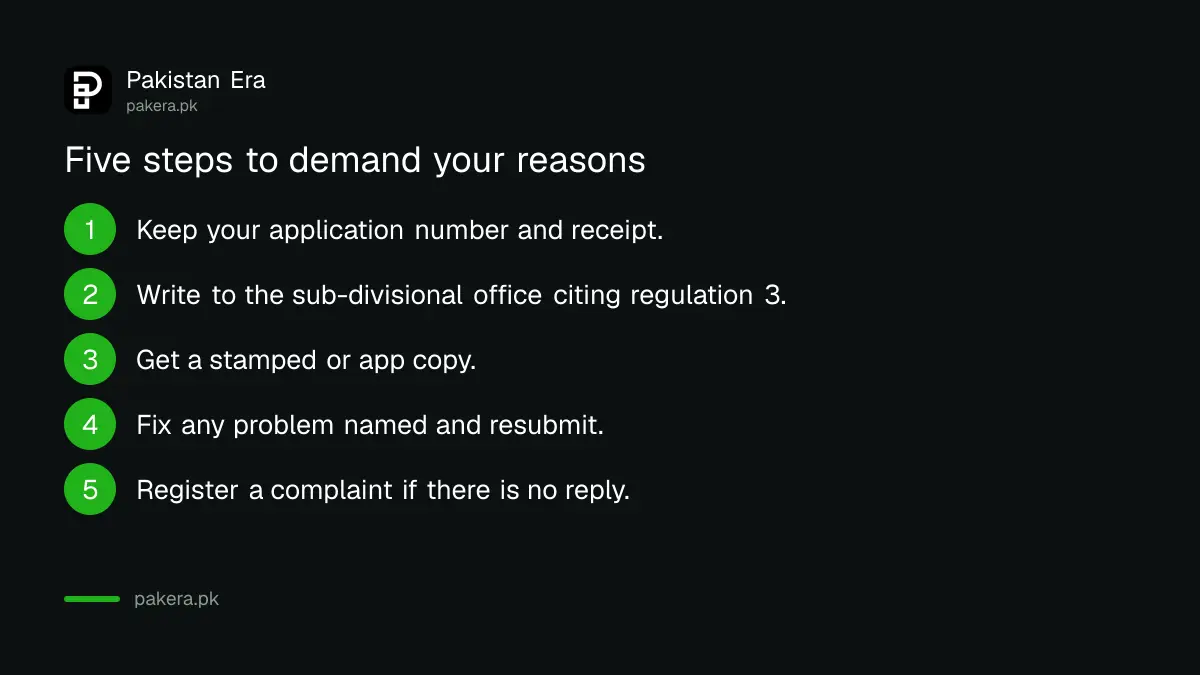
- Keep your application number, date and any receipt.
- Write to the sub-divisional office asking for the grounds for rejection or the reasons for delay, citing regulation 3 of the 2026 rules.
- Get a stamped copy or send it through the company app so there is a record.
- Fix any problem named in the reply and resubmit within the time given.
- If there is no reply, register a complaint and keep the number.
When the office stays silent, take it up the line using NEPRA's complaint route. Complaints not solved by the company go to the Authority, according to regulation 15.
Money for delays has not started
The rules set daily compensation for missed deadlines, for example Rs 200 a day when a net billing connection is late. That clause starts two years after the rules took effect, so you cannot claim it yet. The written reasons rule works now.
NEPRA can fine a company that breaks the standards today. For solar users, our report on the 2026 net metering rules explains the wider changes.
What counts as a good letter
Keep the letter short and polite. Give your name, consumer or application number, the date you applied and the service you asked for. State the rule in one sentence: that the 2026 NEPRA regulations require written grounds before a rejection. Then ask for the grounds in writing within a set number of days.
Do not argue about the merits in the first letter. You are asking for the reasons, and the reasons will tell you what to fix.
If an officer refuses to accept the letter, send it through the company app, or post it by registered mail and keep the receipt. A record of the attempt matters as much as the letter itself when you take the case to NEPRA later.
Common questions
Can the company reject my application without telling me why?
No. The 2026 rules say it must first tell you the specific grounds in writing and give you reasonable time to respond.
Which applications does this cover?
New and temporary connections, load changes, name and tariff changes, shifting, temporary and permanent disconnection, reconnection and net billing connections.
Can I get written reasons if the company is late?
Yes. If you ask in writing, it must give written reasons for each day of delay.
Can I claim money for a late connection now?
Not yet. The compensation clause starts two years after the rules took effect.
Where do I go if the company ignores my letter?
Register a complaint with the company, keep the number, and then take it to NEPRA. The rules send unresolved complaints to the Authority.
How we verified this
What we checked, where we read it, and what we could not confirm.
Last checked on 14 October 2026, Pakistan time. We read NEPRA's Performance Standards (Distribution) Regulations 2026. We did not test the rule with a real application, and we could not confirm how long "reasonable time" is, because the text does not set a number of days.
About the author

Senior Writer, Public Services and Technology
Shahid joined us in 2024 as an author. He is a senior contributor to Pakistan's leading technology websites. He writes detailed articles, mostly covering his expertise in the latest tech, mobiles, apps, gadgets, and step-by-step guides. His ideology is to help people understand the latest trends and explain complex methods through very easy-to-understand guides.