UK Duty-Free Entry for Pakistani Exporters: 0% on 92% of Product Lines Under DCTS
Pakistan sits in the UK's Enhanced tier, with 0% duty on 92% of product lines. See the origin rules, Form A and invoice proof, and who claims the cut.
Pakistan is in the "Enhanced Preferences" tier of the UK Developing Countries Trading Scheme. That tier gives Pakistani goods 0% import duty on 92% of product lines sold into the UK. Exporters prove origin with a Form A or a declaration on the invoice, valid for 2 years, and the UK importer claims the lower duty.
Sellers often ask only about the US and the EU. The UK is a third door, and its scheme is simpler than most. We read the UK government's guidance on the scheme on 15 October 2026, and every rule below comes from it. GOV.UK's own record shows the pages were updated on 14 October 2026, but we cannot say what changed, and Pakistan still appears in the Enhanced tier on the version we read.
Pakistan is in the Enhanced tier, with 0% duty on 92% of product lines
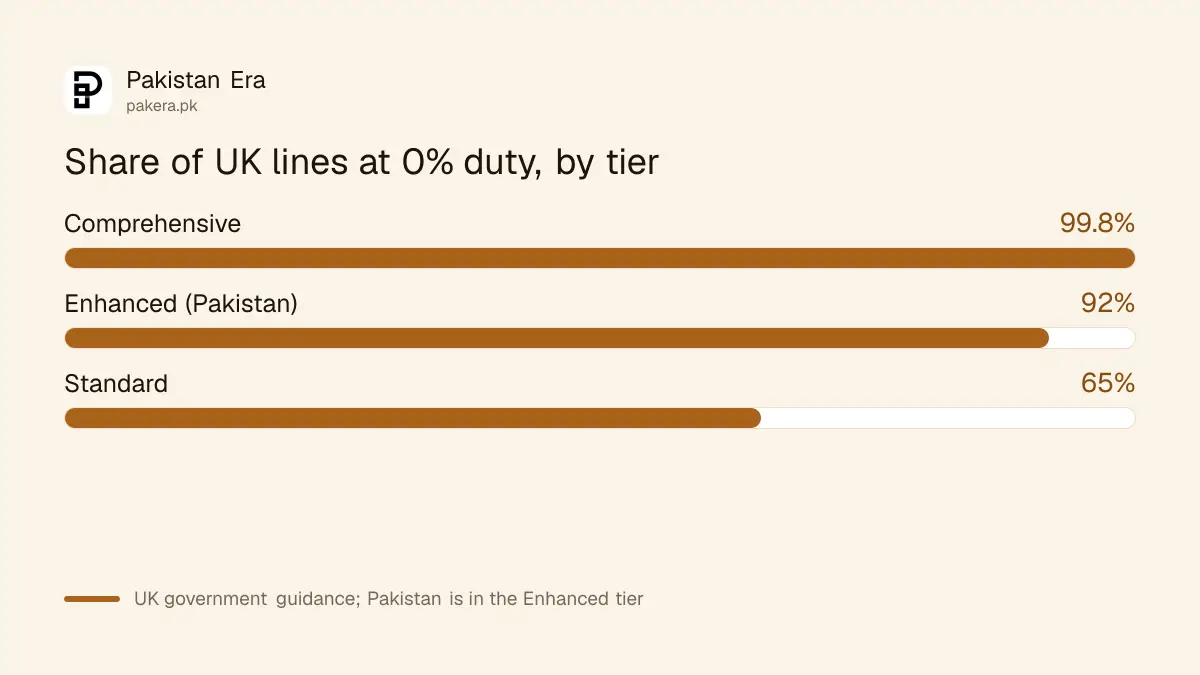
The UK scheme has three tiers. Pakistan appears in the middle one, Enhanced Preferences, which gives 0% import duty on 92% of product lines. Other lines pay a duty, and anything not covered by the tier pays the UK Global Tariff.
The UK lists the share of product lines at each duty level for the three tiers. Pakistan's tier has a small band that still pays tariffs above 10%, including fixed charges per unit of weight or number.
| Tier | Product lines at 0% duty | Lines above 10% duty | Who is in it |
|---|---|---|---|
| Comprehensive | 99.8% | 0% | Least Developed Countries |
| Enhanced (Pakistan) | 92% | 7.2% | Low and lower-middle income countries that are not Least Developed |
| Standard | 65% | 13% | Remaining low and lower-middle income countries |
Before you plan an order, check the exact customs code of your product against the UK tariff. A product in the other 8% pays some duty, so the code matters.
The tier depends on World Bank income level and export variety
The UK says the World Bank's income classes decide who qualifies, and export diversification decides the vulnerability test. Least Developed Countries sit in the top tier. Low and lower-middle income countries that are not Least Developed, like Pakistan, sit in Enhanced.
The UK also says tiers can change when it reviews the scheme. Countries that do not meet the economic vulnerability test fall to Standard. So Pakistan's place is not permanent, and a yearly check is sensible.
One more exit rule matters. If a country stays an upper-middle income country for three years in a row, it is told to leave the scheme. It then has about 18 months of continued tariff cuts before access ends.
Your goods must be made in Pakistan or pass origin rules
Origin rules decide where goods are "from". Goods qualify if they are wholly obtained in Pakistan, or if they get enough processing under product rules. Those rules use a value limit on imported inputs, a change of customs code, or a named process.
The simpler origin rules the UK introduced apply to Least Developed Countries. Pakistan is not in that group, so the standard product rules apply. Textile products in customs chapters 50 to 63 have tolerance rules, which the UK sets out in its notes on applying origin rules.
An example of a processing rule is silk, where spinning of natural fibres counts. The UK also lists rules for flax yarn and glassware. Ask your buyer or customs agent for the rule that applies to your code.
Inputs from India, Bangladesh, Sri Lanka, Nepal and Bhutan can count
Pakistan sits in regional group 2, with Bangladesh, Bhutan, India, Nepal and Sri Lanka. Materials from these countries can be treated as Pakistani if the processing in Pakistan goes beyond minimal levels. Inputs from the UK, the EU, Norway and Switzerland can also count.
Some goods are excluded from this sharing. The UK excludes items whose scheme duty rate differs by country, and items that would get a better rate through cumulation than if sent directly. For Norway and Switzerland, goods in chapters 1 to 24 are excluded.
Sharing inputs across different regional groups is possible only if the business applies to use it. The UK says the finished product's origin is then the country where the last real processing happened.
Prove origin with Form A or an invoice declaration valid for 2 years
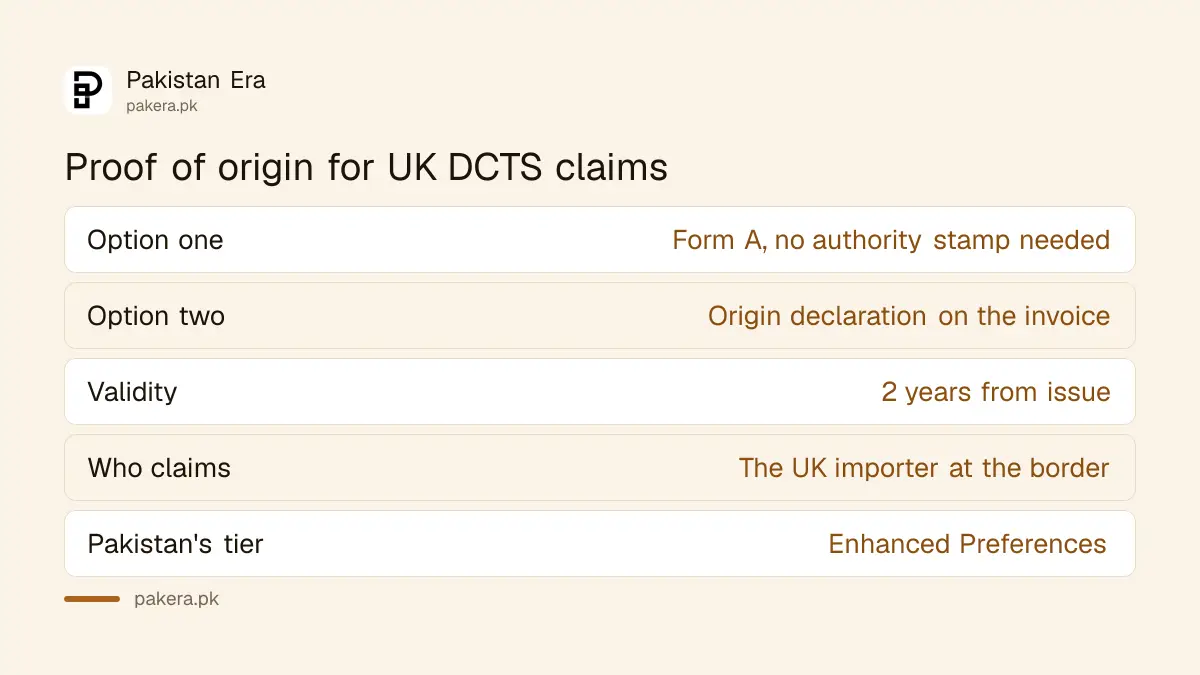
To get the lower duty, goods need a Form A or an origin declaration on an invoice, packing list or consignment note. Form A needs no authority's stamp or signature, and a copy is accepted. Both are valid for 2 years from issue.
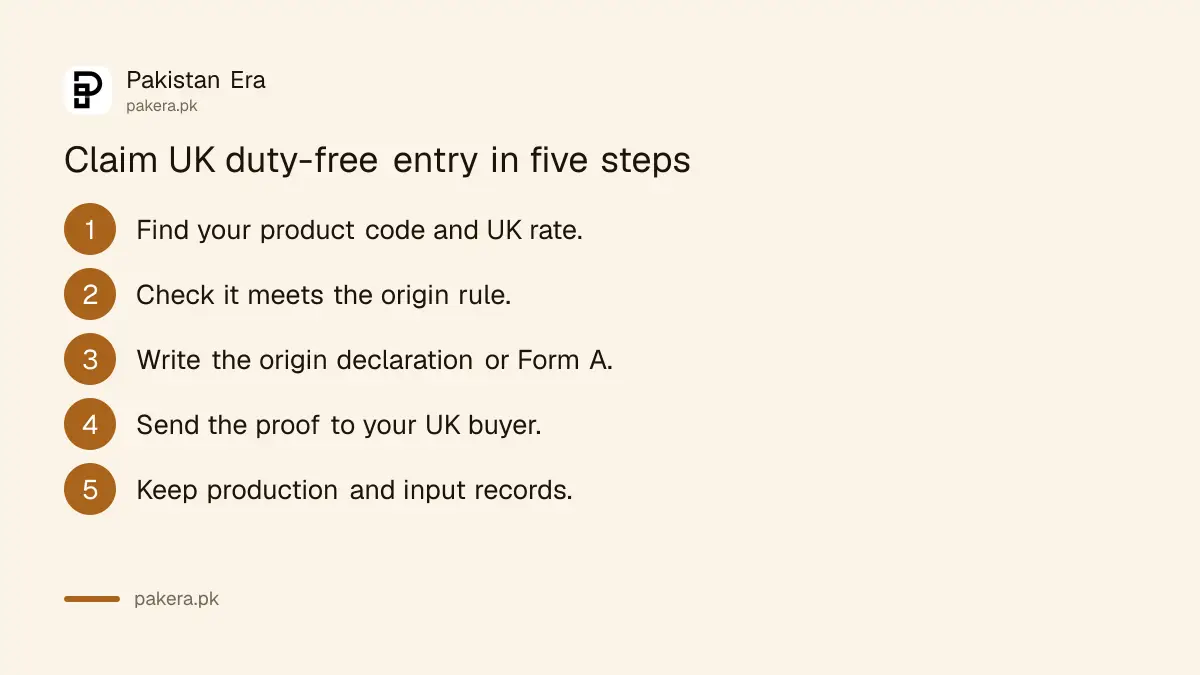
- Find the customs code of your product and its UK duty rate.
- Check that your product meets the origin rule for that code.
- Write the origin declaration on your invoice, or complete a Form A.
- Send the proof to your UK buyer, who makes the claim at the border.
- Keep production and input records in case the UK asks to check.
The UK importer, not the Pakistani seller, claims the preference when the goods enter the UK. So tell your buyer clearly that your goods qualify, and give them the proof with the shipment.
The UK needs proof of origin, the EU a reapplication and the US adds a tariff
The UK scheme needs proof of origin and goods that meet the origin rule. The EU needs a GSP+ reapplication from 2027. The US adds a separate 10% tariff on Pakistani goods, which the US buyer pays.
If you have never exported, registering as an exporter on WeBOC and TDAP comes first. To protect against a buyer who does not pay, see EXIM Bank export credit insurance.
Common questions about the UK scheme for Pakistan
Is Pakistan in the UK Developing Countries Trading Scheme?
Yes. The UK guidance lists Pakistan under Enhanced Preferences. That tier gives 0% duty on 92% of product lines.
Do all Pakistani goods enter the UK duty free?
No. About 92% of product lines are at 0%. Lines outside the scheme pay the standard UK Global Tariff rate.
Who claims the lower duty, me or my buyer?
The importer claims it at the UK border. You provide the proof of origin and tell the buyer your goods qualify.
Do I need a stamp on Form A?
No. The UK says Form A does not need to be stamped or signed by an authority in the exporting country. A copy can be submitted.
How long is a proof of origin valid?
Two years from the date it was issued, for Form A and for an invoice declaration issued in a scheme country.
Can I use Indian or Bangladeshi cloth in my product?
Yes, in many cases. Pakistan, India and Bangladesh are in the same regional group, so inputs can count if your processing goes beyond minimal levels. Check the exclusions first.
How we verified this
What we checked, where we read it, and what we could not confirm.
Last checked 15 October 2026. Tiers, percentages, graduation rules, cumulation, proof of origin and validity come from the UK government's guidance pages Preference tiers under the Developing Countries Trading Scheme, Understanding rules of origin and Use the Developing Countries Trading Scheme to import goods, which we read that day. We did not check individual product codes or UK duty rates. The tier page says 16 countries are in Enhanced but lists more names, so treat the count with care.
About the author

Global Affairs & Political Economy Writer
Muhammad Hatim is a book lover who started writing because he enjoys it. At Pakistan Era he writes about international relations, geopolitics and the global economy, with a particular interest in South Asia and the forces behind current events.