Valorant AFK Penalty and Ban in Pakistan: What Each Penalty Means and How to Avoid the Next One
Valorant AFK, queue dodge and comms penalties explained for Pakistan: RR cuts, teamplay restrictions, bans, At-Risk Alerts, and how to stop drops costing you.
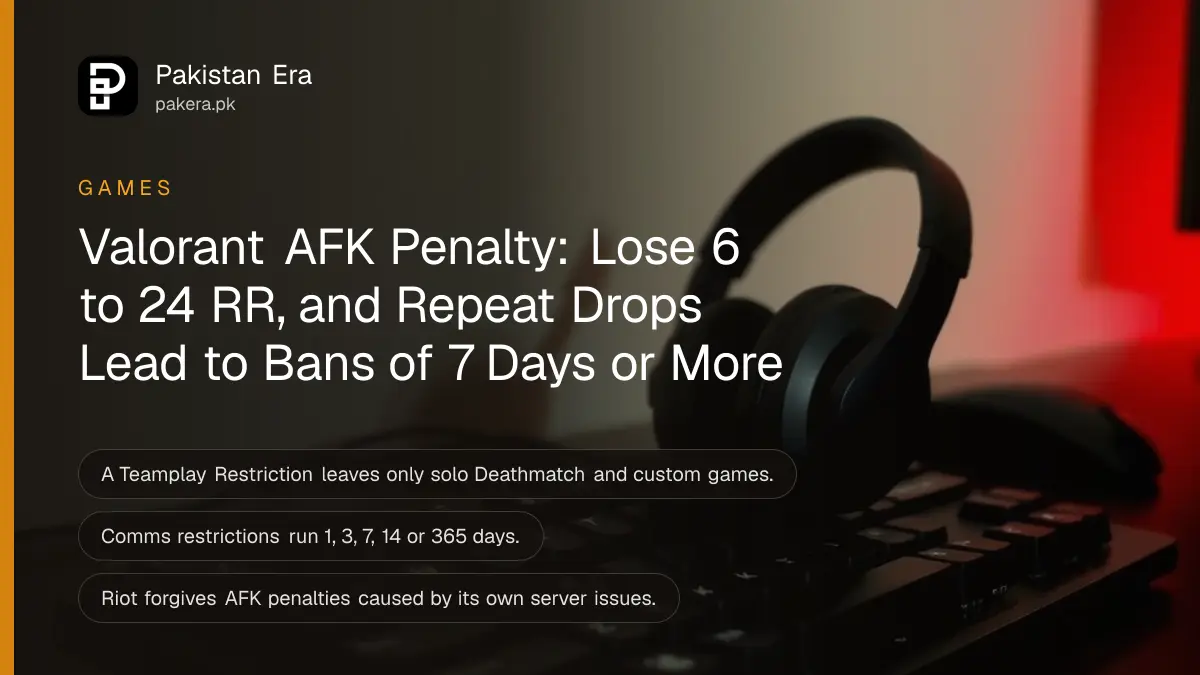
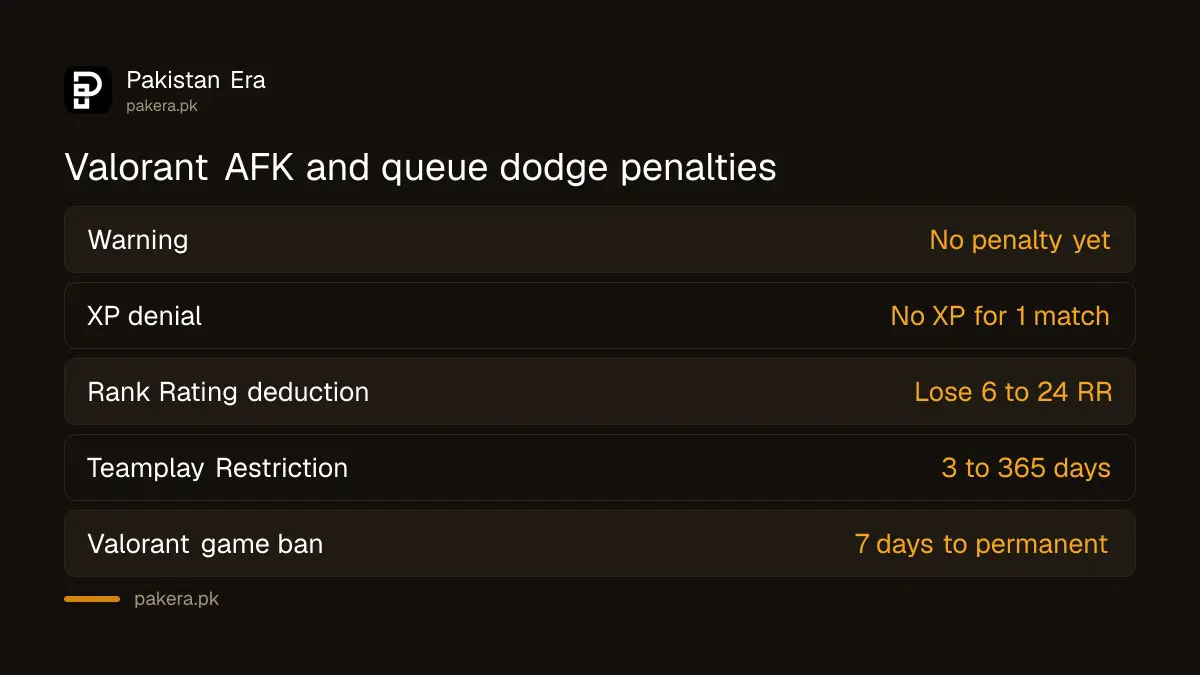
A Valorant penalty for going AFK or queue dodging can be a warning, lost XP, a Rank Rating cut of 6 to 24 RR, a Teamplay Restriction of 3 to 365 days, or a game ban from 7 days to permanent. Abusive chat brings a comms restriction of 1 to 365 days. Riot sets the penalty by your history, not just one match. The fix is to stop the behaviour, and in Pakistan that often means fixing the connection before you queue.
Load shedding, a router that drops at peak hours, or a PC that restarts mid-match all look like AFK to the game. Riot says its systems try not to punish occasional connection trouble, but repeated drops build a record. Below are the penalties, how long each lasts, and how to avoid the next one.
| Penalty | What it does | How long |
|---|---|---|
| Warning | Tells you the AFK or queue dodge system was triggered | None |
| XP denial | No XP for the match that caused it | 1 match |
| Rank Rating deduction | Lose 6 to 24 RR in a Competitive match | 1 match |
| Teamplay Restriction | Only solo Deathmatch and custom games | 3 to 365 days |
| Valorant game ban | Cannot play Valorant until the time shown | 7 days to permanent |
What counts as AFK, queue dodging and friendly fire
Riot treats four habits as letting the team down. AFK means being in the match without playing. Queue dodging means leaving Agent select by disconnecting. Boosting means someone higher ranked playing on your account. Friendly fire means hurting teammates with your Agent's abilities.
- AFK (away from keyboard): you are in the match but not moving your Agent or talking. A frozen PC or a dropped connection looks the same to the system.
- Queue dodging: you disconnect during Agent select, so your team starts one player short.
- Boosting: a higher ranked player logs in to your account to raise your rank. This also puts the account at risk of theft.
- Friendly fire: damaging or killing a teammate with an ability. Riot says a little accidental damage with a clean record gets at most a warning or light penalty.
Riot does not say how it detects these. It does say game bans are kept for repeat offenders who ignored earlier warnings and penalties.
Why your penalty is harsher than your friend's
Riot bases each penalty on your whole history, not one match. Small offences add up, so two players who leave the same match can get very different penalties. You can also get two at once, such as an RR cut and XP denial, and skip steps on the ladder.
Riot's own example: one player may get XP denial three times, never get a queue timer, and then a 28 day ban without ever getting a 7 day one. Penalties follow severity and frequency, not a fixed order.
Before a penalty, a player in good standing may see an At-Risk Alert above their Riot ID in the client. Click it to see what you did and what penalty comes next. The alert itself does not penalise you, and it goes away only when the account is back in good standing.
Comms restrictions for abusive chat and voice
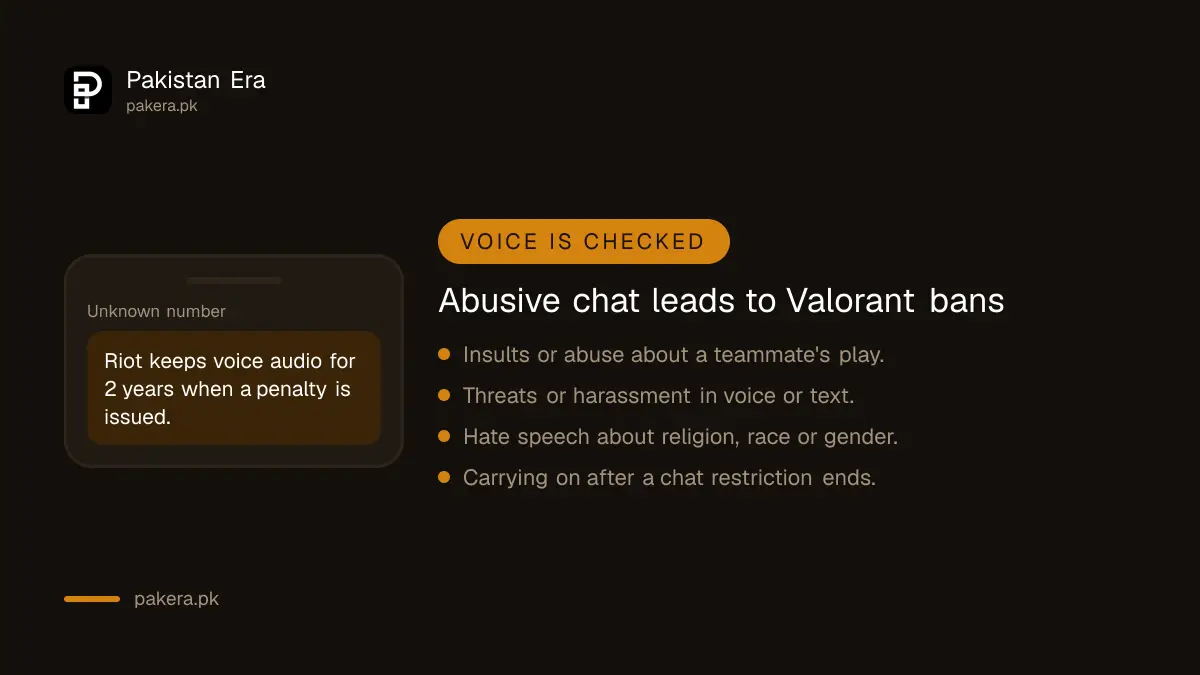
Insults, threats, harassment, abuse about someone's play, and hate speech about race, religion, ethnicity, ability, sexual orientation or gender identity bring a comms restriction. Riot detects both typed and spoken chat. A first restriction can grow into a multi-day game ban.
| Penalty | What it blocks | Possible lengths |
|---|---|---|
| Comms Restriction | Voice and text chat in Valorant | 1, 3, 7, 14 or 365 days |
| Teamplay Restriction | Every mode except solo Deathmatch and custom games | 1, 3, 7, 14 or 365 days |
| Valorant game ban | The whole game | 1, 3, 7, 14 or 365 days |
Riot says game bans for chat come only after a chat restriction, when the player keeps using offensive language. You also lose XP for the match that caused the penalty.
Voice clips are kept for at least 24 hours. If someone reports you, Riot keeps the audio for 7 days, and if a penalty is issued, for 2 years. Transcripts are made only when a match is reported or a penalty is given.
Avoid AFK penalties on a Pakistani connection
Riot says occasional tech and connection problems should not be punished heavily, and it forgives AFK and queue dodge penalties caused by a Riot server issue. Repeated drops are different. Riot's advice is to sit out of matches until your connection is stable, and to submit a ticket if drops keep happening.
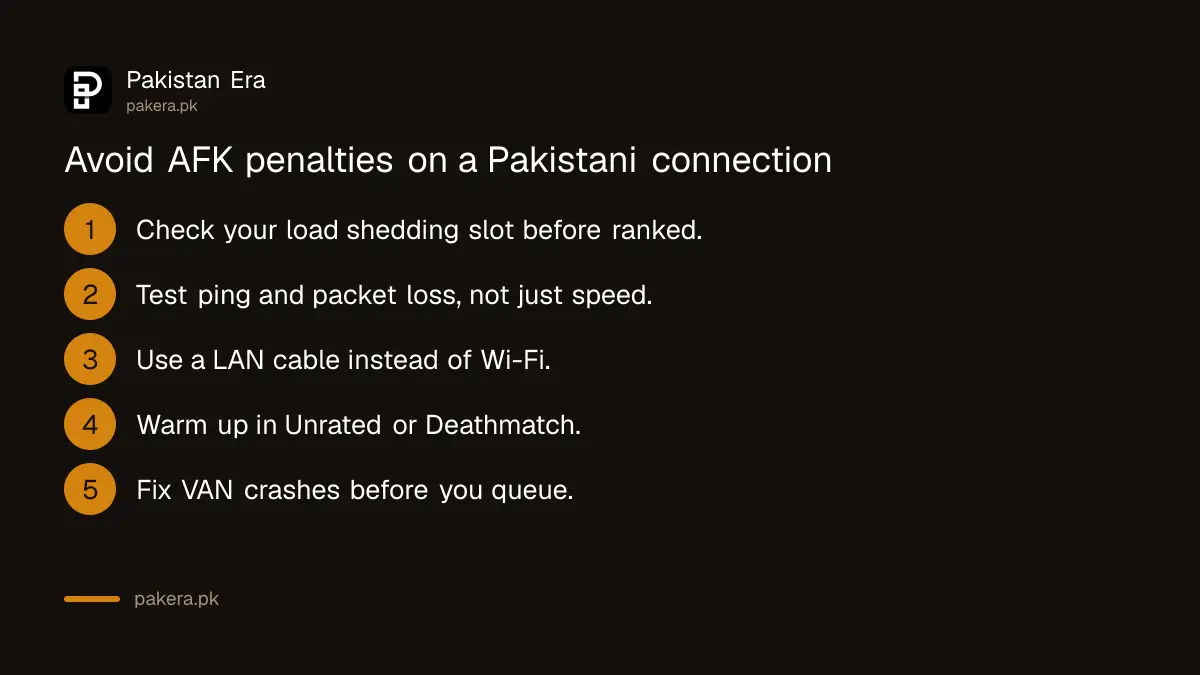
- Check the power first. Do not queue Competitive in the hour before a scheduled load shedding slot. You can check your feeder's load shedding schedule by bill reference number. A UPS for the router alone often keeps the internet up when the power goes.
- Test the line. Run PTA's speed test app and look at ping and packet loss, not just download speed.
- Use a cable. Wi-Fi through two walls drops more than a LAN cable from the router.
- Play Unrated or Deathmatch first. If you disconnect there, you have not cost a ranked team.
- Fix crashes before ranked. A VAN error that throws you out of a match also counts as leaving, so clear any VAN code using Riot's support steps before you queue.
Also check your server and shard. Picking a far server raises ping and timeouts. Valorant servers and payment from Pakistan explains which servers your region can choose.
What you can and cannot do about a penalty
AFK, queue dodge and comms penalties end on their own when the timer runs out. If drops were from a server problem on Riot's side, Riot says it forgives those penalties. For repeated connection trouble, submit a ticket.
- Timer running: wait it out. Play solo Deathmatch or custom games if it is a Teamplay Restriction.
- Drops you cannot fix: submit a ticket to Riot Player Support with the dates and what happened.
- Hacked account caused it: recover the account first, then explain in the ticket. Riot says permanently banned accounts cannot be recovered.
- Someone else played on your account: that is boosting. Never give your login to a booster.
Common questions
How much RR do you lose for leaving a Valorant match?
Riot lists a Rank Rating deduction of 6 to 24 RR for going AFK or queue dodging in a Competitive match, often with XP denial for that match.
Will one disconnect get me banned in Valorant?
Unlikely. Riot says game bans are for repeat offenders, and its systems try not to punish occasional connection problems. Repeated drops build a record.
Can I play anything during a Teamplay Restriction?
Yes. You can still play solo Deathmatch and custom games until the timer shown runs out.
How do I remove an At-Risk Alert in Valorant?
You cannot remove it by hand. Riot's system removes it once the account is back in good standing, so play normally and avoid the behaviour it names.
Does Riot listen to Valorant voice chat?
Riot's systems check voice and text for abuse. Audio is kept at least 24 hours, 7 days after a report, and 2 years if a penalty is issued.
How we verified this
What we checked and where we read it.
Last checked 25 November 2026. Penalties, lengths and rules come from Riot Games Support: Penalties and Bans FAQ (VALORANT), Comms Restrictions and Audio Retention and At-Risk Alerts. The load shedding, UPS and connection steps are our own advice for players in Pakistan.
Free on WhatsApp
Get last dates and rule changes on WhatsApp
We post new last dates, fee changes and fixes for common problems, a few short posts a day.
Follow Pakera on WhatsAppOther followers cannot see your number.
Pakera Solves It
Which online process wasted your time this week?
A portal that will not load, a form nobody explains, a complaint that went nowhere. Tell us. Every week we pick one, solve it step by step and publish the answer.
About the author

Technology Journalist & Multimedia Producer
Ahmad Ali is a technology journalist and multimedia producer at Pakistan Era, joining the team in October 2026. He covers consumer technology and digital life for Pakistani readers, combining research with hands-on product testing.