Weekly Inflation in Pakistan Rises 0.99% as Electricity Jumps 18.76%
Pakistan's SPI rose 0.99% in the week to 24 September 2026, and 11.92% on the year. See what rose, what fell, the three-week trend and each income group.
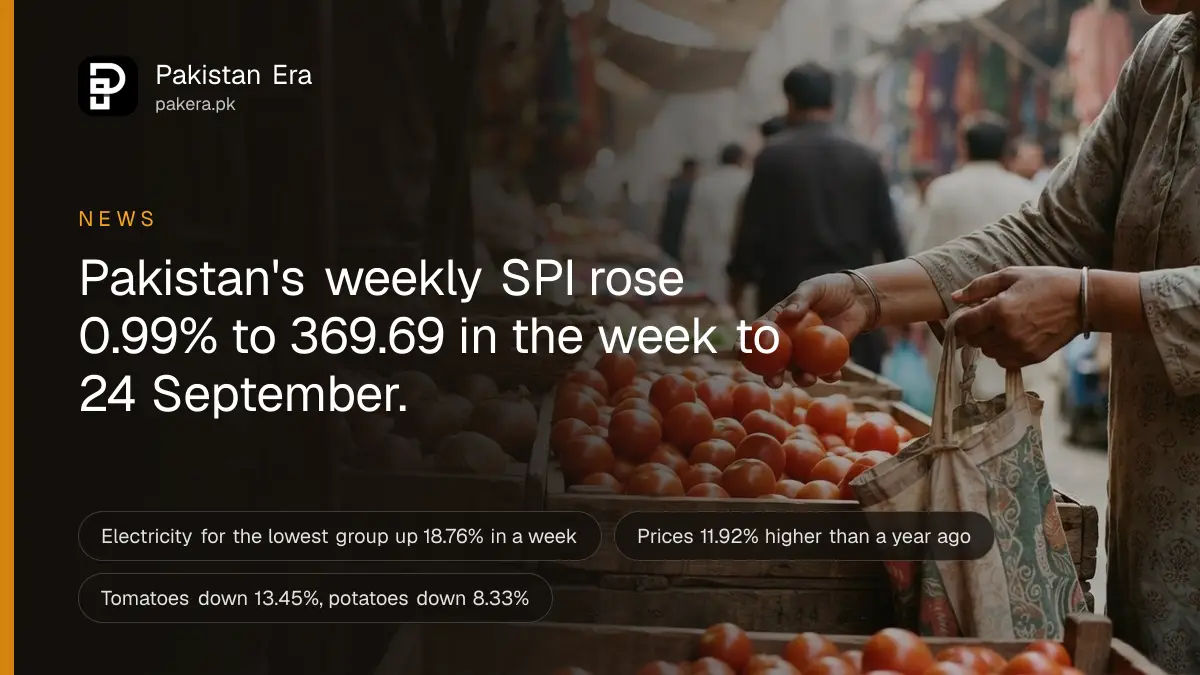
Weekly inflation in Pakistan rose 0.99% in the week ended 24 September 2026, the biggest weekly jump in at least ten weeks. The Pakistan Bureau of Statistics (PBS) put its Sensitive Price Indicator (SPI) at 369.69, and prices were 11.92% higher than a year earlier.
One item did most of the work. Electricity for the lowest spending group rose 18.76% in a single week, from Rs 6.45 to Rs 7.66 a unit. Eggs, garlic and LPG also went up. Tomatoes, potatoes and bananas got cheaper.
We read the PBS release page and both of its PDF files, the executive summary and the annex, on 27 September 2026. Every figure below comes from those documents and the PBS summary for the week before.
Weekly inflation rose 0.99% to an SPI of 369.69
The SPI for the week ended 24 September 2026 was 369.69, up 0.99% from 366.05 a week earlier. That is the largest weekly rise in the ten weeks PBS lists, and it follows a 0.49% rise the week before.
Of the 51 items PBS tracks, 20 went up, 10 went down and 21 did not move. So most prices were flat. The increase came from a small number of items, with electricity far ahead of the rest.
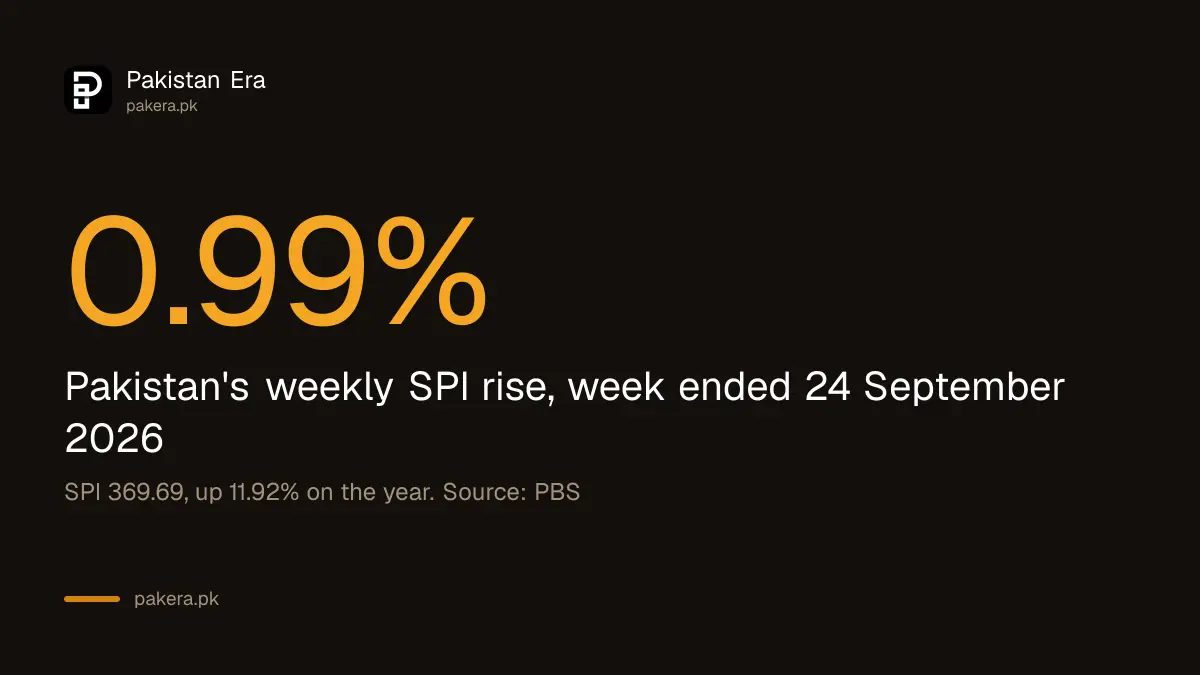
The year-on-year figure matters more for a household budget. At 11.92%, it has climbed from 8.62% just two weeks earlier. In plain terms, a basket that cost Rs 1,000 in late September 2025 now costs about Rs 1,119.
Electricity, eggs and garlic led the weekly rises
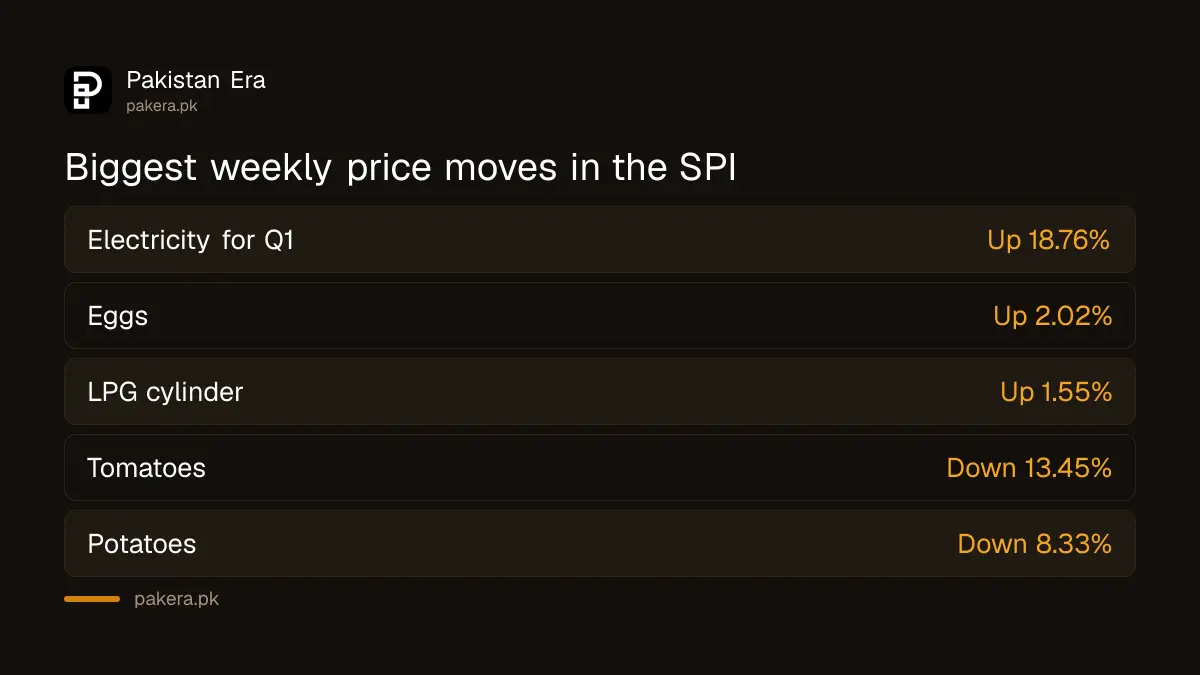
Electricity for the lowest spending group (PBS calls it Q1) jumped 18.76% in one week. Eggs rose 2.02%, garlic 1.57% and LPG 1.55%. The other rises were small, most of them under 1%.
PBS gives the average price of each item across 17 cities. These are the biggest weekly increases:
| Item | 17 September | 24 September | Change |
|---|---|---|---|
| Electricity for Q1 (per unit) | Rs 6.45 | Rs 7.66 | Up 18.76% |
| Eggs, farm (dozen) | Rs 252.56 | Rs 257.66 | Up 2.02% |
| Garlic (1 kg) | Rs 382.62 | Rs 388.61 | Up 1.57% |
| LPG 11.67 kg cylinder | Rs 4,967.05 | Rs 5,044.23 | Up 1.55% |
| Pulse masoor (1 kg) | Rs 261.75 | Rs 263.72 | Up 0.75% |
| Chicken, live broiler (1 kg) | Rs 338.18 | Rs 340.63 | Up 0.72% |
The PBS release does not say why the Q1 electricity rate went up. It only records the price. A separate charge is also on the way: the fuel charge on October electricity bills is still waiting for a NEPRA hearing, so it is not part of this week's number.
An LPG cylinder now averages Rs 5,044. That is Rs 1,968 more than a year ago, a 63.97% rise, and it hurts homes without piped gas the most.
Tomatoes, potatoes and bananas got cheaper
Ten items fell in price this week. Tomatoes dropped the most, down 13.45% to Rs 152.34 a kilo. Potatoes fell 8.33%, bananas 5.66% and onions 2.42%. Diesel and petrol also eased slightly.
- Tomatoes: Rs 176.02 to Rs 152.34 a kilo, down 13.45%
- Potatoes: Rs 55.73 to Rs 51.09 a kilo, down 8.33%
- Bananas: Rs 149.24 to Rs 140.79 a dozen, down 5.66%
- Onions: Rs 193.36 to Rs 188.68 a kilo, down 2.42%
- Diesel: Rs 423.47 to Rs 416.84 a litre, down 1.57%
- Petrol: Rs 393.41 to Rs 392.07 a litre, down 0.34%
The fuel prices here are weekly averages from PBS, not the pump price on one day. The official petrol price from 26 September came after this survey week closed, so it will show up in next week's SPI.
Onions and LPG top the year-on-year rises
Compared with the same week of 2025, onions cost 115.98% more, more than double. LPG is up 63.97%, electricity for Q1 58.59%, diesel 51.80% and petrol 47.49%. Wheat flour is up 32.41%.
A 20 kg bag of wheat flour now averages Rs 2,689.61, against Rs 2,031.24 a year ago. Onions went from Rs 87.36 to Rs 188.68 a kilo.
Some staples are much cheaper than last year. Potatoes are down 39.21%, sugar 21.14%, tomatoes 19.81% and eggs 18.40%. A kilo of sugar now averages Rs 145.05, against Rs 183.94 in September 2025. That is real relief, but it does not cancel out fuel, power and flour.
Three weeks show inflation speeding up
Over the last three weeks the SPI rose each time, and the yearly rate jumped from 8.62% to 11.92%. The weekly rise also grew each week, from 0.23% to 0.49% and then to 0.99%.
| Week ended | SPI | Weekly change | Year on year |
|---|---|---|---|
| 10 September 2026 | 364.26 | Up 0.23% | 8.62% |
| 17 September 2026 | 366.05 | Up 0.49% | 10.64% |
| 24 September 2026 | 369.69 | Up 0.99% | 11.92% |
The week before this one was driven by fuel. In the week to 17 September, PBS recorded diesel up 7.29%, petrol up 6.40% and LPG up 3.26%. This week fuel eased and electricity took over.
Middle-income homes felt the biggest weekly rise
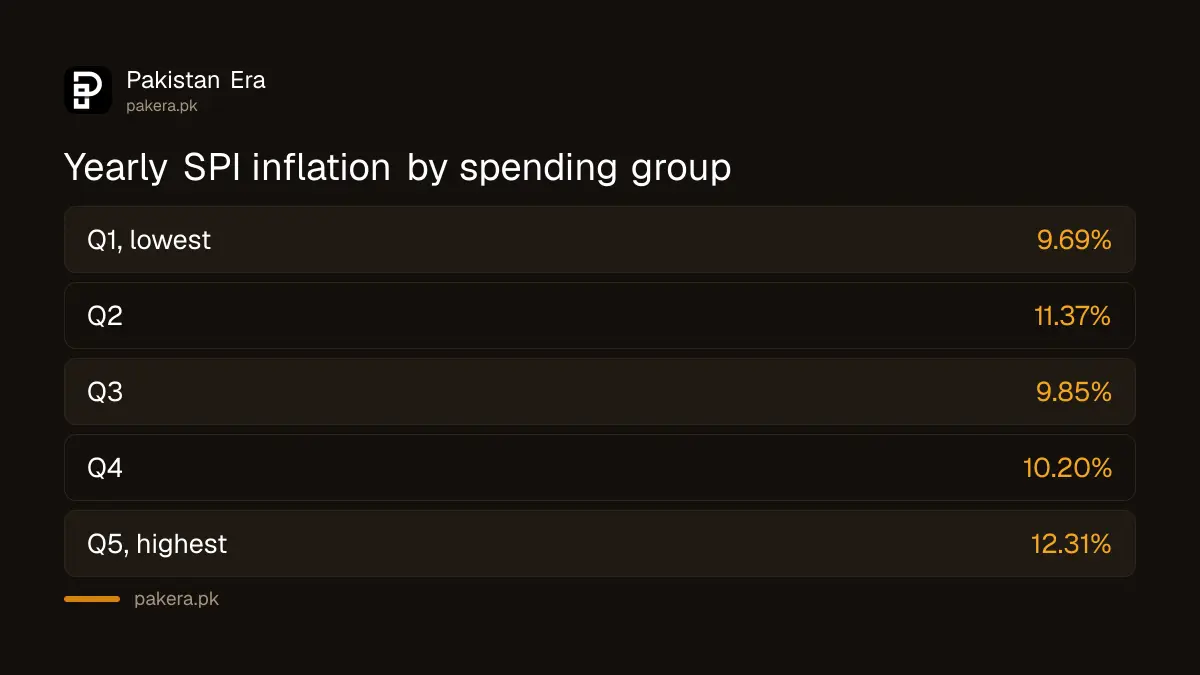
PBS splits households into five spending groups, from Q1 (the lowest) to Q5 (the highest). This week the second group, Q2, saw the biggest rise at 1.28%. Over the year, the richest group, Q5, faces the highest rate at 12.31%.
| Spending group | PBS band | Weekly change | Year on year |
|---|---|---|---|
| Q1, lowest | Up to Rs 17,732 | 0.85% | 9.69% |
| Q2 | Rs 17,733 to 22,888 | 1.28% | 11.37% |
| Q3 | Rs 22,889 to 29,517 | 0.81% | 9.85% |
| Q4 | Rs 29,518 to 44,175 | 0.62% | 10.20% |
| Q5, highest | Above Rs 44,175 | 0.85% | 12.31% |
| Combined | All groups | 0.99% | 11.92% |
Fuel weighs more heavily on better-off homes. In the PBS annex, petrol has a weight of 6.70% in the combined index but only 1.47% for Q1. With petrol up 47.49% in a year, that helps explain why Q5's yearly rate is the highest.
The SPI tracks 51 items in 17 cities, and leaves a lot out
The SPI is a weekly check on 51 essential items, collected from 50 markets in 17 cities. PBS uses it to watch short-term price moves. It is not the official inflation rate, which comes from the monthly Consumer Price Index (CPI).
Here is how to read the weekly number:
- PBS collects prices of 51 items, such as flour, milk, fuel and cloth, in 17 cities.
- It weights each item by how much households spend on it.
- It compares the result with the week before and the same week last year.
- It reports one combined figure plus a figure for each of the five spending groups.
The SPI leaves out rent, school fees, doctors, medicines, transport fares and gold. It covers cities only, not villages. So your own costs may rise faster or slower than 0.99% in a week, depending on what you buy and where you live.
Common questions
What was Pakistan's SPI inflation for the week ended 24 September 2026?
It rose 0.99% over the week, and the SPI stood at 369.69. Prices were 11.92% higher than in the same week of 2025, according to PBS.
Why did weekly inflation rise so much this week?
Mostly because electricity for the lowest spending group rose 18.76%. Eggs, garlic and LPG added a little. PBS did not give a reason for the electricity rise.
Is the SPI the same as Pakistan's inflation rate?
No. The official inflation rate is the monthly CPI. The SPI is a weekly check on 51 essential items and moves more sharply.
Which items got cheaper this week?
Tomatoes fell 13.45%, potatoes 8.33%, bananas 5.66% and onions 2.42%. Diesel, salt, petrol, sugar, mustard oil and gur also eased slightly.
When does PBS publish the next SPI?
PBS usually posts the SPI every Friday for the week ended the day before. The next release should cover the week ended 1 October 2026.
How we verified this
What we checked, where we read it, and what we could not confirm.
We last checked this on 27 September 2026. We read the PBS release for the week ended 24 September 2026, its executive summary PDF and its annex, and the PBS executive summary for the week ended 17 September 2026. The 10 September figures come from the ten-week trend table in the 24 September summary. All prices are PBS averages across 17 cities and may differ from prices in your local market.
About the author

Senior Writer, Public Services and Technology
Shahid joined us in 2024 as an author. He is a senior contributor to Pakistan's leading technology websites. He writes detailed articles, mostly covering his expertise in the latest tech, mobiles, apps, gadgets, and step-by-step guides. His ideology is to help people understand the latest trends and explain complex methods through very easy-to-understand guides.