What to Do During an Earthquake in Pakistan: NDMA's Drop, Cover and Hold On Steps
NDMA's Earthquake Guidelines 2026 in plain steps: drop, cover and hold on, what to do outdoors, in a car or trapped, and what not to do after the shaking.
Short answer: When the ground shakes, drop to your hands and knees, cover your head and neck under a sturdy table or against an inside wall, and hold on until the shaking stops. Do not run outside and do not use a lift. These are the steps in NDMA's Earthquake Guidelines 2026, the national disaster authority's own guide.
Most injuries in an earthquake come from falling objects, not from the building collapsing. NDMA says most injuries happen when people are hit by falling objects, including while they enter or leave a building. That is why staying put and protecting your head matters more than moving fast.
We read the Earthquake Guidelines 2026 on NDMA's website for this page. Our other guide covers what to do before a quake, such as fixing shelves and packing a kit. You can read it in how to prepare your home for an earthquake. This page covers the minutes during and after the shaking.
Drop, cover and hold on is the main rule indoors
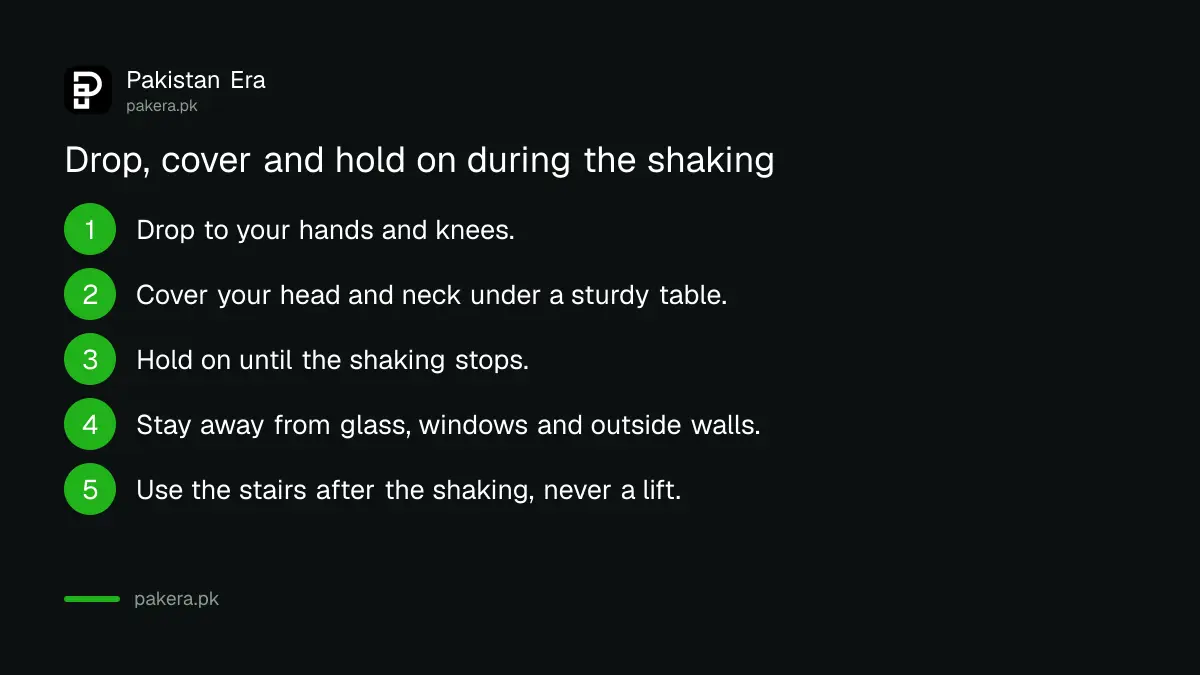
NDMA's guide gives the same core steps for homes, schools, offices and high-rise buildings. Take cover under a sturdy desk, table or bench, or against an inside wall, and hold on. If there is no table near you, cover your face and head with your arms and crouch in an inside corner.
NDMA says it is safer to stay in that position until the shaking is over. It also asks people to stay calm, because calm helps you make better decisions.
In a bed at night, NDMA says to stay there. Hold on and protect your head with a pillow. The one exception is when a heavy light fitting hangs above you. In that case, move to the nearest safe place.
Stay away from glass and do not use a lift
NDMA tells you to stay away from glass, windows, outside doors and walls, and anything that could fall, such as lights and furniture. It says not to use lifts and to use the stairs. Stay inside until the shaking stops and it is safe to go out.
At home, NDMA also asks you to turn off gas, water and electrical appliances if it is safe to do so. This helps prevent fires, floods and gas leaks. NDMA notes that natural gas leaks are common after earthquakes, so listen for hissing and watch for the smell of gas.
If you smell gas after a quake, leave the room and call 1199, the gas emergency number SNGPL and SSGC list. The safe use of gas at home is covered in the guide to using a gas heater or geyser safely.
What to do outdoors, in a car or under rubble
The right move changes with where you are. NDMA gives a short list for each place.
| Where you are | What NDMA says to do |
|---|---|
| Indoors | Drop, cover and hold on. Stay away from glass. Do not use a lift. |
| Outdoors | Stay in clear open space. Move away from buildings, trees, streetlights and wires. |
| In a vehicle | Stop as soon as it is safe, pull to the side and stay in the car. |
| Near bridges | Do not stop near or under overpasses, trees or wires. Do not cross a damaged bridge. |
| Trapped under rubble | Do not light a match. Cover your mouth. Tap on a pipe or wall. Shout only as a last resort. |
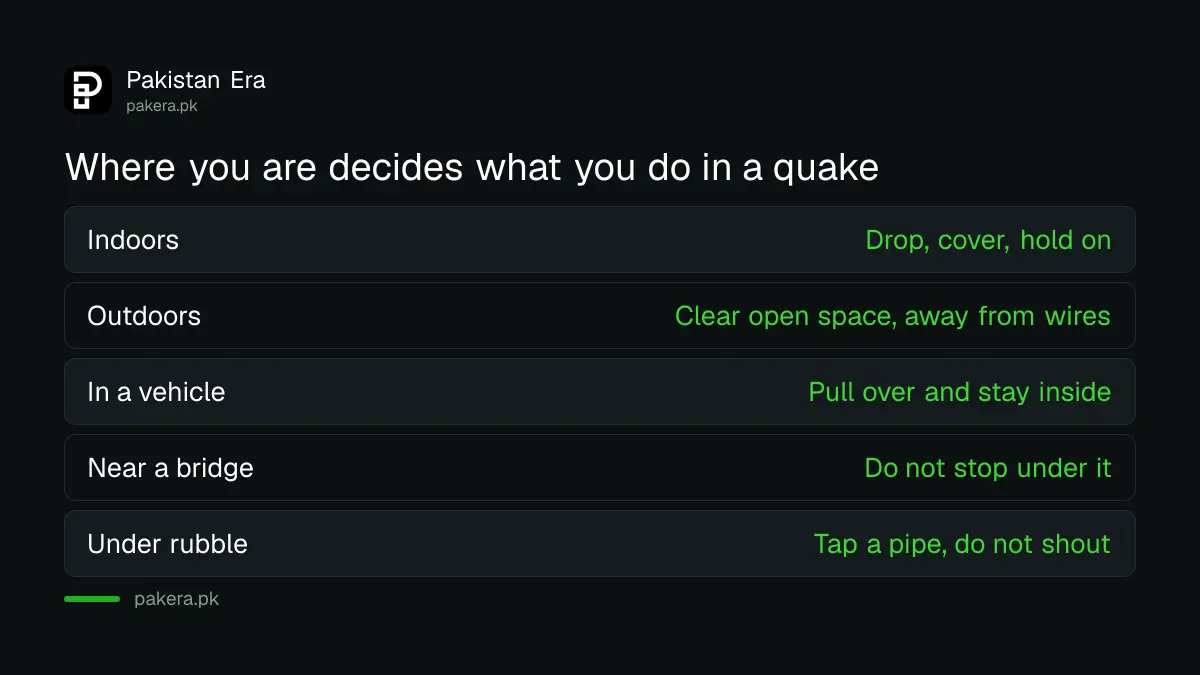
Shouting is the last choice because it makes you breathe in dust. Tapping lets rescuers find you. A whistle helps if you have one.
After the shaking stops, expect aftershocks
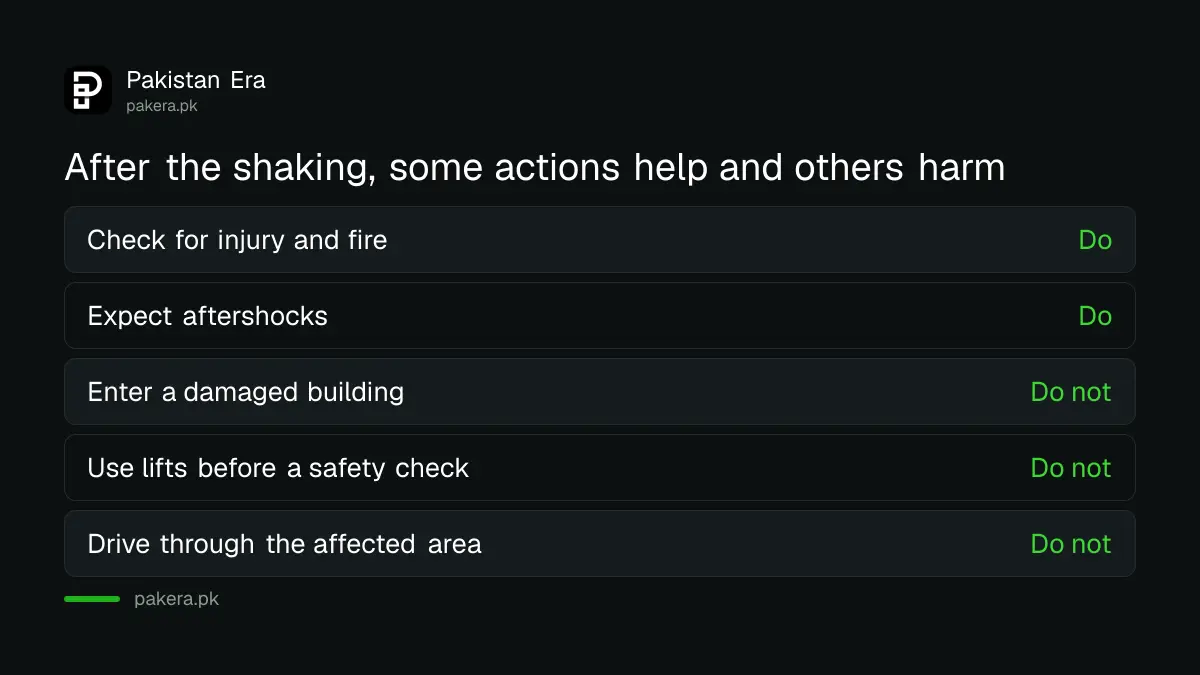
NDMA's after-quake list starts with checking yourself for injury and being ready for aftershocks. An aftershock is a smaller quake that follows the main one, and it can bring down a building already weakened. Check for fire, and use a fire extinguisher if you have one. Look around for broken glass and other hazards.
The guide lists five things not to do. Do not enter a partly damaged building. Do not use busy phone networks without need, because it can block calls to emergency services. Do not drive around in the affected area, because extra traffic slows rescue. Do not use lifts until they are certified safe. Do not cross bridges or flyovers that may be damaged.
- Drop to your hands and knees and cover your head and neck.
- Hold on to your shelter until the shaking stops.
- Check yourself and others for injury, then check for fire and gas.
- Expect aftershocks and stay out of damaged buildings.
- Leave only if you must or if the authorities tell you to, and leave a message saying where you went.
Check the facts after a quake and call for help
After a quake, you may want to know where it struck and how strong it was. The Pakistan Meteorological Department reports magnitude and epicentre, and the steps are in the page on how to check an earthquake in Pakistan. For alerts and the helpline, see how to get NDMA alerts.
NDMA lists its helpline as 051-111-157-157 on its home page. We did not call it. Rescue 1122 and the local district administration are the quickest help in most cities.
Common questions
Should I run outside during an earthquake?
No. NDMA says to stay inside until the shaking stops and it is safe to go out, because most injuries come from falling objects near doors and outside walls.
Is a doorway a safe place?
NDMA does not list a doorway as a safe place. It says to take cover under a sturdy table or desk, or against an inside wall, and to stay away from outside doors and walls.
What should I do if I am in bed?
Stay in bed, hold on and protect your head with a pillow. NDMA gives one exception: if a heavy light fitting is above you, move to the nearest safe place.
What should I do if I am driving?
Stop as soon as it is safe, pull to the side and stay in the car. Avoid stopping near or under buildings, trees, overpasses or wires, and do not cross a damaged bridge.
Can I use a lift after an earthquake?
No. NDMA says not to use lifts until they have been checked and certified safe. Use the stairs.
Should I call everyone after a quake?
No. NDMA asks you not to use phone networks without need right after a quake, so emergency calls can get through.
How we verified this
What we checked, where we read it, and what we could not confirm.
Last checked on 13 October 2026. We read the NDMA Earthquake Guidelines 2026, in particular the sections on individual guidelines for response, and the do's and don'ts after an earthquake. We also read NDMA's advisories page. The advice here is general safety information from NDMA and not a substitute for an instruction from rescue workers. We did not test the NDMA helpline or app.
About the author

Senior Writer, Public Services and Technology
Shahid joined us in 2024 as an author. He is a senior contributor to Pakistan's leading technology websites. He writes detailed articles, mostly covering his expertise in the latest tech, mobiles, apps, gadgets, and step-by-step guides. His ideology is to help people understand the latest trends and explain complex methods through very easy-to-understand guides.