How to Work Out Your Family's Monthly Wheat and Milk Need in Pakistan: 7.12 kg of Flour a Person in Villages
How much wheat flour, milk, chicken and eggs does one person use a month in Pakistan? PBS survey numbers plus a quick sum for your family. Check your totals.
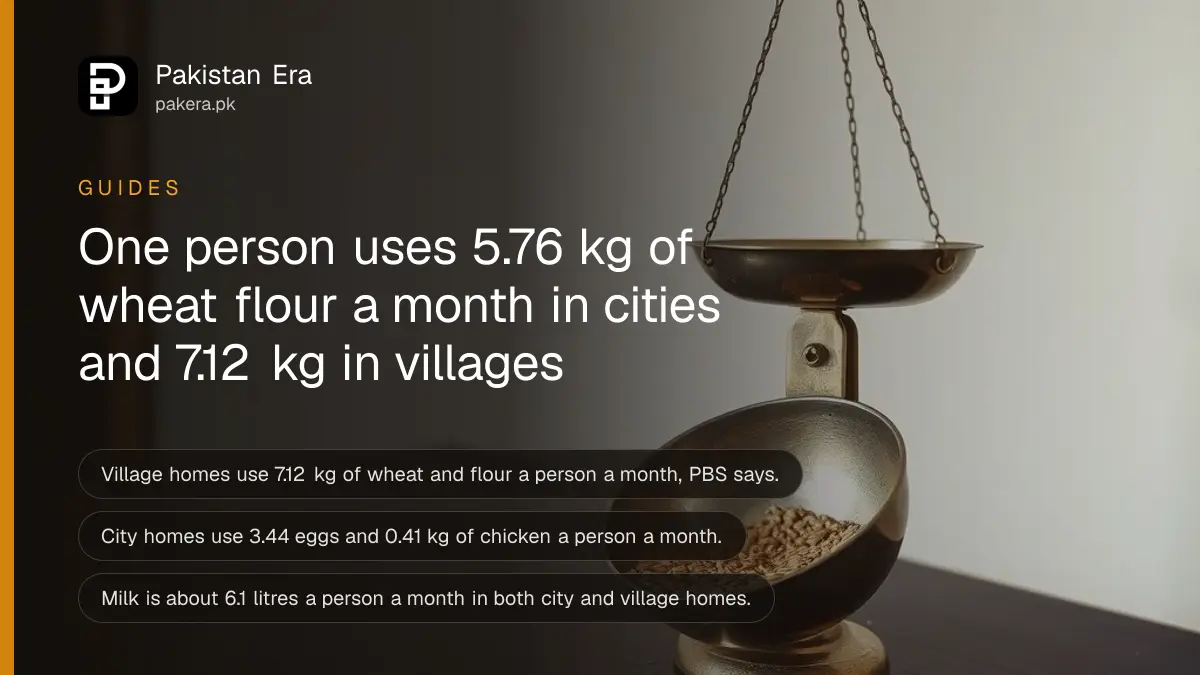
Short answer: The Pakistan Bureau of Statistics (PBS) says the average person in a village home used 7.12 kg of wheat and flour a month in 2024-25, and in a city home 5.76 kg. Multiply by the number of people in your home to get a monthly planning figure. A village family of six lands near 43 kg.
Most families buy flour by the bag and milk by the day. Very few write down how much they actually use. When the flour price jumps, that missing number is the first thing you want.
We read the PBS Household Integrated Economic Survey (HIES) 2024-25 report on 13 October 2026, including its table of monthly quantities per person. These are averages for the whole country. They include babies, children and older people, so they are a planning guide and not a nutrition target.
PBS measures food per person per month
The HIES records what each household consumed and divides it by the number of people. The result is a monthly quantity per person, split into city and village homes. It covers wheat, rice, pulses, milk, cooking oil, meat, eggs, vegetables, sugar and tea.
This is different from the share-of-budget tables that other pages quote. A share tells you how much money an item takes. A quantity tells you how much of it a person actually eats or drinks.
Village homes use more wheat, city homes more eggs and chicken
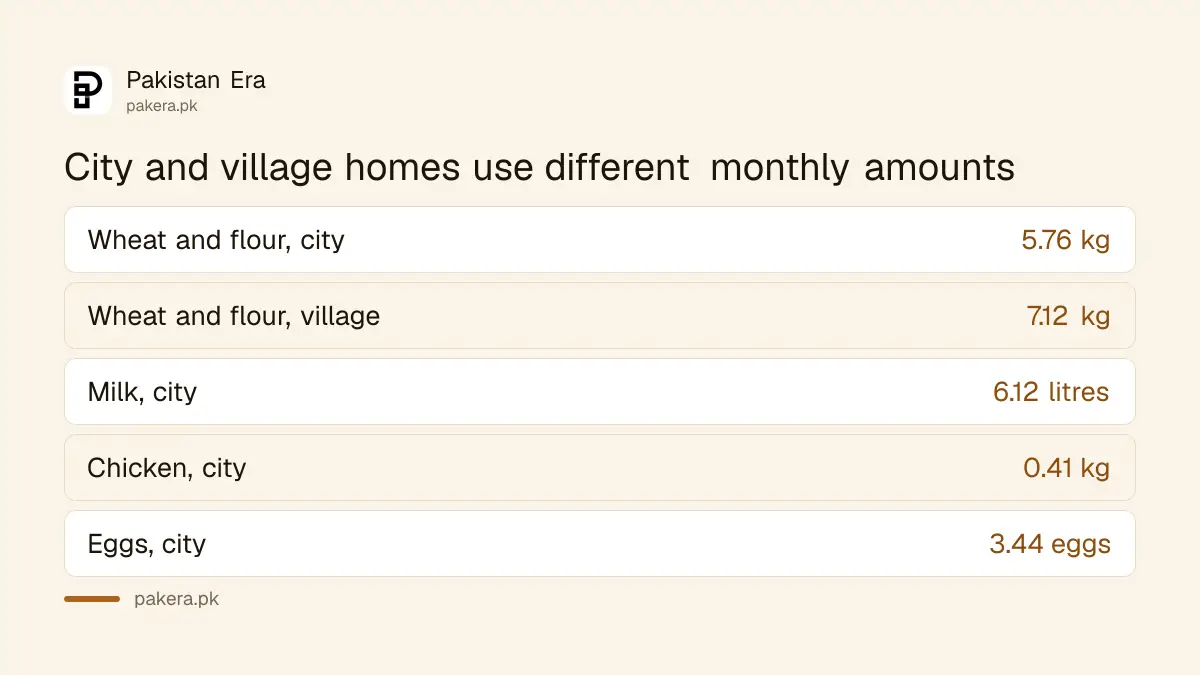
PBS says wheat and flour use is 5.76 kg per person a month in cities and 7.12 kg in villages. City homes use more chicken and eggs. Milk is almost the same in both, at about 6.1 litres a person a month.
| Item, per person per month | City homes | Village homes |
|---|---|---|
| Wheat and flour | 5.76 kg | 7.12 kg |
| Fresh milk | 6.12 litres | 6.17 litres |
| Chicken | 0.41 kg | 0.29 kg |
| Eggs | 3.44 eggs | 2.44 eggs |
| Tea leaves | 79.52 grams | 82.70 grams |
Those are the figures PBS states in its own text. The rice, pulses and other rows sit in a table whose columns the PDF prints in a mixed-up way, so we left them out rather than guess.
Multiply by your head count to get a monthly figure
Take the figure for your kind of home and multiply it by the number of people who eat at your table. Add visitors if you often host. The result is a rough monthly need that you can compare with your actual purchases.
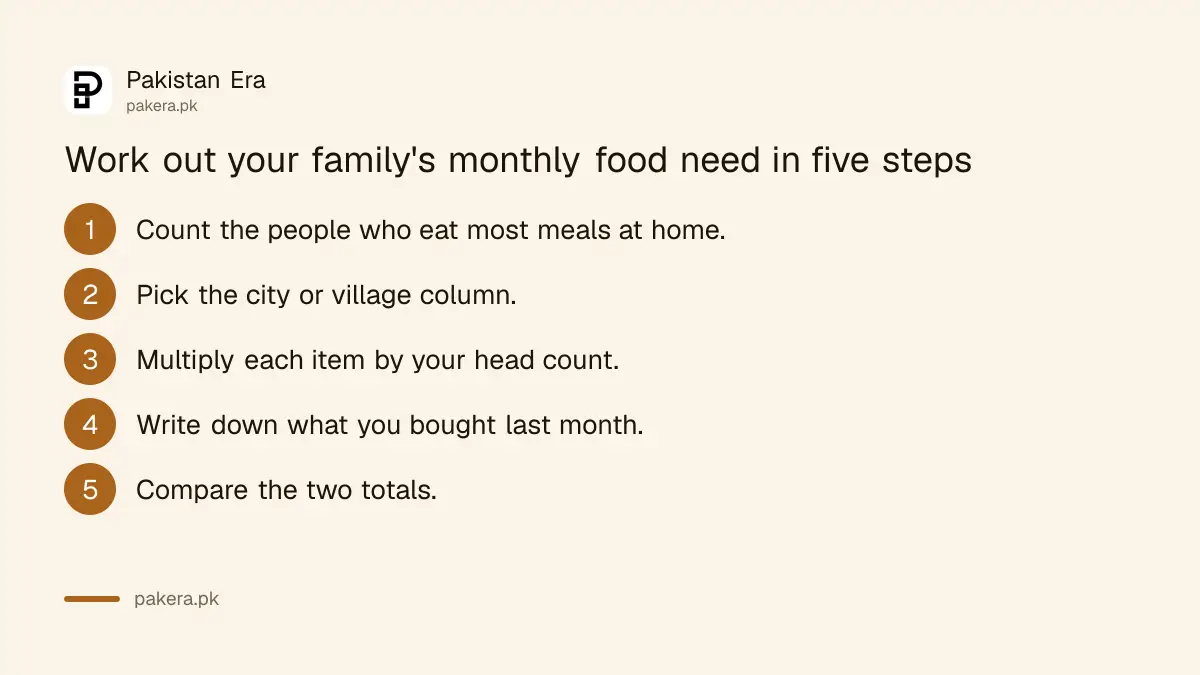
- Count the people who eat most meals at home, including children.
- Pick the city or village column in the table above.
- Multiply each item by your head count.
- Write down what you bought last month for the same items.
- Compare. A big gap means waste, guests or a different diet, and all three are normal.
Here is our own arithmetic for two homes. A village family of six would use about 43 kg of wheat flour and 37 litres of milk a month. A city family of five would use about 29 kg of flour, 31 litres of milk and 17 eggs.
Turn the quantity into a monthly rupee cost
Once you know the kilos, multiply by the current price. For wheat flour that means taking the retail price per kilo from the latest official price sheet. The method for turning a wheat price per maund into a price per kilo is in the page on converting wheat price per maund to flour price per kilo.
For a quick check of what flour costs this week, see the latest flour price by city. If you want to see how prices for milk, rice and pulses differ between cities, the comparison of rice, pulses, milk and sugar prices by city is a good starting point.
Prices change every week. Do the sum again each month, because a 5 per cent rise on a large item like flour moves your total more than a 20 per cent rise on tea.
Use the averages as a check, not a rule
The survey is a national average from 2024-25. It does not know your family. A home with teenagers, a labourer who eats a lot of bread, or a family that rarely buys milk will not match. Use the table to spot an odd number, not to judge your diet.
It also does not tell you what is healthy. If you worry about a child's diet, speak to a doctor or a health worker instead of using a survey average.
One more point helps when you budget: the same survey says food and drinks took about 37 per cent of the average household budget. The page on where an average Pakistani household budget goes shows how that compares with housing and bills.
Common questions
How much wheat flour does one person use a month in Pakistan?
PBS says 5.76 kg in city homes and 7.12 kg in village homes in 2024-25. These are averages across all ages.
How much milk does one person use a month?
About 6.12 litres in city homes and 6.17 litres in village homes, by the PBS survey.
Do city homes eat more chicken and eggs?
Yes. PBS says city homes use 0.41 kg of chicken and 3.44 eggs a person a month, against 0.29 kg and 2.44 eggs in villages.
Is this the amount a person should eat?
No. It is what households reported using on average. It is not a health or nutrition target.
When was the survey done?
PBS ran the HIES between September 2024 and June 2025 and covered over 32,000 households.
Can I use it to plan Ramzan or wedding food?
It is not built for that. Those months use far more of some items, so count them separately.
How we verified this
What we checked, where we read it, and what we could not confirm.
Last checked on 13 October 2026, Pakistan time. We read section 3.9 of the PBS HIES 2024-25 report. The family examples are our own multiplication. We did not use table cells whose columns the PDF mixes together.
About the author

Tax, Bills and Technology Writer
Ali Akhtar is a young and curious voice here at Pakistan Era. He is currently pursuing his A-Levels and has a growing interest in Pakistan’s changing industrial landscape and educational trends. Ali likes to write in a way that helps him explain and explore the world around him. His writing reflects the perspective of the new generation navigating the evolving trends of Pakistan where technology, youth innovation, and shifting opportunities are reshaping the country’s future.