How to Apply for a ZTBL Solar Pump or Biogas Loan of Up to Rs 2.5 Million
ZTBL lends up to Rs 2.5 million for farm solar pumps (10 years) and biogas plants (5 years). See the e-CIB test, the 10 per cent share and the steps to apply.
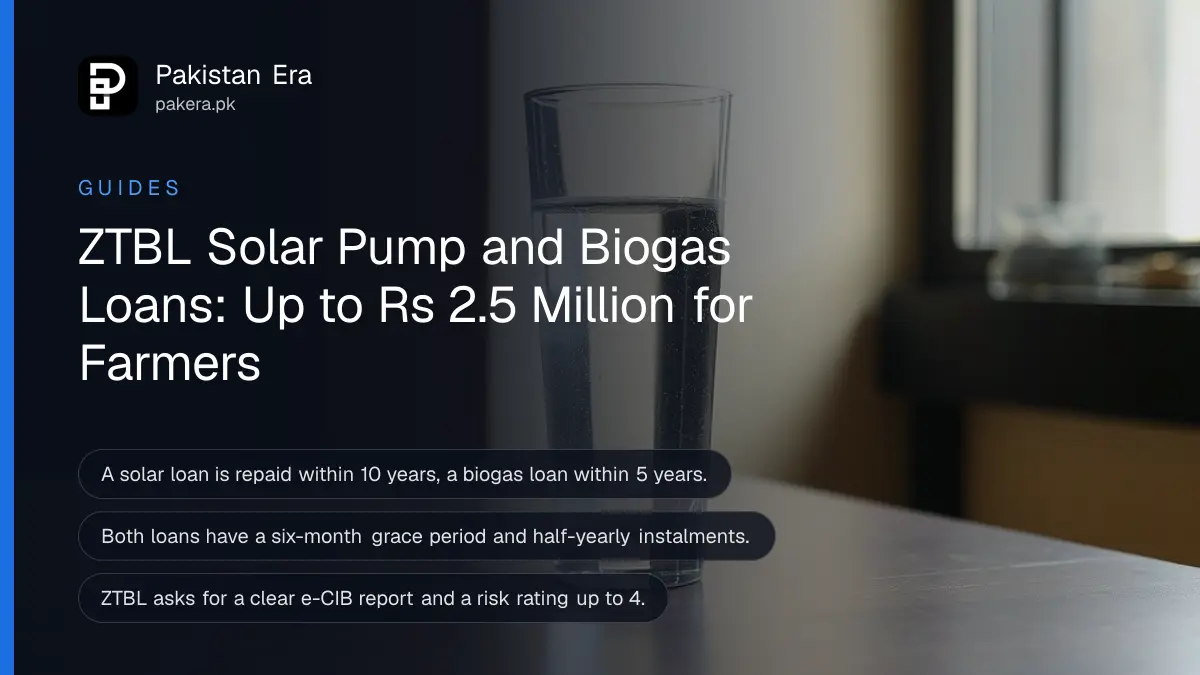
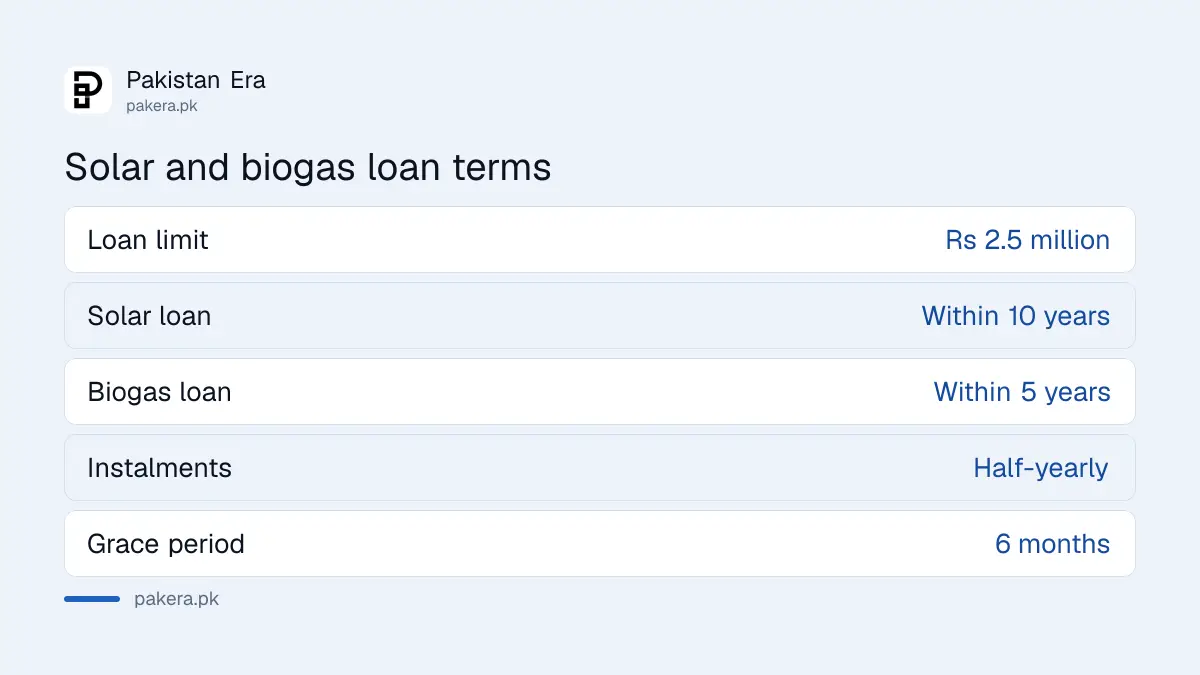
ZTBL lends up to Rs 2.5 million per borrower for a solar energy pump system or a biogas plant on a farm. A solar loan is repaid in up to 10 years and a biogas loan in up to 5 years, both in half-yearly instalments with a six-month grace period. You need a clear e-CIB report.
The bank says high energy cost has held back crop yields. Its answer is to finance a switch to cheaper energy on the farm. We read ZTBL's page on agri land development through alternate and renewable energy on 15 October 2026. Every term below comes from it. The page states no markup rate, so we quote none.
ZTBL finances two products: solar energy systems and biogas units
The scheme has two products: a solar energy system for pumps, and a biogas unit or plant. Both carry a limit of Rs 2.5 million per borrower or party. The scheme runs in all ZTBL branches across Pakistan.
The bank says the idea is to give farmers cheaper energy than the options they use now, and so help production. The page does not list a panel size, a pump size or approved brands. It asks for a quotation, which the next sections explain.
| Product | Loan limit | Repayment | Grace period |
|---|---|---|---|
| Solar energy pump or system | Rs 2.5 million | Within 10 years, half-yearly | 6 months |
| Biogas unit or plant | Rs 2.5 million | Within 5 years, half-yearly | 6 months |
A clear e-CIB report and a risk rating up to 4 are required
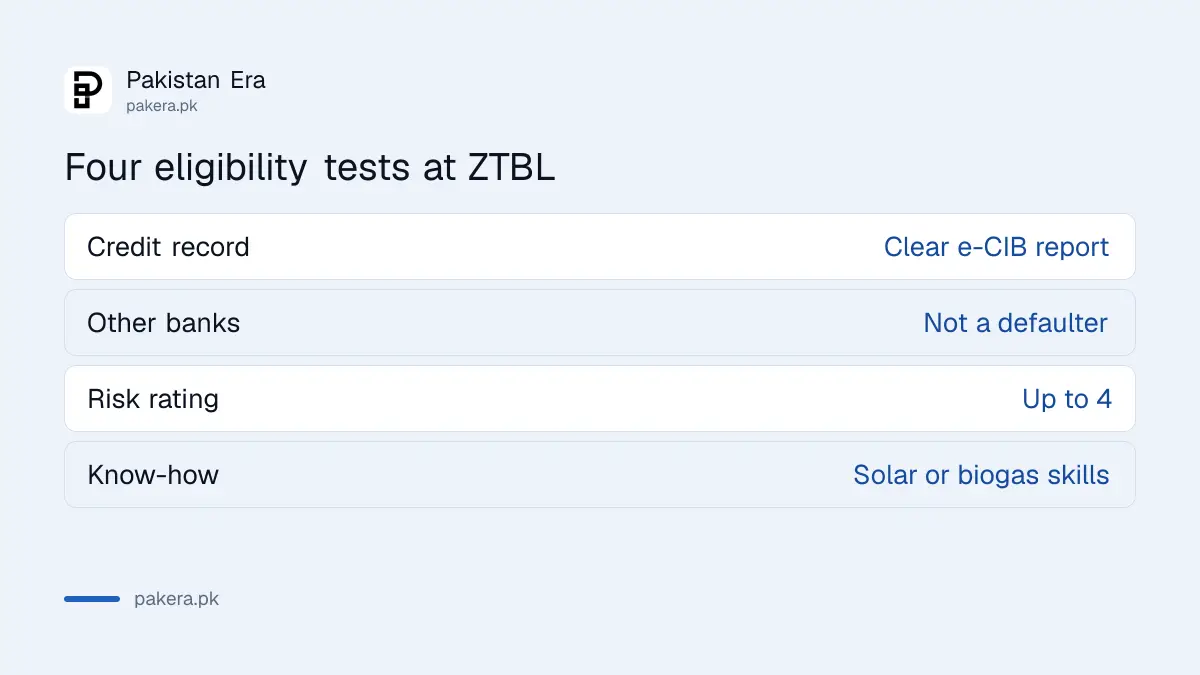
You must be creditworthy, not a defaulter of any bank, and hold a clear e-CIB report. The bank also wants an Obligor Risk Rating up to 4 and technical know-how of the solar pump or biogas unit you plan to run.
The e-CIB is the State Bank's credit record on your name. Check it before you visit the branch, using the steps in the e-CIB credit report guide. The risk rating is the bank's own score, and the page does not say how it is worked out. Old borrowers with good repayment behaviour who know the activity are also considered.
| Eligibility test | What ZTBL's page says |
|---|---|
| Credit record | Clear e-CIB report; not a defaulter of any other bank |
| Risk rating | Obligor Risk Rating up to 4 |
| Know-how | Technical know-how of solar pumps or biogas units |
| Who | Creditworthy rural populace with capacity to repay |
Get a written quotation and have the Branch Manager verify it
You must bring a quotation or estimate for the solar system or biogas unit from the firm that will install it. The Branch Manager verifies it, and you accept it. This step comes before sanction, so do not pay a supplier in advance.
Ask two or three firms for quotes and compare what each includes: panels, inverter, pump, cabling and installation. The page does not say whether ZTBL keeps a list of approved suppliers. Ask the branch. A farmer who wants to compare bank loans for home or farm solar can read the comparison of solar loans from banks in Pakistan.
Put in 10 per cent yourself and insure what you build
If the project costs less than Rs 2.5 million, you deposit 10 per cent of the cost with the bank. For a larger project, you invest the amount above the bank's maximum yourself. The borrower arranges insurance of the assets bought with the loan.
A Rs 2 million solar system needs Rs 200,000 from you, by this rule. Security is tangible property owned by the borrower under the bank's policy. The sanction for up to Rs 2.5 million comes from the Credit Review Department at head office. Documents are a CNIC copy, the application, a passbook or Fard Jamabandi, and two photographs.
Apply in six steps and keep every paper
Check your e-CIB, collect the CNIC, land record and photographs, get a quotation, take them to a ZTBL branch, ask for the markup in writing and submit. The branch forwards the file to head office for sanction.
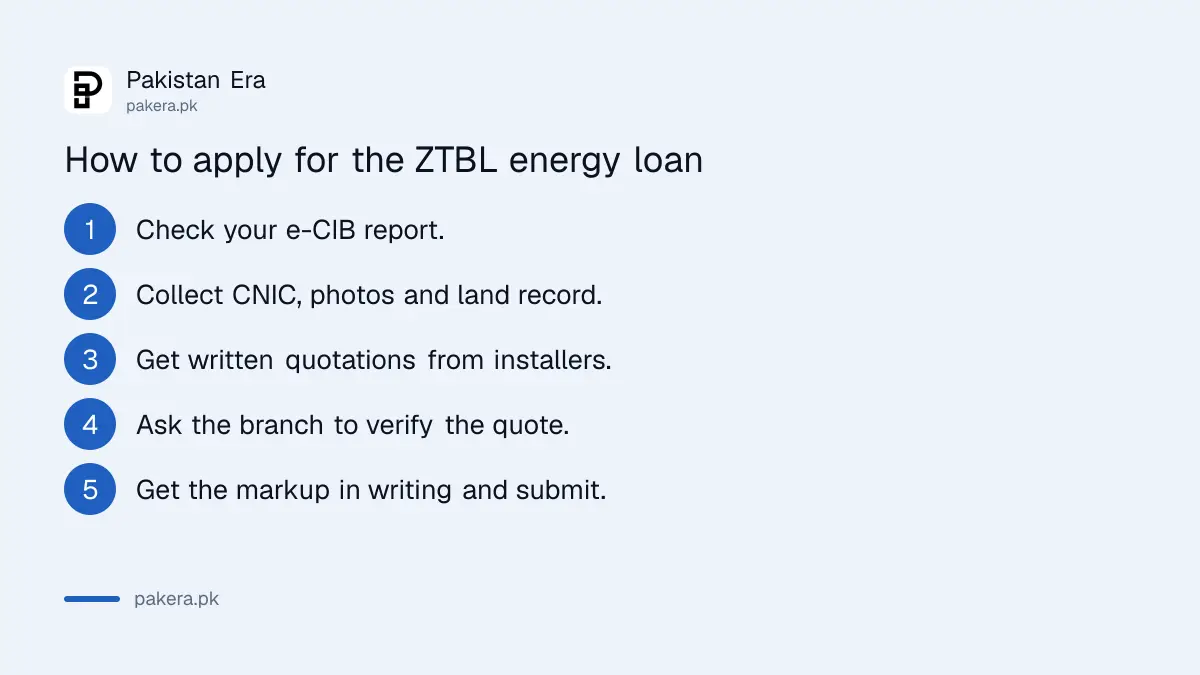
- Check your e-CIB report and clear any wrong entry.
- Collect your CNIC, two photographs and the passbook or Fard Jamabandi.
- Get written quotations from installers and pick one.
- Visit a ZTBL branch and ask for the renewable energy loan application.
- Ask the Branch Manager to verify the quotation and give you the markup rate in writing.
- Submit the file and keep the receipt.
Once the pump runs, a farmer on the grid may want to compare it with a tubewell connection, which is explained in the guide to getting a tubewell electricity connection. In Punjab there is also a separate subsidy, described in the Punjab solar tubewell subsidy scheme. The two schemes are different, and we did not check whether you can combine them.
Common questions about the ZTBL solar and biogas loans
How much can I borrow for a solar pump?
Up to Rs 2.5 million per borrower or party, repayable within 10 years in half-yearly instalments.
How long is the biogas loan?
Five years, in half-yearly instalments, with a grace period of six months.
Do I need a clean credit record?
Yes. ZTBL asks for a clear e-CIB report, no default with another bank, and a risk rating up to 4.
Who buys the equipment?
The page asks for a quotation from the installer, verified by the Branch Manager. It does not say who pays the supplier, so ask the branch how payment is made.
What is the markup rate?
The prevailing development-loan rate applies. The page gives no figure, so ask the branch in writing.
Who insures the equipment?
The borrower arranges insurance of the assets created with the loan.
How we verified this
What we checked, where we read it, and what we could not confirm.
Last checked 15 October 2026. The products, limit, eligibility tests, documents, contribution, repayment terms and sanction authority come from ZTBL's renewable energy loan page at ztbl.com.pk. The worked example of Rs 200,000 is our arithmetic. We did not apply or call a branch. ZTBL can change its terms, so confirm them at the branch.
About the author

Public Services and Education Journalist
Fajr Riaz is a journalist and content writer at Pakistan Era, based in Lahore. She covers the questions people meet in everyday life in Pakistan: how a public service works, what a change in the rules means, and where to find a reliable answer.