How to Apply for an Australia Student Visa From Pakistan: AUD 2,500 Fee and AUD 29,710 Funds
Apply for the Australia student visa from Pakistan: fee from AUD 2,500, AUD 29,710 living funds, IELTS 6.0 or PTE 47 and health cover. See the full checklist.
The Australia student visa (subclass 500) costs from AUD 2,500, and you apply online from outside Australia. For funds, Home Affairs expects AUD 29,710 for 12 months of living costs, plus your first year of course fees and about AUD 2,000 for travel. Your English test must also meet the course score.
Most Pakistani students start with the course fee and forget the rest. The visa fee, the living cost figure, the travel allowance and the health cover all sit on top of it. We opened the official Home Affairs page for the student visa on 15 October 2026, and every figure below comes from it.
The student visa costs from AUD 2,500 and is lodged online
The subclass 500 visa costs from AUD 2,500 for the main applicant. You must apply online and, in most cases, from outside Australia. It allows study in an eligible course for up to six years, depending on your course length.
A lower fee applies to citizens of some Pacific Island countries, Timor-Leste and ASEAN countries. A Pakistani passport is not on those lists, so plan for the standard fee. Home Affairs also runs a Visa Pricing Estimator, and it is the safest way to see your exact total before you lodge.
You may pay for extras too: health checks, police certificates and biometrics. Home Affairs says the estimator does not include them. Applications lodged outside Australia from 14 November 2025 are processed under Ministerial Direction 115, and the processing page shows recent decision times as a guide only.
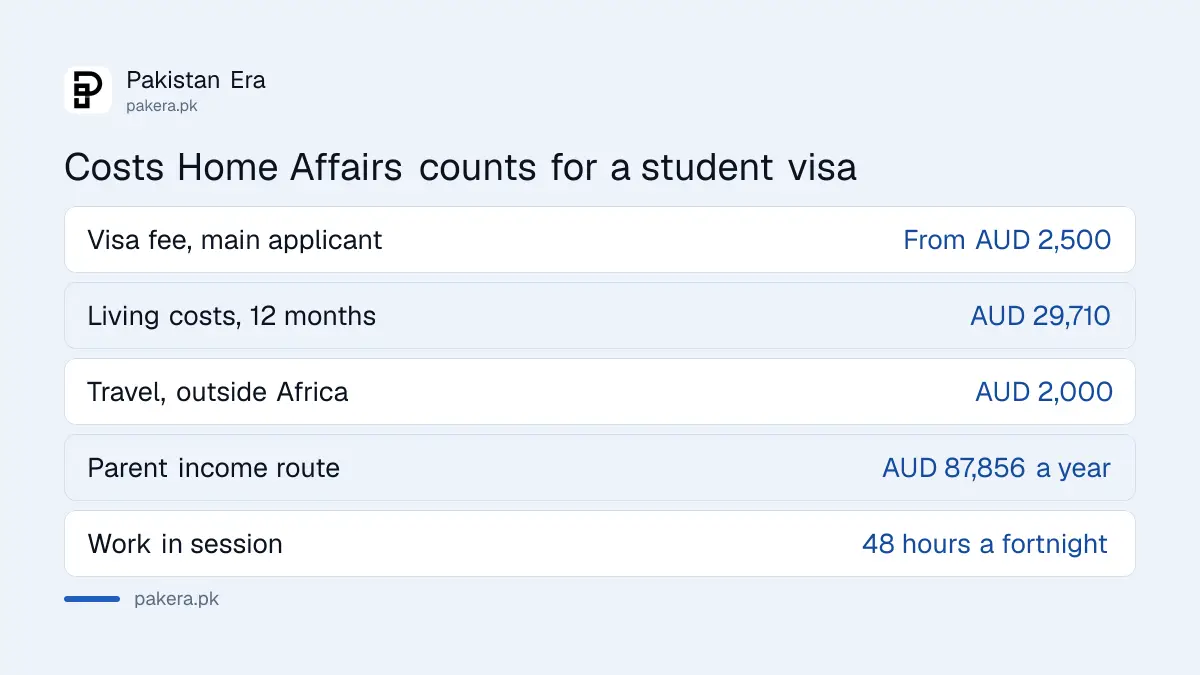
You must show AUD 29,710 for living costs plus first year fees and travel
Home Affairs counts three things: your travel, 12 months of course fees, and 12 months of living costs. Living costs for a student are AUD 29,710. Travel is AUD 2,000 when you apply from outside Australia and outside Africa.
Use the first 12 months of your course fee, or the whole fee if the course is shorter than a year. Subtract anything you have already paid, with a receipt or a Confirmation of Enrolment as proof. For a three year course at AUD 50,000, the first year counts as about AUD 16,666.
| Item | Amount | Source rule |
|---|---|---|
| Visa fee, main applicant | From AUD 2,500 | Fee on the student visa page |
| Living costs, 12 months | AUD 29,710 | Student rate |
| Travel, outside Africa | AUD 2,000 | Guide amount |
| First year course fees | Your own fee, less amounts paid | From your offer |
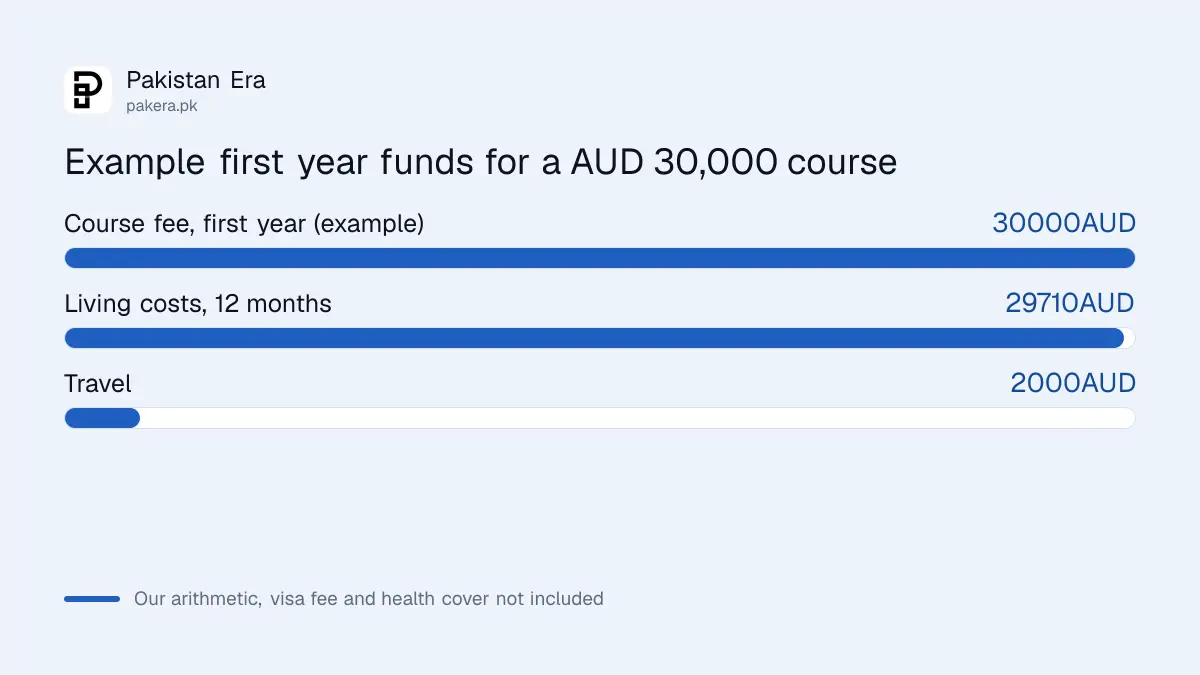
As an example, a course with AUD 30,000 of first year fees needs AUD 61,710 in evidence: 30,000 plus 29,710 plus 2,000. That sum is our arithmetic and leaves out the visa fee and health cover.
Funds can be savings, a loan, a scholarship or a parent's income
Home Affairs lists deposits from a financial institution, a government or bank loan, and scholarships as proof of funds. You can also show that your parents or partner earned at least AUD 87,856 in the 12 months before you apply.
For the income route, the evidence must be official government documents such as tax assessments less than 12 months old. Home Affairs says it will not accept bank statements or direct evidence from an employer for income. If your documents list is short, the department may still ask for more while it assesses you.
Your English test must meet the score for your course
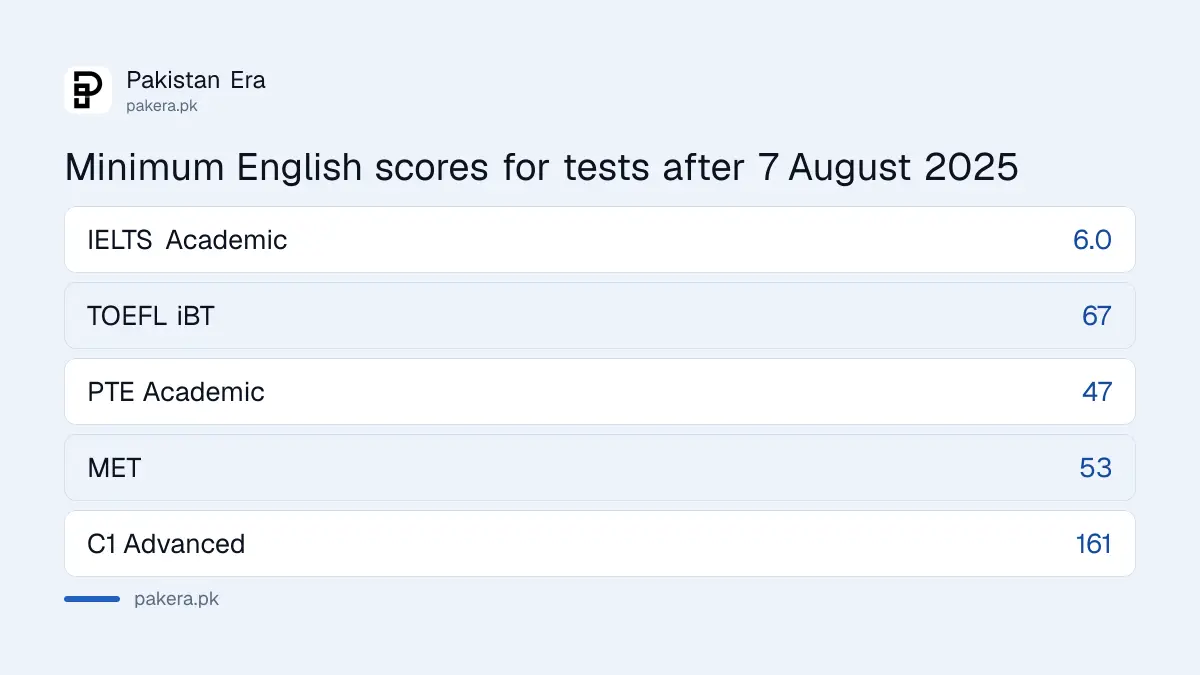
For tests taken on or after 7 August 2025, the main scores are IELTS Academic 6.0, TOEFL iBT 67, PTE Academic 47 and LANGUAGECERT Academic 61. Lower scores apply if your course comes with 10 or 20 weeks of English study.
| Test | Minimum | With 10 weeks English | With 20 weeks English |
|---|---|---|---|
| IELTS Academic | 6.0 | 5.5 | 5.0 |
| TOEFL iBT | 67 | 51 | 37 |
| PTE Academic | 47 | 39 | 31 |
| MET | 53 | 49 | 44 |
| C1 Advanced | 161 | Excluded | Excluded |
Three rules catch applicants out. The test must be taken within two years before you lodge. Tests delivered entirely online from home are not accepted. And from 21 January 2026 a TOEFL taker must pick the option called Taking TOEFL for Australia when registering. The fee side of these exams is covered in the IELTS fee in Pakistan and PTE fee in Pakistan pages.
Health cover, your offer and the genuine student answers come with the application
You need a Confirmation of Enrolment from a course registered on the CRICOS list, and Overseas Student Health Cover for your whole stay. The online form also asks genuine student questions, each with a 150 word limit, and you answer them in English.
Without a Confirmation of Enrolment at the time you lodge, the application is invalid. If you fly before classes begin, cover must start on the day you arrive, not the day classes start. Your college often arranges it, and the policy details go on the Confirmation of Enrolment.
Family is now a separate problem. Australia announced limits on dependants for most new student visas from September 2026, which we explain in the Australia visa changes for Pakistanis. Work rights are 48 hours a fortnight while your course is in session, and no limit for master's by research and doctoral students.
Pakistanis aiming for a funded place can also read about the Australia Awards Scholarship, which is a different route from a self funded visa. And before you pay an agent anything, the checks for a study abroad agent are worth ten minutes.
Apply in this order
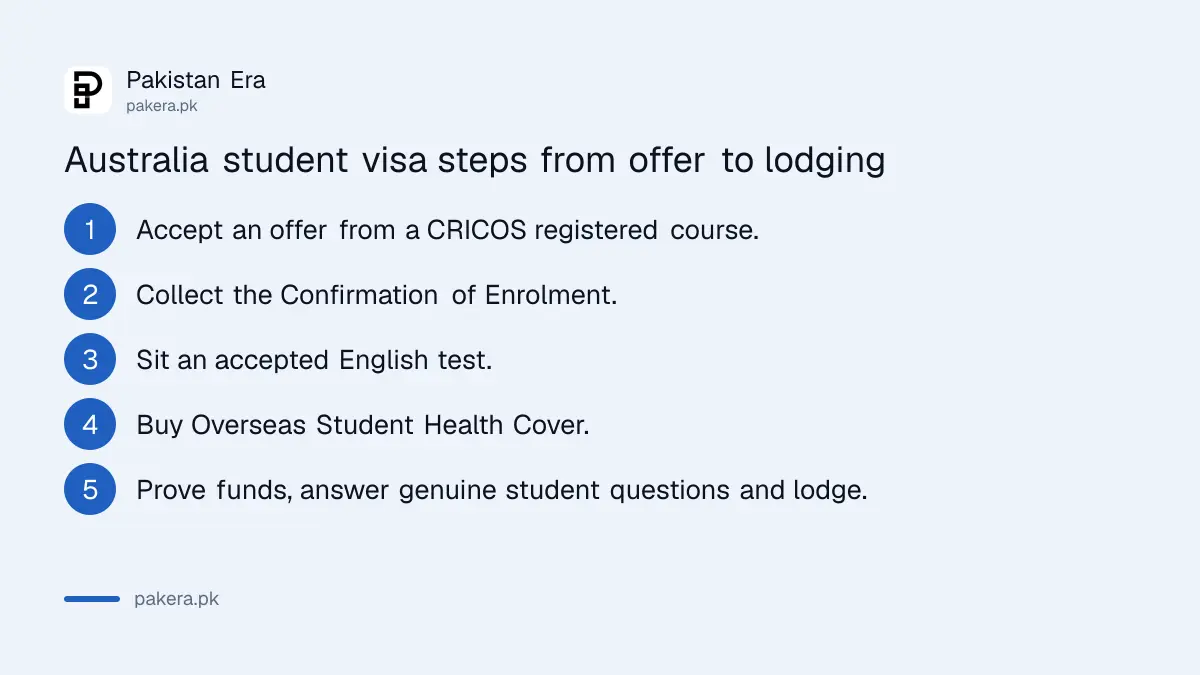
Get the offer and Confirmation of Enrolment first, then the English test result, then health cover, then funds evidence. Lodge the application only when each document is ready, since a missing Confirmation of Enrolment makes the whole application invalid.
- Choose a CRICOS registered course and accept the offer.
- Pay the deposit and collect your Confirmation of Enrolment.
- Sit an accepted English test, or confirm an exemption.
- Buy Overseas Student Health Cover from your provider.
- Add up course fees, AUD 29,710 living costs and travel.
- Gather bank, loan, scholarship or parent income documents.
- Complete the online form and the genuine student answers.
- Pay the visa fee and give biometrics if asked.
Common questions about the Australia student visa from Pakistan
How much is the Australia student visa fee?
It starts from AUD 2,500 for the main applicant, according to the Home Affairs student visa page. Lower fees apply only to some Pacific Island, Timor-Leste and ASEAN passport holders.
How much money must I show for an Australia student visa?
Show 12 months of course fees, AUD 29,710 for living costs and a travel amount, which Home Affairs gives as AUD 2,000 for applicants outside Africa. Parents with income of AUD 87,856 are the alternative.
Which English test do I need?
IELTS Academic 6.0, TOEFL iBT 67 or PTE Academic 47 are the usual minimums, with lower scores for courses that include English study. The test must be less than two years old.
Can I work on a student visa in Australia?
Yes, up to 48 hours a fortnight while your course is in session. Master's by research and doctoral students have no work limit, as stated on the visa page.
Do I need health insurance?
Yes. Overseas Student Health Cover is required for the whole stay, with a few exceptions listed by Home Affairs. If you travel before classes begin, it must start on the day you arrive.
Can I apply from within Pakistan?
Yes. You apply online from outside Australia, which includes Pakistan. Only holders of certain visas already in Australia can lodge from inside the country.
How we verified this
What we checked, where we read it, and what we could not confirm.
Last checked 15 October 2026. Fee, living costs, income threshold, travel amounts, English scores, work limits and health cover rules come from the Department of Home Affairs Student visa (subclass 500) page, which we read on that date. We did not lodge a visa. The AUD 61,710 example is our arithmetic. Check the Visa Pricing Estimator before paying, because fees and thresholds change.
About the author

Public Services and Education Journalist
Fajr Riaz is a journalist and content writer at Pakistan Era, based in Lahore. She covers the questions people meet in everyday life in Pakistan: how a public service works, what a change in the rules means, and where to find a reliable answer.