Who Gets the Monthly Allowance in Azad Kashmir Under the 2024 Social Protection Act
Check who qualifies for Azad Kashmir's monthly allowance under the 2024 Act: widows, orphans under 21, disabled and transgender persons, and what stops it.
Short answer: Azad Kashmir's Social Protection of Vulnerable Population Act, 2024 gives a monthly subsistence allowance to widows, divorced women, orphans under 21, disabled persons and transgender persons who lack the means to live, once they are registered with the Social Protection Board. The Act does not state the amount or the application form.
A widow in Bagh with three children hears that Azad Kashmir pays an allowance to women like her. She asks where to apply and gets three different answers. The law behind the scheme is short, and it explains who is eligible and who can lose the payment.
We read the Azad Jammu and Kashmir Social Protection of Vulnerable Population Act, 2024 (Act II of 2024) on the Law Department's website on 13 October 2026. We did not find a published application form, amount or office list, so this page covers eligibility and rules, not a step by step application.
The 2024 Act replaced the 2021 widows and orphans law
The Act was passed by the Legislative Assembly on 3 May 2024, was deemed assented by the President from 21 May 2024, and takes effect from 10 March 2024. It repeals the 2021 Subsistence Allowance for Widows and Orphans Act and Ordinance I of 2024.
The 2021 law covered only destitute widows, orphans and divorced women. The 2024 law widens the list to disabled persons and transgender persons, and creates a Social Protection Board chaired by the Prime Minister of Azad Kashmir.
The Board includes the ministers of finance and social welfare, the chief secretary, the secretaries of law, finance and social welfare, the Accountant General and two co-opted members. It must meet at least once every quarter.
Five groups can qualify, and each has a test
A vulnerable person is a widow, orphan, disabled person, transgender person or divorced woman registered with the Religious Affairs Department, who lacks the necessities of life and has no other satisfactory means of support. Each group has its own definition.
| Group | What the Act says |
|---|---|
| Orphan | A child who has lost the father, is under 21, and whose family lacks income for a minimum standard of living |
| Widow or divorced woman | A woman who is alone and who, with her dependents, lacks income for a minimum standard of life |
| Disabled person | A person unable to earn a living because of a physical or mental condition, declared so by a government medical board |
| Transgender person | A person declared so by a government medical board, without minimum income |
| Old person | Aged 65 or more and neglected or abandoned, without support or living by begging |
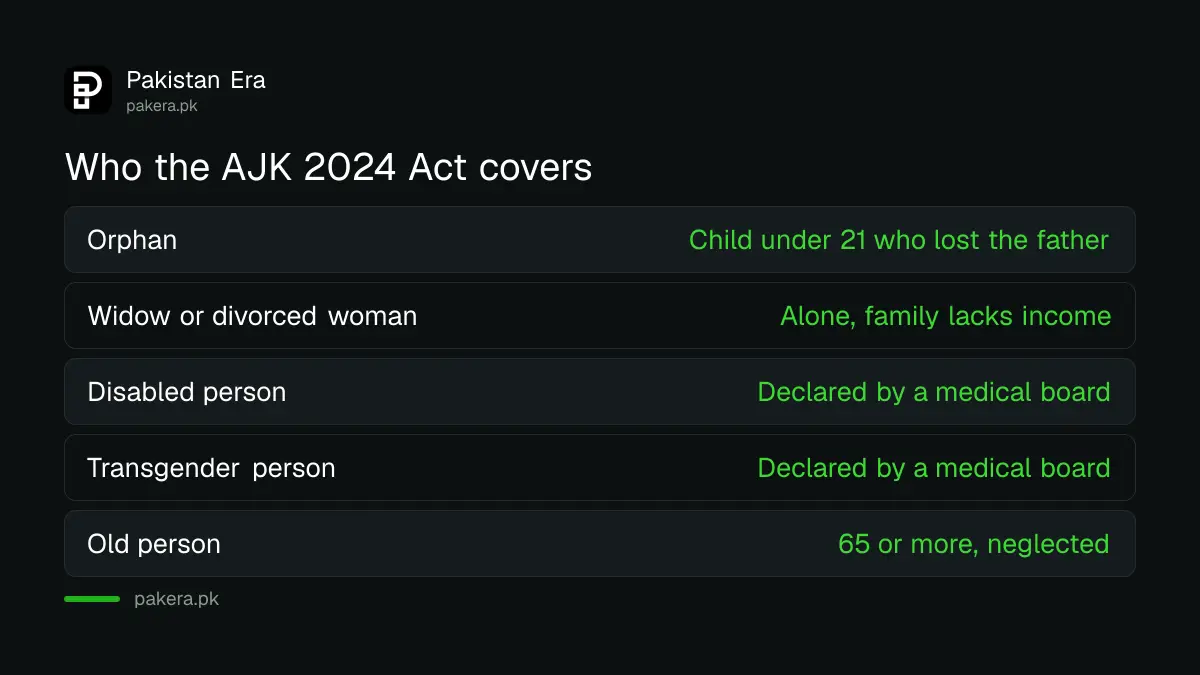
The "old person" category sits in the Act's explanation of the main definition, and the main list names the other five groups. If you are an elder in need, ask the Board whether you are included.
The Board registers beneficiaries and the Accountant General pays them
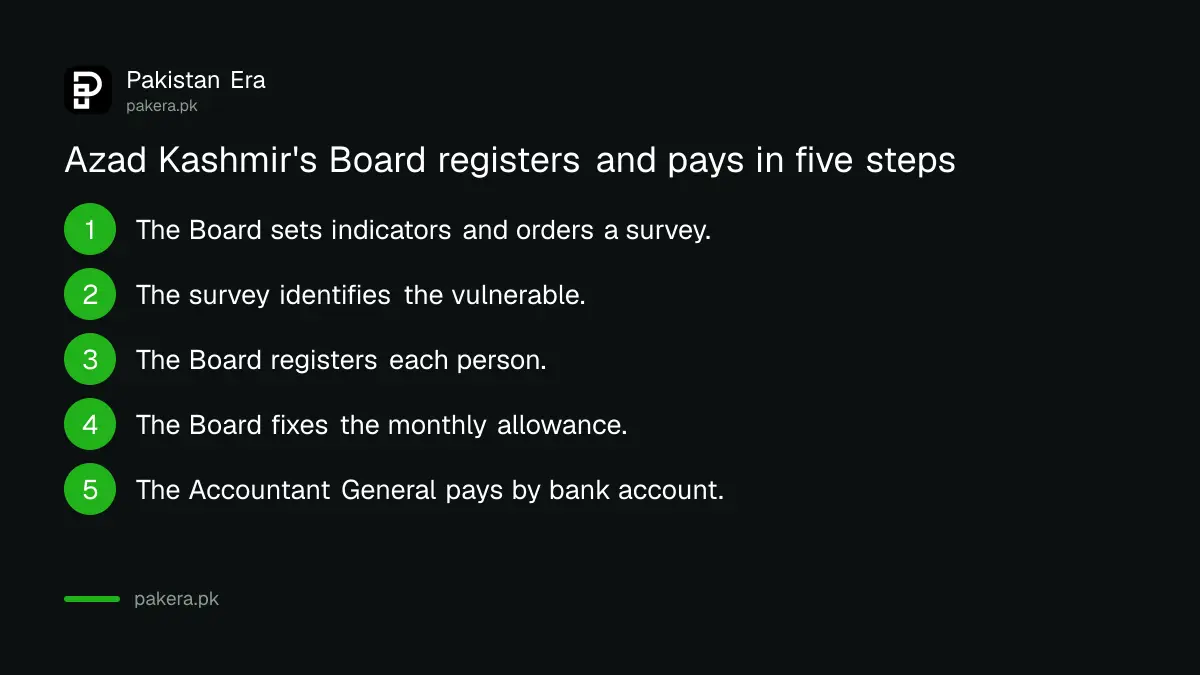
The Board sets indicators for who is vulnerable, runs an independent third party survey, registers the vulnerable population in the manner it prescribes, fixes the monthly allowance, and sends names to the Accountant General for payment. Payment goes through bank accounts or other modern means.
The money comes from the Social Protection Trust Fund. It is built from monthly deductions from the basic pay of contributors, which include the President, ministers, judges, members of the Assembly and civil servants of BPS-7 and above, plus government grants and donations.
- The Board sets the indicators and orders a survey.
- The survey identifies the vulnerable population.
- The Board registers each person in the manner it prescribes.
- The Board fixes the monthly allowance.
- The Accountant General's office pays through bank accounts.
The Board must also redress the grievance of any person who has not been included as a beneficiary, or who has a complaint against a beneficiary. If you are left out, write to the Board through the Social Welfare department and ask for the reason. Keep a dated copy.
Payment can stop, and wrong information is an offence
A beneficiary is barred from the allowance if a widow or divorced woman remarries, if false information was submitted, if an orphan reaches 21, or if the minimum standard of living has been secured. The Board may also stop payment for abuse.
The Board may end payment to a person absent from Azad Kashmir for six months or more, and may reinstate it if the reasons justify. A person paid while ineligible must repay the amount to the Trust Fund within three days, and giving wrong information is an offence under section 177 of the Azad Penal Code. The Board reviews assistance each year where circumstances have changed.
Other schemes may help while you wait. The Pakistan Bait-ul-Mal runs programmes such as the Sweet Home for orphans, assistance for wheelchairs and hearing aids and old home admission for the elderly. Check each scheme's own rules, because they are federal programmes and are not part of this Act.
Common questions
How much is the monthly allowance in Azad Kashmir?
The Act does not state an amount. The Board fixes the rate, and we could not find a published figure on an official page.
Who can get the allowance?
Widows, divorced women, orphans under 21, disabled persons and transgender persons who lack the means to live and are registered. The Act's explanation also defines old persons aged 65 and over who are neglected.
Where do I apply?
The Act says the Board registers beneficiaries in a manner it prescribes. The Social Welfare department's secretary runs the Board's secretariat, so start with that department. We could not confirm a form or a portal.
Does a widow lose the allowance if she remarries?
Yes. A widow or divorced woman who enters another marriage is barred from receiving the allowance.
When does an orphan stop receiving it?
At 21. The Act defines an orphan as a child under 21 who has lost the father.
Is this the same as the Benazir Income Support Programme?
No. This is a provincial scheme under an Azad Kashmir law. The federal BISP is a separate programme with its own eligibility.
How we verified this
What we checked, where we read it, and what we could not confirm.
Last checked on 13 October 2026, Pakistan time. We read the Act as published in the Azad Jammu and Kashmir Gazette of 31 May 2024 on the Law Department's website, and the 2021 Act that it repealed. We could not verify the allowance amount, the application form, any survey result or the current Board rules.
About the author

Senior Writer, Public Services and Technology
Shahid joined us in 2024 as an author. He is a senior contributor to Pakistan's leading technology websites. He writes detailed articles, mostly covering his expertise in the latest tech, mobiles, apps, gadgets, and step-by-step guides. His ideology is to help people understand the latest trends and explain complex methods through very easy-to-understand guides.