How to Check Last Night's Lowest Temperature in Your City on PMD, Pakistan
PMD lists the lowest and highest temperature for about 55 stations. On 15 October 2026 Hunza fell to 0 C and Quetta to 5 C. See how to read the tables.
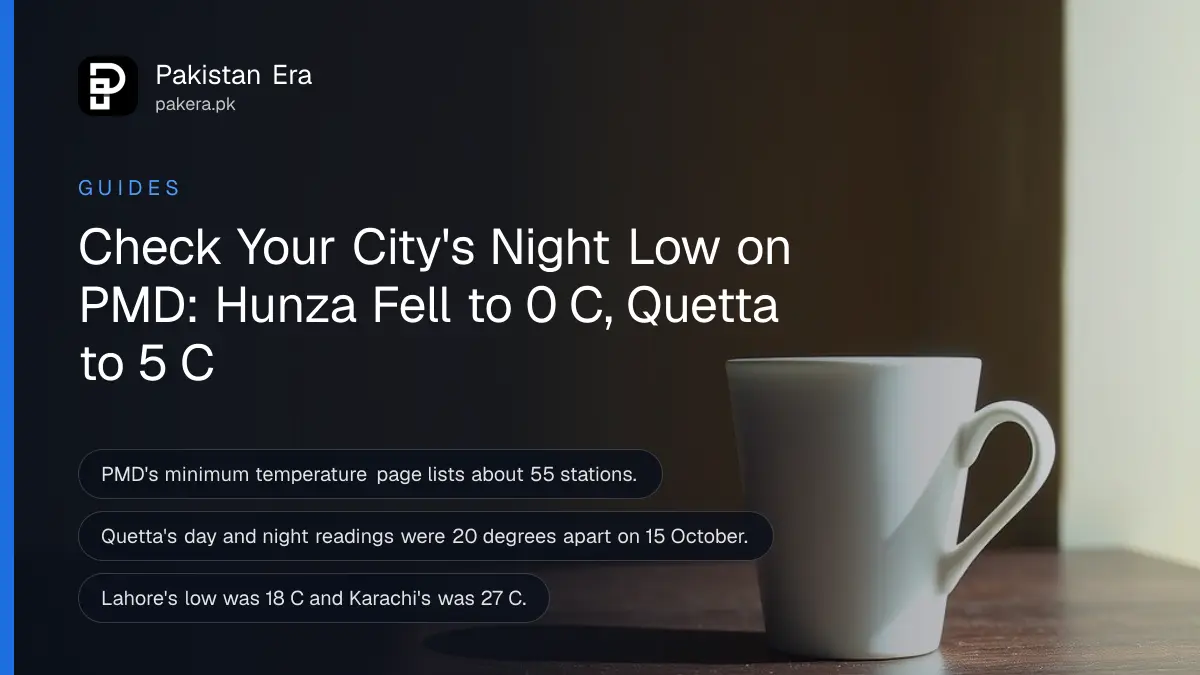
Short answer: To check last night's lowest temperature in your city, open the Minimum Temperature page on the Pakistan Meteorological Department's forecast site, weather.gov.pk. It lists about 55 stations, each with the lowest reading of the last 24 hours. On 15 October 2026 it showed Hunza at 0 degrees C and Quetta at 5.
The first cold mornings of the year arrive without notice. One day you sleep under a fan, and the next you wake up with a blocked nose. PMD, the national weather office, publishes the real numbers for every major city. We opened the page on 15 October 2026 and read the table, and we read the matching maximum temperature page.
PMD lists the lowest and highest temperature for about 55 stations
PMD's National Weather Forecasting Centre runs two pages, Minimum Temperature and Maximum Temperature. Each says "Last 24 Hours" and lists the station, the reading in degrees Celsius and the date. The table groups stations by province or region, from Gilgit Baltistan to Sindh.
The stations include big cities such as Lahore, Karachi, Islamabad, Peshawar and Quetta, and hill places such as Murree, Skardu and Hunza. If your town is not named, pick the nearest station on the same plain or the same valley. On 15 October, Murree's low was 11 degrees below Lahore's, though the two are only a few hours apart by road.
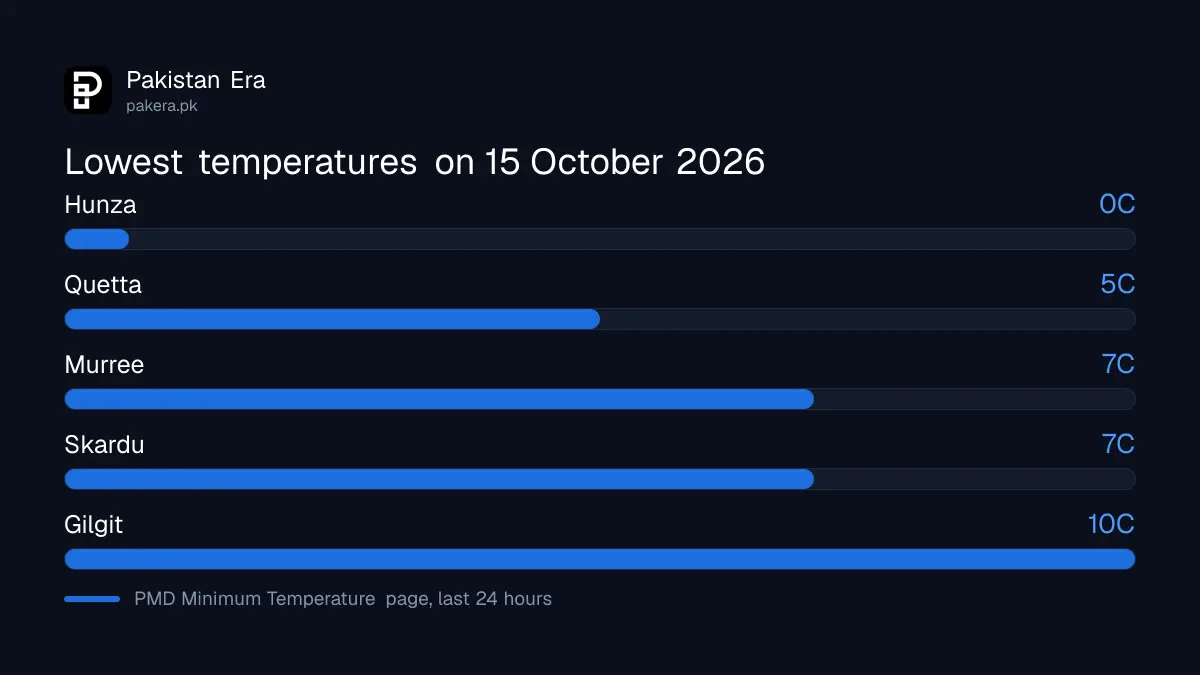
Hunza fell to 0 degrees and Quetta to 5 on 15 October
On 15 October 2026 the table showed the coldest readings in the north and in Quetta. Hunza read 0 degrees C, Quetta 5, and Murree and Skardu 7 each. Gilgit read 10 and Chitral 11. Islamabad read 14 and Lahore 18. Karachi stayed at 27.
| Station | Lowest, degrees C | Highest, degrees C | Gap, degrees C |
|---|---|---|---|
| Hunza | 0 | 13 | 13 |
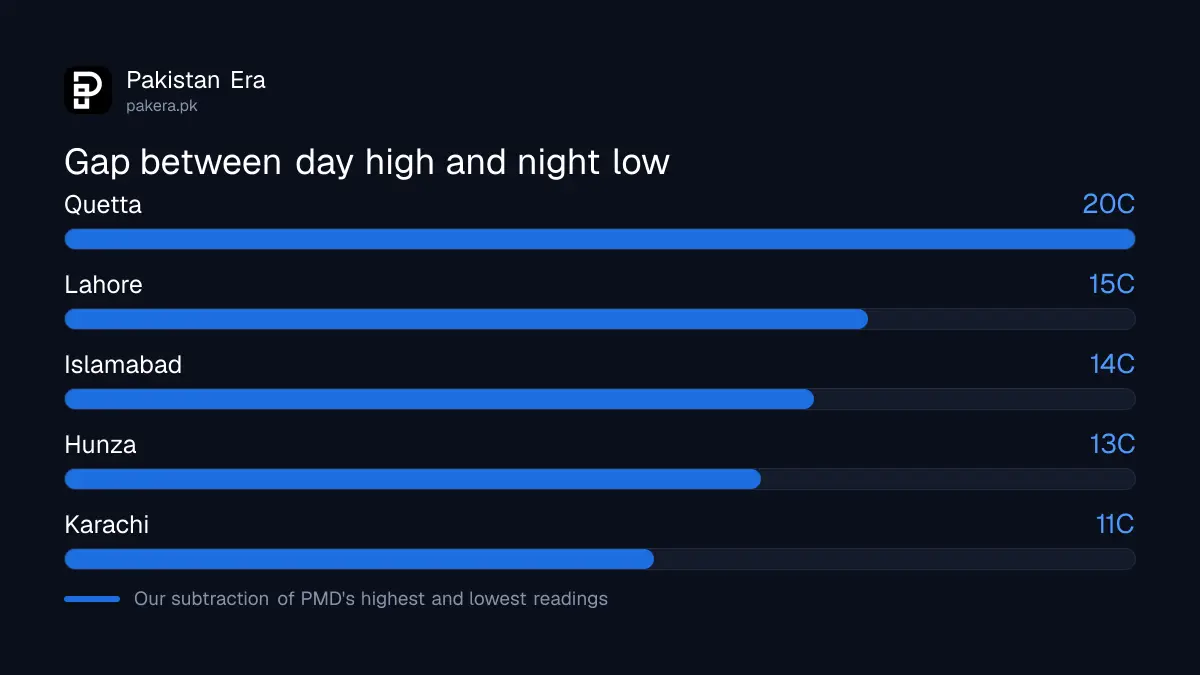
| Quetta | 5 | 25 | 20 |
| Murree | 7 | 18 | 11 |
| Islamabad | 14 | 28 | 14 |
| Peshawar | 16 | 28 | 12 |
| Lahore | 18 | 33 | 15 |
| Multan | 23 | 33 | 10 |
| Karachi | 27 | 38 | 11 |
The gap column is our own subtraction of PMD's two figures. PMD's pages do not show it. The table is a snapshot of one day, and the readings change every day.
Quetta swings 20 degrees between night and day
Quetta's high was 25 and its low was 5, a gap of 20 degrees. Lahore's gap was 15 and Islamabad's 14. With a gap this wide, a warm afternoon can be followed by a cold night, so a light jacket in the evening makes sense.
PMD expects a warmer than normal October to December for most of Pakistan, as we reported in the PMD outlook for October to December 2026. A warm season on average does not stop a cold night. Individual nights, especially in the north and in Balochistan, can still fall sharply.
Read the table in five steps
The pages are plain tables, so they load on a slow phone. You need about two minutes. The steps below work for any day, so you can repeat them each morning as winter nears.
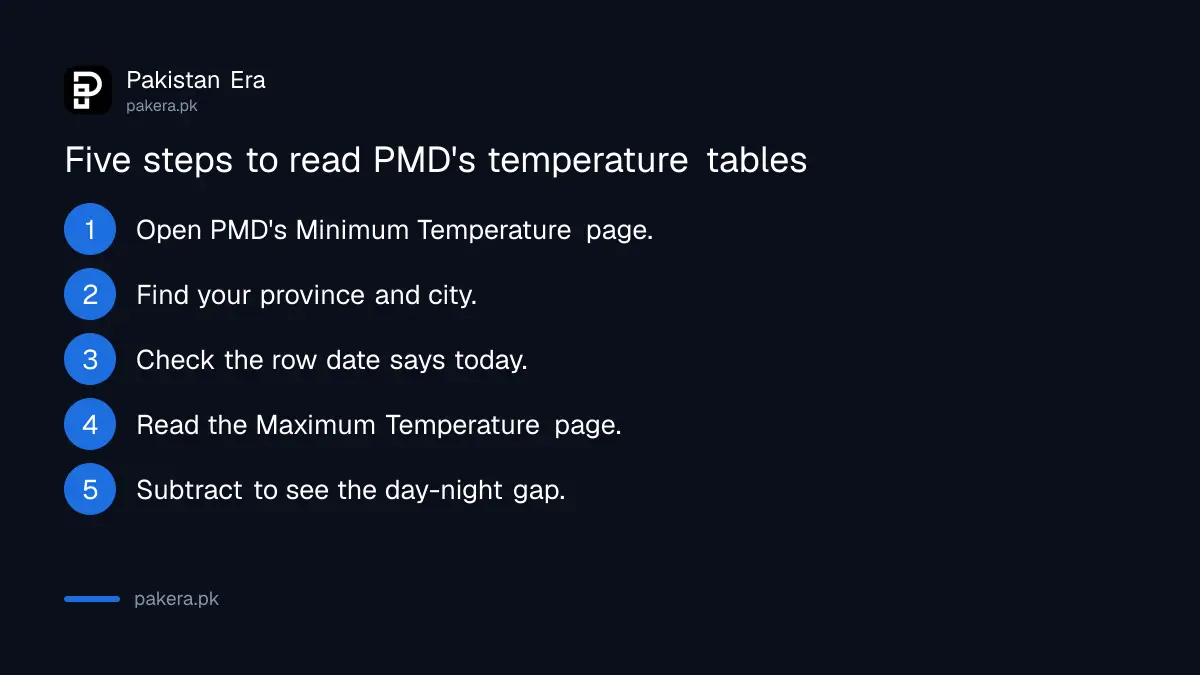
- Open weather.gov.pk and choose the forecast menu, then Minimum Temperature.
- Find your province group and then your city or the nearest station.
- Read the lowest figure and check the date on the row says today.
- Open the Maximum Temperature page and read the same station.
- Subtract the two. A gap above 15 degrees means dress in layers.
Check the date on the row before you trust it. For the forecast of the next few days, use the daily and three day forecast pages on the same site, which where to get the official weather forecast explains.
PMD posts cold wave and smog warnings on the same site
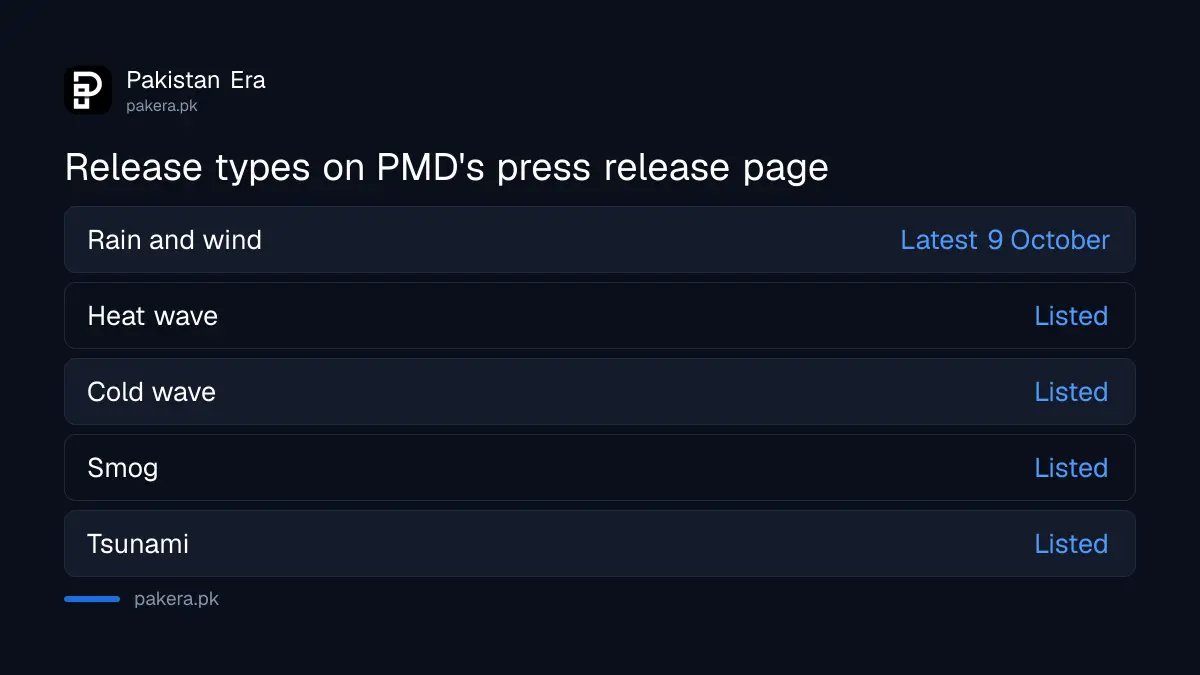
PMD's press release page sorts releases by type. The types we saw on 15 October 2026 were rain and wind, heat wave, cold wave, tsunami, smog, rebuttal and other. The newest rain and wind release on the page was dated 9 October 2026.
So when a cold wave or smog warning is issued, it should appear under its own type. Check it before you travel by road in the north. For winter road trips, fog and motorway closures sets out what to expect.
Prepare for the first cold nights
Cold nights raise two risks that readers ask about at this time of year: colds and flu, and unsafe heaters. Flu shots are most useful before the season peaks, and the 2026 flu vaccine guide says who should get one. If you switch on a gas heater for the first time, SSGC's winter rules for gas heaters and geysers come first.
PMD has flagged smog risk late in the season, as its autumn outlook shows. For air quality, read Lahore's live air quality on Punjab's official site alongside the temperature table.
Common questions about PMD temperature pages
Where do I find the lowest temperature in my city?
On the Minimum Temperature page of weather.gov.pk, PMD's forecast site. It lists the lowest reading for the last 24 hours at about 55 stations, grouped by province.
What was the coldest place in Pakistan on 15 October 2026?
Hunza, at 0 degrees C, among the named stations we read. A few rows in the table had no station name, so we cannot rule out another low reading.
How cold was Lahore on 15 October 2026?
Lahore City read a low of 18 degrees C and a high of 33 on PMD's pages for 15 October 2026, a gap of 15 degrees.
Is the maximum temperature page on the same site?
Yes. PMD's Maximum Temperature page uses the same layout and lists the highest reading of the last 24 hours for each station.
Does PMD predict a cold winter?
PMD's outlook for October to December 2026 expects warmer than normal conditions for most of Pakistan. It does not rule out cold nights, so check the daily table.
How we verified this
What we checked, where we read it, and what we could not confirm.
Last checked 15 October 2026. All temperatures come from the Minimum Temperature and Maximum Temperature pages of the Pakistan Meteorological Department at weather.gov.pk, which we opened on 15 October 2026. Each row carried that date. The press release types come from PMD's press release page on the same day. The gap figures and the station count are our own arithmetic. PMD does not show the time of each reading, and the tables change daily.
About the author

Tax, Bills and Technology Writer
Ali Akhtar is a young and curious voice here at Pakistan Era. He is currently pursuing his A-Levels and has a growing interest in Pakistan’s changing industrial landscape and educational trends. Ali likes to write in a way that helps him explain and explore the world around him. His writing reflects the perspective of the new generation navigating the evolving trends of Pakistan where technology, youth innovation, and shifting opportunities are reshaping the country’s future.