Check Pakistan's EV Policy: 30% of New Sales by 2030, Rs 65,000 Reference for E-Bikes
Pakistan's EV policy 2025-30 targets 30% of new sales by 2030, Rs 65,000 as the e-bike cost share and 3,000 charging stations. See what is firm and what is not.
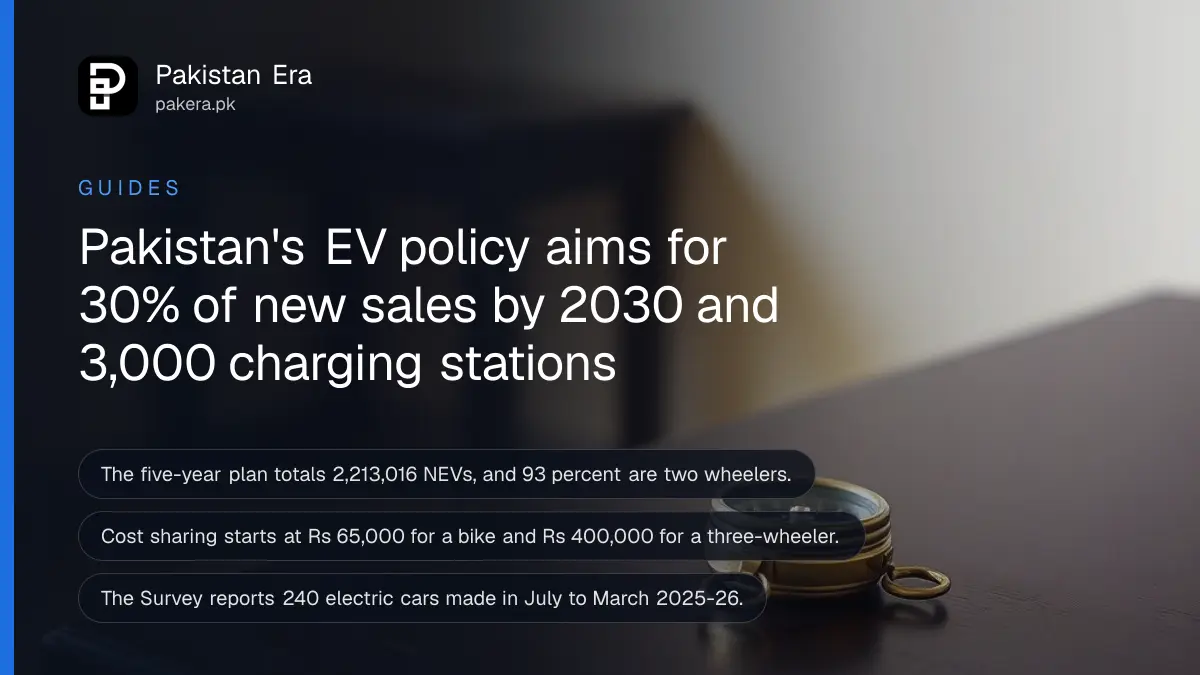
Short answer: Pakistan's New Energy Vehicle (NEV) Policy 2025-30 aims for 30 percent of new vehicle sales to be electric or plug-in hybrid by 2030, about 2.21 million vehicles. It sets Rs 65,000 as the starting cost share for an electric bike and Rs 400,000 for a three-wheeler, falling each year.
Electric bikes already sit outside shops in Lahore and Karachi. The policy behind them is a long document, and most of it is aimed at factories and ministries, not at buyers. This page pulls out what matters to a buyer, and what has not happened yet.
We read the full NEV Policy 2025-30 (Ministry of Industries and Production, Engineering Development Board) and the auto section of Chapter 3 of the Finance Division's Economic Survey 2025-26 on 14 October 2026. Totals we worked out are marked "our sum".
The target is 30 percent of new sales by 2030
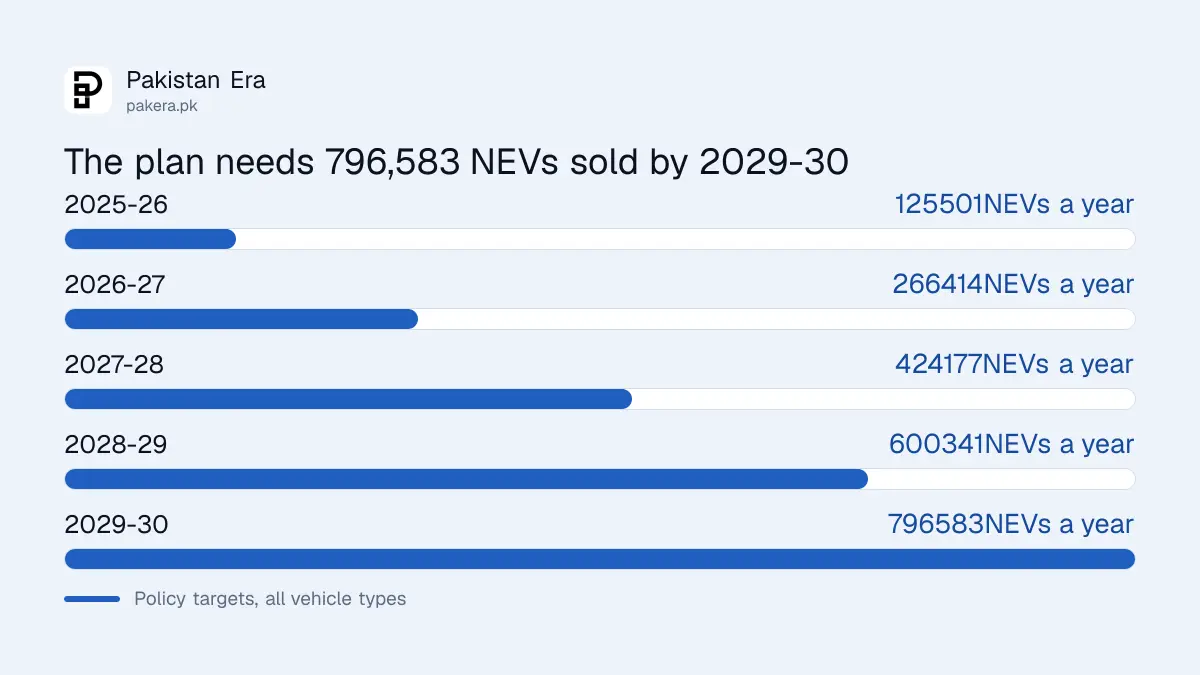
The policy wants NEVs to be 30 percent of new bike, rickshaw, car, van, bus and truck sales by 2030. Beyond 2030 it sets an ambition of 50 percent by 2040 and 100 percent by 2050. The five-year plan totals 2,213,016 NEVs.
An NEV means a battery electric vehicle, a plug-in hybrid, a range-extended electric vehicle or a fuel-cell vehicle. For two and three wheelers only fully battery electric counts. Plug-in hybrids count in bigger vehicles if they run at least 50 kilometres on electricity alone. Ordinary hybrids do not count.
| Year | Two wheelers | Three wheelers | Cars and 4-wheelers | All NEVs |
|---|---|---|---|---|
| 2025-26 | 116,053 | 3,171 | 5,947 | 125,501 |
| 2026-27 | 246,728 | 6,644 | 12,369 | 266,414 |
| 2027-28 | 393,408 | 10,442 | 19,296 | 424,177 |
| 2028-29 | 557,590 | 14,588 | 26,758 | 600,341 |
| 2029-30 | 740,898 | 19,106 | 34,785 | 796,583 |
| Total | 2,054,677 | 53,951 | 99,155 | 2,213,016 |
The "All NEVs" column also includes buses, vans and trucks, which are small numbers. Two wheelers carry the plan: they are 93 percent of the 2.21 million target (our sum).
Cost sharing starts at Rs 65,000 for a bike and falls every year
The policy's starting reference for cost sharing is Rs 65,000 for a two-wheeler and Rs 400,000 for a three-wheeler. For cars, vans, buses and trucks it is Rs 15,000 per kWh of battery or 5 percent of the invoice, whichever is lower. A steering committee sets the final amounts.
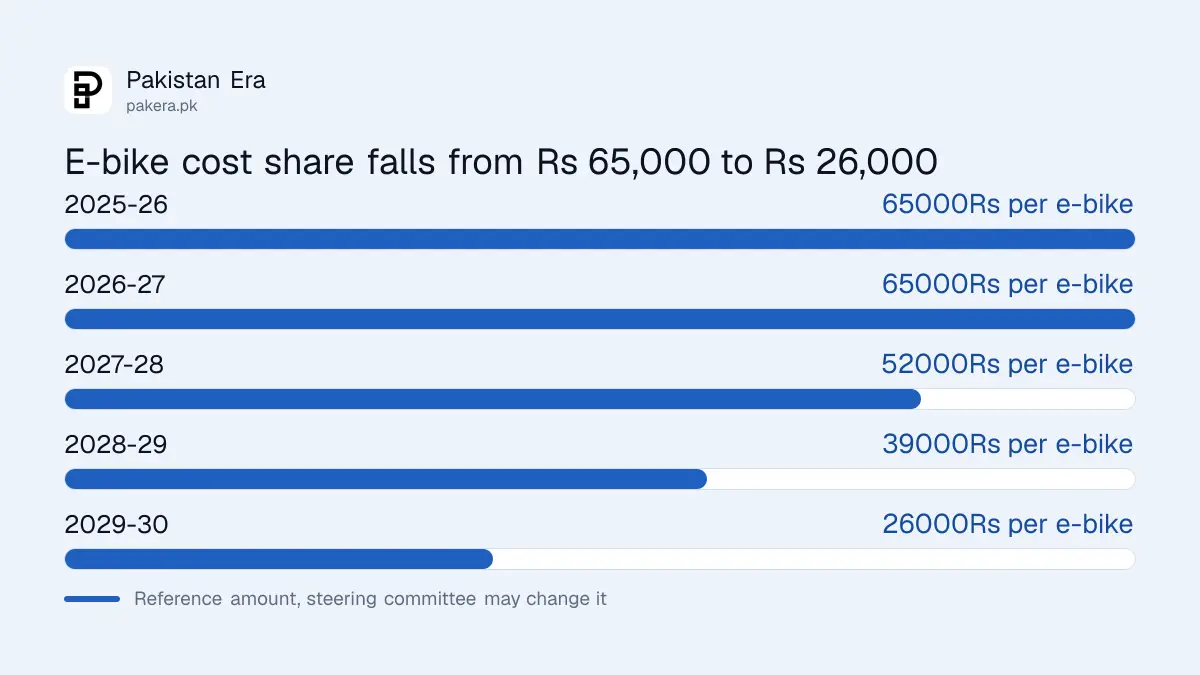
The cost share is cut after the second year: to 80 percent in the third year, 60 percent in the fourth and 40 percent in the fifth. For a bike that means Rs 65,000, Rs 65,000, Rs 52,000, Rs 39,000 and Rs 26,000 across the five years (our sum). The policy says a committee can change this.
The policy budgets Rs 100.36 billion over five years and Rs 8.95 billion in 2025-26. Among cars, only those used as taxis and other public service vehicles qualify, which the policy puts at around 5 percent of the segment. Each buyer is allowed one vehicle per category in a set period, and the vehicle cannot be sold for a minimum time.
These are policy reference numbers, not a promise to any buyer. What a buyer receives depends on the live scheme. Read how to apply for the PAVE electric bike scheme and the 2026 PM electric bike scheme for the amounts being offered now.
The charging plan is 3,000 stations by 2030
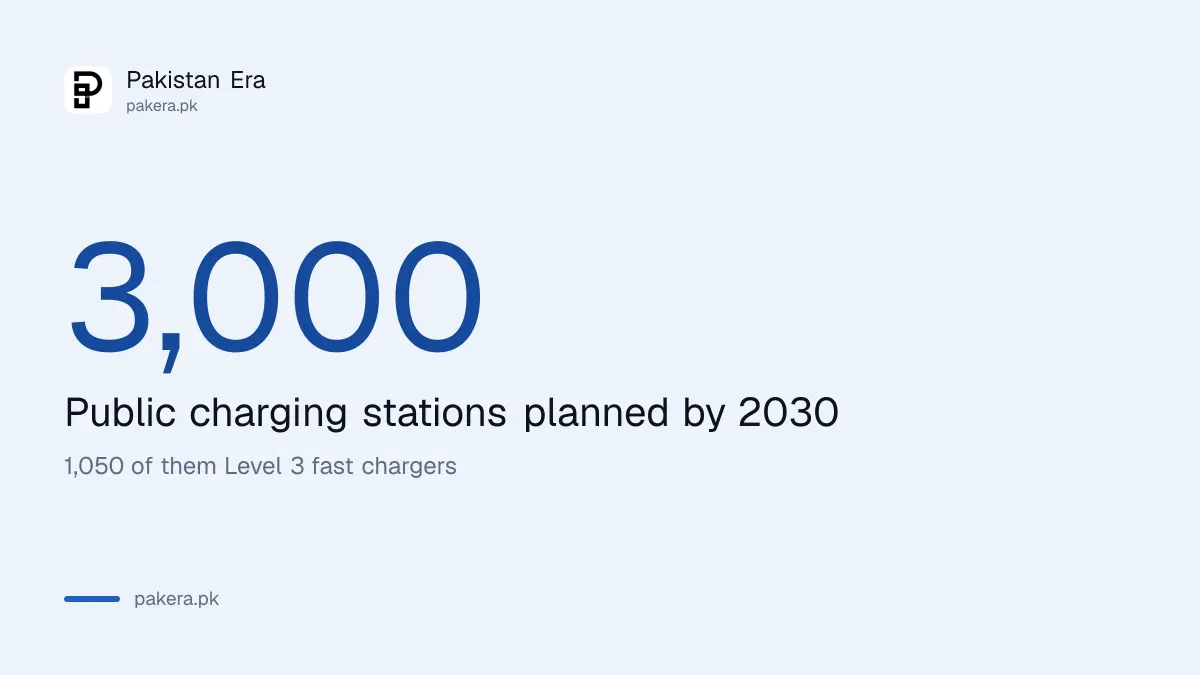
NHA is to build 40 fast-charging stations on motorways and parts of the N5 within six months of approval, about 120 kilometres apart. The full plan is 3,000 public stations by 2030, and one station every 50 kilometres on major highways. Level 3 fast chargers number 1,050.
| Type of station | Number by 2030 |
|---|---|
| Level 3 fast chargers | 1,050 |
| Level 2 chargers | 750 |
| Level 1 chargers (parking lots) | 600 |
| Battery swapping stations | 600 |
| Total | 3,000 |
The policy calls the numbers indicative. If you plan to open a station, see how to register an EV charging station with NEECA. To see what charging costs at home, read the cost to charge an electric car at home or at a station.
Free registration is promised in Islamabad, not yet confirmed
The policy says no registration fee and no annual token fee will be charged for NEVs registered in Islamabad. Provinces are only "encouraged" to do the same, and NHA is "encouraged" to waive tolls. We did not check whether any of this has been put into force.
Confirm any fee with the excise office before you buy. For what registration costs today, read how to register an electric car by province. The policy also proposes a levy of 1, 2 or 3 percent on new and imported petrol and diesel vehicles, by engine size, to pay for the scheme. It says this needs an Act of Parliament, and we did not check if one has passed.
On loans, the policy notes the State Bank limits car loans to Rs 3 million, 30 percent down and three to five years. It only says the ministry will work with the State Bank to look at changes for NEVs.
Check what has actually happened so far
The 2019 electric policy fell far short. For two and three wheelers it aimed at 500,000 in five years and reached 50,000. For four-wheelers it aimed at 100,000 and reached 3,000. The new policy says electric vehicles went from 567 in 2021 to over 80,000 by June 2025.
The Economic Survey reports 240 electric cars made and 263 sold in July to March 2025-26, against 150 and 132 a year earlier. It also says more than seventy licences went to two and three wheeler EV makers. These electric car numbers are not like for like with the policy's four-wheeler target, because that target also counts plug-in hybrids.
- Decide the vehicle type: bike, rickshaw or car.
- Open the scheme page for that type and note the amount, the dates and who can apply.
- Ask the seller if the vehicle meets the scheme's performance and after-sales rules.
- Ask the excise office in your province what the registration fee and token tax will be.
- Compare running costs with petrol. Your monthly petrol cost on a bike or car is the number to beat.
Common questions
What is Pakistan's NEV policy target?
It aims for 30 percent of new vehicle sales to be NEVs by 2030, then 50 percent by 2040 and 100 percent by 2050.
How many NEVs does the policy plan for?
The five-year plan totals 2,213,016 vehicles, of which 2,054,677 are two wheelers.
How much cost sharing does an electric bike get?
The policy's starting reference is Rs 65,000 for a two-wheeler. The live scheme's amount can differ, so check the scheme page.
Do hybrids count as NEVs?
Only plug-in hybrids that run 50 kilometres or more on electricity alone, and only in four-wheelers and bigger vehicles.
Is registration free for electric cars?
The policy says no registration or token fee in Islamabad. We did not confirm that this is in force, so ask the excise office.
How many charging stations are planned?
The policy plans 3,000 public stations by 2030, starting with 40 fast chargers on the motorways and the N5.
How we verified this
What we checked, where we read it, and what we could not confirm.
Last checked on 14 October 2026, Pakistan time. We read the full text of the New Energy Vehicles Policy 2025-30 as linked from the Engineering Development Board's website (edb.gov.pk), including Tables 1 to 9, and the auto section of the Finance Division's Economic Survey 2025-26. We did not find a notification or a cabinet decision in what we read, so treat the policy's amounts as targets and references. Dates and amounts of live schemes can change.
About the author

Senior Writer, Public Services and Technology
Shahid joined us in 2024 as an author. He is a senior contributor to Pakistan's leading technology websites. He writes detailed articles, mostly covering his expertise in the latest tech, mobiles, apps, gadgets, and step-by-step guides. His ideology is to help people understand the latest trends and explain complex methods through very easy-to-understand guides.