Check What PTA's 5G Security Guidelines Say About 4G vs 5G Privacy in Pakistan
PTA's 5G Security Guidelines compare 15 areas of 4G and 5G security. See what changes for your SIM privacy and the four checks to make on your own phone.
Short answer: PTA's 5G Security Guidelines say 5G hides your SIM's permanent identity with encryption, while 4G sends it in plain form when your phone first connects. That change blocks "IMSI catchers", fake towers that read SIM identities. The guidelines are written for operators, so your own part is small: update your phone and use 5G only where it is live.
A fake tower in a crowded bazaar can read the identity of every 4G phone that passes. PTA names this risk in its own paper. The paper explains why 5G is built to close it.
We downloaded PTA's "5G Security Guidelines" from the PTA website on 14 October 2026. The file name carries the date 12 February 2026. We read the full text, including the table that compares 4G with 5G. We did not test any network ourselves.
PTA says 5G hides your SIM identity and 4G does not
PTA's comparison table says that in 4G the SIM identity, called the IMSI, travels in plain form when a phone first attaches to the network. In 5G it is encrypted into a code called SUCI. This stops IMSI catchers from reading it.
The IMSI is the number that tells a network which SIM you hold. If a fake tower reads it, someone can tell that your phone is in that area. PTA says 5G also uses temporary identifiers for paging, and that the first messages between phone and network are ciphered.
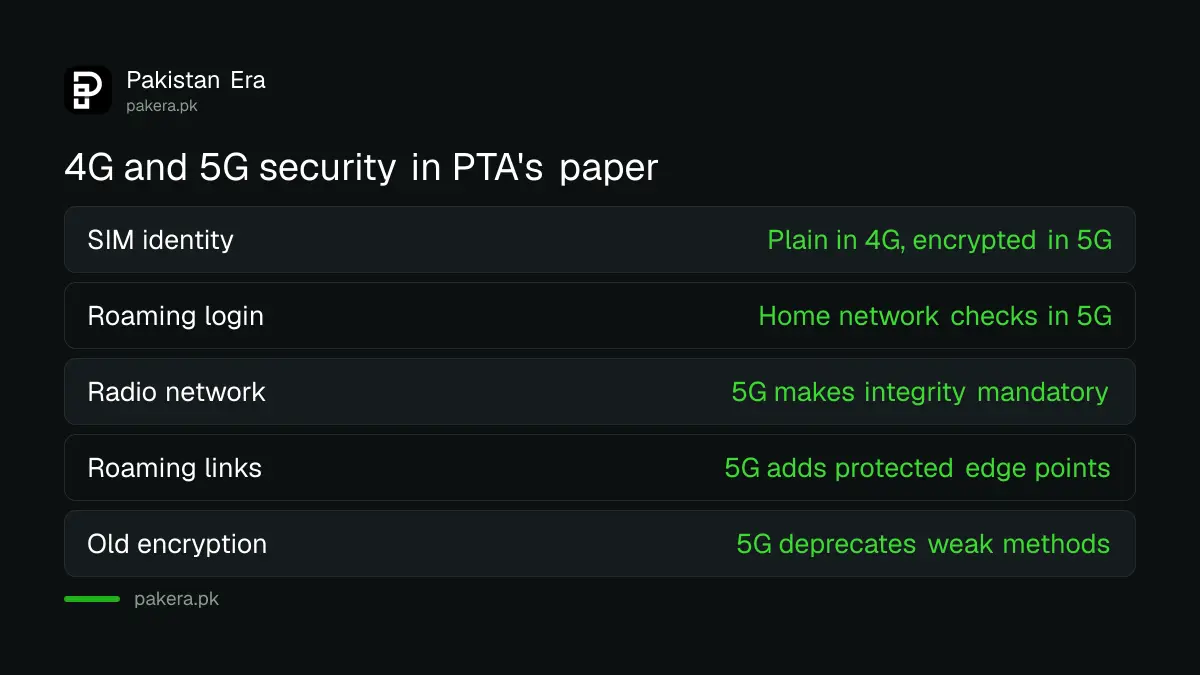
The guidelines add that regulators should enforce "non-null" SUCI schemes. In plain words, an operator should not switch the encryption off in its settings. They also say phones and SIMs should support the full 5G standalone setup.
The guidelines compare 15 security areas
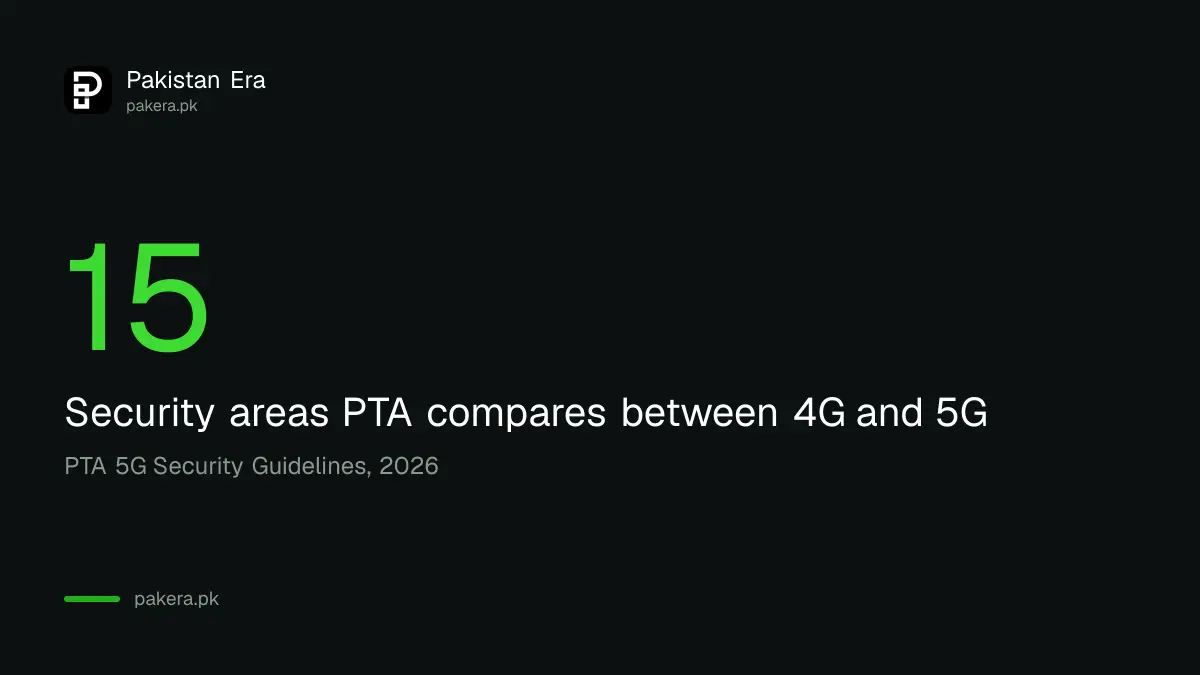
PTA lists 15 areas where 5G differs from 4G. They cover identity protection, login checks, the radio network, the core network, roaming, phone security visibility, encryption and readiness for future codebreaking computers. Most points matter to operators, not to ordinary users.
| Area | 4G, as PTA describes it | 5G, as PTA describes it |
|---|---|---|
| SIM identity | Sent in plain form at first attach | Encrypted as SUCI |
| Roaming login | Ends at the visited network | Checked by your home network |
| Radio network | Integrity protection is optional | User-plane integrity is mandatory |
| Roaming links | Open to signalling attacks | Protected edge points between operators |
| Old encryption | Weak ciphers still common | Legacy methods deprecated |
The roaming row matters if you travel. PTA says 5G keeps login control with your home network. That reduces roaming fraud and rogue networks, according to the paper. If you roam often, read how to activate international roaming on Jazz, Ufone or Zong before you fly.
Phones are named as a weak point
PTA calls user devices "one of the most vulnerable layers" in 5G. It warns about weak identity checks, old phones and connected gadgets that never get updates. The fix PTA lists for users is regular patching, encryption and strong sign-in.
That is the useful part for you. A 5G network cannot protect a phone that has not had a security update in three years. Check how long your brand promises updates in this note on security update years by phone brand in Pakistan.
PTA also says a phone must offer a screen to switch radio types on or off, such as GSM, WCDMA, LTE and NR. NR means the 5G radio. That is the menu you use to pick 4G only if 5G drains your battery.
Four checks for your own phone
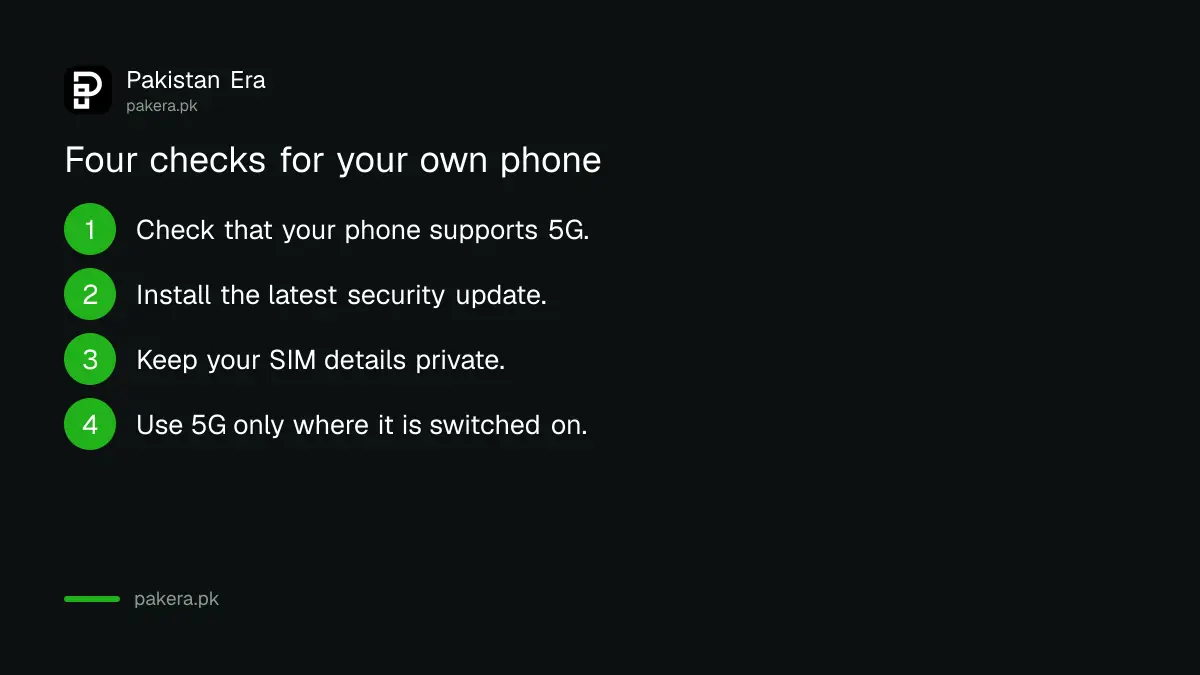
Do four things: confirm your phone can use 5G, install the latest system update, keep your SIM details private, and use 5G only in areas where your operator has switched it on. None of this costs money.
- See whether your handset supports 5G, using the steps to check if your phone supports 5G in Pakistan.
- Install the newest security update from your phone's settings.
- Do not share a photo of your SIM card or its number tray, which shows identifiers.
- Look at the 5G service areas for Jazz and Zong before you buy a plan for it.
Be careful with claims that 5G is "unhackable". PTA's own paper has a long section on 5G risks, including attacks on the radio network, the core and applications. The paper says the encryption used to hide identities "can eventually be broken" in the future. It is better, not perfect.
What the paper does not tell you
The paper does not say which operator has met each rule, and it gives no dates for checks. It is a set of guidelines, so you cannot use it to prove that a given network is safe today. Treat it as PTA's stated direction.
To see how PTA treats network failures, read what the regulator says about when an operator must tell PTA about a data breach. That rule gives a deadline, which the 5G paper does not.
Common questions
Is 5G more private than 4G?
Yes, on one point PTA states clearly. 5G encrypts the SIM identity that 4G sends in plain form at first attach. PTA still lists other 5G risks.
What is an IMSI catcher?
It is a fake mobile tower that tricks phones into connecting and reads their SIM identity. PTA says 5G identity encryption is meant to stop this.
Do these guidelines apply to me as a user?
They are written for operators and network builders. The only user advice is to patch devices and use strong sign-in.
Do I need a new SIM for 5G?
PTA says phones and SIMs should support full 5G standalone setups. For your own case, read the page on whether you need a new SIM for 5G.
Is 5G live in my city?
We cannot say from this paper. Check your operator's coverage list and the 5G service areas page before you rely on it.
How we verified this
What we checked, where we read it, and what we could not confirm.
Last checked on 14 October 2026, Pakistan time. We read PTA's 5G Security Guidelines in full. We did not test any 5G network, and the paper does not say how far each operator has followed it. Treat it as guidance, not a safety rating.
About the author

Technology Journalist & Multimedia Producer
Ahmad Ali is a technology journalist and multimedia producer at Pakistan Era, joining the team in October 2026. He covers consumer technology and digital life for Pakistani readers, combining research with hands-on product testing.