Check If You Qualify for Chevening From Pakistan: 2,800 Hours of Work and Three UK Courses
Check if you qualify for Chevening from Pakistan: 2,800 hours of work, three UK courses and one unconditional offer. Prepare now, before the next round opens.
Short answer: To qualify for a Chevening Scholarship from Pakistan you need at least two years of work experience after your undergraduate degree, equal to 2,800 hours. You must also apply to three eligible UK courses and hold an unconditional offer from at least one by the deadline, and promise to return home for two years after the award.
Applications for the 2027 to 2028 Chevening round closed in October 2026, and Chevening has not published when the next round opens. That is the best time to check yourself, because the two things that stop most people, work hours and offers, take months to fix.
We read three Chevening pages on 14 October 2026: the eligibility guidance, the Pakistan page and the application timeline. For the full picture of the programme and its warnings, see our earlier page on Chevening applications for Pakistanis.
The 2,800 hours rule is the first test
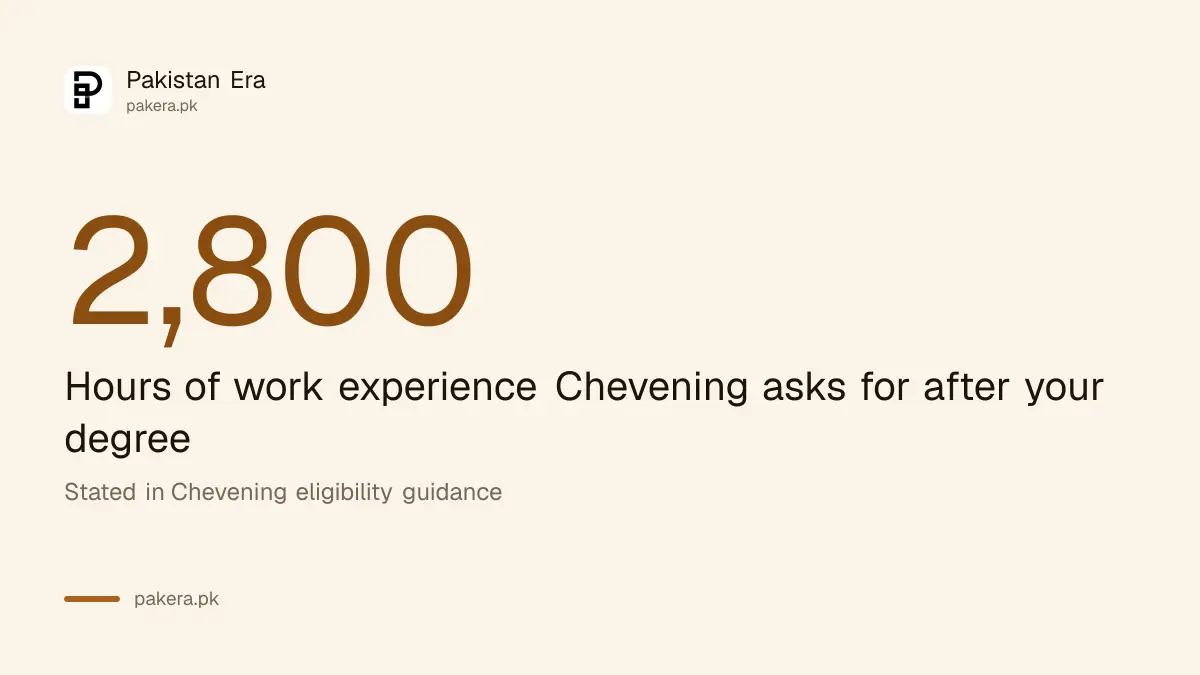
Chevening requires two years of work experience after your undergraduate degree, "equivalent to 2,800 hours". Our arithmetic: a 40 hour week reaches 2,800 hours in 70 weeks. Two years at about 27 hours a week reaches the same total.
The Chevening eligibility page we read did not say which kinds of work count, such as paid, unpaid, voluntary, part-time or self-employed work, or how to add the hours up. It links to separate work experience guidance that we did not read. Read that guidance before you count your hours.
Start a simple record now. List each job, its start and end dates, and the hours a week. A clean record is easier to defend than a memory.
Degree, offers and the return promise
Your degree must qualify you for a UK master's and be finished at least two years before the deadline. You apply to three eligible UK courses, need one unconditional offer, and must promise to return home.
| Requirement | What Chevening says |
|---|---|
| Work experience | At least two years after your degree, equal to 2,800 hours |
| Degree | Qualifies you for a UK master's; studies finished at least two years before the deadline |
| Degree certificate | Not needed at application, but needed by your interview |
| UK courses | Apply to three different eligible courses |
| Offers | Unconditional offer from at least one by the deadline |
| Return | At least two years in your country after the scholarship ends |
The unconditional offer is the hard part. A conditional offer, one that waits for a language score or a final transcript, does not meet the rule. Book your language test early; see IELTS fees and booking in Pakistan and which English tests the UK accepts.
Check each university too. A course at a school without a sponsor licence causes trouble later, as we explain in how to check a UK student sponsor licence.
Who is not eligible
You cannot apply if you studied in the UK on a UK government funded scholarship, or if you live in the UK when you apply. A past Chevening Fellowship means waiting five years. Some employees of listed bodies, and their relatives, are also excluded.
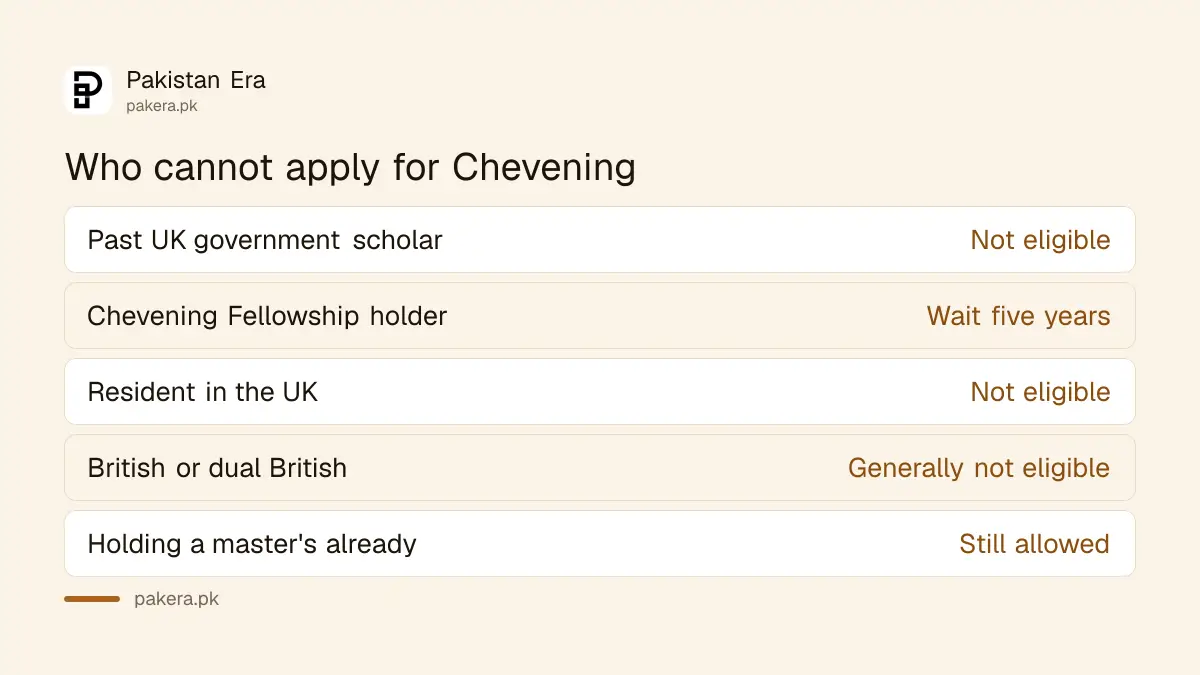
Having one master's degree does not stop you from applying for a second UK master's, according to the page. British and dual British citizens are generally not eligible. The Pakistan page we read lists no extra rule for Pakistani applicants beyond this general guidance.
Chevening also notes that for awards in ODA-eligible countries, you must be resident in such a country and show a clear intention to support your country of award. If you live outside Pakistan now, ask Chevening before you apply.
The calendar shows when to move
Chevening's timeline for the 2027 to 2028 round ran from August to October 2026 for applications, mid-October to January for reading, mid-February for shortlisting, March and April for interviews, and results from mid-June 2027. The offer deadline is 8 July 2027.
Use that rhythm as a guide for the next round, but do not treat it as promised. The Pakistan page says only that applications for 2027 to 2028 are closed and to watch Chevening's channels for the next opening.
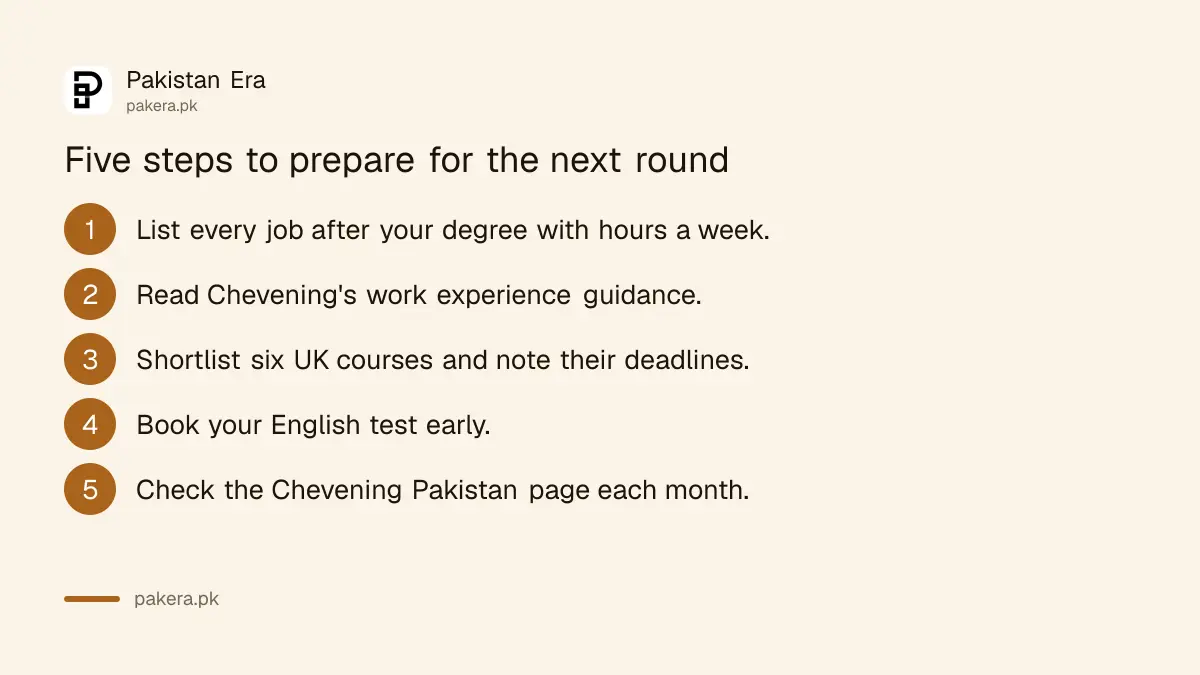
- Write down every job and its hours from your first post-degree role.
- Read Chevening's work experience guidance and mark which roles count.
- Pick six UK courses and read each one's entry rules and deadlines.
- Book your English test early enough to meet course offers.
- Check Chevening's Pakistan page every month for the opening date.
Chevening is not the only fully funded UK route. Compare the Commonwealth Scholarship through HEC and the Gates Cambridge Scholarship, and see the steps for the UK student visa from Pakistan once you have a place.
Common questions
How many hours of work experience does Chevening require?
At least two years of work experience after your undergraduate degree, equal to 2,800 hours, according to Chevening.
Is the Chevening round open now?
No. The Pakistan page says applications for the 2027 to 2028 scholarships are now closed. It gives no date for the next opening.
Do I need a UK offer before applying?
You apply to three UK courses and need an unconditional offer from at least one by the deadline on the timeline.
Must I return to Pakistan after the scholarship?
Yes. You must commit to returning to your country of award for at least two years after the scholarship ends.
Can I apply with a second master's?
Yes. Chevening says having a master's does not prevent you from applying for a second UK master's.
How we verified this
What we checked, where we read it, and what we could not confirm.
Last checked on 14 October 2026, Pakistan time. We read Chevening's eligibility guidance, its Pakistan page and the application timeline. We could not read which kinds of work count towards the 2,800 hours, or the exact close date of the round that just ended.
About the author

Public Services and Education Journalist
Fajr Riaz is a journalist and content writer at Pakistan Era, based in Lahore. She covers the questions people meet in everyday life in Pakistan: how a public service works, what a change in the rules means, and where to find a reliable answer.