How to Use a SMEDA Pre-Feasibility Study Before You Start a Business in Pakistan
SMEDA lists pre-feasibility studies by sector, from Services to Plastic. See what they show, why costs are approximate and how to update them before you invest.
Short answer: SMEDA publishes pre-feasibility studies for dozens of business types on its website. Open the pre-feasibility page, pick your sector, such as Services, Food and Beverages or Plastic, and read the study for machinery, space, staff, raw material and costs. SMEDA warns that its money figures are approximate, so update them with today's prices.
Most small businesses in Pakistan start with a guess. The owner thinks a bakery needs Rs 2 million, opens, and finds out in month three that the oven, the rent and the stock cost double. A pre-feasibility study is a way to make that guess smaller before you spend a rupee.
We opened the pre-feasibility page of the Small and Medium Enterprises Development Authority, known as SMEDA, on 13 October 2026. This guide explains what the page offers and how to use it. We did not open each study in full, so we do not quote any cost from a single study.
SMEDA lists studies in more than twenty sectors
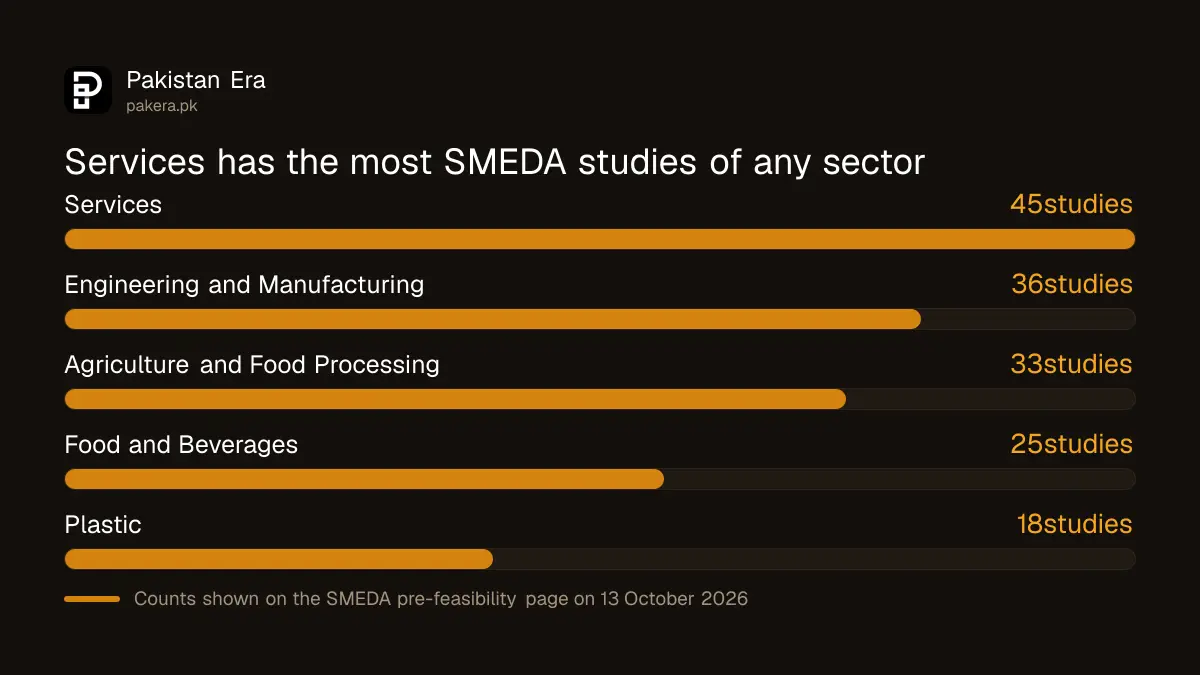
The SMEDA page groups its studies by sector, with the number of documents shown next to each name. The bigger groups on the day we read it were Services with 45, Engineering and Manufacturing with 36, Agriculture and Food Processing with 33, and Food and Beverages with 25.
| Sector on the SMEDA page | Studies listed |
|---|---|
| Services | 45 |
| Engineering and Manufacturing | 36 |
| Agriculture and Food Processing | 33 |
| Food and Beverages | 25 |
| Plastic | 18 |
| Health and Medical | 17 |
| Construction | 12 |
Smaller groups include Dairy with 6, Education with 4, Trading with 5, Furniture with 3 and Tourism and Travel with 2. There is also an archive group of older studies with 157 documents. Older studies are useful for the idea, but their prices will be out of date.
A study shows what the business needs to run
SMEDA tells readers to focus on the basics: production processes and capacities, space, machinery, human resources and raw material needs. These are the facts that do not change much from year to year. They tell you whether a business suits your money, your skills and your city.
Read a study the way you read a recipe, not a promise. It shows a model business of a set size. Your shop in Multan or Peshawar will have different rent and different wages.
Look first at the size of the model. If the study assumes a factory of 500 square yards and you have a 100 square yard shop, the money numbers do not apply to you.
The money figures are approximate on purpose
SMEDA states on the page that figures and financial projections are approximate because exchange rates, energy costs and fuel prices keep changing. It advises readers to look at the essential elements instead of the final numbers.
That is honest, and you should take it seriously. A study written two years ago did not know about today's electricity rate. Treat any total cost as a starting point.
The safest way to update a study is to rebuild its cost list with current quotes. Ask three suppliers for the price of each machine. Ask a landlord for rent in your area. Then compare your list with the study.
Update a study in six steps
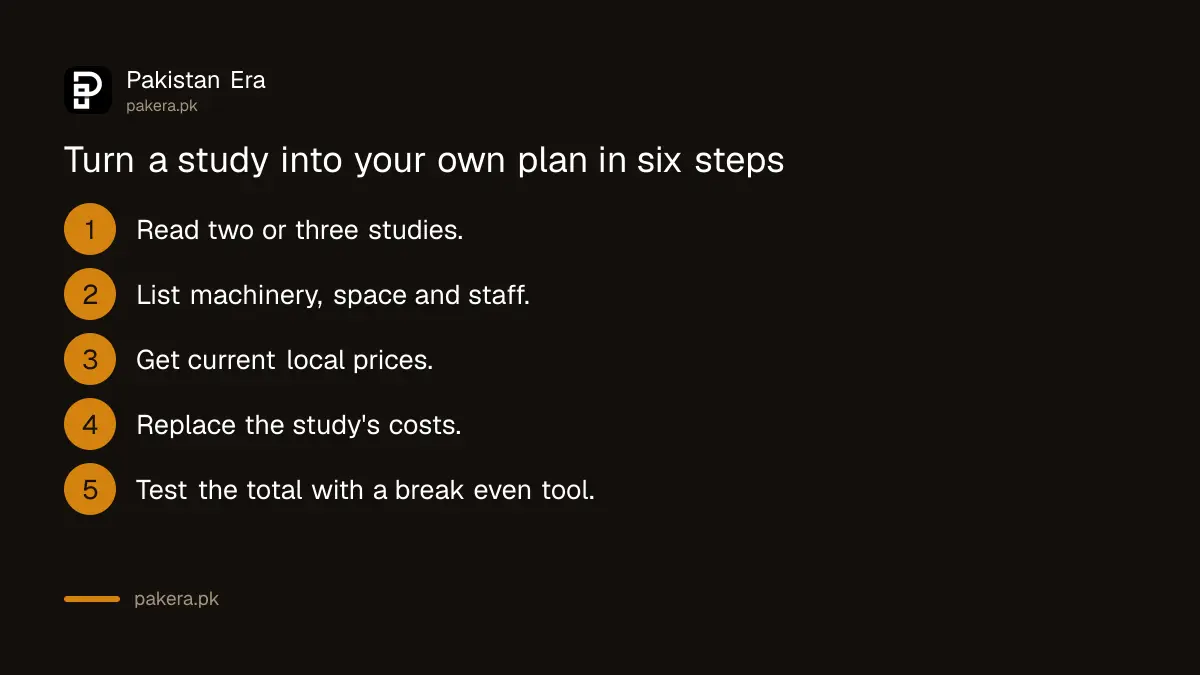
Use this order when you turn a study into your own plan. It takes a few evenings, not a few months.
- Pick the sector and read two or three studies, not just one.
- Write down the machinery, space, staff and raw material the study lists.
- Get a current price for each item from local suppliers.
- Replace the study's costs with your quotes.
- Test the new total with a break even tool, such as the free calculators on SMEDA's financial tools site.
- Decide the legal form of the business, then register.
For step 5, see how to use SMEDA's free financial calculators. For step 6, the right form depends on size. A one person shop may only need to register as a sole proprietor with FBR. A venture with partners or investors may need a company, as explained in how to register a private limited company with SECP.
Pair the study with a consultant check
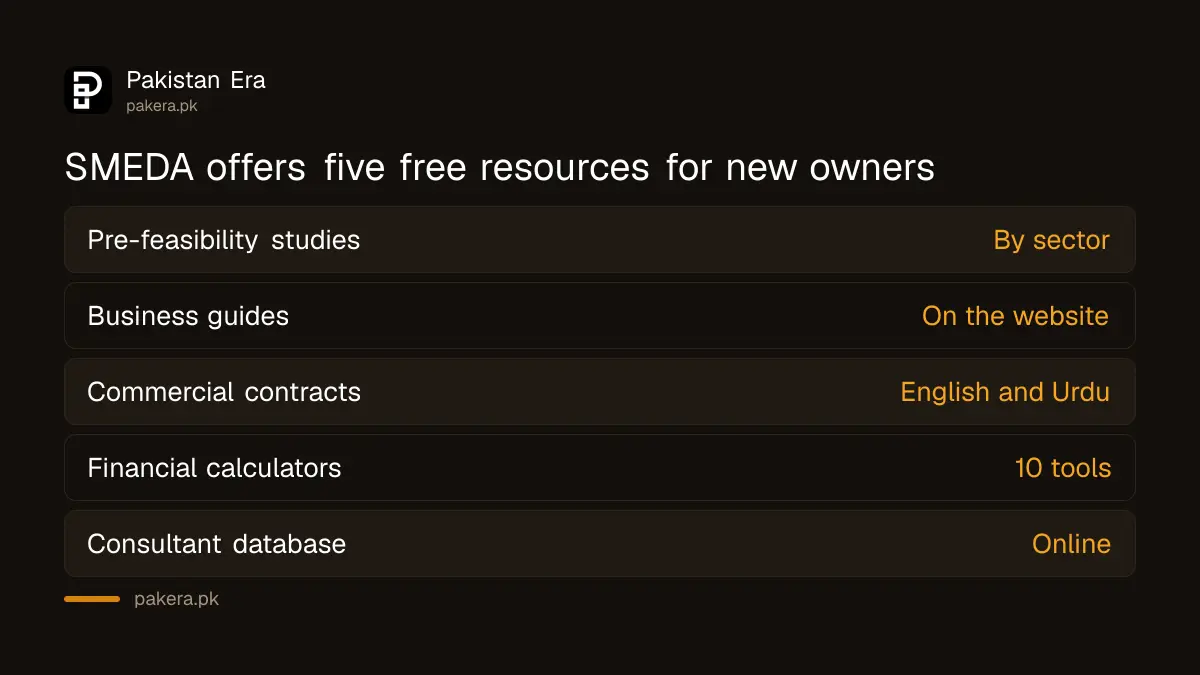
SMEDA also runs a consultant database on its website. It is described as free and easy to use. If your plan needs more than a few hundred thousand rupees, a short call with a person who has run a similar business can save you money.
We have not checked the quality of the consultants listed, so ask for past work before you pay for anything. A listing is not the same as a recommendation.
Also think about banking. A lender will ask for your plan, and a study you have updated with real quotes is more convincing than a copied one. The page on opening a business bank account lists the documents you will need.
Where this free help stops
A study will not tell you whether customers will buy from you. It cannot check your location, your competitors or your local licence needs. Walk the area, count the shops that sell the same thing and talk to ten possible customers.
It also does not replace tax advice. If your business sells to shops, ask an accountant how sales tax applies. For a small retail shop, the page on filing under FBR's small shopkeeper scheme may help.
Finally, keep your own copy of the study you used and the date you read it. If a bank or partner asks where your numbers came from, you can show them.
Common questions
What is a pre-feasibility study?
It is an early plan for a business that lists processes, space, machinery, staff, raw material and rough costs, so you can judge the idea before you invest.
Where do I find SMEDA pre-feasibility studies?
On the pre-feasibility page of the SMEDA website, grouped by sector.
Are the SMEDA cost figures current?
Not necessarily. SMEDA says the figures are approximate because exchange rates and energy and fuel prices change.
Is there a study for a small shop or service?
The Services sector lists 45 studies and Trading lists 5, so look there first.
Does SMEDA charge for the studies?
We could open the category page without logging in and saw no price. Check the page before you download.
Do I need a company to start?
Not always. A one person shop can start as a sole proprietor, but the right form depends on your plan.
How we verified this
What we checked, where we read it, and what we could not confirm.
Last checked on 13 October 2026, Pakistan time. We read the SMEDA pre-feasibility studies page and its sector counts. We did not read individual studies, and the counts change when SMEDA adds or removes a file. We saw no price on the page, but SMEDA does not state that every file is free.
About the author

Global Affairs & Political Economy Writer
Muhammad Hatim is a book lover who started writing because he enjoys it. At Pakistan Era he writes about international relations, geopolitics and the global economy, with a particular interest in South Asia and the forces behind current events.