DRAP Draft Would Restrict Conventional Syringes of 10 cc and Below in Pakistan
DRAP's 7 October 2026 draft would restrict conventional syringes of 10 cc and below, insulin excepted. See what it says, the 10 day window and what to check.
Short answer: The Drug Regulatory Authority of Pakistan (DRAP) has put out a draft guidance on sterile single-use syringes for public comment. The draft says the policy is to completely restrict the making, import and sale of conventional syringes of 10 cc and below, except insulin syringes. It is a draft, it has no start date yet, and comments are open for 10 days from 7 October 2026.
Most people never think about the syringe in a clinic. This draft is about exactly that object. It follows a surge of HIV and hepatitis cases that officials linked to unsafe injection practice, including the reuse of syringes. A syringe that can be used only once is a syringe that cannot be reused by mistake or by a shortcut.
We opened the DRAP notice and the full draft PDF on 12 October 2026. This article reports what the draft says. It does not say the restriction is already law, because the document itself says it is a first edition draft with a blank effective date.
DRAP published the draft on 7 October 2026 and asked for comments in 10 days
The DRAP page is titled "Draft Guidance on Quality Control of Sterile Single-Use Syringes (For Comments)" and is dated 7 October 2026. It asks for comments within 10 days, so the window closes on or about 17 October 2026. The PDF is document DRAP/GL/MD-002, Edition 01, from the Division of Medical Devices and Medicated Cosmetics.
The draft is addressed to DRAP, the notified testing laboratories, and the makers, importers and registration holders of syringes. It is not written for patients. Its effect would reach patients through what clinics and shops are allowed to stock.
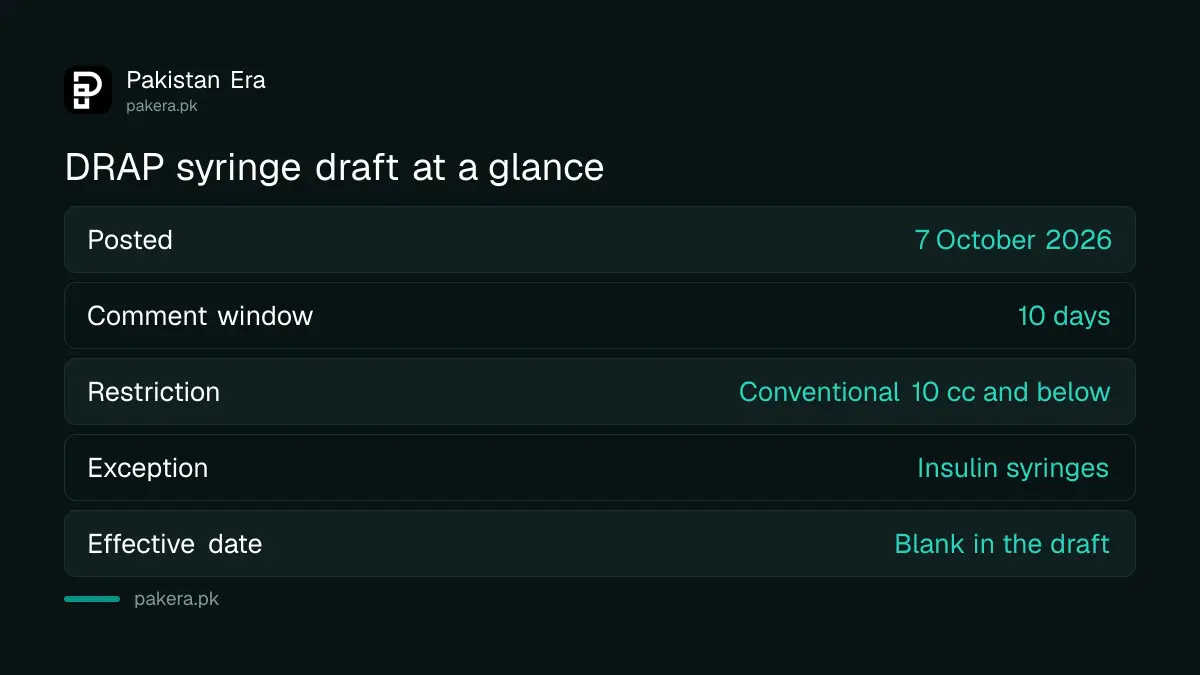
| Point | What the DRAP draft says |
|---|---|
| Document | Draft Guidance on Quality Control of Sterile Single-Use Syringes, Edition 01 |
| Posted | 7 October 2026 |
| Comment window | 10 days from posting |
| Effective date | Blank in the draft ("00-00-0000") |
| Legal basis named | DRAP Act 2012, Medical Devices Rules 2017 (Rule 68) |
| Board decision it carries out | Medical Device Board, 139th meeting, 13 August 2026 |
The draft says conventional syringes of 10 cc and below would be restricted, except insulin
The introduction of the draft states a policy directive: complete restriction on the manufacturing, import and sale of conventional syringes of 10 cc and below, except insulin syringes. It also bars non-medical grade raw materials. The numbered list of key directives in the body of the draft covers materials and standards, not this restriction.
The wording matters. DRAP calls the restriction a mandatory policy directive that it is carrying out from a Medical Device Board decision. But the draft does not set a date, a transition period or a penalty. Until DRAP issues a final, notified document, a clinic or pharmacy has no new legal duty from this page alone.
The draft also does not define "conventional" in plain words. Its glossary defines the safer types instead: auto-disable syringes for fixed-dose immunisation, reuse-prevention syringes for treatment, and syringes with a sharps injury protection feature. A reasonable reading is that the safer types are what would remain on sale, but the draft does not spell that out, so we do not claim it.
The reason DRAP gives is HIV cases linked to reused syringes
The draft says its background is a reported surge of HIV cases associated with unsafe medical practices, in particular the alleged reuse of contaminated syringes, and weak infection prevention and control. It says the Prime Minister's Office gave directions, and the health ministry set up a working group.
That matches the pattern we covered in our report on the Karachi HIV outbreak traced to one hospital. The draft names two goals beyond the HIV link: cutting healthcare-associated infections from syringe reuse, and protecting health workers from needle-stick injuries.
We do not have an official count tying a number of cases to syringe reuse on the DRAP page, so we give none. The draft says "alleged" and "reported", and so do we.
The draft sets two levels of testing for every syringe maker and importer
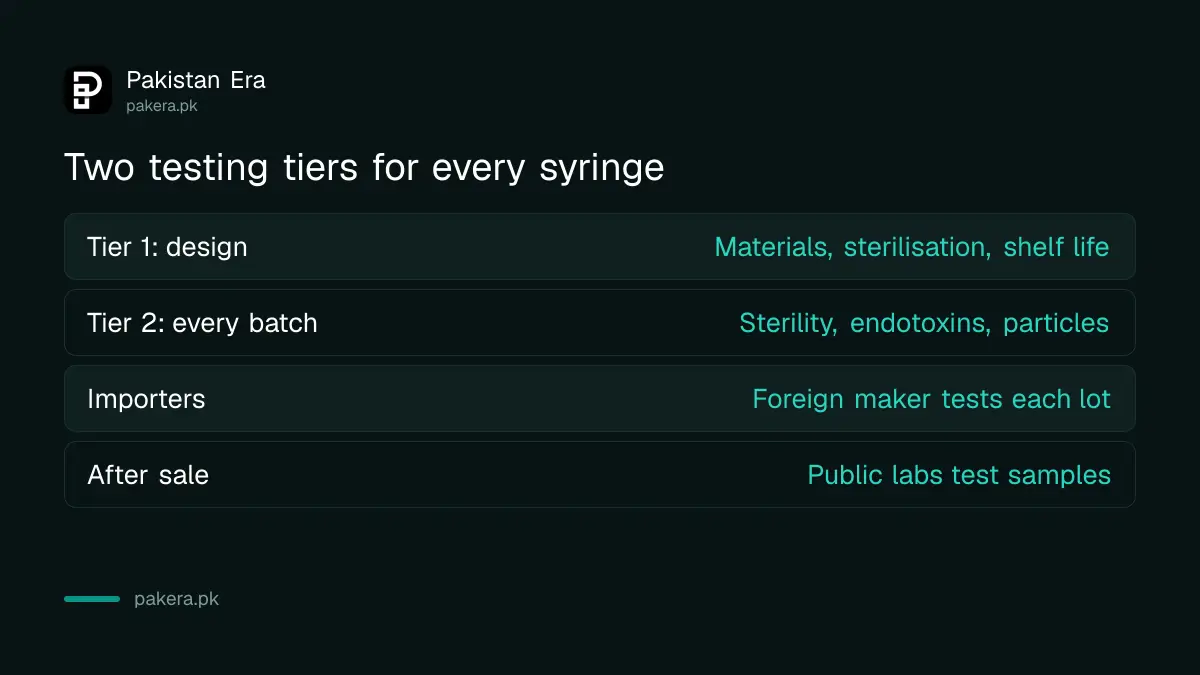
Makers and importers would have to prove a syringe is safe at design stage and then test every batch. The draft calls these Tier 1 and Tier 2. Importers would rely on testing by the foreign maker, and public laboratories would test again after sale.
Tier 1 covers design and materials. It includes biocompatibility, sterilisation validation, shelf life, and how the safety feature behaves under force. Tier 2 is routine batch release. The draft lists 12 common batch checks, including sterility, bacterial endotoxins, particles, chemical limits, package seal strength and, for syringes with a needle, needle strength.
| Tier | When | Examples in the draft |
|---|---|---|
| Tier 1 | New design or a major change | Biocompatibility, sterilisation validation, shelf life, override force |
| Tier 2 | Every batch, and after-sale checks | Sterility, endotoxins, particles, seal integrity, needle checks |
Registration holders would also have to send DRAP and the notified laboratories a list of the standards that apply to each syringe within 60 days of issue. They would keep records for every lot of raw material. The standards named include the ISO 7886 series, ISO 10993 and ISO 23908.
What this means for you today
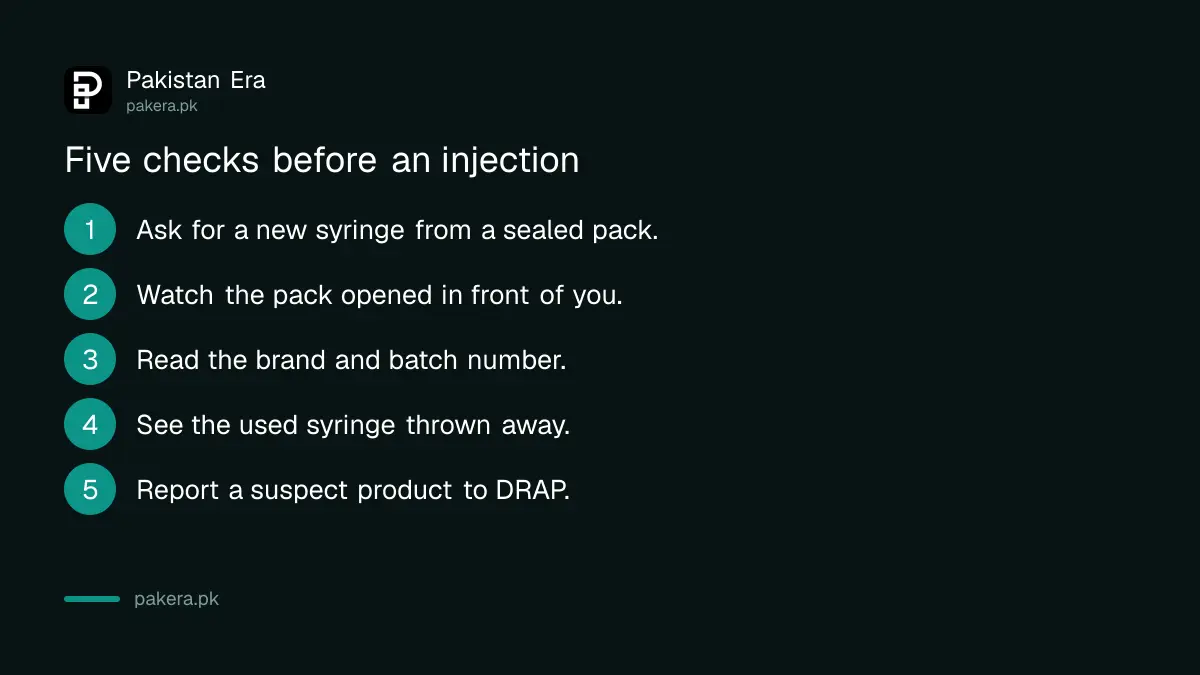
Nothing changes at the clinic counter yet. The restriction is a draft and has no date. The check that protects you today is the same one it would make universal: ask for a new syringe from a sealed pack, and watch it opened.
- Ask the clinic or pharmacy for a new syringe from a sealed pack.
- Watch the pack being opened in front of you.
- Read the brand and batch number on the pack.
- See the used syringe thrown away, not set aside.
- If a syringe or injection looks wrong, report it to DRAP.
Our guide to checking an injection syringe against DRAP recall alerts lists the brands that failed tests in 2026. To report a suspect product, see how to report counterfeit medicine to DRAP.
Common questions
Has DRAP banned normal syringes in Pakistan?
Not yet as a final rule. The draft says the policy is to restrict conventional syringes of 10 cc and below, except insulin syringes, but it is a draft with no effective date and is open for comments.
When does the DRAP syringe restriction start?
The draft does not say. Its effective date is blank. We will not give a date until DRAP publishes a final notified document.
Who can send comments on the draft?
DRAP invited comments from stakeholders within 10 days of 7 October 2026. The last page of the draft prints a contact email at dra.gov.pk and a phone number, 051-9255965. The DRAP notice itself does not describe a submission method, so we could not confirm the exact route.
Do insulin syringes stay on sale?
The draft says insulin syringes are excepted from the restriction on conventional syringes of 10 cc and below. It also lists insulin syringes among the types to be quality tested.
What type of syringe should I ask for at a clinic?
Ask for a new syringe from a sealed pack that is opened in front of you. The draft describes reuse-prevention and auto-disable types as the safer designs, and a clinic may not stock them. We do not give treatment advice beyond DRAP's own words.
Does the draft cover vaccine syringes?
Yes. It lists auto-disable syringes for fixed-dose immunisation in its scope, with the ISO 7886-3 standard for batch testing.
How we verified this
What we checked, where we read it, and what we could not confirm.
We read the DRAP notice at dra.gov.pk and the full 13 page draft PDF on 12 October 2026. We did not find a final, notified version. The restriction on 10 cc and below syringes appears in the draft's introduction, not in its list of key directives, and we do not know if the final text will keep it as written.
About the author
Public Services and Education Journalist
Fajr Riaz is a journalist and content writer at Pakistan Era, based in Lahore. She covers the questions people meet in everyday life in Pakistan: how a public service works, what a change in the rules means, and where to find a reliable answer.