Avoid FBR's Higher Penalties for Ignored Audit Notices and False Statements in Pakistan
From 1 July 2026 FBR penalties rise: Rs 100,000 to Rs 300,000 for ignored audit notices and Rs 500,000 for false statements. See the old and new figures.
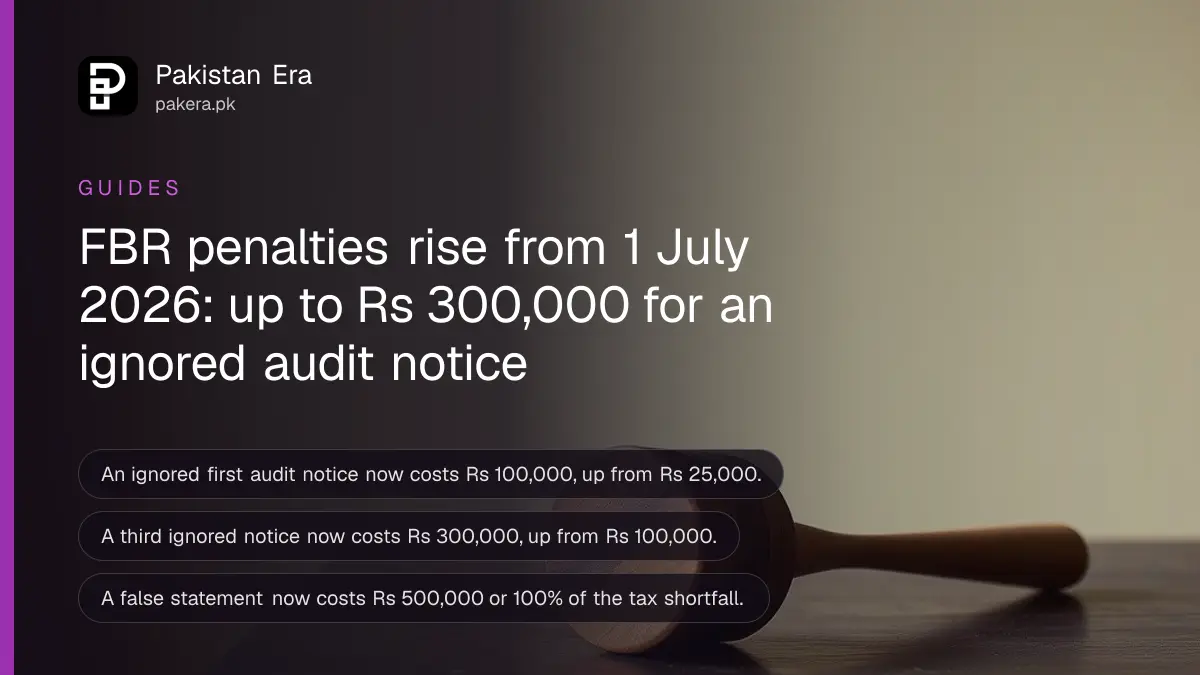
Short answer: The Finance Act 2026 raises two FBR penalties from 1 July 2026. Failing to produce records under a section 177 audit notice now costs Rs 100,000, Rs 200,000 and Rs 300,000 for the first, second and third notice. A false or misleading statement now costs Rs 500,000 or 100% of the tax shortfall, whichever is higher.
FBR can fine you for ignoring a notice or for giving wrong information. The Finance Act 2026 makes these fines much bigger. Older articles and old penalty tables still show the earlier amounts.
We read the Act's amending text on FBR's own download site on 13 October 2026. We also read the Income Tax Ordinance as amended up to 31 July 2025, so we can show the old figure beside the new one.
Ignored audit notices now cost up to Rs 300,000
Section 177 lets FBR audit your return and call for records. If you fail to produce the records without a reasonable cause, entry 8 of the penalty table in section 182 applies. The Act raises each step of that entry.
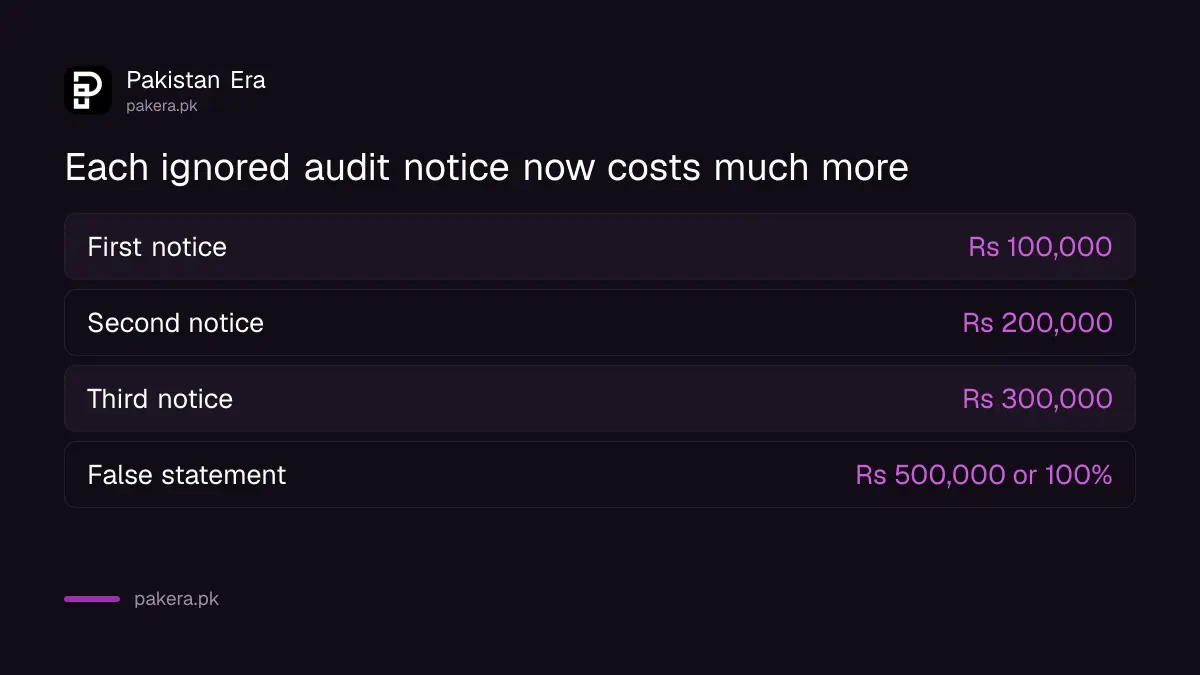
| Notice | Penalty before | Penalty from 1 July 2026 |
|---|---|---|
| First notice | Rs 25,000 | Rs 100,000 |
| Second notice | Rs 50,000 | Rs 200,000 |
| Third notice | Rs 100,000 | Rs 300,000 |
The old figures come from the Ordinance as amended up to 31 July 2025. The new figures follow the Act's substitutions in the entry. Each step needs a notice. Do not wait for the third one.
A false statement now costs Rs 500,000 or 100% of the shortfall
Entry 10 covers a false or misleading statement made to an Inland Revenue authority. That can be a return, a declaration, an objection, a statement in writing or a spoken answer. The Act replaces Rs 25,000 with Rs 500,000 and 50% of the shortfall with 100%.
The shortfall is the tax you should have paid, minus the tax you did pay. The penalty is whichever of the two amounts is higher. On a Rs 2,000,000 shortfall, 100% is Rs 2,000,000, which is higher than Rs 500,000.
The old text also protected a taxpayer in a deemed assessment who took a reasonably arguable position on the law. We read that protection in the July 2025 text and did not see the Act remove it. Check the current table before you rely on it.
Late returns are measured against a higher base
Entry 1 sets the penalty for a late return at the higher of 0.1% of the tax payable for each day, or Rs 1,000 for each day. The Act changes the meaning of tax payable for this entry.
It now means the higher of two figures. One is the tax on the assessment already made. The other is the tax payable for the previous tax year for which a return was duly filed. A person who has filed before can no longer count on a low base after a short year. See how to file a tax return after the deadline for the steps.
Penalties need an order and a hearing
The penalty section still says no penalty is payable unless the Commissioner, Commissioner (Appeals) or the Appellate Tribunal passes a written order after giving you a chance to be heard. We read that sub-section in the July 2025 text and found no change to it in the Act.
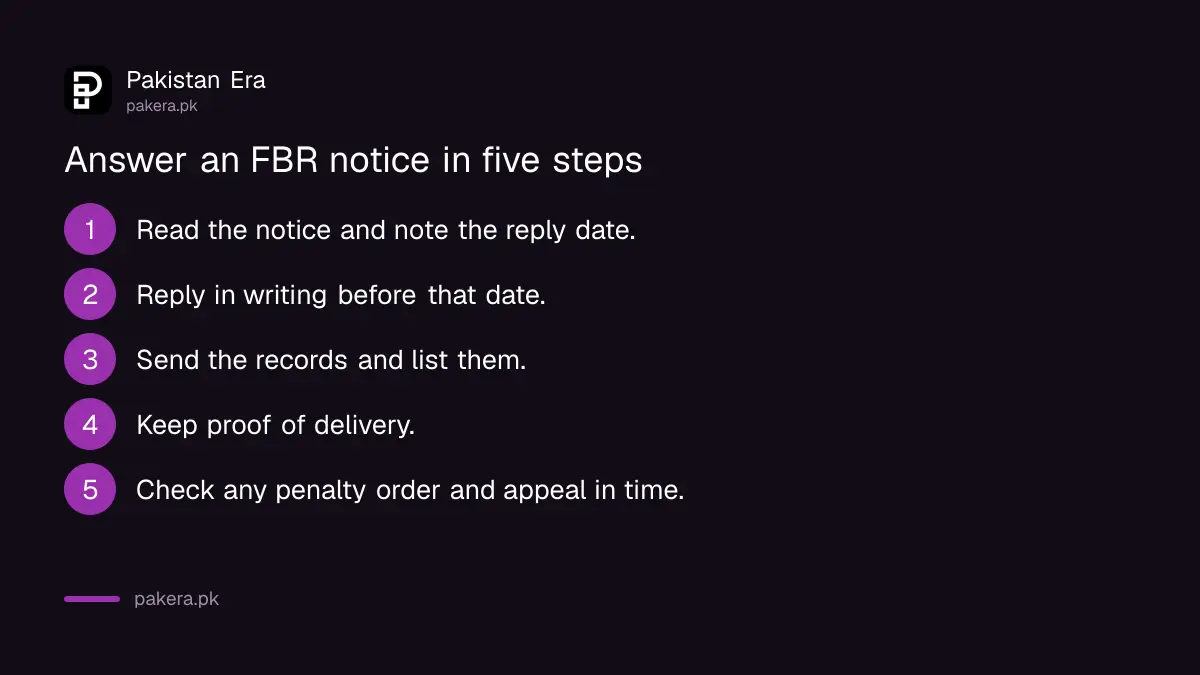
- Read every notice the day it arrives and note the date to reply.
- Reply in writing before the date, even if you need more time.
- Send the records asked for, with a list of what you attach.
- Keep proof of delivery, such as an IRIS submission receipt.
- If a penalty order arrives, check the amount against the table above and appeal in time.
Our guide to replying to an FBR section 177 audit notice shows what records to produce. If you find a mistake in a filed return, revise your income tax return before FBR asks. To challenge an order, read how to appeal to the Commissioner (Appeals).
Two new penalties target business systems
The Act also adds two entries aimed at businesses. Entry 2A covers a person who is told to install and use an electronic resource for tax records and fails to do so. The penalty is 1% of turnover or Rs 1 million for the first default, whichever is higher, and Rs 2 million for every later quarterly default.
Entry 2B covers an agency or organisation notified as an integrated organisation that fails to connect its IT system or share data as required. The penalty is Rs 500,000 for the first default and Rs 1 million for each later one, imposed on the principal officer or chief executive.
Common questions
What is the penalty for ignoring a section 177 notice from 1 July 2026?
Rs 100,000 for the first notice, Rs 200,000 for the second and Rs 300,000 for the third, under the Finance Act 2026.
What is the penalty for a false statement to FBR?
The Act raises it to Rs 500,000 or 100% of the tax shortfall, whichever is higher.
Does a penalty apply without a hearing?
No. The penalty section requires a written order after giving you a chance to be heard.
Are these penalties in force already?
The Finance Act 2026 came into force on 1 July 2026 unless it says otherwise. We found no later start for these entries.
Why do some pages show Rs 25,000?
That was the figure before the Act. FBR's online copies of the tables may be updated later than the Act, so check the Act's wording.
Can I avoid the penalty by revising my return?
Revising a return before FBR acts can reduce the risk. It does not remove a penalty that has already been ordered.
How we verified this
What we checked, where we read it, and what we could not confirm.
Last checked on 13 October 2026, Pakistan time. We read section 182 as amended by the Finance Act 2026 and the Ordinance as amended up to 31 July 2025, both on FBR's download site. We did not read a consolidated table that includes the 2026 changes, so the new figures follow the Act's substitutions and should be confirmed against the current table.
About the author

Senior Writer, Public Services and Technology
Shahid joined us in 2024 as an author. He is a senior contributor to Pakistan's leading technology websites. He writes detailed articles, mostly covering his expertise in the latest tech, mobiles, apps, gadgets, and step-by-step guides. His ideology is to help people understand the latest trends and explain complex methods through very easy-to-understand guides.