File Your FBR Quarterly Withholding Statement by 20 October 2026
The July to September withholding statement is due to FBR on or before 20 October 2026, even with no tax deducted. See who files, what it lists and the penalty.
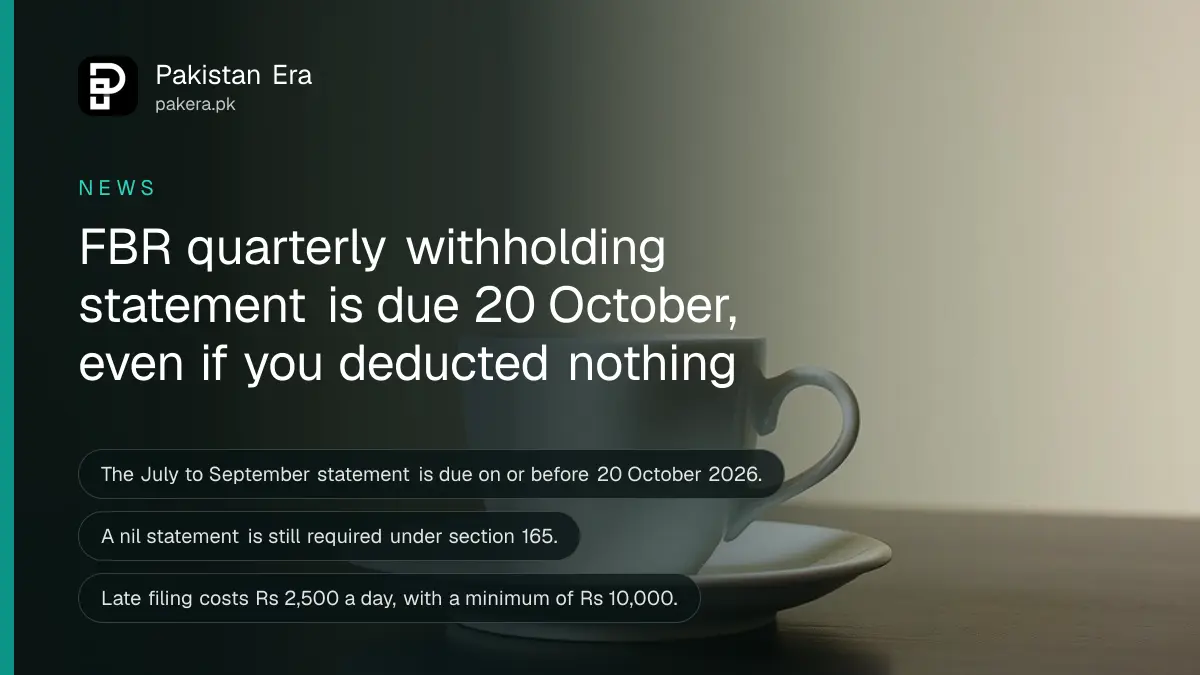
Short answer: If you deducted or collected income tax from anyone between 1 July and 30 September 2026, your quarterly withholding statement is due to FBR on or before 20 October 2026. The law says you must file it even if you deducted nothing. A late statement costs Rs 2,500 for each day of default, with a minimum of Rs 10,000.
Picture a small company that paid rent, a contractor and three staff in the July to September quarter. The accountant paid each deduction on time and then forgot the statement. The tax was paid, so it feels finished. It is not. The statement is a separate filing, and the penalty runs on its own.
We read section 165 and the penalty table in the Income Tax Ordinance, 2001, as amended up to 30 June 2026, on FBR's own website on 12 October 2026. We did not log in to IRIS, because that needs a taxpayer account. So this guide gives the legal dates and penalties, and tells you where we could not check the portal steps.
The July to September statement is due on or before 20 October 2026
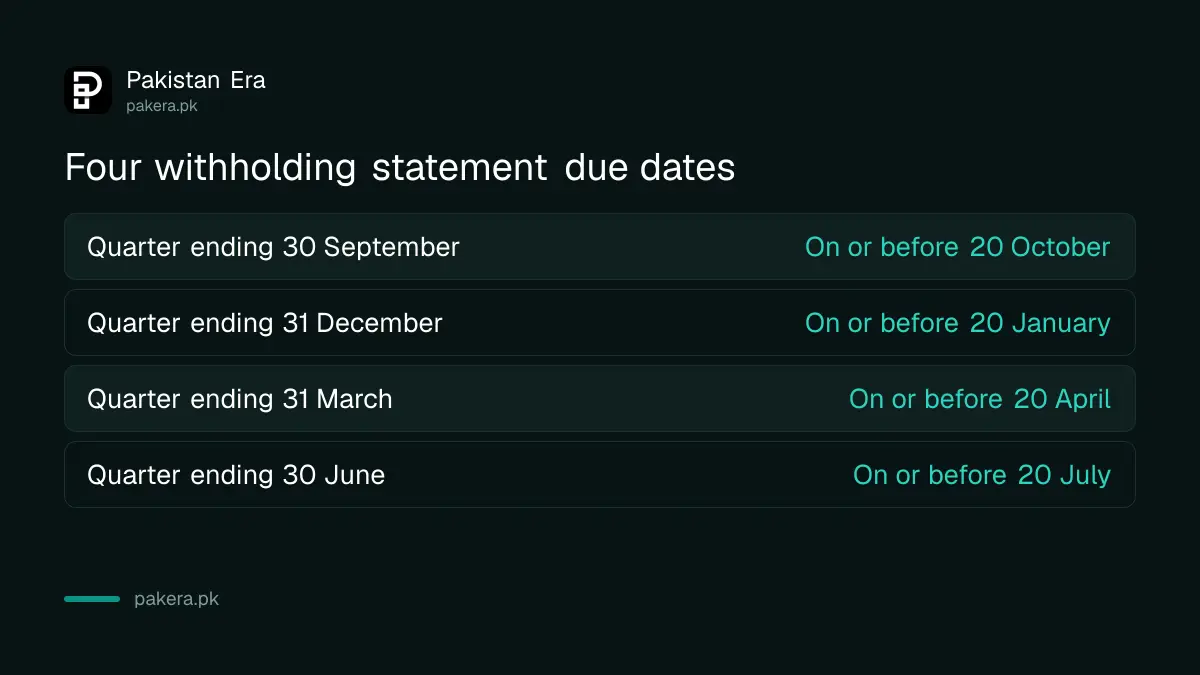
Section 165(2) of the Ordinance sets four dates in a year. The quarter that ends on 30 September must be filed on or before 20 October. That is Tuesday next week. The law counts the day itself, so the statement must reach FBR by the end of 20 October.
| Quarter ending | Months covered | File on or before |
|---|---|---|
| 30 September | July, August, September | 20 October |
| 31 December | October, November, December | 20 January |
| 31 March | January, February, March | 20 April |
| 30 June | April, May, June | 20 July |
Anyone who deducts or collects tax must file, including with a nil result
The duty falls on every person who collects advance tax or deducts tax at source under the Ordinance. A proviso to section 165(1) adds that the statement is required even where no tax was collected or deducted in the period.
Think of an employer who deducts salary tax, a company that deducts tax from a supplier's invoice, or a landlord's tenant business that deducts tax from rent. Each of them is a withholding agent. The law says "prescribed person" in some places. FBR's rules decide who is prescribed, and we did not read those rules, so confirm your own position on IRIS or with your tax adviser.
The deductions themselves are covered in our pages on tax to deduct from rent, supplier and contractor deductions and salary tax deduction. This page is only about the statement that reports them.
What the statement must list
For each person you deducted from or collected from, the statement gives the name, CNIC, National Tax Number and address, the total paid to that person in the quarter, and the total tax deducted or collected. FBR can also prescribe other particulars.
That means you need a clean record before you start. Keep one sheet per quarter with every payee, every payment, the tax withheld and the date you paid that tax to the government. A missing CNIC or NTN is the most common reason a line fails to match later.
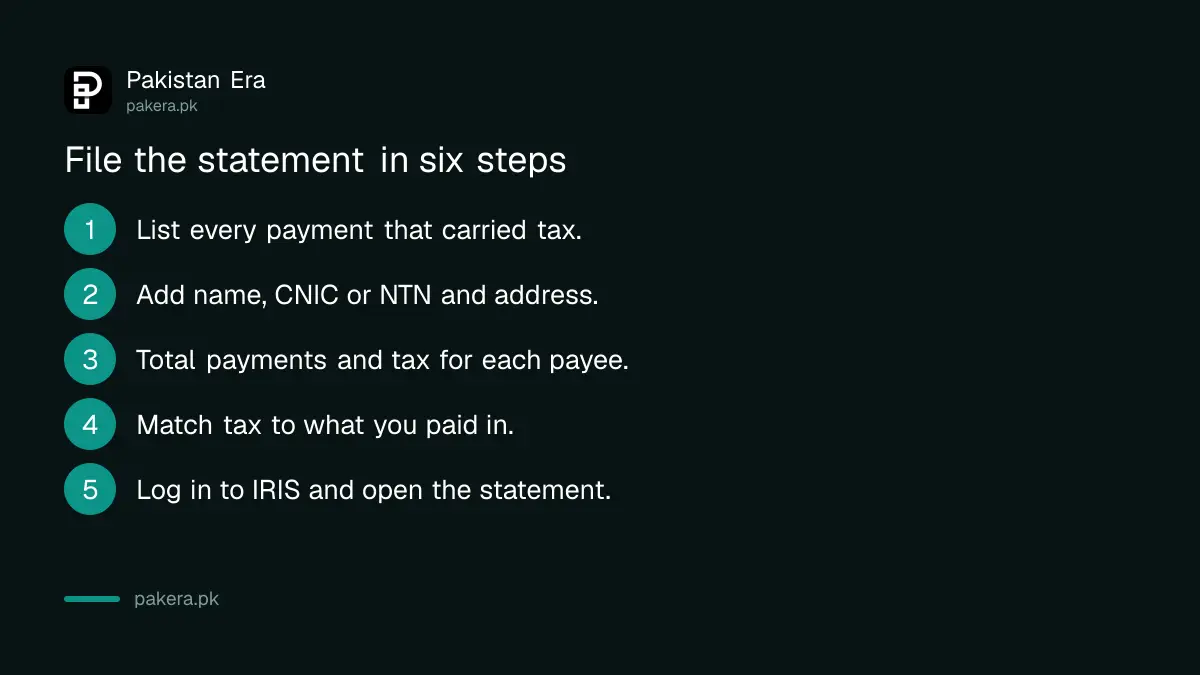
- List every payment you made in July, August and September on which tax applied.
- Write the payee's name, CNIC or NTN and address against each line.
- Add the payments and the tax deducted for each payee.
- Match the total tax to the payments you already made to the government.
- Log in to IRIS and open the withholding statement for the quarter.
- Check the figures, submit, and save the acknowledgement.
Section 165(5) lets FBR make rules for electronic filing, and the Ordinance describes the statement as one furnished "in the prescribed form". We did not open the IRIS menu, so use the form name and menu path that IRIS shows you.
A late statement costs Rs 50,000 or Rs 2,500 a day
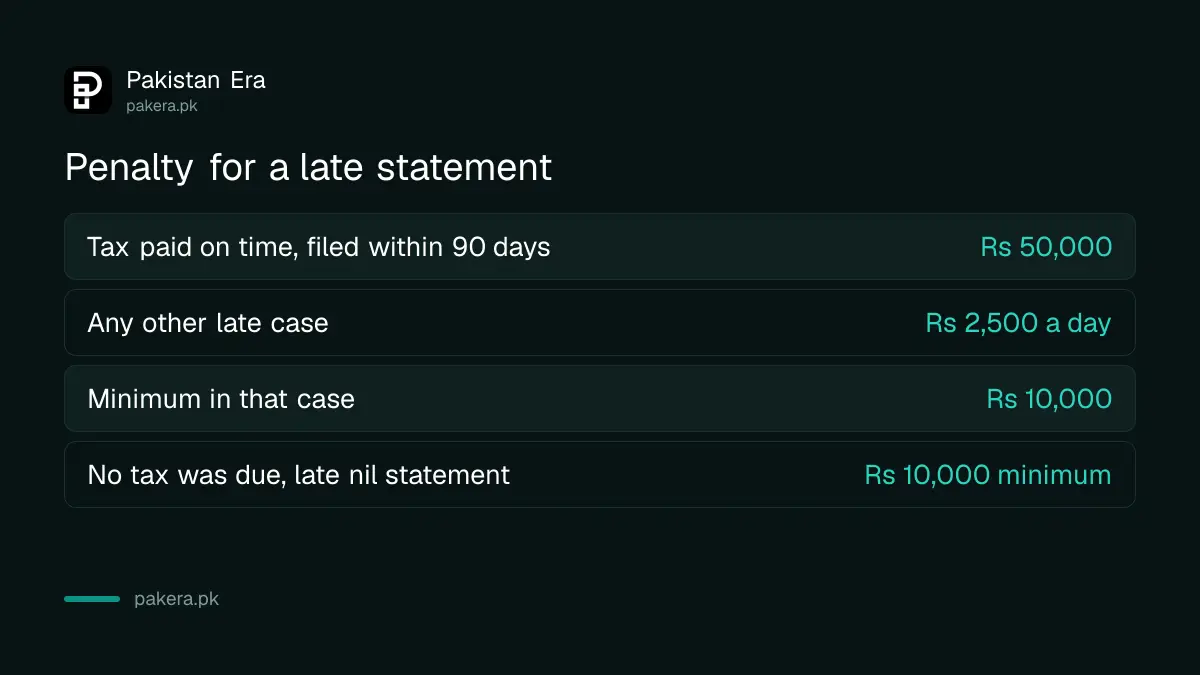
The penalty table in section 182 has a specific entry for a missing statement under section 165. If you paid the tax on time and then file within 90 days of the due date, the penalty is Rs 50,000. In every other case it is Rs 2,500 for each day, with a minimum of Rs 10,000.
One proviso helps a nil filer. Where it is established that no tax had to be deducted or collected in the period, the minimum penalty is Rs 10,000. So a nil statement filed late still costs money, but the floor is lower.
The penalty is a penalty on the statement. It is not the tax itself. If you also failed to deduct or pay the tax, a different section applies, and the tax can be recovered from you personally. Do not treat the statement as the only risk.
You can fix a mistake or ask for more time
Section 165(2A) lets you file a revised statement within 60 days of filing the first one, if you find a missing or wrong entry. Section 165(4) lets you apply to the Commissioner in writing for an extension, but only for reasonable cause, and the Commissioner decides.
An application for extra time is not an automatic extension. File the request before the date if you can, state the real reason, and attach proof. A busy month is not usually a reasonable cause. A documented system failure may be.
FBR can also ask for a statement outside the normal dates. Under section 165(2B) the Commissioner can send a notice requiring a statement for a period the notice names. If one arrives, answer it by the date it gives. You can check any such message against IRIS using our guide on checking that an FBR notice is real.
Annual statements follow later
Section 165(6) asks anyone deducting tax from payments under section 149 to give an annual statement. That is the salary tax section. Section 165(7) asks prescribed persons to e-file an annual statement within 30 days of the end of the tax year. These are separate from the quarterly filing described above.
The tax year ended on 30 June 2026, so the 30 day window for that annual statement has passed. If you have not filed it, ask your adviser now whether it applied to you. The quarterly statement due on 20 October is the one still open.
Common questions
Do I have to file if I deducted no tax this quarter?
Yes. The proviso to section 165(1) says a statement is required even where no tax was collected or deducted in the period. A nil statement filed late still carries a penalty, with a Rs 10,000 minimum.
What is the due date for the July to September statement?
It is on or before 20 October 2026. Section 165(2)(c) fixes the 20th day of the month after the quarter ends. The next three dates are 20 January, 20 April and 20 July.
What is the penalty for filing late?
It is Rs 50,000 if you paid the tax on time and file within 90 days of the due date. Otherwise it is Rs 2,500 for each day of default, with a minimum of Rs 10,000.
Can I correct a statement after I file it?
Yes. Section 165(2A) allows a revised statement within 60 days of filing the original. After that, ask the Commissioner, and expect to give a reason.
Who counts as a person who must file?
Anyone who collects or deducts tax under the Ordinance, and is a prescribed person, which includes employers and businesses that deduct tax from payments. FBR's rules say exactly who is prescribed, and we did not read them.
Is filing the statement the same as paying the tax?
No. The tax is paid to the government under section 160 within the time set by the rules. The statement reports who was deducted from and how much. You need to do both.
How we verified this
What we checked, where we read it, and what we could not confirm.
We read section 165 and the section 182 penalty table in the Income Tax Ordinance, 2001, amended up to 30 June 2026, published by FBR at fbr.gov.pk, on 12 October 2026. We did not read the Income Tax Rules that define "prescribed person" or the date by which deducted tax must be paid. We did not log in to IRIS. FBR can extend a date by order, so look at the FBR notice board before 20 October.
About the author

Senior Writer, Public Services and Technology
Shahid joined us in 2024 as an author. He is a senior contributor to Pakistan's leading technology websites. He writes detailed articles, mostly covering his expertise in the latest tech, mobiles, apps, gadgets, and step-by-step guides. His ideology is to help people understand the latest trends and explain complex methods through very easy-to-understand guides.