PTA Blocks a Fraudulent SIM and the Phones Tied to It at Once: What Regulation 12-B Means in Pakistan
PTA's regulation 12-B blocks a fraudulently issued SIM and the IMEI of devices tied to it at once. See how a genuine SIM or phone is restored in Pakistan.
Short answer: Under PTA's new regulation 12-B, a SIM reported as issued by fraud must be blocked by the operator immediately, and so must the IMEI of the devices used to issue it, activate it or last report it. Blocked SIMs and devices are restored after verification, with a recorded reason, especially for genuine subscribers.
A student in Lahore buys a used phone from a friend. A week later it shows as blocked on PTA's status check. The phone is clean. The SIM that was last used in it was not. A rule added to the Gazette on 11 September 2026 explains how that can happen.
We read the rule on PTA's regulations page. It is regulation 12-B, inserted by the Subscriber Antecedents Verification (3rd Amendment) Regulations, 2026. The notification is S.R.O. 1519(I)/2026. It is a scanned Gazette page, so we read the page as an image.
A SIM reported as fraudulent is blocked at once
The text says that where any SIM is reportedly issued through fraudulent means, the operator shall block it immediately. The word "reportedly" means a report is enough to trigger the block. The operator does not have to wait for a court or an investigation.
That helps you if a SIM was issued on your CNIC without your knowledge. Reporting it should lead to a block, not a long wait. The steps for finding and reporting such a number are in how to report an unknown SIM on your CNIC.
It also means a genuine SIM can be blocked by mistake if someone reports it wrongly. The same regulation covers that case, as the last section shows.
The phones used to activate it can be blocked too
The same rule says the IMEI of devices used for the issuance, activation or last reported use of such SIMs shall also be blocked immediately. An IMEI is the 15 digit number that identifies one handset. A blocked IMEI stops the phone working on Pakistani networks.
Three groups of devices are named. The first is the device used to issue the SIM, which is usually the biometric device at a franchise. The second is the handset used to activate it. The third is the handset the SIM was last seen in.
Our reading is that the third group is the one an ordinary buyer can fall into. A phone that carried a fraudulent SIM last can be blocked, even if the buyer never saw that SIM. That is our interpretation of the wording. PTA's page does not give an example.
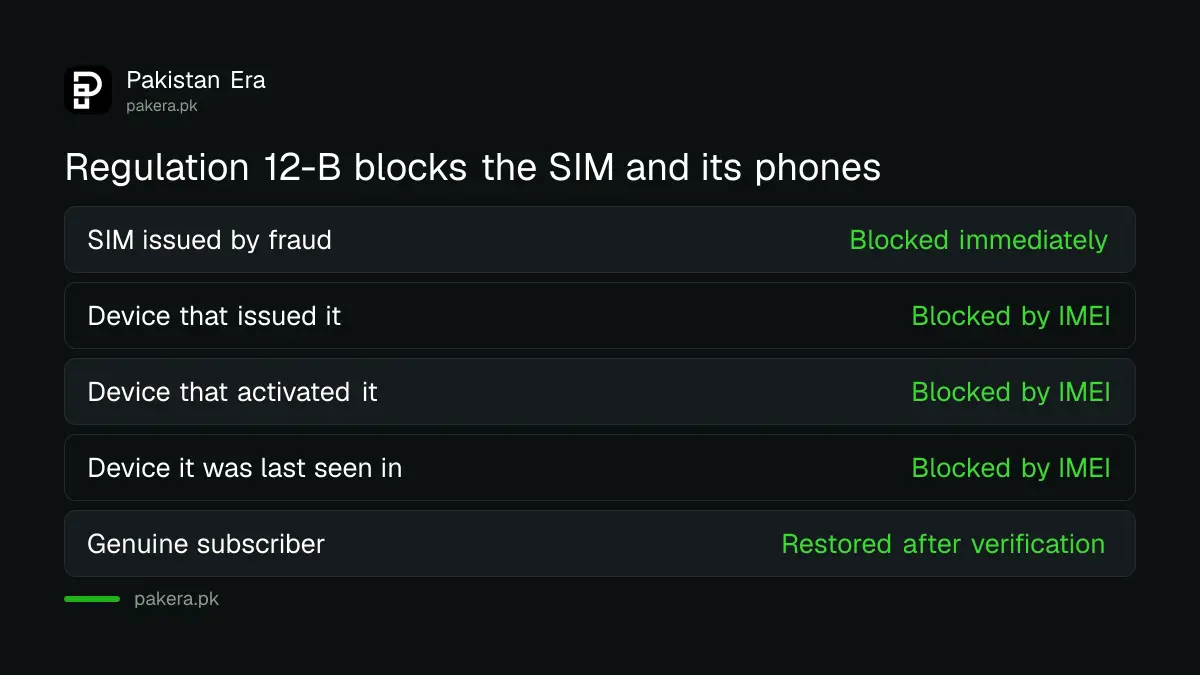
| Item | Blocked under 12-B | When | Restored how |
|---|---|---|---|
| SIM issued by fraud | Yes | Immediately, on a report | After verification |
| Handset that activated the SIM | Yes, by IMEI | Immediately | After verification |
| Handset the SIM was last seen in | Yes, by IMEI | Immediately | After verification |
| Biometric device that issued it | Yes, as a BVS device | When blocked | After verification, with a recorded reason |
Restoration needs verification and a recorded reason
Sub-regulation 12-B(2) says a blocked SIM or biometric device shall be restored upon verification and by recording reasonable justification, particularly for genuine subscribers. The operator must write down why it restored.
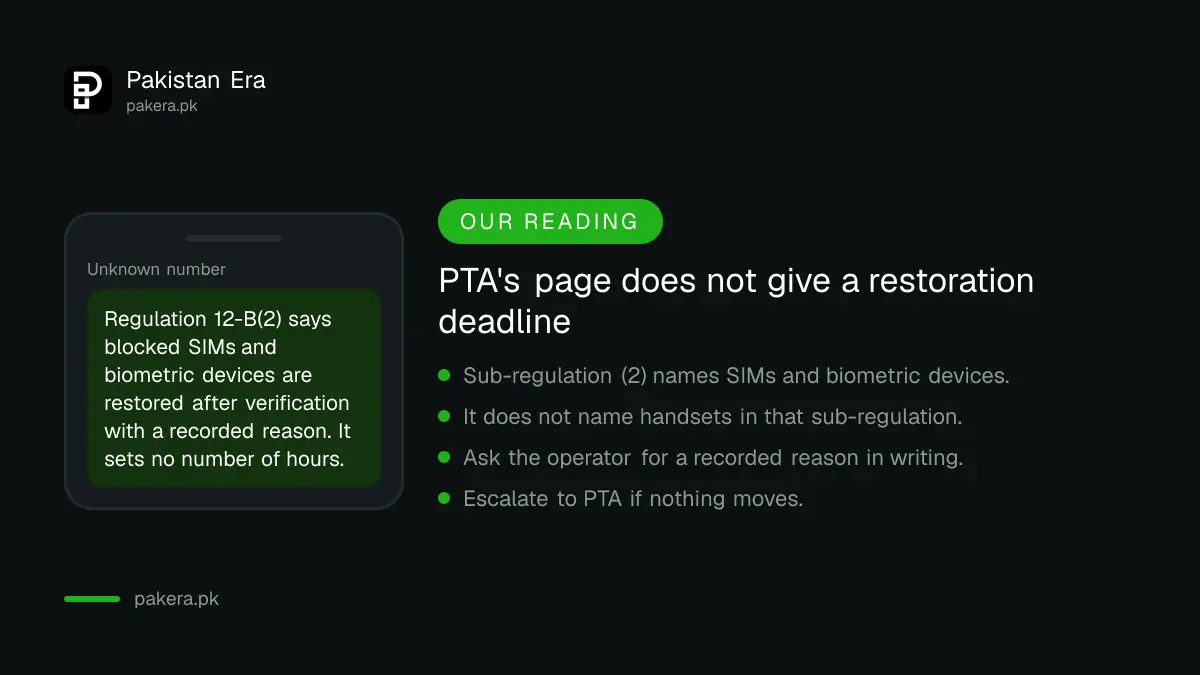
That gives you something to ask for. If your own SIM or phone was blocked by mistake, you are entitled to verification and a recorded reason, not a flat refusal. The regulation does not set a number of hours for the restoration, and we found no time limit for it on PTA's page.
The wording names SIMs and biometric devices in sub-regulation (2). It does not name handsets there. We could not confirm that a blocked IMEI is restored by the same route. A handset block is normally lifted through PTA's own processes, as explained in unblocking a recovered phone.
What to do if your phone or SIM is blocked
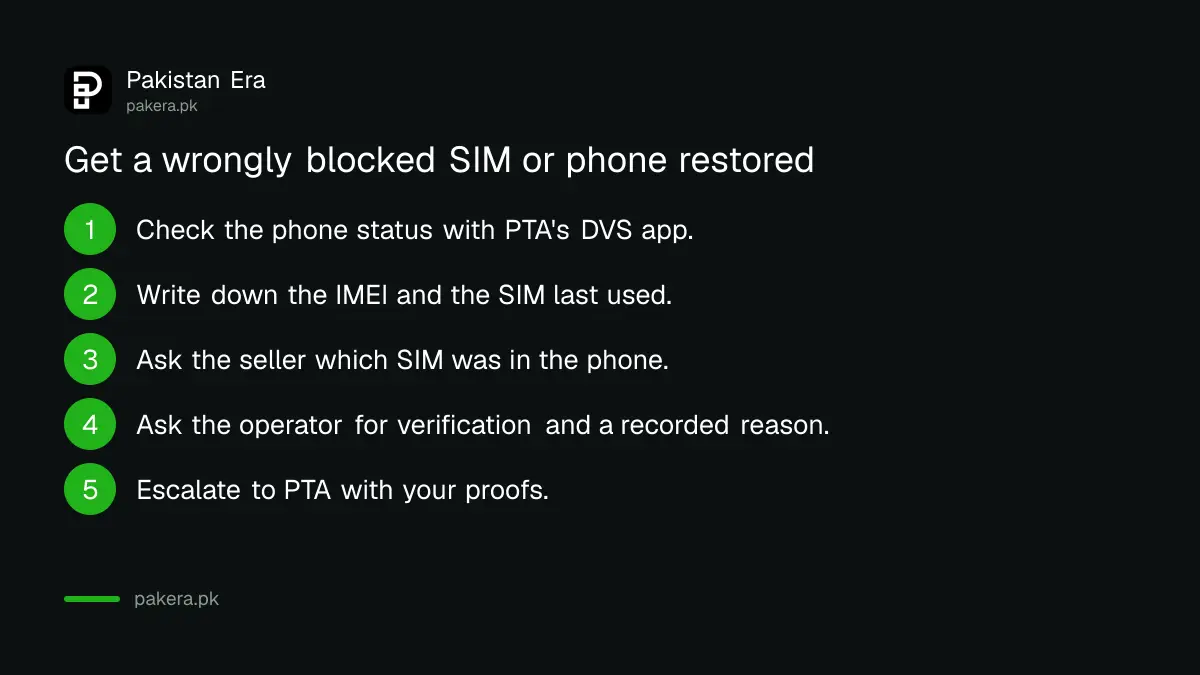
Work from the phone's status first, because it tells you which kind of block you have. Keep your CNIC, the purchase receipt and the box.
- Check the phone's status using PTA's DVS app and status check.
- Write down the IMEI, the date it was blocked and the SIM last used in it.
- Ask the seller which SIM was in the phone last, if you bought it used.
- Complain to your operator and ask for verification and a recorded reason under regulation 12-B.
- If the operator does not act, use the PTA complaint steps with your proofs.
Before you buy a used phone, run the checks in checking a phone bought online before you insert a SIM. A clean status on the day of purchase does not tell you the future, but it removes the worst cases. A cloned or duplicate IMEI is a separate problem, covered in fixing a blocked duplicate IMEI.
Common questions
Does a fraud report block a SIM straight away?
Yes. Regulation 12-B says a SIM reportedly issued by fraud shall be blocked immediately by the operator. The operator does not have to wait for proof first.
Can my phone be blocked because of someone else's SIM?
It can, on our reading. The rule blocks the IMEI of devices used for issuance, activation or the last reported use of such SIMs. PTA's page gives no example, so check your status.
How do I get a wrongly blocked SIM restored?
Ask the operator for verification and a recorded reason under regulation 12-B(2). Take your original CNIC. If it refuses, escalate to PTA with your proofs.
Is there a deadline for the operator to restore it?
We found none in regulation 12-B. Another PTA rule sets 4 hours for restoring a suspended service, but we could not confirm it covers a fraud block.
What is a BVS device?
It is a biometric verification system device used by a franchise or outlet to scan fingerprints when a SIM is issued. The regulation lets a blocked one be restored after verification.
How we verified this
What we checked, where we read it, and what we could not confirm.
Last checked on 13 October 2026, Pakistan time. We read the Gazette entry for the Subscriber Antecedents Verification (3rd Amendment) Regulations, 2026 on PTA's regulations page. We did not verify how operators apply the rule in practice, whether a handset block follows the same restoration route, or any time limit. The used phone example is our reading of the text.
About the author

Technology Journalist & Multimedia Producer
Ahmad Ali is a technology journalist and multimedia producer at Pakistan Era, joining the team in October 2026. He covers consumer technology and digital life for Pakistani readers, combining research with hands-on product testing.