Who Gets Gas First in a Pakistan Winter: Homes Rank First and CNG Stations Last
Pakistan gas priority order: homes and shops first, power and export industry second, CNG stations last, under a 2018 Petroleum Division letter. See the list.
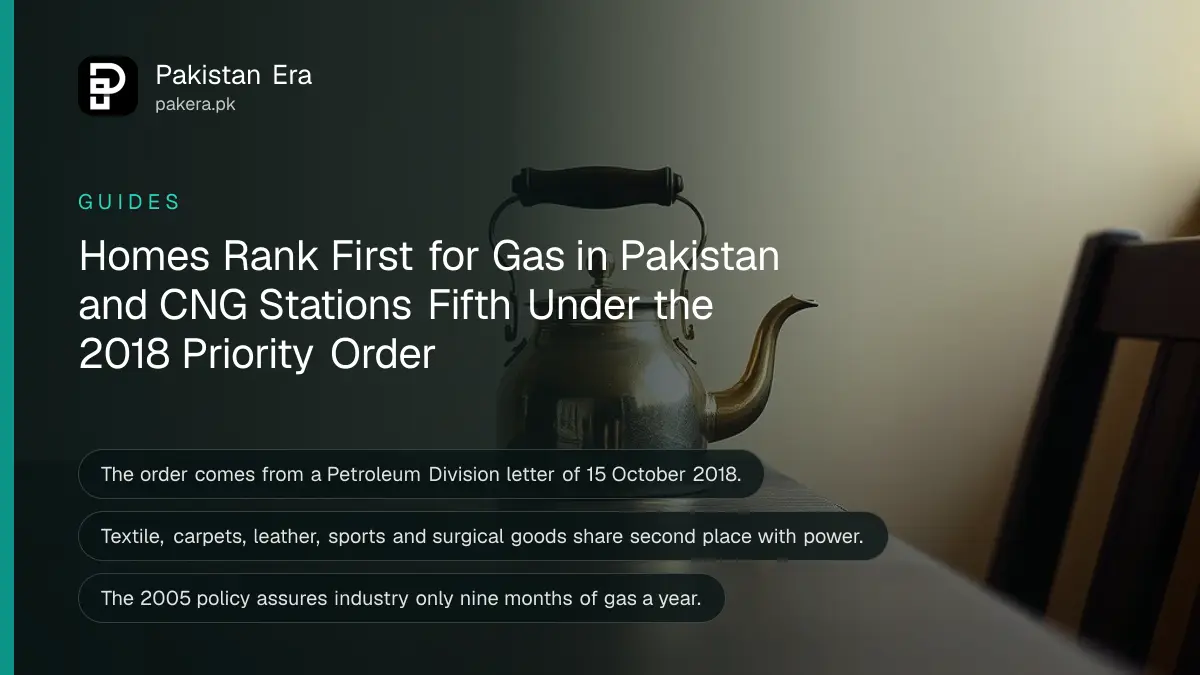
When gas runs short in Pakistan, the law of the queue is a Petroleum Division letter of 15 October 2018: homes and shops are served first, power plants and five export industries second, general industry, fertiliser and captive power third, cement fourth and CNG stations last. That order revised the Natural Gas Allocation and Management Policy of 2005, and both documents are on SNGPL's website, where we read them on 19 October 2026. It is the reason a CNG station shuts before your stove does.
Every winter the same question comes up as pressure drops at breakfast: who decided that my kitchen gets gas at 7 am and not at 9? The schedule itself is set by SNGPL and SSGC with the Petroleum Division, and neither company has published its winter 2026-27 timetable yet. The priority order behind that schedule, though, is public and has not changed since 2018.
The 2018 letter puts domestic and commercial consumers first
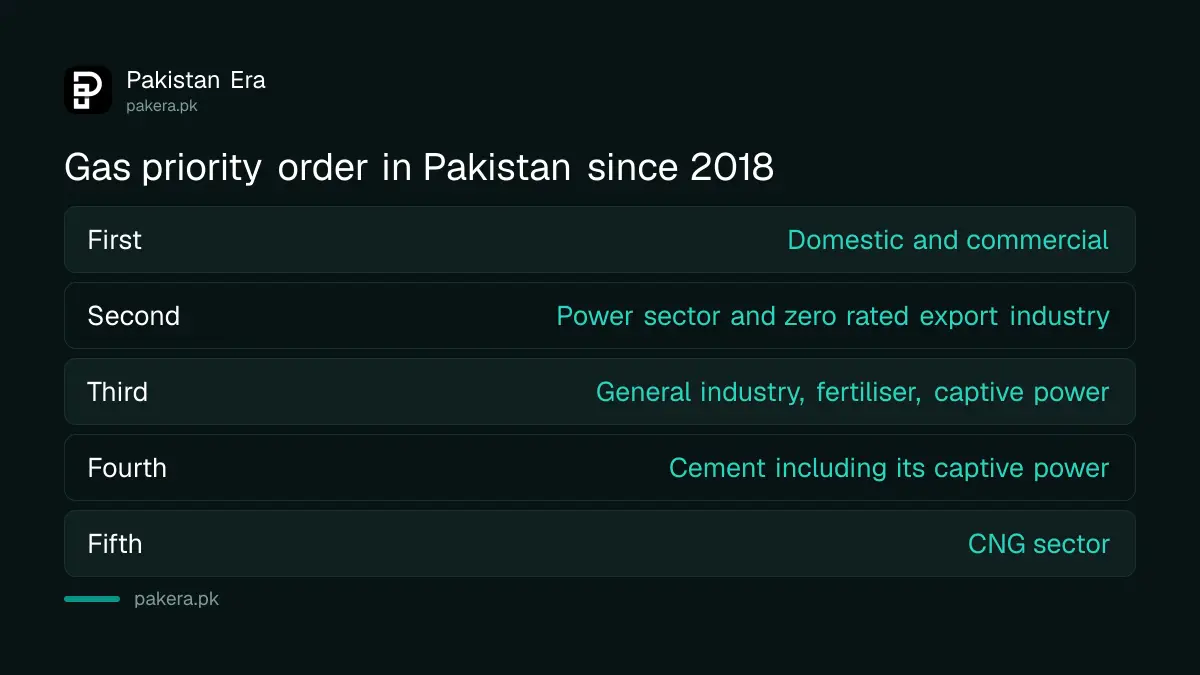
The Petroleum Division's letter NG(I)-7(158)/17-LS, addressed to the managing directors of SNGPL and SSGC, records a decision of the Economic Coordination Committee on 17 September 2018. It lists five priority groups for system gas, with domestic and commercial consumers in first place and the CNG sector in fifth.
| Priority | Category of consumers, as listed in the 2018 letter |
|---|---|
| First | Domestic and commercial |
| Second | Power sector, and zero rated general industry |
| Third | General industrial, fertiliser and captive power |
| Fourth | Cement sector, including its captive power |
| Fifth | CNG sector |
The letter's footnote defines zero rated industry as "textile (including jute), carpets, leather, sports and surgical goods", the five export sectors. The ECC's direction was to bring those five sectors up to second priority alongside power. Commercial means shops, restaurants and tandoors on a commercial meter, and they share first place with homes.
The 2005 policy had six steps and put fertiliser above power
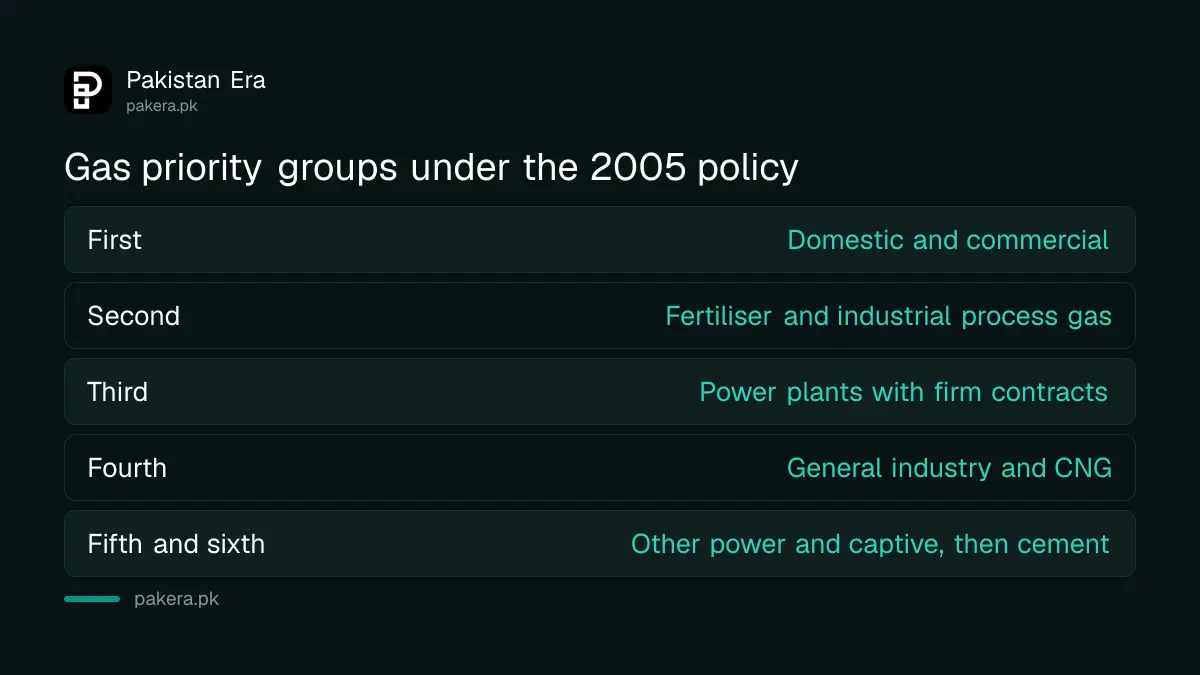
The original Natural Gas Allocation and Management Policy, issued by the Ministry of Petroleum and Natural Resources in September 2005, set a six step merit order for the pipeline system. Domestic and commercial were first there too. Fertiliser and the process gas of industry came second, firm contract power plants third, general industry and CNG fourth, other power and captive power fifth, and cement sixth.
| Group | 2005 policy, section 4.1 | 2018 revision |
|---|---|---|
| Domestic and commercial | First | First |
| Fertiliser | Second, with industrial process gas | Third |
| Power plants with firm contracts | Third | Second |
| Export industry, the five zero rated sectors | Fourth, inside general industry | Second |
| General industry | Fourth | Third |
| CNG | Fourth | Fifth |
| Captive power | Fifth | Third |
| Cement | Sixth | Fourth |
Two moves stand out. Fertiliser dropped from second to third, and CNG fell from fourth to last. The CNG decline that followed is set out in the report on CNG use in Pakistan, which found gas use by the sector down 83 per cent since 2011-12. New CNG licences are now issued only on imported RLNG, which sits outside this queue.
The policy already assumed winter curtailment of industry and power
Section 2.2 of the 2005 policy describes how peak winter demand was managed even then: domestic and commercial consumers "get continuous gas supply", fertiliser plants are supplied continuously, industries on nine month contracts "are curtailed or totally disconnected", power plants get gas after everyone else, and cement is served "as and when available".
That nine month idea runs through the policy. Section 3.1.4 gives general industry assured supply for process gas on a twelve month basis, but for all other uses only nine months, with the remaining period "on the best effort basis". The three months left out are the winter. So an industrial gas holiday in December is not a breach of contract; it was written into the allocation rule from the start.
What the policy does not promise is continuous pressure at every hour for homes. First priority means homes are the last group to be cut and the first to be restored. It does not stop the companies from timing supply to cooking hours when the shortfall is large, which is what the gas load shedding schedule has looked like in past winters.
Imported RLNG consumers sit in a separate, ring fenced queue
The priority order applies to system gas, the indigenous supply from Pakistani fields. RLNG, the regasified imported gas, is sold under separate contracts at a separate price and the companies account for it on a ring fenced basis. New domestic connections since the ban was eased are RLNG connections, and their contract says supply is "on as and when available basis".
In practice the molecules mix in the same pipe, and SNGPL's own RLNG contract says so. But the pricing and the allocation are different. The monthly RLNG price is set by OGRA, as covered in the report on the RLNG price for September 2026, and Karachi's power supply has already felt what happens when RLNG cargoes slip, as in the piece on K-Electric's temporary load management.
What to do when your supply drops below the priority you are owed
If a domestic meter loses gas while an industrial unit on the same line keeps running, the order is being broken and the company has to answer for it. Note the time and pressure, call 1199, and log a complaint with a number you can quote. If it is not fixed, OGRA is the next step.
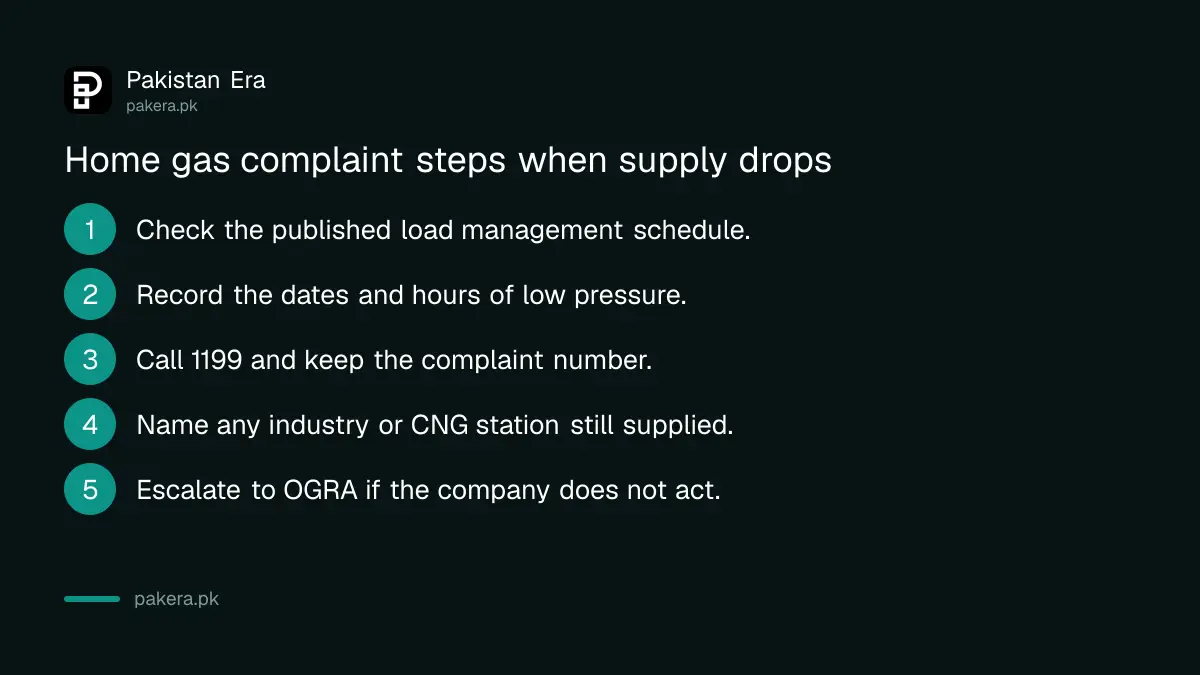
- Check whether the company has published a load management schedule for your region and whether your area is on it.
- Record the dates and hours of low or no pressure, and a photo of a gas lighter failing to catch is as good a record as any.
- Call 1199 or use the online form, and keep the complaint number. The routes are in the guide to SNGPL and SSGC gas complaints.
- If a factory or CNG station nearby is clearly supplied while homes are not, say so in the complaint, naming the priority order.
- Escalate to OGRA with the complaint number if the company does not act within its own timelines.
Winter bills are the other half of the season. Lower pressure often means longer cooking and higher consumption, and the slab you land in decides the bill; the slabs are worked through in the guide to Sui gas winter bill slabs. The money behind the shortfall, the Rs 3.6 trillion gas circular debt, is covered in the report on the gas circular debt plan.
Common questions about gas priority in Pakistan
Who gets gas first when there is a shortage in Pakistan?
Domestic and commercial consumers, under the Petroleum Division's 2018 revision of the 2005 allocation policy. Power and the five export industries come second.
Why do CNG stations close before homes lose gas?
Because CNG is fifth and last in the 2018 priority order. The 2005 policy had it fourth, alongside general industry.
Are factories entitled to gas in winter?
Only partly. The 2005 policy assures general industry supply for nine months, with the rest on a best effort basis, except for process gas, which is on a twelve month basis.
Does first priority mean 24 hour supply for homes?
No. It means homes are cut last and restored first. The companies can still time supply to cooking hours when the shortfall is severe.
Does the order apply to RLNG connections?
The order governs system gas. RLNG is sold under separate contracts that say supply is as and when available, though the gas mixes in the same pipes.
Has the winter 2026-27 gas schedule been announced?
Not as of 19 October 2026. SNGPL's load management page still showed notices from December 2021 when we checked, and SSGC had posted none.
How we verified this
What we checked, where we read it, and what we could not confirm.
Last checked 19 October 2026. The 2018 priority order comes from the Petroleum Division letter NG(I)-7(158)/17-LS dated 15 October 2018, "Gas Allocation and Management Policy 2005 - Revision in Priority Order", a scanned copy of which SNGPL publishes on its gas allocation policy page; we read it there on 19 October 2026. The 2005 order, the nine month rule and the winter management description come from the Natural Gas Allocation and Management Policy, 2005, of the then Ministry of Petroleum and Natural Resources, downloaded from the same page. The RLNG contract wording is from SNGPL's domestic RLNG supply contract on its contracts page. We checked SNGPL's load management and low pressure pages and SSGC's home page the same day and found no winter 2026-27 schedule. We could not confirm whether any later ECC decision has changed the 2018 order; none is posted by SNGPL.
About the author

Senior Writer, Public Services and Technology
Shahid joined us in 2024 as an author. He is a senior contributor to Pakistan's leading technology websites. He writes detailed articles, mostly covering his expertise in the latest tech, mobiles, apps, gadgets, and step-by-step guides. His ideology is to help people understand the latest trends and explain complex methods through very easy-to-understand guides.