How to Get an Electronic Certificate of Origin (E-CO) in Pakistan Through PSW
Apply for an Electronic Certificate of Origin in Pakistan on PSW with TDAP: login, LPCO, nine steps, who issues which paper and what we could not confirm.
Short answer: Log in at psw.gov.pk, open LPCO, choose Electronic Certificate of Origin and click Create New Request. Pick the trade agreement, fill in the exporter, importer and goods details, attach your documents and submit. TDAP approves it online, and you download, sign and stamp the certificate for your buyer.
A buyer in Europe asks for proof that your towels were made in Pakistan. Without it, the shipment may not get the lower duty it was priced on. That proof is a certificate of origin, and Pakistan now issues it online.
We opened the Trade Development Authority of Pakistan (TDAP) origin certification page and the Pakistan Single Window (PSW) TDAP page on 12 October 2026. We did not log in, because that needs a registered exporter account. We could not read the fee amounts or the processing time, so this guide gives none.
TDAP issues the certificate through PSW, and chambers issue the plain ones
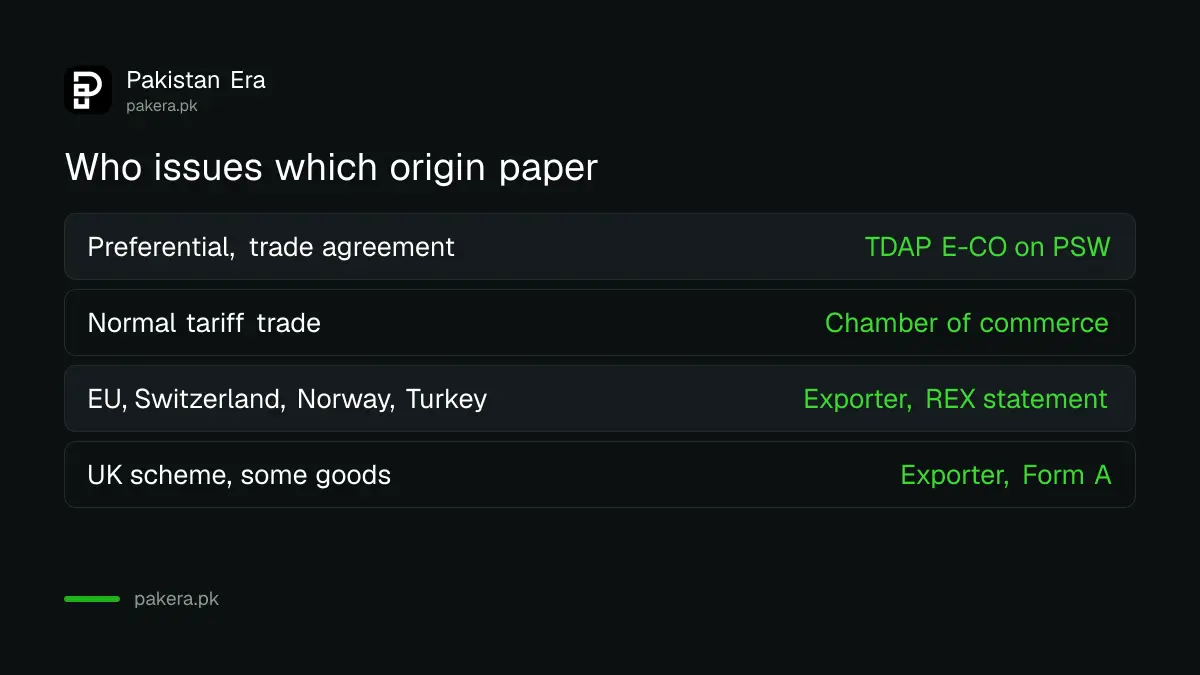
TDAP issues certificates of origin for preferential exports under bilateral, regional and GSP schemes, through PSW. Chambers of commerce issue the certificate for ordinary trade at normal tariff rates. So the first question is which kind of certificate your buyer needs.
| Need | Who issues it | How |
|---|---|---|
| Preferential origin under a trade agreement or GSP | TDAP | Electronic Certificate of Origin (E-CO) on PSW |
| Normal trade at standard tariff rates | Chamber of commerce | Chamber's own process |
| EU, Switzerland, Norway or Turkey | The exporter, once registered under REX | Statement on Origin |
| UK scheme, under certain rules | The exporter | Self-certification on Form A |
TDAP's page says online issuance of the E-CO began in September 2024. A QR code on the certificate lets the buyer verify it online.
You need a PSW account before you can apply
An E-CO request is made from your own PSW account. That account is the same one used to file goods declarations. If you do not have one yet, register first and finish the identity step.
Our guides cover each step: registering as an exporter through WeBOC and TDAP, linking your bank profile on PSW and the PSW biometric check on the PakID app. If you are unsure which system to use for the shipment itself, read WeBOC or PSW for the goods declaration.
The nine steps from login to the signed certificate
PSW lists nine steps. You log in, create a new E-CO request, choose the trade agreement and your goods declaration, enter the party and goods details, attach documents, submit, wait for approval, and then download and send the certificate.
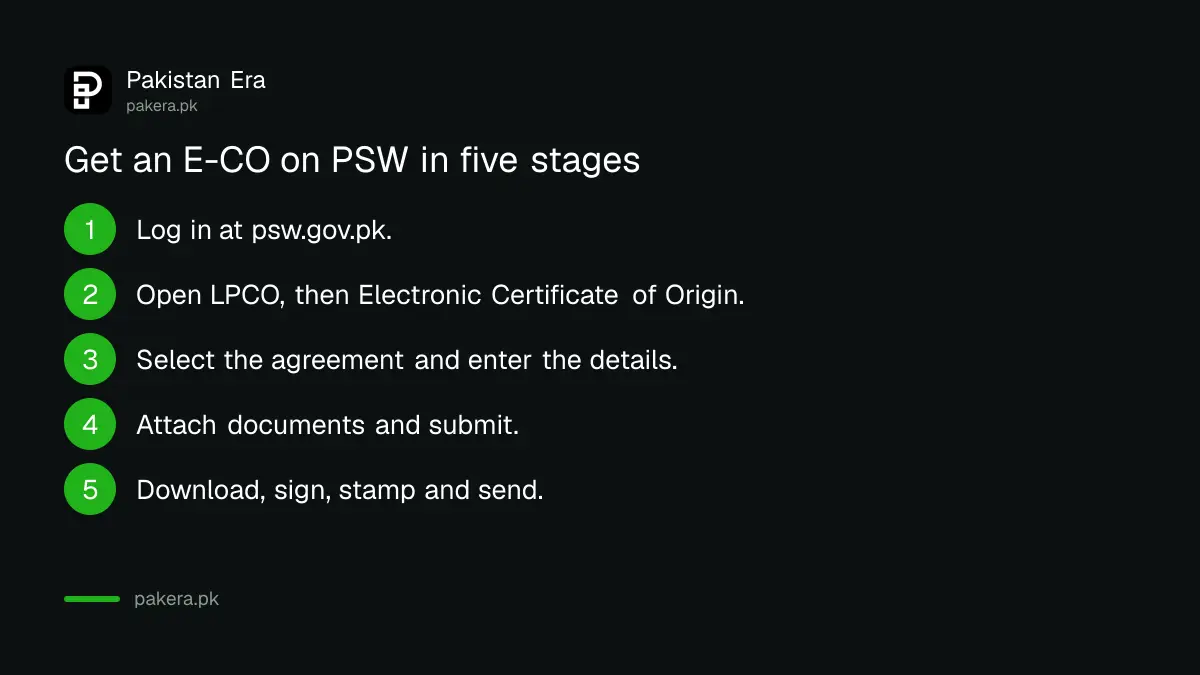
- Log in at psw.gov.pk with your user ID and password.
- Open the LPCO box (Licenses, Permits, Certificates, Others), then Electronic Certificate of Origin, then Create New Request.
- Select the trade agreement and the goods declaration the certificate belongs to.
- Enter the city of issue and the exporter, importer and producer details. The exporter details fill in by themselves.
- Add the means of transport, the commodity details and any remarks.
- Attach the required documents and preview the certificate.
- Submit, and note the request number you receive.
- Wait until the status shows Approved.
- Download the certificate, sign and stamp it, and send it to your buyer.
Forms, fees and help come through PSW and TDAP
PSW says the fee for certificate of origin forms is paid through a PD account or a 1Link payment channel. It also says the forms can be requested separately, by courier or by collecting them yourself. We could not read the fee amount on the pages we opened.
For help with the system, PSW lists a support line at (021) 111 111 779. TDAP's head office is at the Finance and Trade Centre, Shahrah-e-Faisal, Karachi. Keep your request number ready when you call.
Origin proof matters more when tariffs and schemes change
Where the buyer applies a special rate, the origin paper is what supports it. Rules for those schemes change, so check the rate and the paper your buyer needs before you ship. Our notes on the EU GSP+ rules from 2027 show how a scheme can change the paperwork exporters must hold.
The same care applies to the new United States tariff on Pakistani goods. We have not seen an official rule that an origin certificate changes that tariff, so ask your buyer's customs broker. What exporters must check is set out in the 10 per cent tariff on Pakistani goods. Keep the certificate, the invoice and the packing list together for every shipment.
Common questions
What is an E-CO in Pakistan?
An E-CO is an Electronic Certificate of Origin. TDAP issues it through the Pakistan Single Window, and a QR code lets the buyer verify it online.
Who issues a certificate of origin in Pakistan?
TDAP issues the preferential ones through PSW. Chambers of commerce issue those for non-preferential trade at normal tariff rates.
Do I have to visit a TDAP office?
No. PSW says the E-CO module removes the need for physical visits, because you apply, track approval and talk to TDAP officers online.
How long does approval take?
We could not find a processing time on the TDAP or PSW pages. Plan some days before the shipment date and ask PSW support for the current time.
How much does an E-CO cost?
We could not read a fee amount on the pages we opened. PSW says form fees go through a PD account or 1Link, so ask TDAP or PSW support for the current rate.
What if my goods go to the European Union?
TDAP says exporters registered under REX issue a Statement on Origin for the EU, Switzerland, Norway and Turkey. Check with your buyer which document they need.
How we verified this
What we checked, where we read it, and what we could not confirm.
Last checked 12 October 2026. We read the TDAP origin certification page and the PSW TDAP page. The two PDF manuals on the TDAP site did not open as text for us, so the steps follow the PSW page. We did not read fee amounts, processing times or the list of required documents.
About the author

Global Affairs & Political Economy Writer
Muhammad Hatim is a book lover who started writing because he enjoys it. At Pakistan Era he writes about international relations, geopolitics and the global economy, with a particular interest in South Asia and the forces behind current events.