Social Media Rules for Federal Government Employees in Pakistan, 2026
Federal civil servants need prior sanction to run a blog, vlog or podcast. Closed-group posts are exempt. The 2026 rules on what you can and cannot post online.
If you are a federal civil servant, you need prior sanction from your Cadre Administrator before you run a website, blog, vlog, podcast or channel, even under a fake name. Posts shared only with a limited, defined group are outside that rule. Anything you say in public must not embarrass the Government, and any breach is misconduct.
These are the social media rules for government employees in Pakistan under the Civil Servants (Conduct) Rules, 2026. The Establishment Division notified them as S.R.O. 638(I)/2026 on 13 April 2026, and they appeared in the Gazette of Pakistan on 14 April 2026. Rule 1 says they came into force at once. Rule 35 repealed the old Government Servants (Conduct) Rules, 1964.
We read all 14 pages of the Gazette notification on the Establishment Division website on 26 September 2026. The rule numbers below are quoted from it. The honest summary: an ordinary personal account is allowed, but it now sits under the same conduct standards as your office.
Who the social media rules cover
The rules cover every civil servant under the Civil Servants Act, 1973, on duty or on leave, inside or outside Pakistan, and on deputation. The Federal Government can also extend them by direction to autonomous bodies, regulators, state companies and universities.
That comes from rule 2. The same rule says an entity can adopt the rules voluntarily, and then its employees count as "civil servants" for these rules. So a staff member at a federal university or a state-owned company should check with their own HR office whether a direction has been issued.
One term runs through every rule below. A "Cadre Administrator" is the person or authority that manages your service or group. Rule 3(d) lists the Secretary of a Ministry or Division, the Head of an Attached Department or Subordinate Office, or the Chairman, Chief Executive or Board of a statutory or autonomous body.
Provincial employees are different. Provinces have their own conduct rules, and this notification is federal.
Running a channel, blog or podcast needs prior sanction
Rule 17(1) bars a civil servant from owning, writing for, editing or managing a website, blog, vlog, podcast, streaming channel, messaging service, TV or radio broadcast, or newspaper without the Cadre Administrator's prior sanction. Using your real name, no name or a pen name makes no difference.
The list in the rule is wide. It names "any website, web page or portal", "content-streaming platform for video or audio blogging, vlogging or podcasting" and "content-sharing or messaging service". A cooking channel, a cricket podcast or a poetry page are all inside it, whatever the topic.
There is one exception, in the proviso to rule 17(1). Content posted from a personal account that is open "to only a limited and defined group of individuals, and not the public at large" falls outside the sub-rule. A family WhatsApp group or a Facebook account locked to friends fits that description.
What about a normal public profile where you post now and then? The rule does not say. A public account is visible to "the public at large", so the exception does not clearly protect it. If you post publicly and often, ask your Cadre Administrator in writing rather than guess.
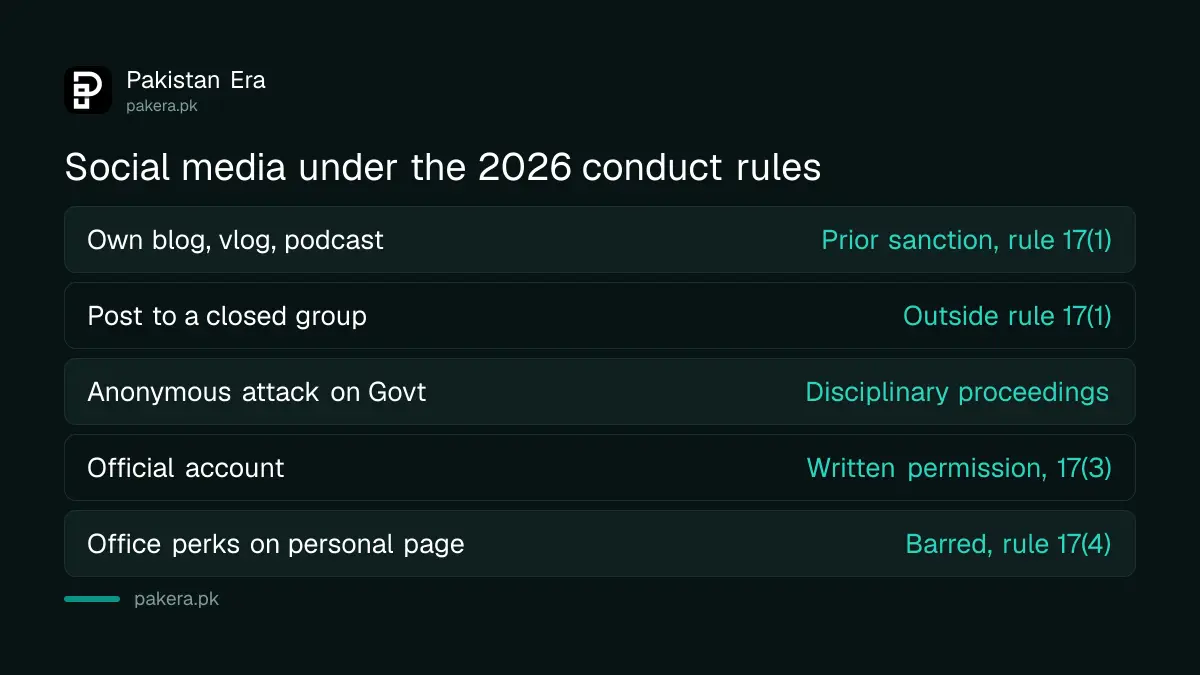
Anonymous, personal and official accounts have separate rules
Rule 17 treats three kinds of account differently. An anonymous account that discredits the Government leads to disciplinary proceedings. A personal account must not show off official work. An official account needs written permission and is handed over when you are transferred.
Anonymous and pseudonymous accounts
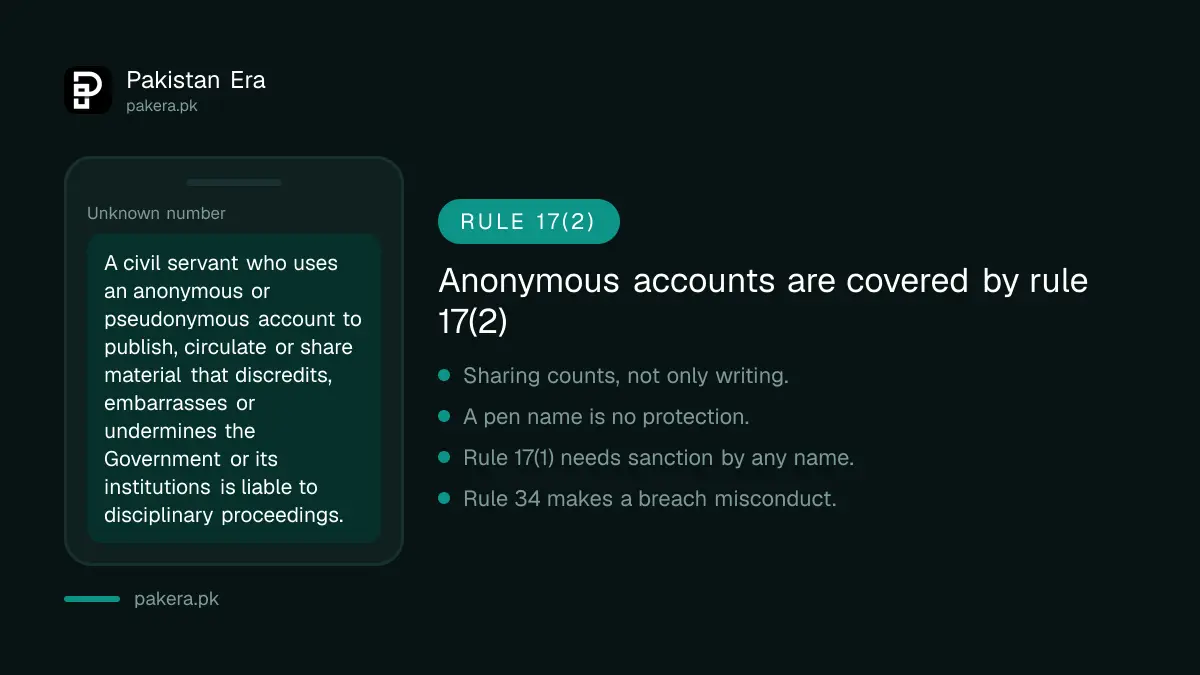
Rule 17(2) says a civil servant who uses an anonymous or pseudonymous account to publish, circulate or share material that "discredits, embarrasses or undermines the Government or its institutions" is liable to disciplinary proceedings. Sharing counts, not only writing. A forwarded post can be enough.
Personal accounts
Rule 17(4) says personal accounts must be kept separate from official ones. You must not post anything about your official work, duties, facilities, entitlements, work environment or government resources for personal benefit, "showmanship, publicity or personal image building". Photos of your office car, your protocol or a raid you led are exactly what it targets.
The same sub-rule lets a Cadre Administrator, by special order, require civil servants to declare their personal accounts, public or private. Officers in BS-17 and above already list their accounts in the "Proclamations" part of the asset declaration on the FBR portal, due by 30 October 2026.
Official accounts
Under rule 17(3), an official account needs the prior permission of the supervising officer, in writing and duly notified. It may carry only verified official information and the work of the office. On transfer, the outgoing officer hands over all logins, archived data and admin rights to the successor. No official account may be used for personal branding or lifestyle posts.
Public statements must not embarrass the Government
Rule 18 bars any statement of fact or opinion that "may potentially embarrass, undermine or compromise" the Government or its policy. It applies to a social media post, blog, podcast, online video, webinar, TV or radio programme, press comment or public speech alike.
The test is wide. The words "may potentially" mean the post does not have to cause harm. It only has to be capable of it. And it covers local, national and international matters.
Other rules sit next to it. Rule 16 bars sharing any official document or information with a person not authorised to receive it. Rule 17(5) bars memoirs that disclose confidential information. Rule 22 bars views "detrimental to the ideology or integrity of Pakistan". Rule 31 then says the same standards of conduct apply "on personal and official social media accounts".
So a screenshot of an internal letter, even with names blurred, is a rule 16 problem before it is a social media problem.
Books, articles and politics have their own limits
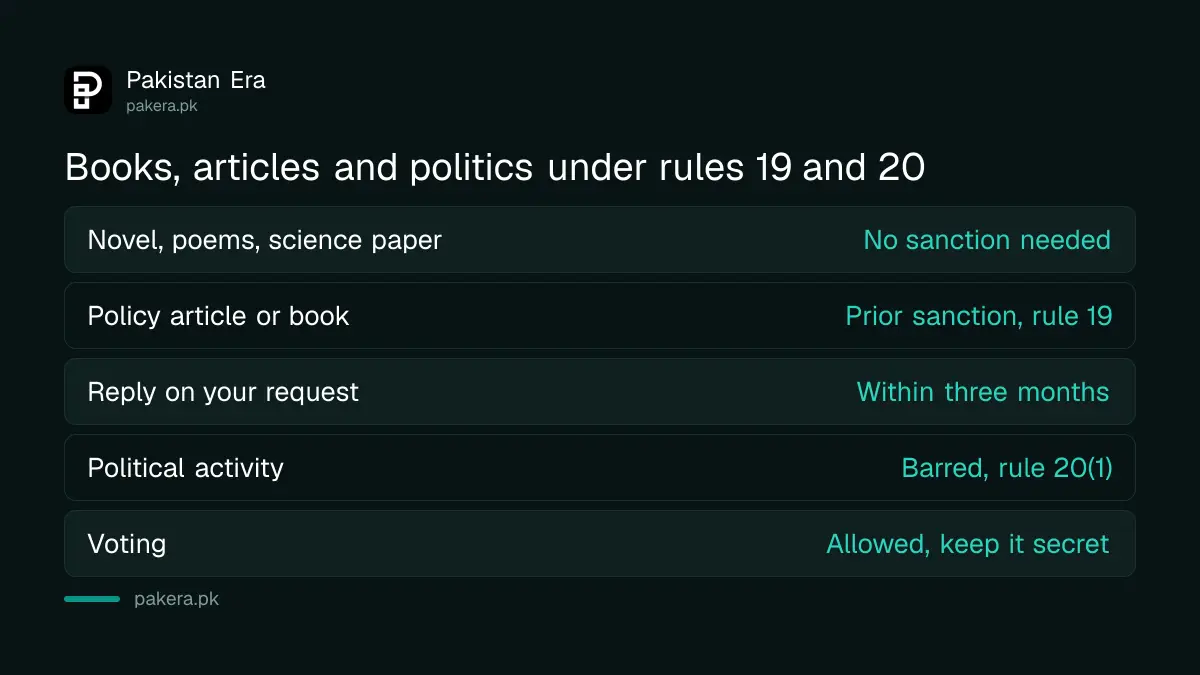
A book or article needs the Cadre Administrator's prior sanction unless it is literary, artistic or scientific. You must be told within three months whether permission is given. Political activity is banned outright, but you may vote as long as you do not reveal how.
That is rule 19 for writing. A novel, a poetry collection or a paper in a science journal needs no sanction. An opinion column on tax policy does. Rule 19 is silent on what happens if the three months pass with no answer, so do not treat silence as a yes.
Rule 20(1) bars taking part in, subscribing to, or assisting "in any way" any political activity in Pakistan or about Pakistan's affairs. Rule 20(3) bars canvassing or using influence in an election. Its proviso lets a qualified voter vote, but says they "shall give no indication of the manner in which he proposes to vote or has voted". A selfie with a party symbol after voting breaks that.
Rule 23 adds that no civil servant may take part in or help any public demonstration against a Government decision or policy. Sharing a protest call is the online version of that help.
A practical do and don't list for government employees
Keep personal accounts private and personal, ask in writing before you start any public channel, and never post office documents, political views or complaints about Government policy. The table below turns rules 16 to 23 and 31 into everyday choices.
| You can | You should not | Rule |
|---|---|---|
| Share family news with a closed group of friends | Start a public vlog or podcast without sanction | 17(1) |
| Post under your own name within the conduct standards | Run an anonymous account criticising the Government | 17(2) |
| Run an official account with written permission | Use it for personal branding or lifestyle posts | 17(3) |
| Keep personal and office accounts apart | Post your office, car or protocol for image building | 17(4) |
| Publish a novel, poems or a science paper | Publish a policy article without sanction | 19 |
| Vote in an election | Show or say who you voted for | 20(3) |
| Speak to the press to defend yourself, with intimation | Share internal letters or files | 25, 16 |
The press row comes from rule 25. It lets a civil servant go to court or the press to defend their public acts from defamatory attacks, under intimation to the Cadre Administrator, except where the Government has started disciplinary or criminal proceedings.
How to ask for permission before you post publicly
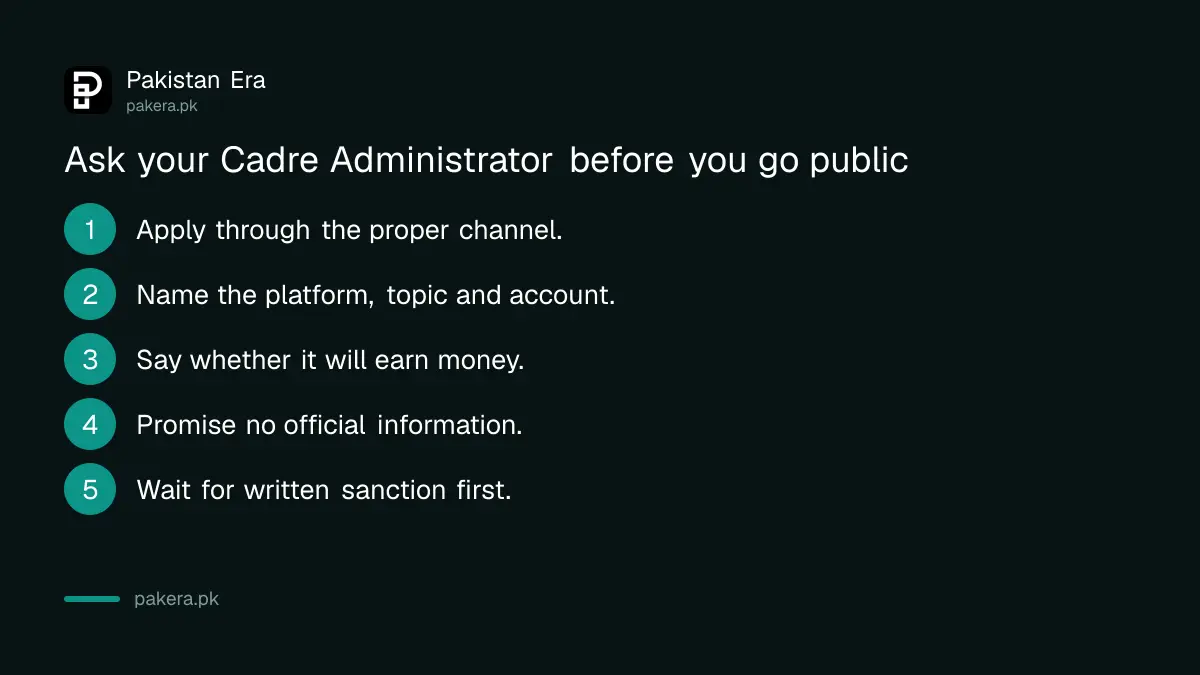
Write to your Cadre Administrator through the proper channel, describe the platform, the topic and whether it earns money, and wait for a written answer before you publish anything. The rules set no form, so a clear letter on file is your protection.
- Write an application addressed to your Cadre Administrator. Rule 29 says applications go through the proper channel, usually your immediate officer.
- Name the platform, the account name, the topic and how often you plan to post.
- Say whether it will earn money. Paid work falls under the separate side job rules for government employees, which may need its own permission.
- Confirm you will not use official information, office premises or government resources.
- Keep a copy of the application and the written sanction, and do not go live before the sanction arrives.
If the channel earns money, remember the tax side too. Platform income goes on your return, and the rules on YouTube and TikTok income in the tax return apply to civil servants like anyone else.
Breaking the social media rules is misconduct
Rule 34 says any act in violation of the 2026 Conduct Rules "shall be deemed to be an instance of misconduct" under the Civil Servants (Efficiency and Discipline) Rules, 2020. That opens the formal disciplinary process under the 2020 rules.
The conduct rules do not list penalties themselves. They hand the case to the Efficiency and Discipline Rules, which govern the process and the penalty. Rule 17(2) repeats the point for anonymous accounts, saying they lead to "disciplinary proceedings under the applicable rules".
Press reports in August 2026 said the Government would monitor officers' personal accounts more closely. We checked the Establishment Division's latest notices page on 26 September 2026 and found no published order on this. So treat the monitoring as reported. The rules themselves are in force either way.
Common questions
Can a government employee in Pakistan use Facebook or WhatsApp?
Yes. Nothing in the 2026 rules bans a personal account. Posts to a limited, defined group are outside rule 17(1). Public posts must still follow rules 16, 18, 20 and 31.
Can a government employee run a YouTube channel?
Only with the Cadre Administrator's prior sanction. Rule 17(1) covers any vlogging or streaming platform, under your name or a pen name, whatever the topic.
Can a civil servant criticise the Government on social media?
No. Rule 18 bars any statement that may potentially embarrass, undermine or compromise the Government or its policy, and rule 31 applies the same standard to personal accounts.
Can a government employee post that they voted?
You may vote, but rule 20(3) says you must give no indication of how you voted or plan to vote. A photo showing a party symbol breaks that.
Do I have to tell my department about my social media accounts?
If your Cadre Administrator issues a special order under rule 17(4), yes, public and private accounts alike. BS-17 and above officers also list accounts in their annual asset declaration, of which only selected parts are made public.
Do these rules apply to provincial government employees?
No. S.R.O. 638(I)/2026 is federal. Provincial employees follow their own province's conduct rules, unless a specific direction says otherwise.
How we verified this
What we checked, where we read it, and what we could not confirm.
Last checked on 26 September 2026. Every rule quoted here is read in the Civil Servants (Conduct) Rules, 2026, S.R.O. 638(I)/2026 dated 13 April 2026, Gazette of Pakistan Extraordinary, 14 April 2026, as published by the Establishment Division: rule 1 (in force at once), rule 2 (extent and extension), rule 3(d) (Cadre Administrator), rules 16 to 20, 22, 23, 25, 29 and 31, rule 34 (misconduct) and rule 35 (repeal of the 1964 rules). The notification is a scanned document, and we read each page ourselves. The August 2026 monitoring reports could not be matched to a published order on the Establishment Division's website, so they are marked as reported. The rules do not say whether an occasional public post from a personal account needs sanction; we say so rather than guess.
About the author

Senior Writer, Public Services and Technology
Shahid joined us in 2024 as an author. He is a senior contributor to Pakistan's leading technology websites. He writes detailed articles, mostly covering his expertise in the latest tech, mobiles, apps, gadgets, and step-by-step guides. His ideology is to help people understand the latest trends and explain complex methods through very easy-to-understand guides.