Government Employee Side Job Rules in Pakistan: Teaching, Business and Freelancing
Government employees need written permission to teach or consult, and 1/25 of that pay goes to the Treasury. What the 2026 rules allow, bar and exempt.
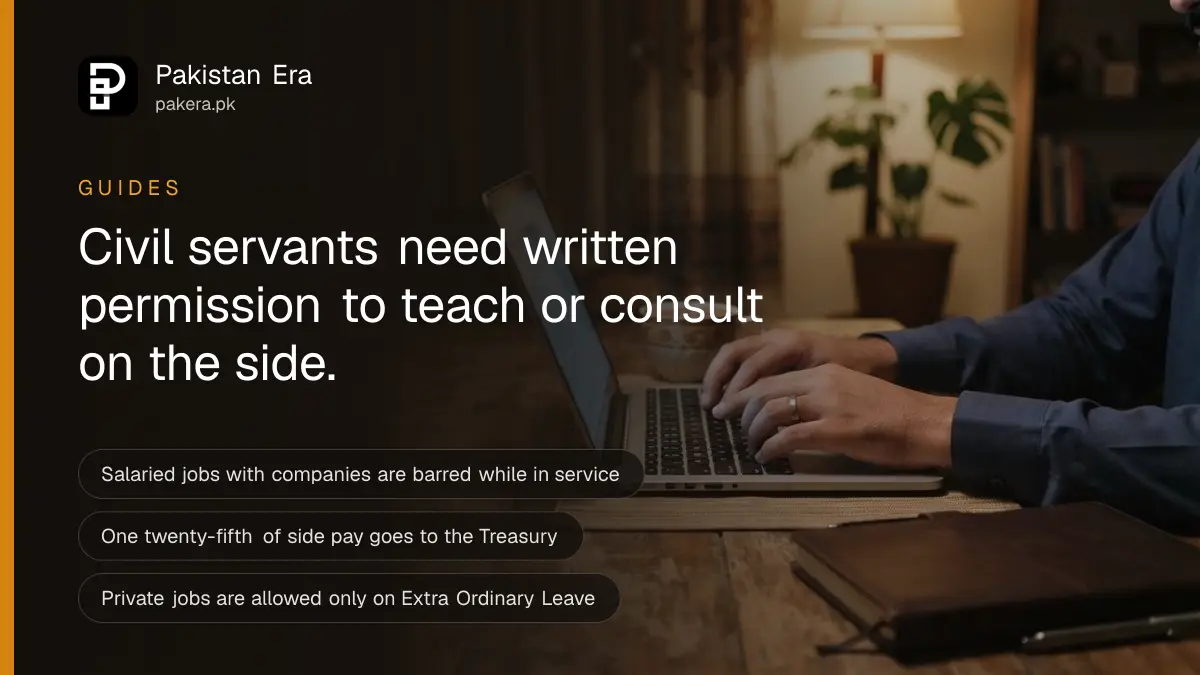
A federal government employee in Pakistan cannot take a full-time or part-time job with any company, bank, trust or NGO while in service. With prior written permission from the Cadre Administrator, you can teach, consult or do other private work, as long as there is no conflict of interest. One twenty-fifth of what you earn goes to the Treasury.
These side job rules for government employees come from the Civil Servants (Conduct) Rules, 2026. The Establishment Division notified them as S.R.O. 638(I)/2026 on 13 April 2026, in the Gazette of Pakistan of 14 April 2026, and rule 1 put them in force at once. Rules 7 to 10 deal with outside work. They replace the 1964 rules, which rule 35 repealed.
We read the full Gazette notification on the Establishment Division website on 26 September 2026, page by page. The short version is better than many people expect. Teaching and consultancy are allowed. They just need paperwork first, and a small cut for the Treasury.
Who the side job rules apply to
The rules apply to every federal civil servant under the Civil Servants Act, 1973, on duty or leave, in Pakistan or abroad, and on deputation. The Federal Government can extend them by direction to autonomous bodies, state companies, regulators and universities, whose staff then count as civil servants for these rules.
That is rule 2. If you work for a federal corporation or university, ask your HR office whether a direction or voluntary adoption applies to you. Provincial employees follow their own province's conduct rules. Private-sector staff are under different law again, covered in the misconduct and dismissal rules for private employees.
Every permission below comes from the "Cadre Administrator". Rule 3(d) defines it as the authority that manages your cadre or group, such as the Secretary of your Ministry or Division, or the Head of your Attached Department.
Side work a government employee can never do
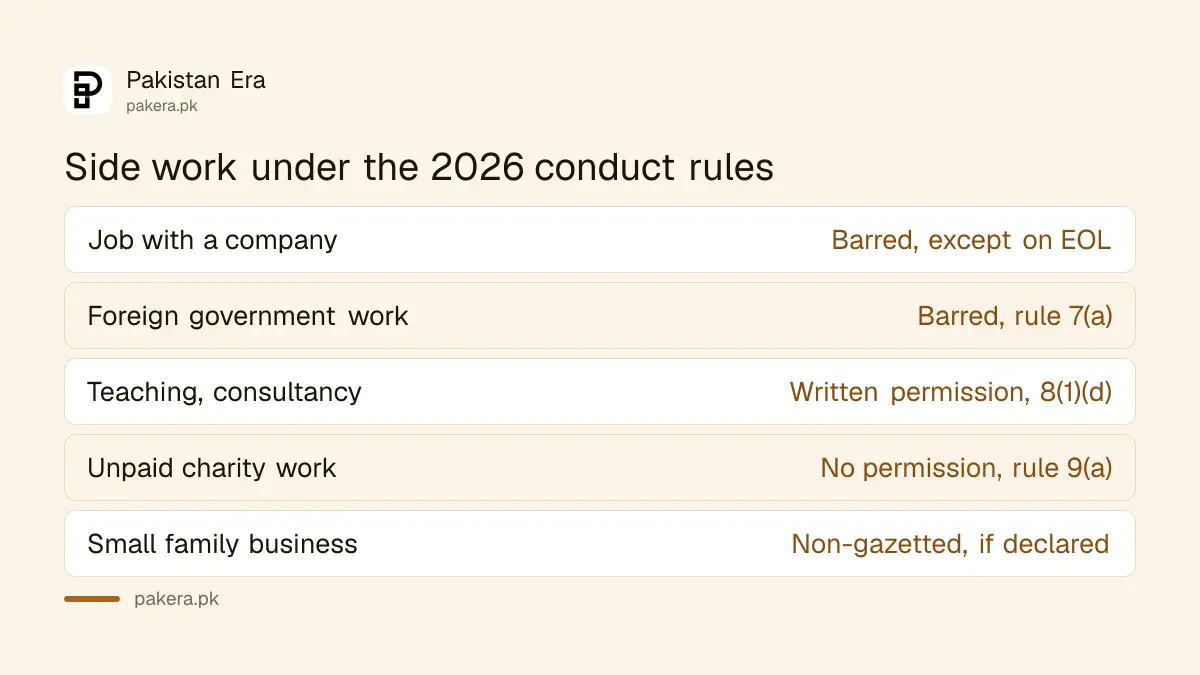
Rule 7 bars three things outright: any work for a foreign government, any full-time or part-time job with a bank, company, trust, foundation or NGO while in service, and using your office to raise funds or advance a private interest. The only door to a private job is sanctioned Extra Ordinary Leave.
- Rule 7(a): no employment, engagement or assignment with a foreign government.
- Rule 7(b): no full-time or part-time employment with any bank, company, private trust, foundation, not-for-profit or similar entity, "except during sanctioned Extra Ordinary Leave, subject to rule 10".
- Rule 7(c): no using your position to solicit funds, secure votes, or advance a private, personal or organisational interest not connected with your job.
So an evening shift at a call centre, or a salaried part-time role on a private school's payroll, is out. The word "part-time" in rule 7(b) closes that gap on purpose.
Teaching, consultancy and business need written permission
Rule 8(1) lets a civil servant, with prior written permission of the Cadre Administrator, raise funds for a registered non-profit, help manage a company or trust short of full-time work, and do private work such as teaching and consultancy with no conflict of interest.
The four permitted activities are:
- 8(1)(a): raising funds for a public or charitable purpose, if a non-profit registered in Pakistan collects and spends them and you do not handle the money directly.
- 8(1)(b): fundraising linked to another civil servant or someone recently retired, if you have no personal relationship with them.
- 8(1)(c): promoting, registering or helping manage a bank, company, trust, foundation, cooperative or academic institution, if it "does not amount to full-time employment".
- 8(1)(d): private work, "including teaching, consultancy or other professional activities", if no conflict of interest arises and "the official duties are not affected at all".
Rule 8(2) adds that if you receive or hold funds, you keep proper accounts and submit them to your next higher officer.
Where does freelancing fit? The rules never use the word. Project work for private clients, paid per job and not as an employee, reads most naturally as "private work" under rule 8(1)(d). That means written permission first and the Treasury share after. If you are paid as an employee of a foreign company, rule 7(b) is the more likely fit, and that is barred. Get the answer in writing, and keep your freelancer payments records clean either way.
The one twenty-fifth Treasury deposit, worked out
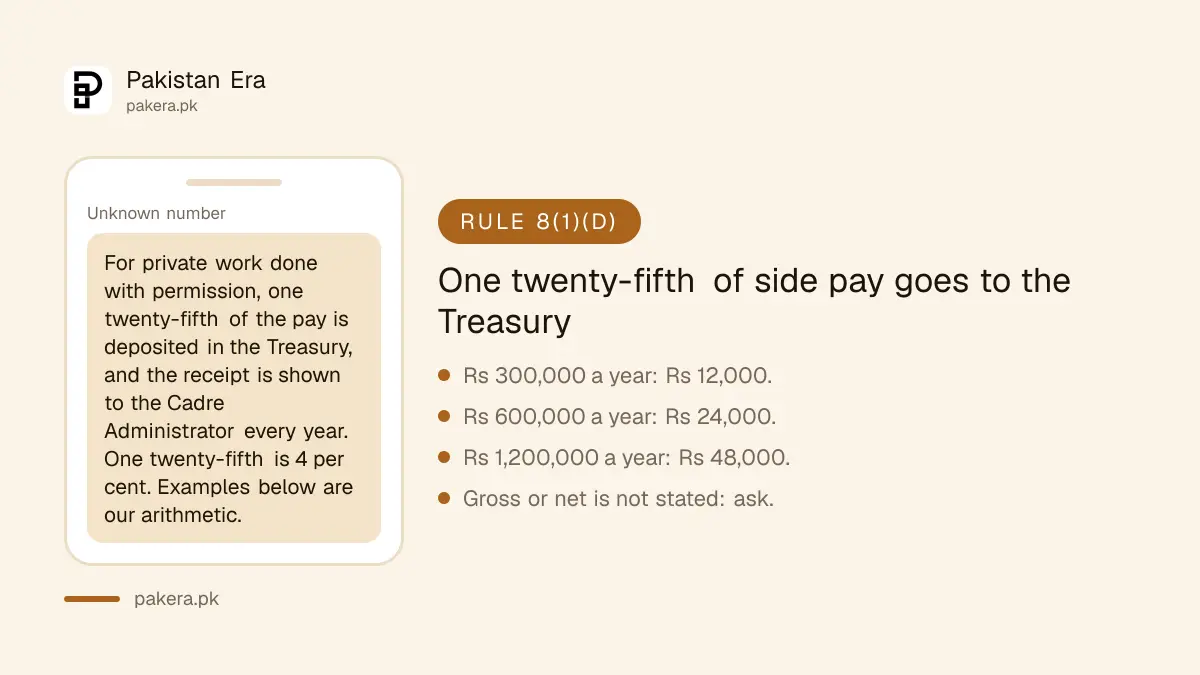
The proviso to rule 8(1)(d) says one twenty-fifth of the pay received for private work "shall be deposited in the Treasury". You present the receipt to your Cadre Administrator every year. One twenty-fifth is 4 per cent, so Rs 100,000 earned means Rs 4,000 deposited.
The figures below are our own arithmetic, using round numbers. They are not from any official table.
| Side income a month | Side income a year | One twenty-fifth to Treasury |
|---|---|---|
| Rs 25,000 | Rs 300,000 | Rs 12,000 |
| Rs 50,000 | Rs 600,000 | Rs 24,000 |
| Rs 100,000 | Rs 1,200,000 | Rs 48,000 |
Take a federal officer in BS-18 who teaches two evening classes at a private university for Rs 50,000 a month. Over a year that is Rs 600,000. Divide by 25 and the Treasury share is Rs 24,000, and the receipt goes to the Cadre Administrator once a year.
Three things the rule does not say. It does not say whether the share is on gross pay or pay after tax. It does not name a deposit form or account head. And it does not set a date in the year. Ask your accounts office before the first deposit, and keep it in writing. The deposit is separate from income tax, and the full income still goes on your income tax return.
Work you can do without permission
Rule 9 lets any civil servant do honorary religious, social or charitable work, and occasional literary, academic or artistic work, without asking first. Non-gazetted staff may also run a small family enterprise using family labour, if they declare it in their asset declaration.
Rule 9(a) has two conditions. Your official duties must not suffer, and the work must not conflict with your position. A superior officer can still tell you to stop. If you disagree, you can refer the matter to the Cadre Administrator.
Honorary means unpaid. Teaching Quran at the local mosque for free, running a blood donation drive, or writing the odd poem fits here. A weekly paid tuition centre does not. That is regular private work under rule 8.
Rule 9(b) is the one that helps junior staff. A non-gazetted civil servant, generally one in the lower grades (your office can confirm whether your post is gazetted), may "operate or participate in a small family enterprise absorbing family labour". A family shop or a small poultry unit run with a spouse and children fits. It must go in the declaration of assets under rule 12, which BS-17 and above officers now file on the FBR asset declaration portal.
Taking a private job on Extra Ordinary Leave
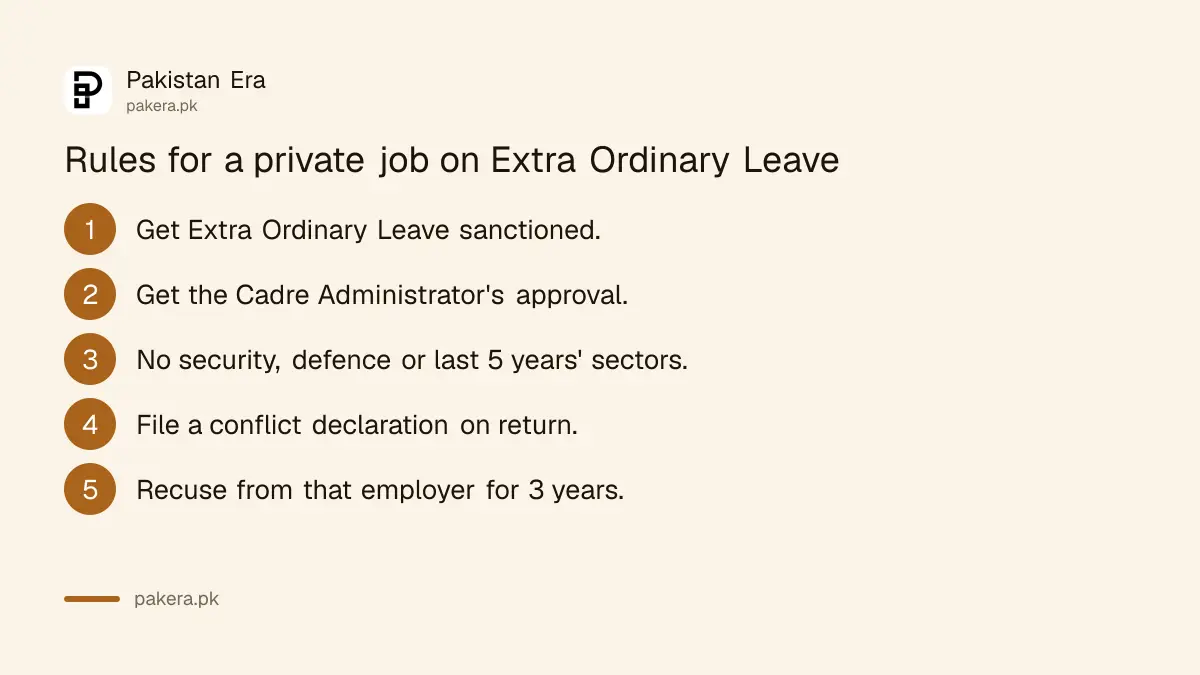
Rule 10 allows full-time private employment only during sanctioned Extra Ordinary Leave. The Cadre Administrator must approve the job, it must not be in security, defence or any sector you handled in the last five years, and on return you must stay out of that employer's matters for three years.
- Get Extra Ordinary Leave sanctioned. Rule 7(b) allows a private job only during it.
- Get the Cadre Administrator's approval for the specific job, under rule 10(a).
- Check the five-year bar in rule 10(b): no security or defence work, and nothing in areas, sectors, services or industries tied to posts you held in the last five years.
- On rejoining, file a conflict of interest declaration under rule 10(c).
- For three years, do not take part in any decision that benefits your former employer. Recuse yourself.
The five-year bar is the hard part. A tax officer who wants a year at an accounting firm, or a telecom regulator's staffer eyeing a mobile company, will struggle to pass it.
Gifts, loans and conflicts in outside work
Side work does not lift the other rules. You cannot accept gifts from clients or companies, lend to or borrow from anyone within your official authority, or invest where a conflict may arise without telling the Cadre Administrator in writing first.
Rule 4(1) bars accepting any gift from any person, company or organisation, for you or your family. Rule 4(2) bars hospitality that puts you under an obligation against your official duty. So a client's "thank you" hamper after a consultancy job is a problem.
Rule 11(1) bars lending to or borrowing from anyone within the limits of your official authority or with whom you have official dealings. Normal business with a bank or a firm of standing is allowed. Rule 13(4) adds that if you or your immediate family plan an investment that may create a conflict of interest, you disclose it in writing to the Cadre Administrator first, and any order they pass is binding.
How to apply for side work permission
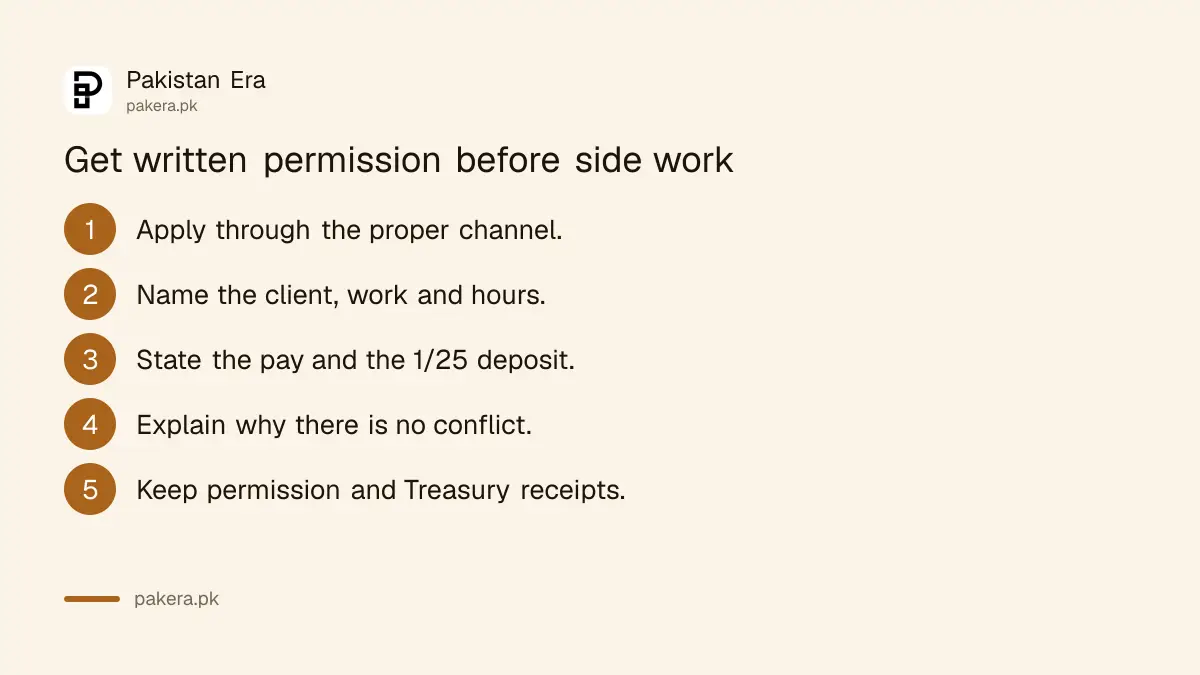
Write to your Cadre Administrator through the proper channel before you start. Describe the work, the client or institution, the hours, the pay, and why there is no conflict with your post. Do not begin until the permission is in writing.
- Address the application to your Cadre Administrator and send it through your immediate officer, as rule 29 requires.
- Name the institution or client and describe the work, with hours and days.
- State the expected pay, and confirm you will deposit one twenty-fifth in the Treasury.
- Explain why there is no conflict of interest and why your duties will not suffer.
- Keep the written permission, every Treasury receipt, and a copy of each yearly submission.
Rule 34 makes any breach of these rules "misconduct" under the Civil Servants (Efficiency and Discipline) Rules, 2020. A side job without permission is not a paperwork slip. It opens formal disciplinary proceedings.
Common questions
Can a government employee in Pakistan do a private job?
Not a salaried one. Rule 7(b) bars full-time and part-time employment with any company, bank, trust or NGO while in service, except during sanctioned Extra Ordinary Leave under rule 10.
Can a government teacher give private tuition?
Paid teaching is private work under rule 8(1)(d), so it needs prior written permission from the Cadre Administrator and one twenty-fifth of the pay goes to the Treasury. These are the federal rules; provincial teachers follow their province's rules.
Can a government employee do freelancing on Fiverr or Upwork?
The rules do not mention freelancing. Paid project work for private clients most closely matches private work under rule 8(1)(d), which needs written permission first. Freelancer tax registration is a separate matter and does not replace that permission. Ask your Cadre Administrator and keep the answer in writing.
Can a government employee run a business in Pakistan?
Helping manage a company short of full-time work needs written permission under rule 8(1)(c). Non-gazetted staff may run a small family enterprise without permission under rule 9(b), if declared.
How much of my side income goes to the Treasury?
One twenty-fifth, which is 4 per cent. On Rs 600,000 a year that is Rs 24,000, by our arithmetic. The receipt goes to your Cadre Administrator every year.
Can I work for a private company while on leave?
Only on sanctioned Extra Ordinary Leave, with the Cadre Administrator's approval, outside security, defence and your last five years' sectors, and with a three-year recusal when you return.
How we verified this
What we checked, where we read it, and what we could not confirm.
Last checked on 26 September 2026. Every rule here is read in the Civil Servants (Conduct) Rules, 2026, S.R.O. 638(I)/2026 dated 13 April 2026, Gazette of Pakistan Extraordinary, 14 April 2026, as published by the Establishment Division: rule 1 (in force at once), rule 2 (extent), rule 3(d) (Cadre Administrator), rule 4 (gifts), rules 7 to 10 (outside work and Extra Ordinary Leave), rule 11 (lending and borrowing), rule 13(4) (investments), rule 29 (proper channel), rule 34 (misconduct) and rule 35 (repeal). The notification is a scan, and we read each page ourselves. The Treasury deposit examples are our own arithmetic. The rules do not say whether the deposit is on gross or net pay, how to deposit it, or where freelancing fits, and we say so in the text.
About the author

Public Services and Education Journalist
Fajr Riaz is a journalist and content writer at Pakistan Era, based in Lahore. She covers the questions people meet in everyday life in Pakistan: how a public service works, what a change in the rules means, and where to find a reliable answer.