IMF Chief Says Oil Could Stay High Into 2027: What It Means for Pakistan
IMF chief Georgieva says oil may stay near $100 into 2027. What it means for Pakistan's Rs 398.96 petrol, the $1.2 billion IMF deal and your loan payments.
IMF Managing Director Kristalina Georgieva said on 7 October 2026 that oil prices "remain around $100 per barrel" and that Brent futures "predict high oil prices through 2027". For Pakistan, that points to petrol staying near Rs 400 a litre for months, not weeks. OGRA set petrol at Rs 398.96 a litre from 9 October.
Georgieva gave the speech, titled "Navigating the Crosscurrents of a Changing World Economy", ahead of the IMF and World Bank Annual Meetings in Bangkok. We read it on the IMF website. She named three forces: high energy prices, record public debt and the fast rise of AI.
Pakistan was not named in the speech. But almost every warning in it lands on a Pakistani household in some way: at the pump, in the budget and in the IMF programme the country is still inside. Here is each point, set against Pakistan's own official numbers.
Georgieva said oil prices may stay high into 2027
The IMF chief said oil is "around $100 per barrel", that gas supply from the Gulf is "severely impaired", and that shipping through the Strait of Hormuz "remains threatened". She said Brent futures, the prices traders agree today for oil delivered later, point to high prices through 2027.
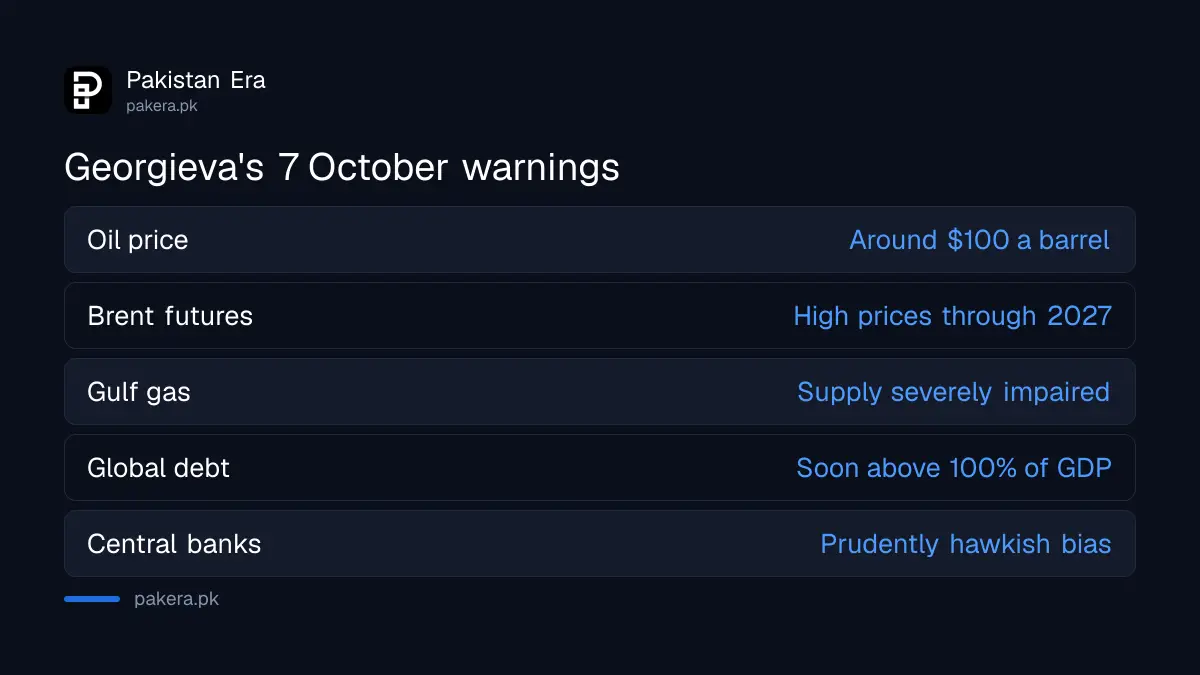
She described the Gulf conflict as "a war in the Gulf in its eighth month". She also said refined fuels are under extra pressure. In her words, a global shortfall in refining capacity has produced "record-high retail prices for diesel and other refined products".
Two more lines matter for a country like ours. She warned of "scattered hits in energy-import reliant and policy-space-constrained countries". Pakistan buys most of its oil from abroad and has little room in its budget, so it fits both parts of that description. She also said winter could add pressure, because reserves are being refilled just as the cold season starts in the northern half of the world.
Petrol in Pakistan is already at Rs 398.96 a litre
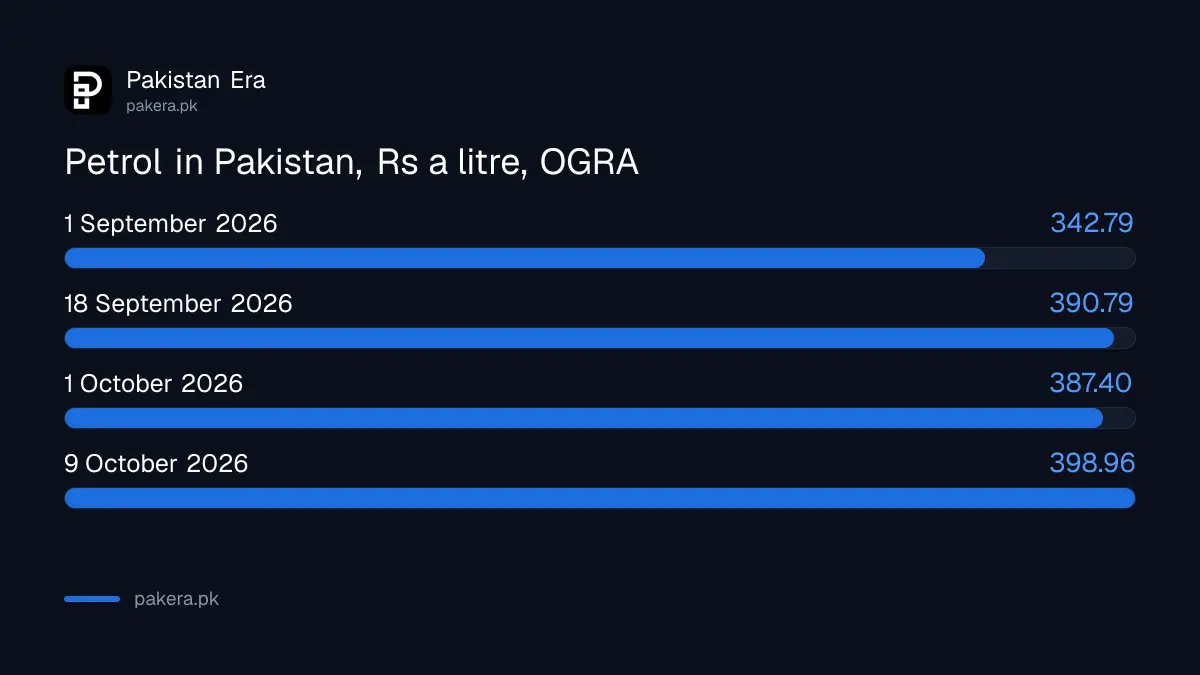
OGRA's price sheet for 9 October 2026 puts petrol at Rs 398.96 a litre and high speed diesel at Rs 395.72. Petrol was Rs 387.40 on 1 October and Rs 342.79 on 1 September, so it has risen Rs 56.17 a litre in under six weeks.
Pakistan now sets fuel prices every working day. OGRA uses a seven working day rolling average of international prices, and its sheet says the "full impact" of a change is passed on in seven working days. So a rise in world oil today shows up at your local pump within about a week and a half.
| OGRA sheet date | Petrol (Rs a litre) | Diesel (Rs a litre) | Petrol benchmark ($ a barrel) |
|---|---|---|---|
| 1 September 2026 | 342.79 | 370.41 | 105.89 |
| 18 September 2026 | 390.79 | 424.92 | 131.33 |
| 1 October 2026 | 387.40 | 400.35 | 127.74 |
| 9 October 2026 | 398.96 | 395.72 | 133.52 |
The benchmark in the last column is the seven day average Platts Arab Gulf price for petrol, which OGRA uses. It is a price for finished petrol, so it sits well above crude. Day by day figures are on petrol price today in Pakistan updates.
If the IMF is right that high prices last into 2027, the useful reading is simple. Do not plan a household or business budget on petrol falling back to Rs 340 soon. Nothing in the speech or the forecasts behind it supports that.
The government takes Rs 85 a litre before oil prices
Of the Rs 398.96 you pay for a litre of petrol, Rs 80 is the petroleum levy and Rs 5 is the climate support levy, both set by the federal government. Customs duty adds Rs 24.94. These charges do not fall when oil falls, and they do not rise when oil rises.
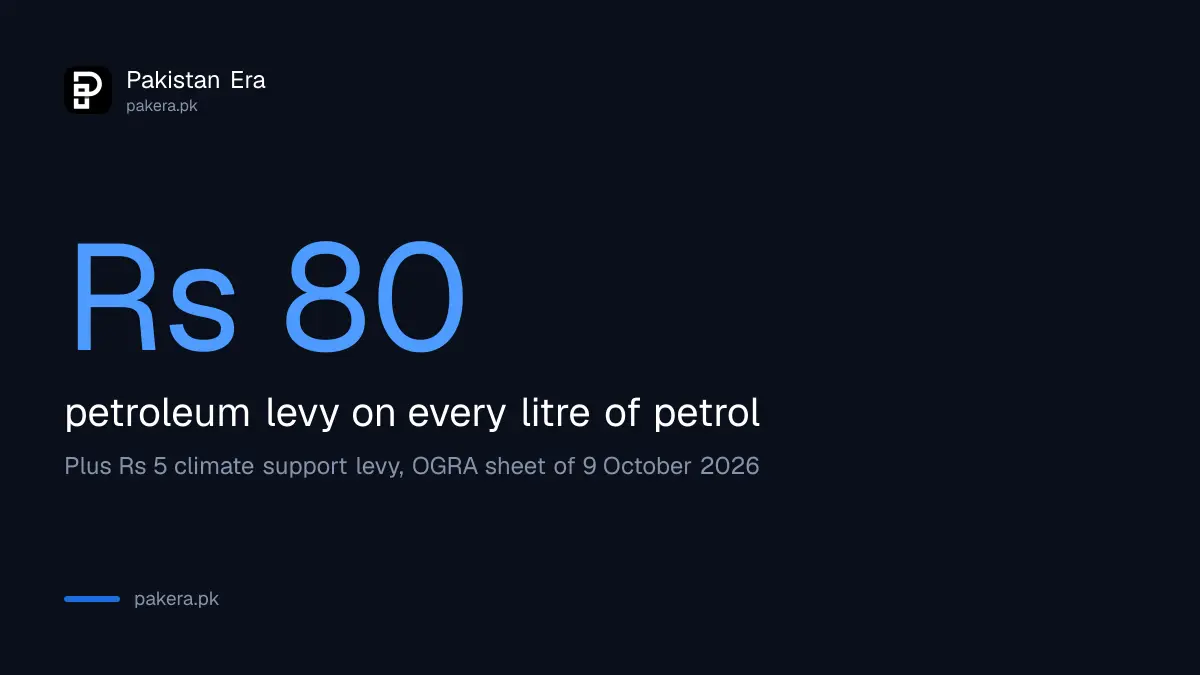
That is why the levy is where the budget and the pump meet. Pakistan collected Rs 1.567 trillion in fuel levy last year, which makes it one of the federal government's biggest earners. When oil is high, there is pressure to cut the levy to give relief. When debt is high, there is pressure to keep it. Georgieva's speech pushes on both sides at once.
Her advice on debt was direct. She said emerging markets "should expand fiscal space and grow foreign exchange buffers". Fiscal space means room in the budget to spend in a crisis without new borrowing. For Pakistan, a levy cut would shrink that room, so a large cut looks unlikely while the programme runs.
Pakistan's IMF deal is agreed but not yet approved
IMF staff and Pakistan reached a staff-level agreement on 7 October for about $1.2 billion, under the fourth review of the Extended Fund Facility and the third review of the Resilience and Sustainability Facility. The IMF Executive Board still has to approve it before any money is released.
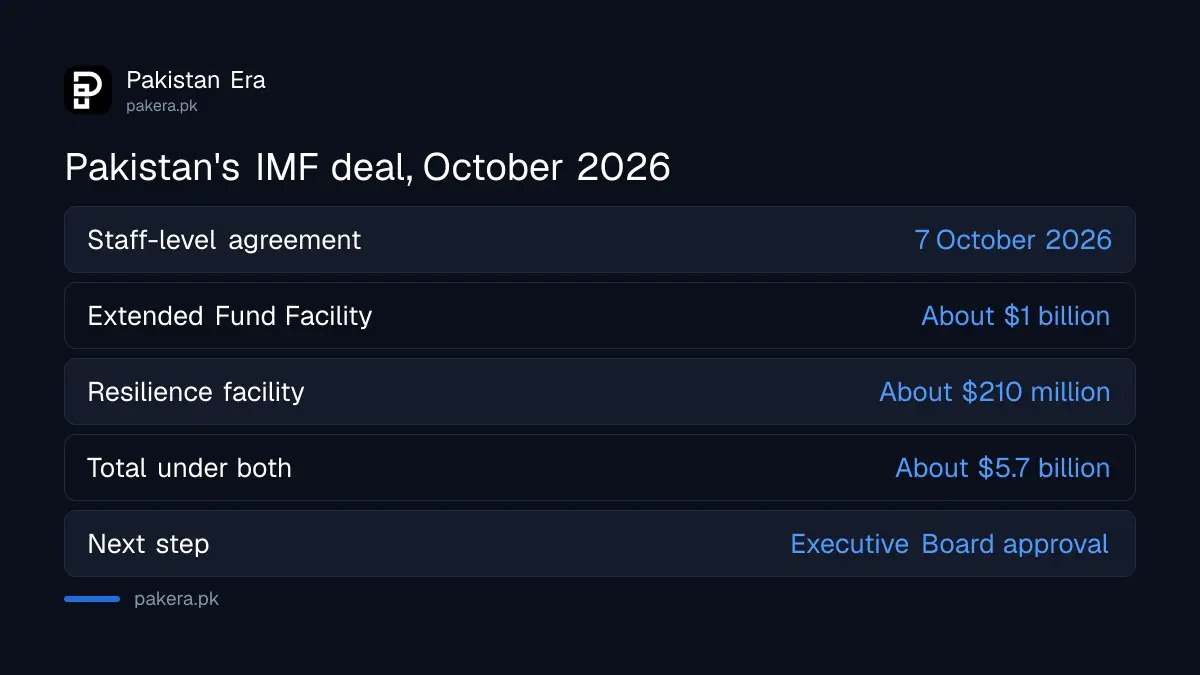
Radio Pakistan carried the IMF mission statement on 8 October. It said Pakistan would get about $1 billion under the EFF and about $210 million under the RSF, bringing the total under both to about $5.7 billion. Mission chief Iva Petrova said Pakistan had "successfully navigated the impact of the Middle East conflict". The detail is in our report on the $1.2 billion staff-level agreement.
Here is how the speech and the deal fit together. The mission praised Pakistan for coping with the oil shock so far. The Managing Director said the shock may last another year. So the policies that earned the praise, a tight budget and a steady rupee, are likely to stay. That means no big fuel relief and continued pressure to collect taxes.
Higher oil keeps pressure on inflation and interest rates
Georgieva said higher energy prices "are pushing up inflation, policy rates, and benchmark yield curves", and that "a prudently hawkish bias may be appropriate in many countries". Hawkish means a central bank leans towards keeping interest rates high to fight inflation.
Pakistan's own numbers show why that matters here. The Pakistan Bureau of Statistics put inflation at 10.3 per cent in September 2026, with electricity and motor fuel among the biggest monthly rises. The State Bank kept its policy rate at 11.5 per cent in September, and the next decision is due on 26 October 2026, as set out in our look at the SBP monetary policy meeting.
An IMF chief advising central banks to stay cautious makes a deep rate cut in October less likely. If you have a car loan, a house loan or a business running finance line, plan for your monthly payment to stay about where it is.
What you can do now
Most of this is outside your control, but a few steps soften the hit. These follow from the official figures above, not from any IMF instruction to households.
- Budget petrol at about Rs 400 a litre through the winter, not at September's lower prices.
- Check OGRA's daily sheet before a big fill for a business vehicle. Prices move a little every working day.
- Expect transport fares and goods delivery charges to stay high while diesel is near Rs 396.
- Do not assume your loan payment will fall soon. Wait for the State Bank's 26 October decision.
- If you receive money from family abroad, check the rate your bank gives you. A stable rupee helps, but fees still differ between banks.
The household side of this oil shock, from food to electricity bills, is broken down in what the oil shock means for your household budget.
Common questions
What did the IMF chief say about oil prices on 7 October 2026?
Kristalina Georgieva said oil prices "remain around $100 per barrel" and that Brent futures "predict high oil prices through 2027". She also said Gulf gas supply is severely impaired and Hormuz shipping remains threatened.
Did the IMF speech mention Pakistan?
No. The speech did not name Pakistan. It warned about energy importing countries with little budget room, which describes Pakistan's position.
What is the petrol price in Pakistan today?
OGRA set petrol at Rs 398.96 a litre and diesel at Rs 395.72 from 9 October 2026. Prices now change on working days.
Will petrol get cheaper in Pakistan soon?
Not on the IMF's reading. If oil stays high into 2027, petrol is likely to stay near current levels. Only a sharp fall in world prices or a levy cut would bring it down quickly.
Has the IMF released Pakistan's $1.2 billion?
Not yet. Staff agreed the deal on 7 October 2026, but the IMF Executive Board must approve it first. No Board date had been announced when we checked.
When will the IMF publish its new world forecast?
The IMF says the full October 2026 World Economic Outlook will be published on 13 October 2026, during the Annual Meetings in Bangkok.
How we verified this
What we checked, where we read it, and what we could not confirm.
Last checked 9 October 2026, about 2:00 am PKT. We read the Managing Director's curtain raiser speech of 7 October 2026 on the IMF website, and the OGRA price sheets for 1 September, 18 September, 1 October and 9 October 2026. The IMF staff statement was read as carried by Radio Pakistan on 8 October. Price changes and the petrol table are our own reading of OGRA's sheets.
About the author

Global Affairs & Political Economy Writer
Muhammad Hatim is a book lover who started writing because he enjoys it. At Pakistan Era he writes about international relations, geopolitics and the global economy, with a particular interest in South Asia and the forces behind current events.