Your Mobile Package Costs Up to Rs 500 More Than Last Year
Jazz, Zong, Ufone and Telenor raised bundle prices by up to 33 per cent in a year. Where to compare, and four ways to pay less.

Your monthly mobile bundle can cost up to Rs 500 more than it did a year ago.
Jazz, Zong, Ufone and Telenor have all raised call and data package prices. Across the four networks, some bundles are up to 33 per cent more expensive over the past year.
This did not happen in one jump, which is why most people did not notice.
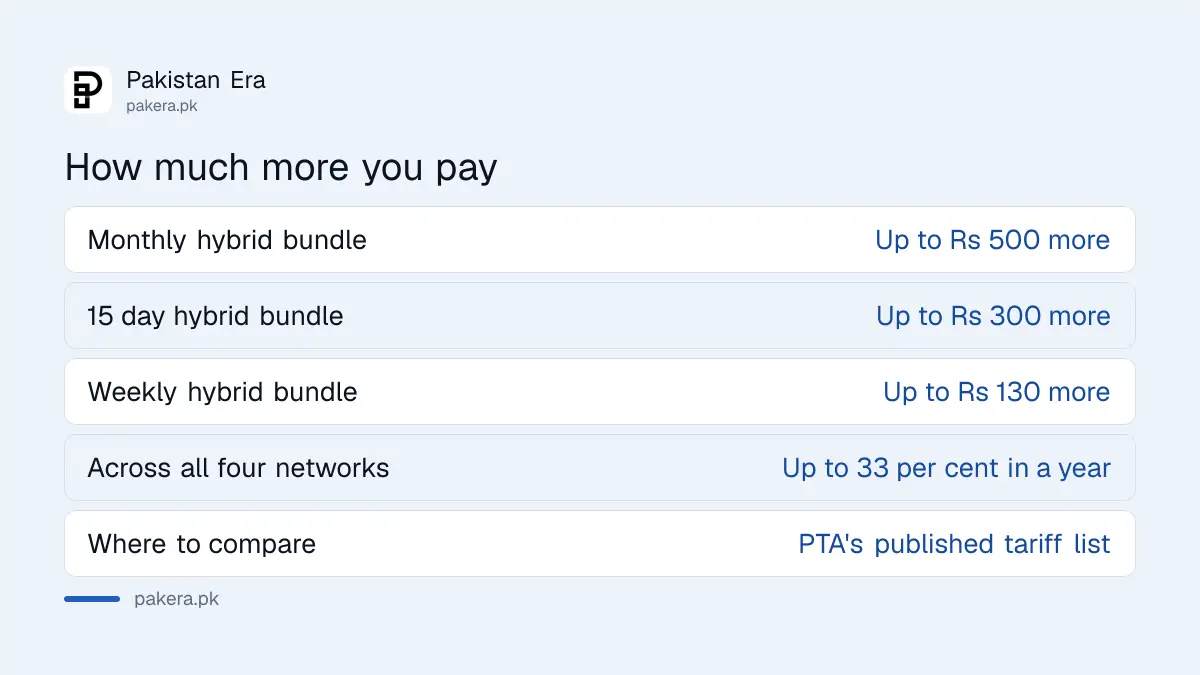
How much more you are paying
| Package type | Price rise over the year |
|---|---|
| Monthly hybrid, call and data | Up to Rs 500 |
| 15 day hybrid bundle | Up to Rs 300 |
| Weekly hybrid bundle | Up to Rs 130 |
| Across all four networks | Up to 33 per cent |
A hybrid bundle is one that gives you minutes, SMS and data together, which is what most people buy.
Rs 500 a month is Rs 6,000 a year. On a weekly bundle, Rs 130 more each week is about Rs 6,760 a year. The weekly user often ends up paying more, not less.
PTA has published the numbers so you can compare
This is the useful part and hardly anyone knows it exists.
The Pakistan Telecommunication Authority has published tariff details for the top 15 hybrid and data-only bundles from all four operators. For each one it shows:
- The price, quarter by quarter
- The percentage increase over the year
- How long the package lasts
- What incentives the operator offers with it
PTA says the point is to let people compare packages and choose with the latest prices in front of them.
That matters because operators do not advertise a price rise. A bundle keeps the same name and the same marketing while the price moves, so you only see it on your balance.
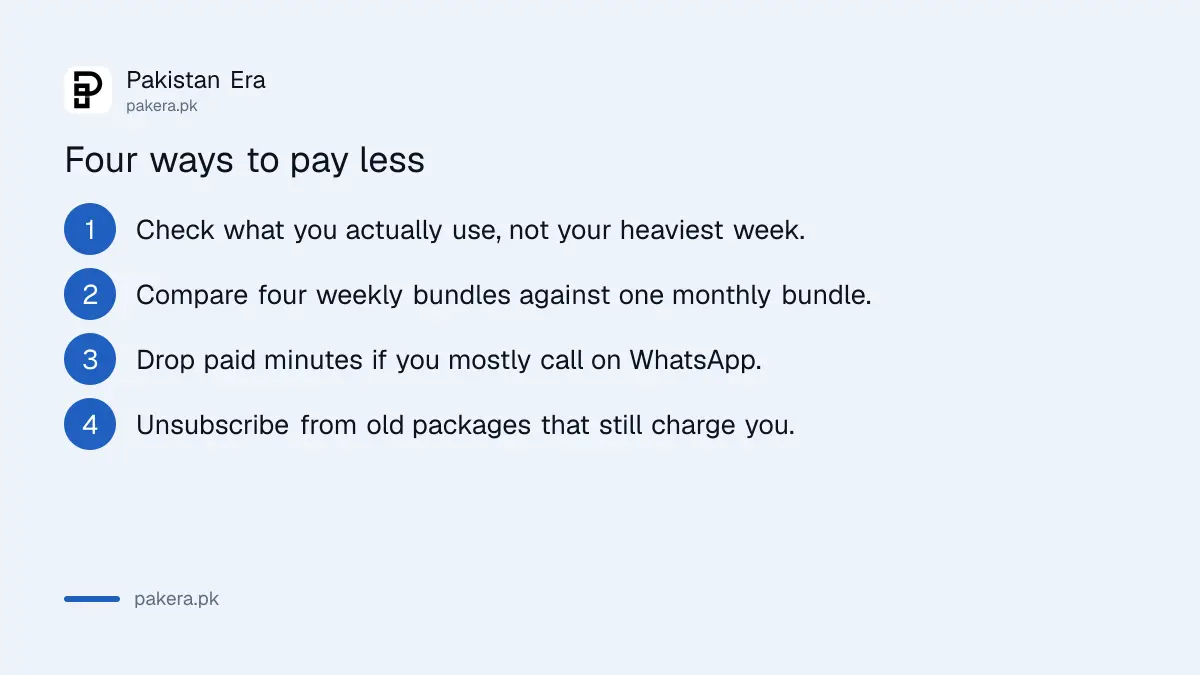
Four ways to pay less
- Check what you actually use. Most people buy a bundle sized for their heaviest month and pay for it in every other month. Look at your real data use for the last few weeks, not your worst week.
- Compare monthly against weekly. Four weekly bundles usually cost more than one monthly bundle. If you are buying weekly out of habit, do the multiplication.
- Drop the minutes you do not use. Hybrid bundles charge you for calls and SMS. If you call over WhatsApp, a data-only package may be cheaper.
- Unsubscribe from what you forgot. Old packages keep charging quietly. We have step by step guides for Jazz, Zong and Telenor.
Check your balance before you blame the network
When a bundle costs more, people usually notice it as balance disappearing rather than as a price rise. Before you complain, find out where the money went.
Every network has a balance check code and a remaining data check. If you are not sure of yours, we have simple guides for Zong, Telenor and Ufone, and for checking remaining MBs and minutes on each network.
Why prices keep going up
Three reasons, in plain terms.
Tax. Mobile services in Pakistan carry heavy taxes and withholding. A large part of what you pay never reaches the network.
Costs in dollars. Networks buy equipment, spectrum and international bandwidth in dollars while earning rupees. When the rupee weakens, their costs rise even if nothing else changes.
Electricity and fuel. Thousands of towers need power, and many run on generators when the grid fails. Fuel and electricity costs go straight into the price of a bundle.
None of that is a reason to accept a package you do not need. It is the reason the trend goes one way.
Prepaid users feel it more
Most people in Pakistan are on prepaid, and prepaid hides price rises better than a bill does.
On a postpaid bill you see a line with an amount next to it. On prepaid you load balance, buy a bundle, and the balance goes down. Nothing tells you the bundle costs Rs 200 more than it did last year. You simply run out sooner and load again.
So the rise shows up as a feeling that your balance does not last, rather than as a price you can point at. That is why PTA publishing the actual numbers is worth using: it turns a feeling into a figure.
If you top up with scratch cards, the effect is the same. Our guides for reloading balance on Zong and Ufone cover the mechanics, but the amount you are getting for that card has quietly changed.
What to do this month
Spend ten minutes on it once and it pays for itself.
Write down what you paid for your last bundle. Check your actual data and minutes used. Then look at PTA's published tariff list for the top bundles on your network and see whether a cheaper package covers what you really use.
If you find you are paying for minutes you never make, that is money leaving every single month.
Questions readers are asking
How much have mobile packages gone up in Pakistan?
By up to 33 per cent over the past year across Jazz, Zong, Ufone and Telenor. Monthly hybrid bundles are up to Rs 500 more, 15 day bundles up to Rs 300 more, and weekly bundles up to Rs 130 more.
Which networks raised prices?
All four: Jazz, Zong, Ufone and Telenor.
Where can I compare package prices?
PTA has published tariff details for the top 15 hybrid and data-only bundles from each operator, including quarterly prices, the annual percentage increase, validity and incentives.
What is a hybrid bundle?
A package that includes minutes, SMS and data together, rather than data alone. It is what most subscribers buy.
Is a weekly package cheaper than a monthly one?
Usually not. Four weekly bundles normally cost more than one monthly bundle, so it is worth doing the multiplication before choosing.
Why do mobile prices keep rising?
Heavy taxes on telecom services, costs paid in dollars while revenue is earned in rupees, and the electricity and fuel needed to run towers.
How do I stop a package I did not want?
Each network has an unsubscribe code or app option. We have step by step guides for Jazz, Zong and Telenor.
About the author

Senior Writer, Public Services and Technology
Shahid joined us in 2024 as an author. He is a senior contributor to Pakistan's leading technology websites. He writes detailed articles, mostly covering his expertise in the latest tech, mobiles, apps, gadgets, and step-by-step guides. His ideology is to help people understand the latest trends and explain complex methods through very easy-to-understand guides.