How Pakistan Sets the Petrol Price Every Day: Gulf Price Plus a $16.12 Premium and Rs 85 in Levies
Pakistan's petrol price follows a daily OGRA formula: Gulf petrol, a $16.12 premium, the rupee rate, margins and Rs 85 levies. See each line and do the sums.
Pakistan's petrol price is set every day by OGRA from a formula. It starts with the seven day average Gulf price of petrol, adds a $16.12 a barrel premium, converts it at the State Bank's average rupee rate, then adds customs duty, margins and Rs 85 in levies. On 9 October 2026 that came to Rs 398.96 a litre.
Most people see only the final number on the pump. But the price sheet OGRA publishes each day shows every part of it, line by line. Once you can read it, you can tell why petrol went up by Rs 2.31 on Friday, and roughly what tomorrow's change will be.
We read OGRA's petrol price sheets for 7, 8 and 9 October 2026 and worked through the sums.
The formula has five layers
The petrol price is built in five layers: the world price, the cost to land it in Karachi, customs duty, the margins for transport, oil companies and dealers, and the government's levies. Sales tax is zero, because petrol is currently exempt.
| Layer | What it is | 9 October 2026 |
|---|---|---|
| Platts Arab Gulf petrol, 7 day average | World price of 92 RON petrol | $133.52 a barrel |
| Premium including freight | PSO's import premium and shipping | $16.12 a barrel |
| Cost in rupees at Karachi port | Converted at Rs 277.21, plus port costs | Rs 261.82 a litre |
| Exchange rate adjustment and customs duty | Rupee gap on PSO's payments, plus duty | Rs 1.33 and Rs 24.94 |
| Freight, oil company and dealer margins | IFEM, OMC margin, dealer margin | Rs 8.02, Rs 7.87, Rs 9.98 |
| Petroleum levy and climate support levy | Set by the federal government | Rs 80 and Rs 5 |
| Total | Price before secondary freight | Rs 398.96 a litre |
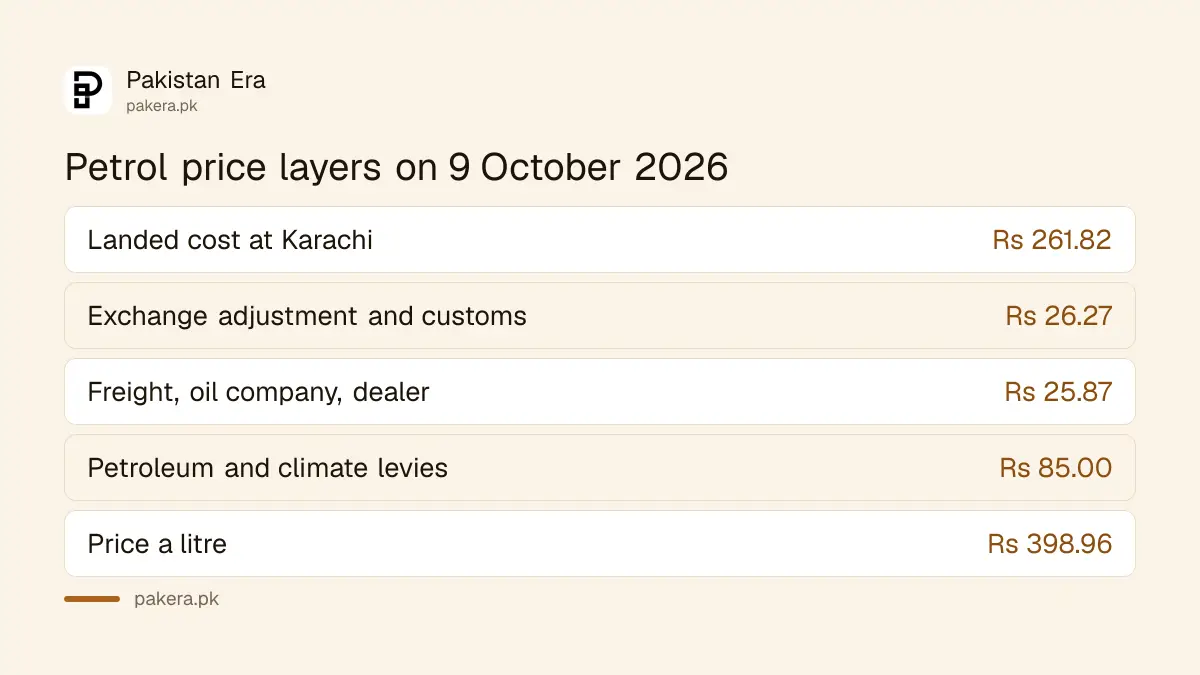
A barrel holds 158.98 litres, and that number is in the formula too. The dollar price per barrel is multiplied by the rupee rate, then divided by 158.98 to get rupees a litre.
World price and the rupee make the daily change
Only two inputs normally move from day to day: the seven day average Platts price and the seven day average rupee rate. Everything else in the formula stays the same unless the government or OGRA changes it.
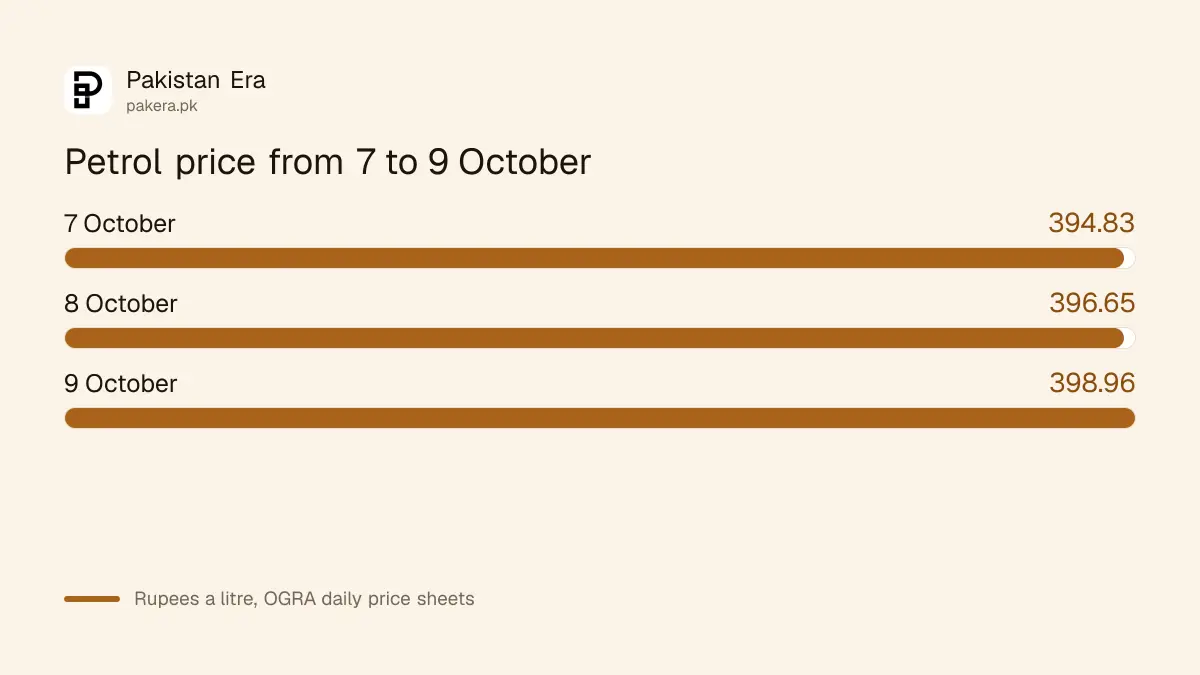
The sheets show this clearly. Between 7 and 9 October the Platts average rose from $131.37 to $133.52 a barrel. Petrol rose from Rs 394.83 to Rs 398.96. Over the same days, the customs duty, the margins and the levies did not change at all.
| Date | Platts average ($ a barrel) | Petrol (Rs a litre) |
|---|---|---|
| 7 October 2026 | 131.37 | 394.83 |
| 8 October 2026 | 132.18 | 396.65 |
| 9 October 2026 | 133.52 | 398.96 |
The daily figures are tracked on petrol price today for 9 October, and diesel has its own formula built from Dubai crude, set out in how Pakistan sets the diesel price.
A $1 move in petrol adds about Rs 1.74 a litre
You can estimate the effect of a world price move yourself. At a rupee rate of Rs 277.21, each $1 a barrel works out to about Rs 1.74 a litre. That is 277.21 divided by 158.98.
- A $1 rise in the seven day Platts average adds about Rs 1.74 a litre.
- A Re 1 weaker rupee, at a $149.64 barrel cost, adds about Rs 0.94 a litre.
- A $5 jump in world petrol prices adds about Rs 8.72 a litre once it fully feeds through.
Check it against Friday. The Platts average rose $1.34, which predicts about Rs 2.34. The actual rise was Rs 2.31, because the rupee average also moved by one paisa. Close enough to plan around.
The sheet says the full impact of a change in the daily world price is passed on over seven working days. That is the rolling average at work. A one day spike in the Gulf reaches the pump in small steps over about a week and a half, and a fall does the same.
Taxes and margins are Rs 135.81 of every litre
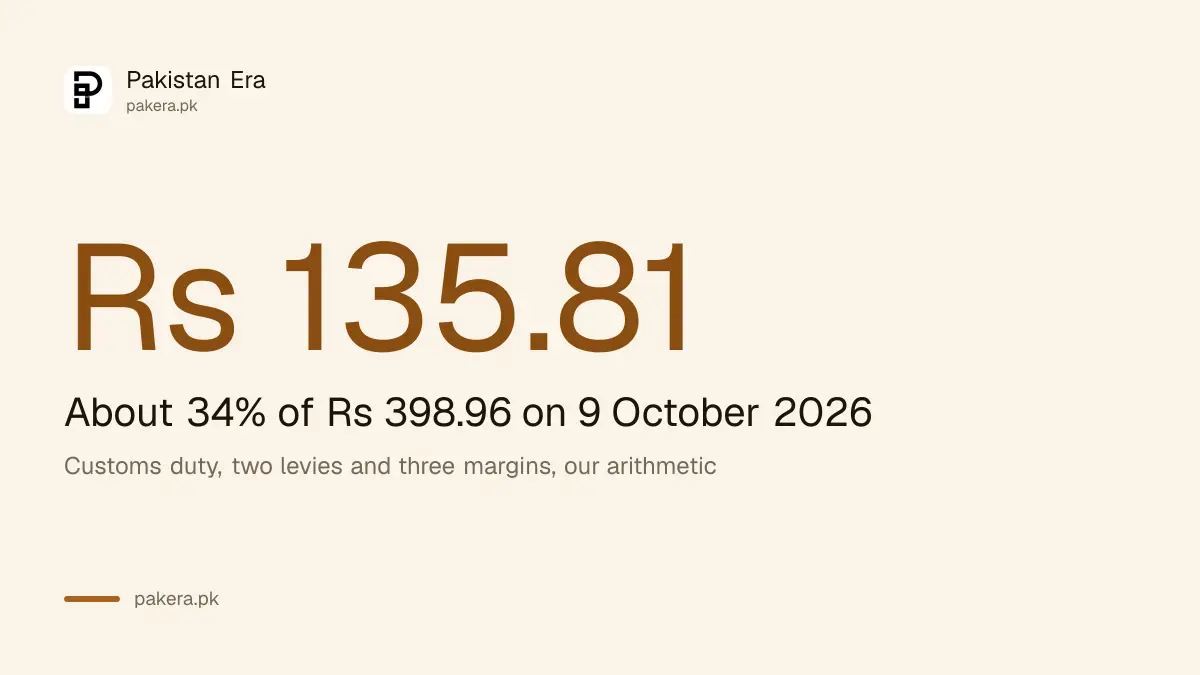
Customs duty, the two levies and the three margins add Rs 135.81 to every litre. That is about 34% of the Rs 398.96 price. The levies alone are Rs 85, which is more than a fifth of the price.
This is also why petrol often falls less than world oil prices. A fixed Rs 85 levy does not shrink when oil gets cheaper, as why petrol does not fall with oil explains in detail. The dealer's Rs 9.98 is a fixed government margin too, and its cost is tracked in who pays for the dealer margin rise.
Read OGRA's petrol price sheet in five steps
OGRA posts the sheet each day as a PDF. Reading it takes a few minutes once you know where to look.
- Open ogra.org.pk and go to Daily Fuel Prices, then Price Publication.
- Open the newest sheet, named by its effective date. Petrol is on the first page.
- Read line A, the seven day Platts average, and compare it with the day before.
- Read line D, the State Bank average rupee rate, for the second moving part.
- Read the total at the bottom. That is the price before secondary freight to your pump.
Secondary freight is the cost of moving fuel from the oil company's depot to an individual pump, so the price at some stations can differ slightly from the sheet.
Common questions
How is the petrol price calculated in Pakistan?
OGRA takes the seven day Platts Arab Gulf petrol average, adds a $16.12 premium, converts it to rupees, then adds customs duty, margins and Rs 85 in levies.
How often does the petrol price change?
OGRA publishes a new sheet with an effective date every day, so the price can change daily.
Is there sales tax on petrol?
No. The sheet says petrol is currently exempt from sales tax, so the sales tax line is zero.
Why does a world price change take days to show?
The formula uses a seven working day rolling average, so a change feeds through over seven working days.
How much of the petrol price is tax?
On 9 October 2026, customs duty of Rs 24.94 and levies of Rs 85 came to Rs 109.94, about 28% of the price.
How we verified this
What we checked, where we read it, and what we could not confirm.
Last checked on 9 October 2026. Every figure is from OGRA's petrol price sheets effective 7, 8 and 9 October 2026, posted under OGRA's daily price publications, including the formula explanations printed beside each line. The per dollar and per rupee estimates and the shares are our own arithmetic.
About the author

Global Affairs & Political Economy Writer
Muhammad Hatim is a book lover who started writing because he enjoys it. At Pakistan Era he writes about international relations, geopolitics and the global economy, with a particular interest in South Asia and the forces behind current events.