How to Read PMD's Official Weather Alert Feed in Pakistan: Severity, Urgency and Expiry
Check a forwarded weather warning against PMD's official CAP alert feed. Learn what severity, urgency and expiry mean, and why the 9 October alert is over.
Short answer: PMD's website links an official alert feed at cap-sources.s3.amazonaws.com/pk-pmd-en/rss.xml. Each alert has a severity, an urgency, a certainty, a start time and an expiry time. The newest alert we found, sent on 9 October 2026, was rated Moderate and expired on 14 October at 12:00 PKT.
Forwarded weather warnings rarely say when they end. A message from last week looks the same as a message from today. PMD's alert feed fixes that, because every alert carries its own start and end time.
We opened the feed and two of its alert files on 14 October 2026. This guide shows what each field means and how to tell a live alert from an old one.
The feed lists PMD alerts as small data files
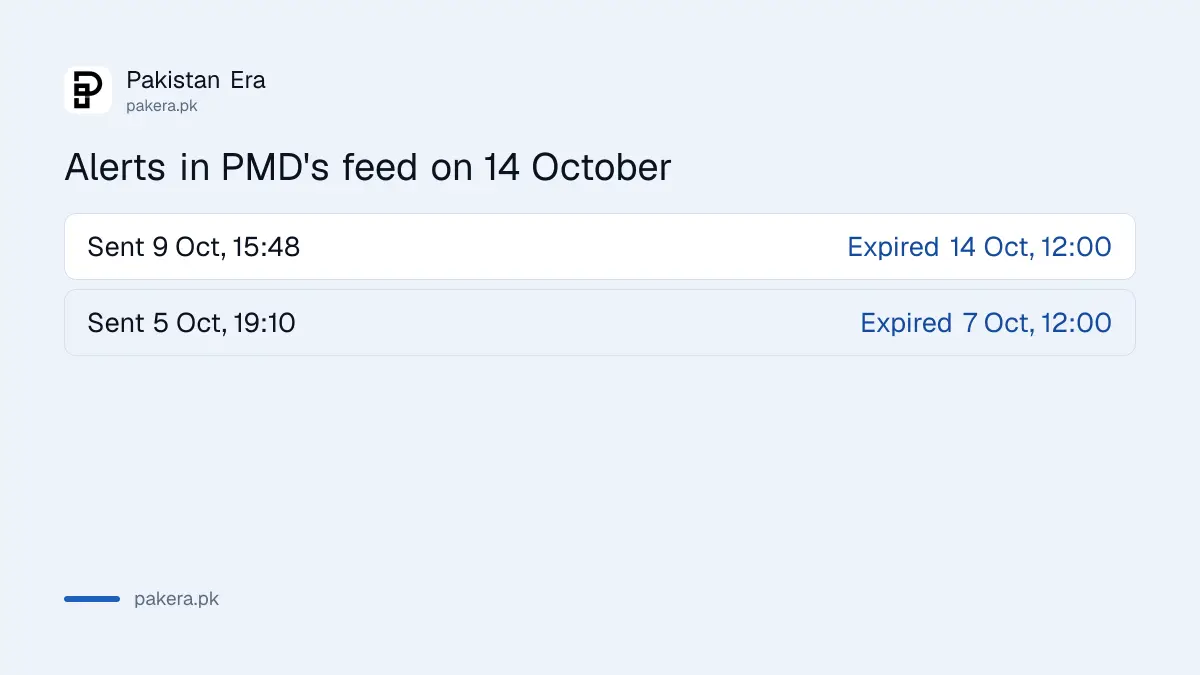
PMD's weather.gov.pk site has a menu link named CAP Alerts. It opens an RSS feed, which is a list of recent items. On 14 October 2026 the feed held two alerts, dated 5 October and 9 October.
CAP stands for Common Alerting Protocol, an international format for public warnings. Each PMD alert is a file in that format. You can open it in a browser, and a style sheet turns it into readable text. Apps and websites can also read it automatically.
Use it as a second check. If a warning is not in the feed and not on PMD's forecast and warnings pages, treat it with care.
Six fields tell you how serious an alert is
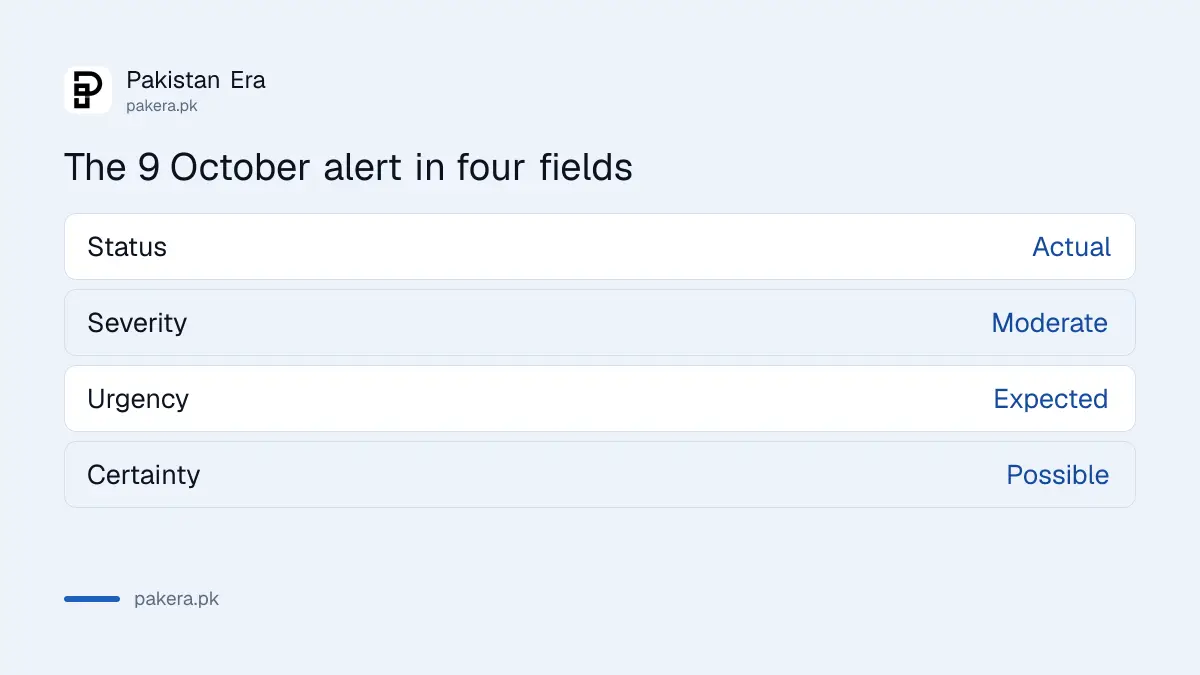
The fields to read first are status, severity, urgency, certainty, onset and expires. Together they say whether the alert is real, how bad it could be, when it starts and when it ends. Both alerts we read carried the same first four values.
| Field | Meaning | 9 October alert |
|---|---|---|
| Status | Real alert or a test | Actual |
| Severity | How bad the effects could be | Moderate |
| Urgency | How soon to act | Expected |
| Certainty | How likely it is | Possible |
| Onset | When it starts | 10 October, 01:00 PKT |
| Expires | When it ends | 14 October, 12:00 PKT |
The meanings in the second column are the standard CAP meanings. PMD's own pages do not explain them, so check the dates and values against the file itself.
The 9 October alert shows what the text contains
The alert was titled "Rain-wind-hailstorm/thunderstorm predicted in upper/central from weekend". It was sent at 15:48 PKT on 9 October by the National Weather Forecasting Centre. The description lists districts by province and dates, and an instruction list follows.
The instructions told people that wind, hail and lightning may damage weak structures such as kacha house roofs, electric poles, billboards, vehicles and solar panels. They also said hail may damage standing crops in the plains of Punjab and Khyber Pakhtunkhwa, and that day temperatures may drop 2 to 4 degrees. Farmers were told to manage crop work around the weather.
The same storm window is covered in NDMA's matching rain and hail alert for 10 to 15 October. For safety steps, see how to stay safe from lightning.
An expired alert is not a live warning
The feed still showed the 9 October alert on 14 October, because it keeps recent items. But its expiry time had passed at 12:00 PKT. An alert that has expired describes weather that PMD no longer says is expected.
The 5 October alert expired on 7 October at 12:00 PKT. The feed we saw held no newer alert after 9 October. That does not mean the weather is calm, because PMD also issues forecasts and press releases outside this feed. It only means no new CAP file appeared.
A forwarded message with no dates fails this test. Ask for the source, then find the item in the feed, as we show below.
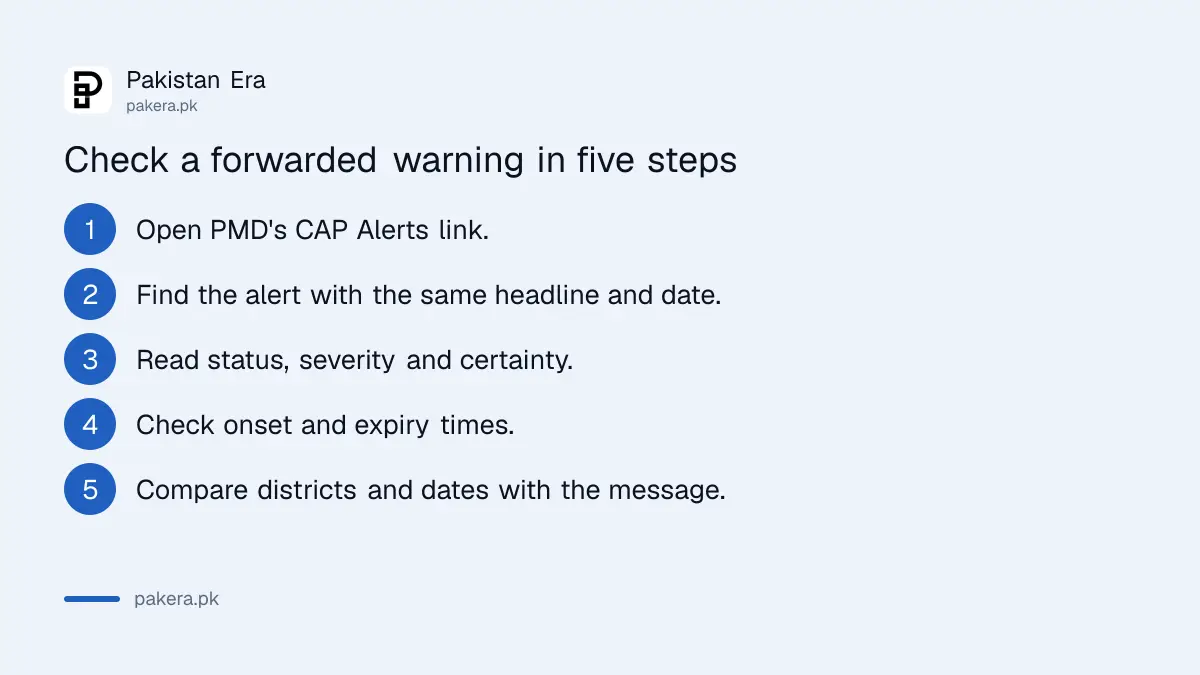
Check a forwarded warning in five steps
The steps below take about two minutes. They work on a phone browser.
- Open the CAP Alerts link on weather.gov.pk, or the feed address above.
- Find the alert with the same headline and send date as your message.
- Open the file and read the status, severity and certainty.
- Check the onset and expires times in Pakistan time.
- Compare the districts and dates with what the message claims.
If the alert is missing, look at PMD's press releases next. Our guide to checking a weather warning on PMD's press release page shows how. And for the national advisory list, see how to get NDMA alerts.
Common questions about PMD's alert feed
What is the PMD CAP alert feed?
It is a list of PMD weather alerts in the Common Alerting Protocol format. Each alert is a file with severity, urgency, certainty and start and end times.
How many alerts did it hold on 14 October 2026?
It held two: one dated 5 October and one dated 9 October. Neither was still active that day.
What does "Moderate" severity mean?
In the CAP standard it means a possible threat to life or property. PMD rated both alerts we read as Moderate, with possible certainty.
Is the feed the only official source?
No. PMD also posts forecasts, press releases and warnings on weather.gov.pk. NDMA posts its own advisories as dated PDFs.
Do I need an app to read it?
No. A normal browser opens the feed and each alert file. Developers can also read the same data in their own apps.
How we verified this
What we checked, where we read it, and what we could not confirm.
Last checked 14 October 2026. The feed and alert files are linked from PMD's weather.gov.pk site and open at the CAP alert feed. We read the 9 October and 5 October alert files in full. The field meanings come from the CAP standard, not from PMD. We did not test how fast new alerts appear in the feed. For emergencies, use NDMA's advisories page and local helplines.
About the author

Public Services and Education Journalist
Fajr Riaz is a journalist and content writer at Pakistan Era, based in Lahore. She covers the questions people meet in everyday life in Pakistan: how a public service works, what a change in the rules means, and where to find a reliable answer.