Check Where SadaPay and NayaPay Keep Your Money: SBP's Trust Account Rule in Pakistan
SBP rules make SadaPay and NayaPay keep your money in a trust account at an A rated bank, apart from their own. See what that protects, and what it does not.
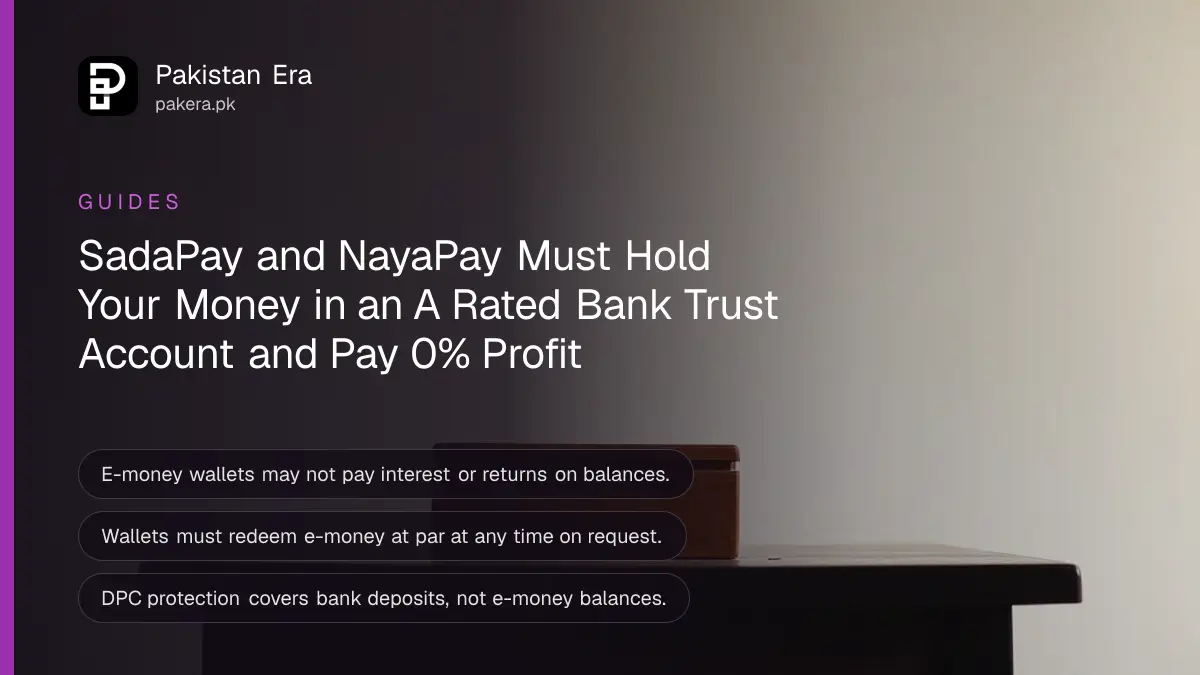
Short answer: SadaPay and NayaPay are e-money wallets regulated by the State Bank of Pakistan (SBP), not banks. SBP's rules for e-money institutions say they must keep your money apart from their own, in a trust account at a licensed bank rated at least A. They may not pay you profit on that balance. The Deposit Protection Corporation (DPC) covers bank deposits, not e-money balances.
People ask this when a wallet's name turns up in the news, or when they keep a freelancer's income in the app for weeks. The useful question is not "is it safe" in general. It is where the money sits and which rule protects it. We read SBP's Regulations for Electronic Money Institutions and the wallets' own websites on 20 October 2026. Here is what the rules say, and what they do not.
E-money wallets must keep your money in a trust account
Para 14 of SBP's EMI regulations says an e-money institution shall not mix company funds with customers' funds. It must place the money it receives in a trust account with a licensed bank in Pakistan rated at least A. A trust account is a bank account held for customers and kept separate from the company's own money.
The same paragraph adds four more safeguards. Above Rs 100 million in customer balances, no more than half may sit with one trustee bank. If the trustee's rating is cut, the wallet must move to another bank within three months. It must give SBP a copy of the trust agreement. And it may invest up to 50% of its average customer balance in government securities of up to one year.
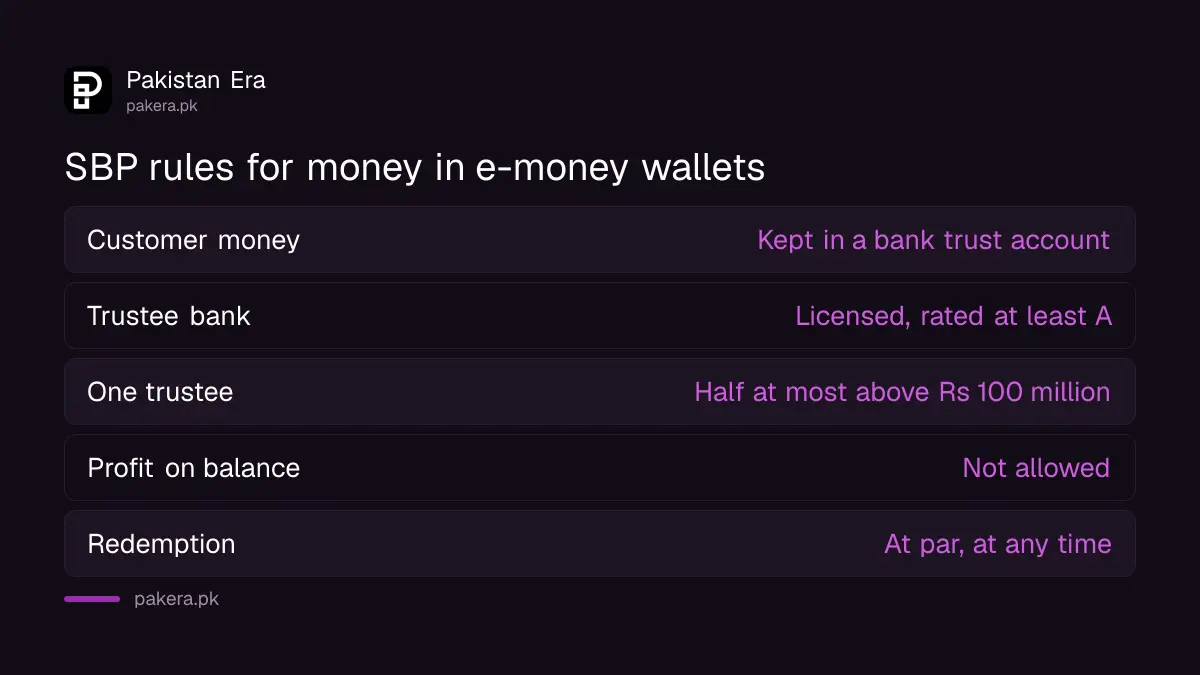
So your SadaPay or NayaPay balance is meant to be backed by money in a bank, in an account the wallet cannot use for its own costs. SBP can also cancel a licence if a wallet fails to safeguard customer funds, or if it enters insolvency, the regulations say.
SadaPay and NayaPay say SBP regulates them
NayaPay's website says it is "authorised and regulated by the State Bank of Pakistan as an Electronic Money Institution". SadaPay's website says it "is regulated by the State Bank of Pakistan", and its terms say a SadaPay account lets you store electronic money. JazzCash and Easypaisa sit under different licences, run by banks.
| Wallet | Who holds the account, per its own site | Main protection for your balance |
|---|---|---|
| NayaPay | NayaPay (Private) Limited, an SBP licensed EMI | EMI trust account rule |
| SadaPay | Sadapay Private Limited, regulated by SBP, account stores electronic money | EMI trust account rule |
| JazzCash | Mobilink Microfinance Bank Limited, branchless banking account | Microfinance bank rules |
| Easypaisa | easypaisa Bank Ltd | Bank rules and DPC membership |
JazzCash's terms define the bank as Mobilink Microfinance Bank Limited and the account as a branchless banking account. Easypaisa's website names easypaisa Bank Ltd. Our check of bank deposit protection found Easypaisa Bank on DPC's member list and no microfinance bank on its March 2026 list. How digital banks differ from wallets is in our explainer on digital banks in Pakistan.
Wallets cannot pay profit on your e-money balance
The regulations say an e-money institution shall neither pay interest or returns to customers nor offer anything that adds to the value of the e-money. It may offer discounts on goods and services, but not ones linked to how much you hold or for how long. So money left in an EMI wallet earns nothing.
That has a practical cost. Rs 300,000 left in a wallet for a year earns nothing, while a bank savings account at the 10% minimum would pay about Rs 30,000 before tax. If you keep a large balance in a wallet for convenience, the lost profit is the price. The minimum bank rate is explained in our page on the bank savings minimum rate.
You can redeem e-money at par at any time
Para 13 says an e-money institution shall redeem e-money at par value at any time, when the holder asks, without charges. At par means one rupee of balance returns one rupee. Cash redemption needs biometric verification. In plain terms, you can always move your balance back out.
The wallets' fee lists still show charges on some withdrawals. Both list Rs 35 for a local ATM withdrawal, according to our pages on SadaPay limits and charges and NayaPay limits and charges. Transfers to a bank through Raast are listed as free on NayaPay. So the cheapest way to take money out is usually a transfer to your own bank account.
The 2019 rules have been updated since in places
The regulations on SBP's circular page are dated 1 April 2019. Some figures in them are clearly out of date. They set a monthly load limit of Rs 50,000 or Rs 200,000, while both wallets now publish limits of Rs 400,000 a month after biometric checks. So read the 2019 text as the base rules, not every current figure.
We found no later SBP circular changing the trust account clause, but we did not read every payment systems circular since 2019. Keep that in mind before relying on the details. Here is what we would do with money in an e-money wallet:
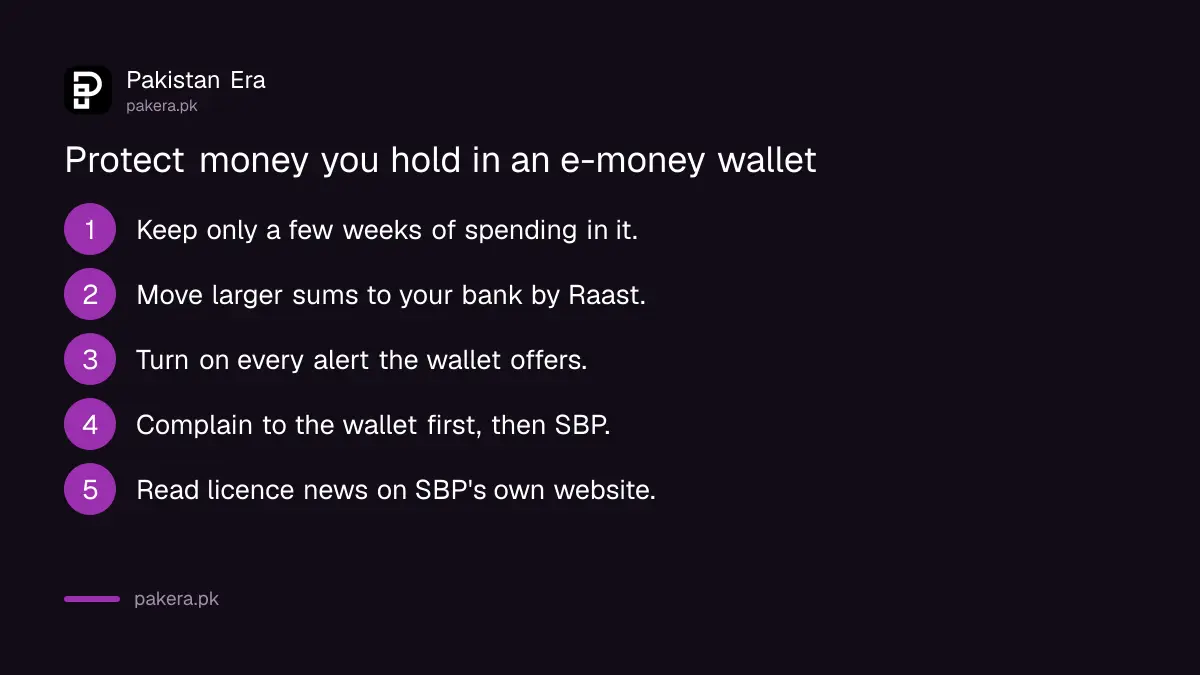
- Keep in the wallet only what you need for the next few weeks of payments.
- Move larger sums to your own bank account, ideally by Raast to avoid fees.
- Keep your app updated and turn on every alert the wallet offers.
- If a wallet blocks or freezes your account, complain to it first, then to SBP.
- Read any notice from SBP about a wallet's licence on SBP's own website, not on social media.
Complaints about wallets go to SBP rather than the Banking Mohtasib in many cases, as set out in how to complain about a microfinance bank or wallet. If money left your wallet without your consent, see how to claim a digital fraud refund.
Common questions
Is money in SadaPay or NayaPay covered by deposit protection?
DPC covers deposits at its member banks. An e-money balance is not a bank deposit. It is protected by the rule that wallets keep customer money in a trust account at a bank rated at least A.
Does SadaPay pay profit on my balance?
No. SBP's EMI regulations do not allow e-money institutions to pay interest or returns on e-money.
What happens to my money if a wallet company fails?
The rules keep customer money in a separate trust account, apart from the company's own funds, which is meant to protect it. SBP's regulations do not set out a payout process for customers, so we cannot say how long recovery would take.
Can a wallet refuse to give my money back?
The regulations require redemption at par at any time on request. A wallet can still hold an account for security or legal checks, and cash redemption needs biometric verification.
Are JazzCash and Easypaisa EMIs too?
No. JazzCash's terms name Mobilink Microfinance Bank Limited. Easypaisa's website names easypaisa Bank Ltd. Different rules apply to each.
Which bank holds SadaPay's trust account?
Neither wallet names its trustee bank on the pages we read. The rules require at least an A rated licensed bank in Pakistan.
How we verified this
What we checked, where we read it, and what we could not confirm.
Last checked 20 October 2026. We read SBP's PSD Circular No. 01 of 2019 and its annex, the Regulations for Electronic Money Institutions, including para 13 on redemption, para 14 on safeguarding and the ban on paying returns, on 20 October 2026. The licence statements come from the NayaPay and SadaPay websites and SadaPay's terms, and the JazzCash and Easypaisa entities from their own sites, read the same day. The DPC position is from DPC's FAQ as read for our deposit protection page on 3 October 2026. The Rs 30,000 figure is our arithmetic. We could not identify either wallet's trustee bank or confirm every SBP amendment since 2019.
About the author

Technology Journalist & Multimedia Producer
Ahmad Ali is a technology journalist and multimedia producer at Pakistan Era, joining the team in October 2026. He covers consumer technology and digital life for Pakistani readers, combining research with hands-on product testing.