Stop an Unauthorised Direct Debit From Your Bank Account in Pakistan: What SBP Says the Bank Must Do
Never approved a direct debit? SBP's guidelines say your Pakistani bank will cancel it and reverse the money and fees, unless you approved it with card and PIN.
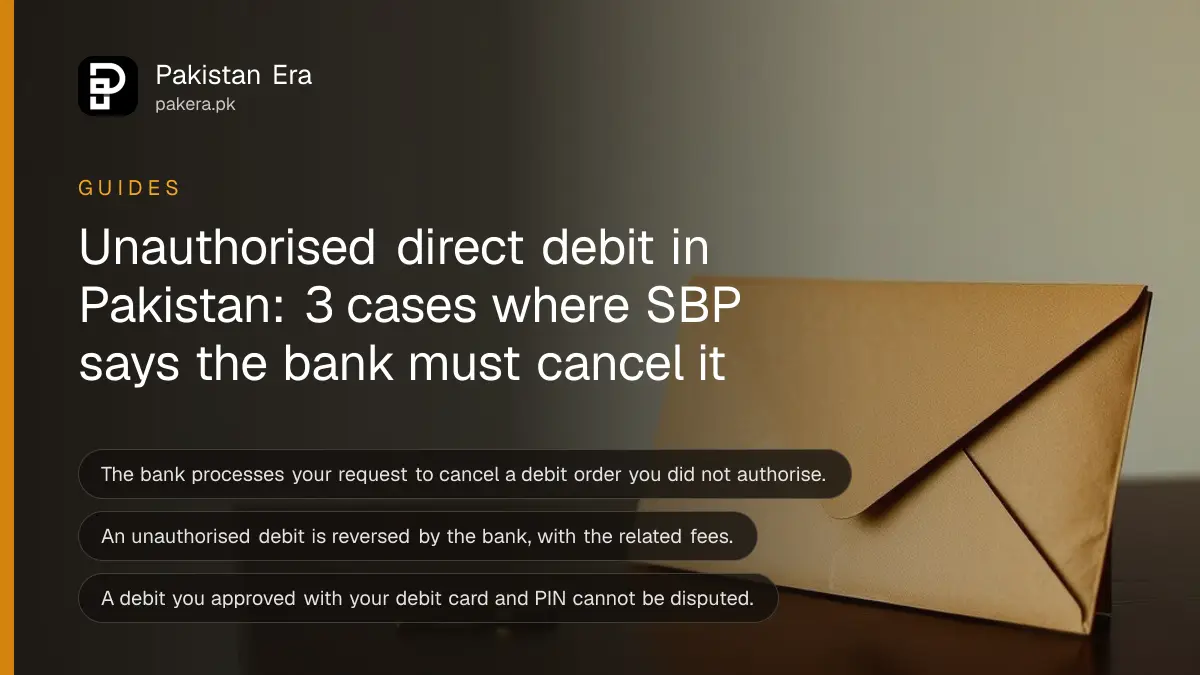
Short answer: Write to your bank and ask it to cancel the direct debit. SBP's guidelines say a bank will process your request to cancel a debit order that you did not authorise, and will reverse the transaction and the related fees. The exception: you cannot dispute one that you approved with your debit card and PIN.
Rs 2,450 leaves your account every month, labelled with the name of a company you do not remember dealing with. It may be an insurance premium, a membership or a loan instalment. You did not ask for it. The first question is whether you gave permission, and the second is how to stop it.
We read the State Bank of Pakistan's Guidelines of Business Conduct for Banks, published by its Consumer Protection Department, on 13 October 2026. The guidelines define a direct debit and set out what a bank does when a customer disputes one. The copy on SBP's site cites circulars up to 2014, so ask your bank for its current terms too. This page covers bank accounts. For card payments, see the steps for a credit card dispute.
A direct debit is a payment you allow someone else to start
SBP defines direct debits as arrangements where a customer authorises the bank to make payments directly from the account to a third party who has set up the arrangement. The amount can be fixed or variable. If it is variable, SBP says the bank should give the customer prior notice of changes.
This is different from a standing instruction, where you tell your bank to pay a set amount on a set date. With a direct debit, the other company starts the pull. The steps for the standing instruction type are in the guide to stopping a standing instruction.
Check the amount each month against what you agreed. A company that raises the amount must warn you first, according to SBP's definition. If you were not warned, say so in your complaint.
The bank must act on your request to cancel
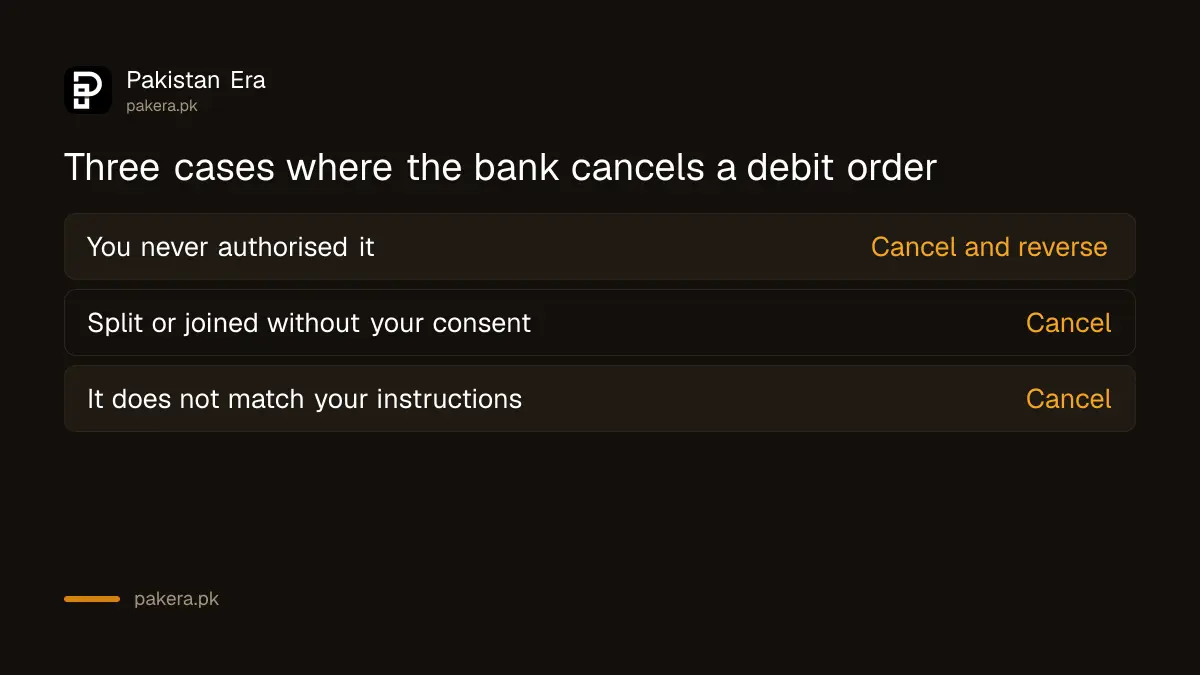
SBP's guidelines say the bank will process a customer's instruction to cancel a direct debit request in three cases. The first is a debit order that the customer did not authorise. The second is one carried out in a way the customer did not allow, such as splitting an amount or joining several debit orders. The third is one that does not match the customer's instructions.
The guidelines also say the bank may ask you to prove your identity and confirm the transaction. If the bank finds that the debit order was not authorised, it will reverse the transaction and any related fees.
You cannot dispute one you approved with your card and PIN
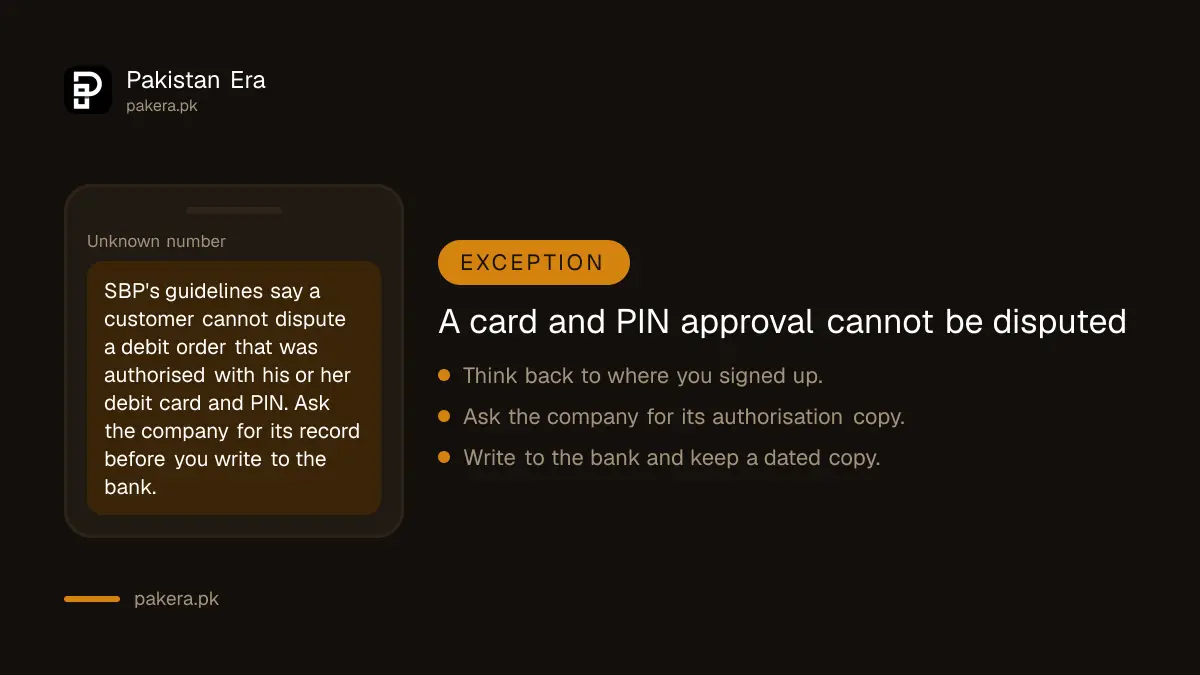
There is a clear exception. The guidelines say a customer cannot dispute a debit order if the authorisation was given by the customer using his or her debit card and PIN. If you typed your PIN on a form or a machine to set it up, the bank can treat it as approved.
Before you write to the bank, think back. Did you sign up in a shop, an office or on a website? Did you enter a PIN or a one time code? If yes, the company may hold proof. Ask the company for a copy of what you agreed.
| Your situation | What SBP's guidelines say |
|---|---|
| You never authorised the debit | The bank will cancel the order and reverse the money and fees |
| The debit was split or combined in a way you did not allow | The bank will process your cancellation |
| The debit does not match your instructions | The bank will process your cancellation |
| You approved it with your debit card and PIN | You cannot dispute it |
| The amount rose without notice | The bank should give prior notice of changes |
Stop and recover the money in six steps
These steps follow SBP's guidelines for the bank's duty. The order and the advice to write are our own plain reading.
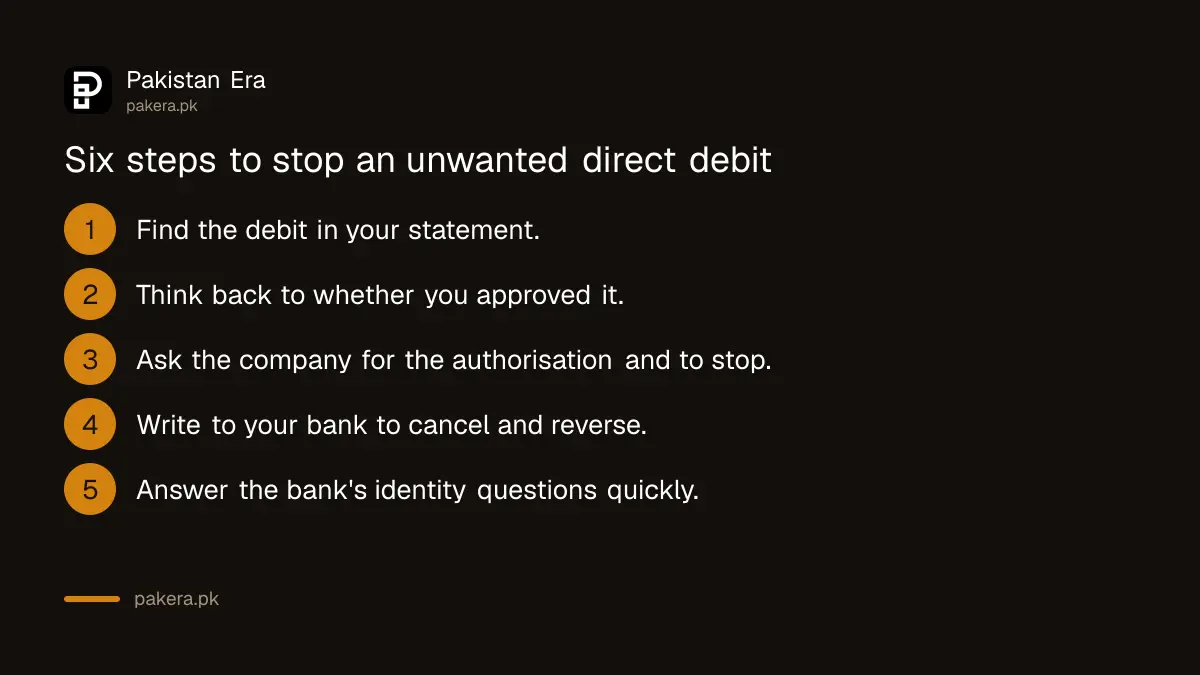
- Find the debit in your statement and note the date, amount and the name of the company.
- Think back to whether you approved it, and with what card, PIN or form.
- Ask the company for a copy of the authorisation, and ask it to stop collecting.
- Write to your bank asking it to cancel the direct debit and reverse the unauthorised debits and fees. Keep the date and a copy.
- Answer the bank's identity questions quickly. It is allowed to ask.
- If the bank does not act, make a complaint to the bank, then to the Banking Mohtasib or SBP.
If money left your account through fraud rather than a company's debit order, use the steps in the page on claiming a digital fraud refund. For a subscription you signed up for by SMS, read about the 15 day free look rule. The route for escalating a complaint is in the page on the SBP Sunwai complaint portal.
Common questions
Can I cancel a direct debit from my account in Pakistan?
Yes. SBP's guidelines say the bank will process your instruction to cancel a direct debit that you did not authorise, or that was made in a way you did not allow.
Will I get the money back?
If the bank finds the debit was not authorised, SBP's guidelines say it will reverse the transaction and the related fees. The guidelines give no number of days, so ask the bank for a date.
Can the bank ask me to prove who I am?
Yes. The guidelines allow the bank to ask for proof of identity and confirmation of the transaction before it acts.
What if I approved it with my debit card and PIN?
Then you cannot dispute it under SBP's guidelines. Ask the company for its record and, if you think the record is wrong, complain.
Is a direct debit the same as a standing instruction?
No. A direct debit is started by the company you authorised. A standing instruction is started by your bank on your order.
Must the company warn me before changing the amount?
SBP's definition says the bank should give prior notice of changes when the amount is variable. Keep any notice you receive.
How we verified this
What we checked, where we read it, and what we could not confirm.
Last checked on 13 October 2026, Pakistan time. We read SBP's Guidelines of Business Conduct for Banks, the definition of direct debits and clause 4.13, and SBP's Consumer Protection page for the complaint route. The guidelines cite circulars up to 2014, so we could not confirm every clause is unchanged. The guidelines set no deadline for reversal, and we did not test any bank's actual process.
About the author

Technology Journalist & Multimedia Producer
Ahmad Ali is a technology journalist and multimedia producer at Pakistan Era, joining the team in October 2026. He covers consumer technology and digital life for Pakistani readers, combining research with hands-on product testing.