UK Pornography Law From 6 November 2026: What Is Illegal and the Visa Risk for Pakistanis
From 6 November 2026, three types of pornography are illegal to own in England and Wales. What stays legal, chat group risks and when a visa is at risk.
یہ صفحہ اردو میں پڑھیں
Short answer: from 6 November 2026, it is a crime in England and Wales to possess or publish three more types of pornography: images of strangulation or suffocation, sex between relatives, and sex where someone is, or pretends to be, under 16. Legal adult pornography is still legal for adults to watch. Viewing legal material does not put a visa at risk. A conviction can, and a prison sentence of 12 months or more leads to automatic deportation.
The change comes from the Crime and Policing Act 2026, which received Royal Assent on 29 April 2026. The pornography sections were switched on by the Crime and Policing Act 2026 (Commencement No. 4) Regulations 2026, which name 6 November 2026 as the start date. We read the Act, the commencement regulations, the Ministry of Justice guidance, the Immigration Rules and the UK Borders Act on legislation.gov.uk and GOV.UK on 6 November 2026.
This page is for Pakistani students, workers and families in the UK. It explains the rules in plain words. It is not legal advice. If the police contact you, speak to a solicitor.
Three new possession offences started on 6 November 2026
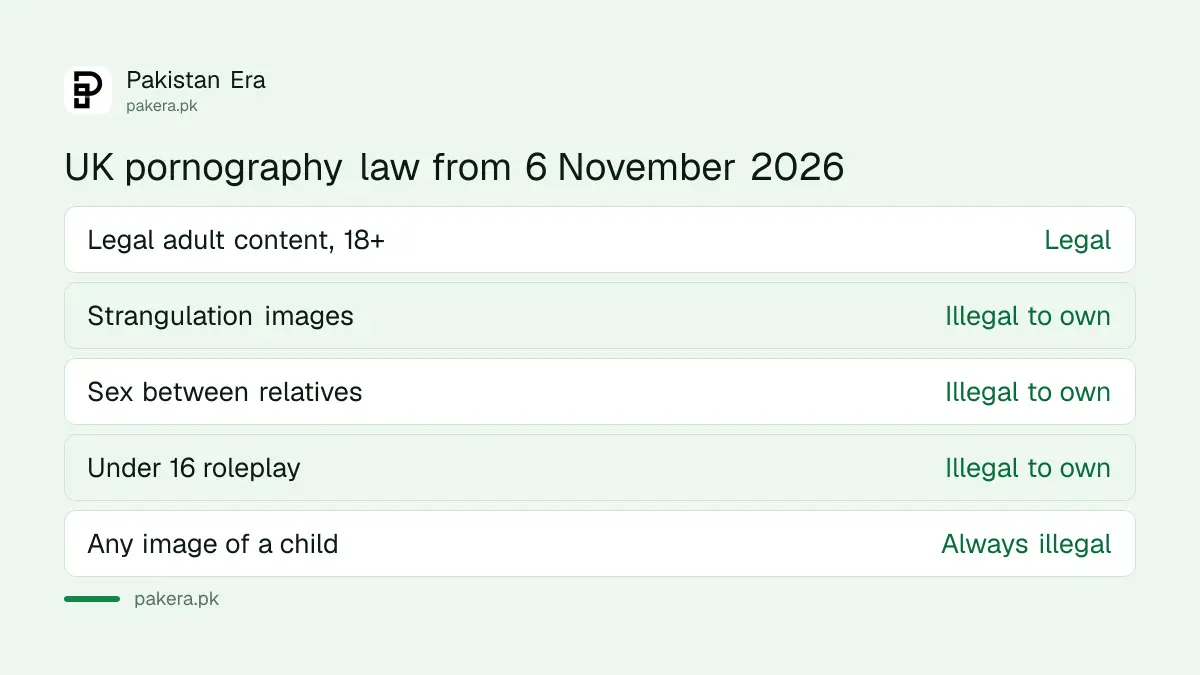
Three types of pornographic image became illegal to possess, not only to make or share, in England and Wales on 6 November 2026. The offences cover images that look real to a reasonable person, including realistic AI images.
Sections 104, 106 and 107 of the Crime and Policing Act 2026 add new offences to the Criminal Justice and Immigration Act 2008. The Ministry of Justice guidance, published on 16 October 2026, lists them like this:
- Strangulation or suffocation. Pornographic images that show, in an explicit and realistic way, one person strangling or suffocating another.
- Sex between relatives. Penetrative sexual activity between people a reasonable person would think are related, or pretending to be related, in certain ways. This includes some step and foster relationships where one person is, or pretends to be, under 18.
- Sex involving a child under 16, real or pretended. Sexual activity where a reasonable person would think at least one person is, or is pretending to be, under 16. This covers adults acting as children.
The government's factsheet says the strangulation offence "would therefore include realistic AI generated images". Cartoons that nobody would mistake for real people are outside these three offences, because each one needs the people to look real.
| New offence (from 6 November 2026) | Maximum for possession | Maximum for publishing |
|---|---|---|
| Strangulation or suffocation images | 2 years in prison | 5 years in prison |
| Sex between relatives | 2 years in prison | 5 years in prison |
| Sex with someone under 16, real or pretended | 3 years in prison | 5 years in prison |
"Publish" is wide. The guidance says it includes "giving or making an image available to another person by any means", such as uploading, posting, sending or sharing. Forwarding a clip in a group chat is publishing.
The rules apply in England and Wales. The strangulation section also covers Northern Ireland, but the 6 November regulations start it only "so far as it extends to England and Wales". Scotland has its own section 105, which was not part of the 6 November start.
Files you already have count, so delete them now
Old files count. The Ministry of Justice says possession is a continuing act, so an image saved before 6 November is still possessed after it. The guidance tells people to delete such images permanently.
The guidance says possession usually means having "custody or control" of an image. That includes images on a phone or laptop, in a cloud account, or in saved files. A clip you saved two years ago and forgot about is still on your device.
The law gives four defences. You may have one if:
- You had not seen the image and did not know, or have cause to suspect, what it was.
- It was sent to you without you asking, and you did not keep it "for an unreasonable length of time". This defence is for possession only.
- You had a legitimate reason, such as certain work or research.
- You directly took part in the act shown, and other conditions are met.
The second defence is the one most people will rely on. It protects someone who receives a clip they did not ask for. It does not protect someone who keeps it, saves it to a gallery or forwards it.
Legal adult pornography stays legal for adults
Adults aged 18 or over can still watch and keep legal pornography in the UK. What changed in 2025 is how sites check age. What changed in 2026 is a short list of banned content. Neither turns ordinary adult viewing into a crime.
Since 25 July 2025, every site or app that allows pornography must use "highly effective" age checks for UK users, under the Online Safety Act 2023. Ofcom, the regulator, accepts methods such as facial age estimation, photo ID matching and credit card checks. Ticking a box saying "I am over 18" is no longer enough. Ofcom says its role "is not to stop adults from accessing legal pornography".
The new offences are also "priority offences" under the Online Safety Act. That means platforms must find and remove this material, not wait for a complaint. Ofcom can fine a platform up to £18 million or 10 per cent of its worldwide revenue, whichever is higher.
Using a VPN is not itself an offence
The Online Safety Act places its age check duties on websites and apps, not on adult users. We found no offence in it for an adult who uses a VPN, a service that hides your location. But a VPN changes nothing about the content. An illegal image is just as illegal when it reaches your phone through a VPN. This is our reading of the Act, and Ofcom's own user page could not be opened when we checked.
Some content was already illegal before 2026
The new offences add to older ones. Extreme pornography, indecent images of children and intimate image abuse were all crimes before 6 November 2026. Several of these rules catch people who never made anything, only kept or shared it.
Extreme pornography under section 63
Section 63 of the Criminal Justice and Immigration Act 2008 already made it an offence to possess an "extreme" pornographic image that looks real. That covers explicit and realistic images of an act that threatens a person's life, serious injury to the genitals, anus or breasts, sex with a dead body, sex with an animal, and non-consensual penetration. The image must also be "grossly offensive, disgusting or otherwise of an obscene character".
Indecent images of children: always illegal
Any indecent image of a person under 18 is illegal. Section 160 of the Criminal Justice Act 1988 makes possession a crime, with up to five years in prison. Making, sharing or forwarding such images is a separate and more serious offence under the Protection of Children Act 1978. A "pseudo-photograph", such as an edited or AI image, counts too.
The same two defences apply as above: you had not seen it, or it was sent without request and you did not keep it for an unreasonable time. Nothing else changes the rule. It does not matter that a group admin posted it, that the app saved it on its own, or that you only forwarded it as a joke.
Deepfakes and sharing someone's intimate image
- Sharing without consent. Since 31 January 2024, sharing, or threatening to share, an intimate photo or film of someone without consent is an offence under section 66B of the Sexual Offences Act 2003. It covers an image that "appears to show" the person.
- Creating a fake. Since 6 February 2026, creating a fake intimate image of an adult without consent is an offence under section 66E, added by the Data (Use and Access) Act 2025.
- Nudification tools. Since 29 June 2026, making, adapting or supplying a tool built to create fake intimate images is an offence under section 66I, with up to 3 years in prison. Using such a tool on a real person is caught by section 66E.
For the full list of Pakistan's own cyber offences, see our PECA sections and punishments guide.
WhatsApp and Telegram groups carry the biggest everyday risk
Most people who get into trouble did not go looking for anything. A clip arrives in a large group, the app saves it, and it sits in the phone's gallery. Turning off auto-download and leaving such groups are the two simplest protections.
WhatsApp and Telegram can save photos and videos to your phone without you opening them. If you want to leave Telegram altogether, our guide to deleting a Telegram account has the steps. In WhatsApp the setting is under Settings, then Storage and data, then Media auto-download. In Telegram it is under Settings, then Data and Storage. Set photos and videos to download only when you tap them.
If something illegal arrives:
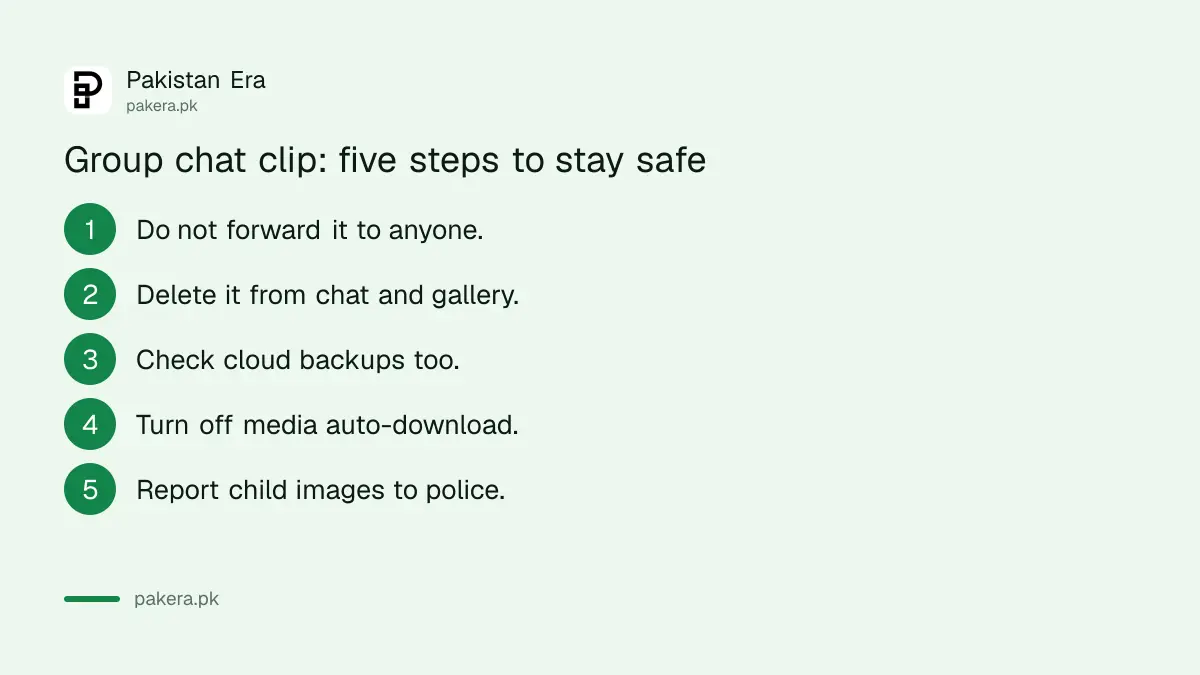
- Do not forward it, not even to complain about it. Forwarding is publishing.
- Delete it from the chat and from your gallery, and empty any "recently deleted" or bin folder.
- Check that the app did not back it up to Google Photos, iCloud or a similar cloud account.
- Leave the group if this keeps happening.
- If it shows a child, report it to the police on 101, or 999 in an emergency, rather than sharing it with anyone.
A conviction can cancel a visa, and 12 months in prison means deportation
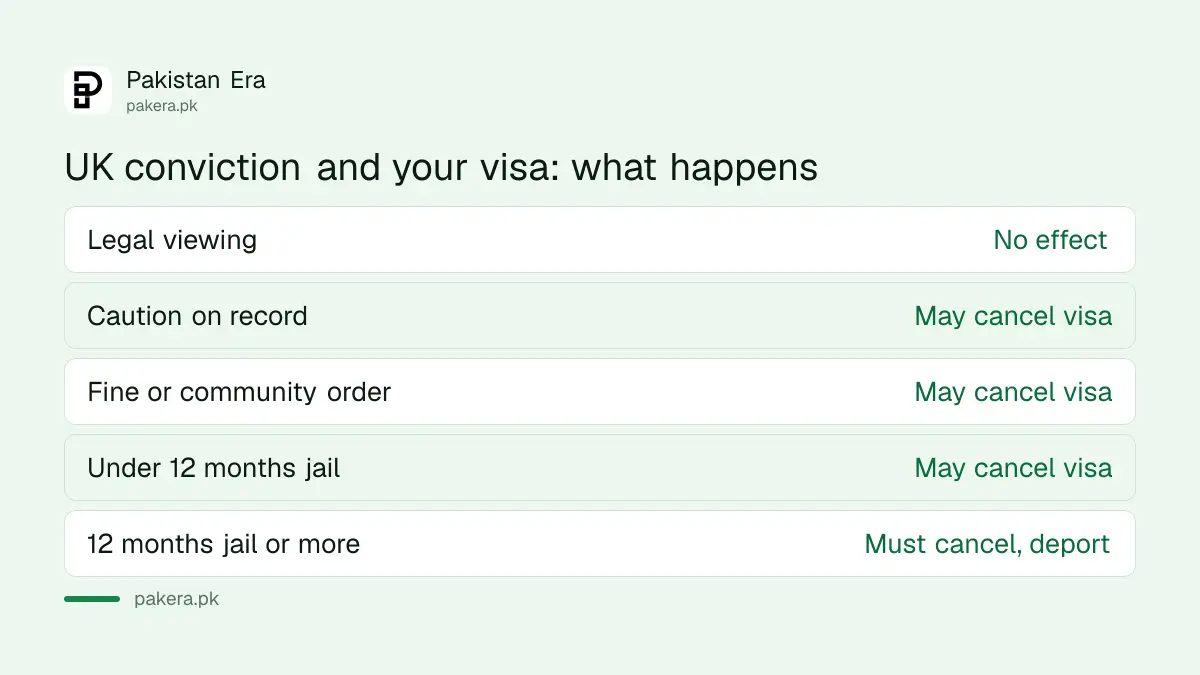
Viewing legal adult material does not affect a visa. A criminal conviction can. Under the Immigration Rules, a prison sentence of 12 months or more means the Home Office must cancel or refuse permission. Shorter sentences, fines and recorded cautions allow it to do so.
A fresh visa application is also judged on these rules, and our UK visa processing time guide covers how long a decision takes. The criminality rules sit in Part Suitability of the Immigration Rules, which GOV.UK showed as updated on 29 October 2026. They apply to every visa, including Student, Graduate, Skilled Worker and family visas.
| Outcome | Effect on current visa | Effect on new applications |
|---|---|---|
| Custodial or suspended sentence of 12 months or more | Must be cancelled (SUI 5.2) | Must be refused (SUI 5.1) |
| Sentence under 12 months | May be cancelled (SUI 5.5) | May be refused (SUI 5.3) |
| Fine, community order or other non-custodial sentence | May be cancelled (SUI 5.5) | May be refused (SUI 5.3) |
| Caution or other out-of-court disposal on your record | May be cancelled (SUI 5.5) | May be refused (SUI 5.3) |
| Viewing legal adult content | No effect | No effect |
"May" means the Home Office weighs the case. It does not mean it always will. Persistent offending and offences that caused serious harm are mandatory grounds too.
What triggers automatic deportation
Section 32 of the UK Borders Act 2007 calls a non-British citizen who is convicted in the UK and sentenced to at least 12 months in prison a "foreign criminal". The Home Office "must" then make a deportation order, unless one of the exceptions in section 33, such as human rights grounds, applies.
Two limits matter. Section 38 says a suspended sentence does not count unless a court later orders it to take effect. And several short consecutive sentences that add up to more than 12 months do not count on their own. The Home Office can still consider deportation in other cases on public good grounds, but the automatic duty starts at 12 months.
So the maximum sentence for an offence is not what counts. The sentence the court actually gives is. A conviction with a shorter sentence, a fine or a caution still brings the discretionary visa rules in the table above. Only a solicitor can say how this applies to one case.
Always declare a conviction or caution
Visa, settlement and citizenship forms ask about convictions and cautions. Hiding one is a bigger problem than the record itself. Under SUI 9.1, an application must be refused where the applicant used deception, and SUI 12.1 sets a 10 year ban on some entry clearance applications after deception. If you are planning a family visa, our UK student dependants guide and UK eVisa share code guide cover the other steps.
If the police contact you, get free legal advice first
Anyone questioned at a police station in England and Wales has the right to free, independent legal advice. Ask for the duty solicitor before you answer questions. Foreign nationals can also ask for help from the Pakistan High Commission in London.
GOV.UK says: "You have the right to free legal advice (legal aid) if you're questioned at a police station." Tell the police you want legal advice and they contact the Defence Solicitor Call Centre. A duty solicitor is "available 24 hours a day and independent of the police". You also have the right to tell someone where you are, and to ask for an interpreter.
Do not delete messages or files after the police have contacted you, and do not discuss the case in chats. Ask your solicitor what to do.
The Pakistan High Commission in London lists a call centre on 0207 664 9200, Monday to Friday, 9:30 am to 5:30 pm, and a weekend emergency number, 020 7664 9276. Consular staff can help with family contact and documents. They cannot act as your lawyer. If your passport is also an issue, see our lost Pakistani passport abroad guide.
Sending material to Pakistan brings in PECA
Sending this kind of material to someone in Pakistan can also fall under Pakistan's Prevention of Electronic Crimes Act 2016 (PECA). Sections 22, 22B and 22C, on child sexual abuse material and related offences, carry 14 to 20 years and a fine of at least Rs 1 million. Section 21 covers sharing a person's sexually explicit image without consent.
Summary: what is legal and what is not in the UK
This table puts the rules in one place. It shows the law in England and Wales from 6 November 2026 and the most serious immigration effect each activity can have.
| Activity | Legal in England and Wales? | Possible immigration effect |
|---|---|---|
| Adult (18+) watching legal pornography after an age check | Legal | None |
| Using a VPN | No offence found for users | None on its own |
| Keeping strangulation, relative or under-16 roleplay images | Illegal from 6 November 2026 | Visa may be cancelled; deportation if jailed 12 months or more |
| Forwarding or posting any of those images | Illegal, up to 5 years | Same, with a higher risk of prison |
| Keeping or sharing any indecent image of a person under 18 | Always illegal | Visa cancellation and deportation risk |
| Sharing or faking someone's intimate image without consent | Illegal | Visa may be cancelled or refused |
| Receiving a clip you did not ask for and deleting it quickly | A defence is available | None if no charge follows |
Frequently asked questions
Is watching pornography illegal in the UK now?
No. Adults can still watch legal pornography. From 6 November 2026, three types became illegal to possess or publish in England and Wales: strangulation or suffocation, sex between relatives, and sex involving someone who is or pretends to be under 16.
Can I be deported to Pakistan for watching legal adult videos?
No. Lawful viewing is not a crime and is not a ground in the Immigration Rules. Deportation and visa cancellation follow a criminal conviction, and automatic deportation starts at a prison sentence of at least 12 months.
Someone sent a clip in our WhatsApp group. Am I in trouble?
The law gives a defence if it was sent without your request and you did not keep it for an unreasonable time. Do not forward it. Delete it from the chat, the gallery and any cloud backup, and turn off media auto-download.
Do old videos saved before 6 November count?
Yes. The Ministry of Justice says possession is a continuing act, so an image you still hold after 6 November 2026 is covered. Its guidance tells people to delete such images permanently.
Does a police caution affect my Student visa?
It can. A caution or other out-of-court disposal recorded on your record is a discretionary ground to cancel permission or refuse a new application under SUI 5.3 and 5.5. You must declare it on future forms.
Does the new law apply in Scotland?
Not from 6 November 2026. The regulations started the offences in England and Wales. Scotland has its own strangulation section, which was not part of that start date.
Sources and last checked
Last checked 6 November 2026. We read the Crime and Policing Act 2026, its Commencement No. 4 Regulations, the Ministry of Justice guidance on offences relating to pornography, the government's pornography factsheet, section 63 of the 2008 Act, section 160 of the Criminal Justice Act 1988, sections 66B and 66E of the Sexual Offences Act 2003, Immigration Rules Part Suitability, sections 32 and 38 of the UK Borders Act 2007, and GOV.UK on legal advice at the police station. The Ofcom age check date and quote are from Ofcom's own pages as shown in search results; its user page refused our request. The High Commission numbers are from phclondon.org as read on 5 November 2026. The section 33 exceptions, the public good deportation power and the app menu names were not re-read at source today.
About the author

Technology Journalist & Multimedia Producer
Ahmad Ali is a technology journalist and multimedia producer at Pakistan Era, joining the team in October 2026. He covers consumer technology and digital life for Pakistani readers, combining research with hands-on product testing.