Weekly Inflation in Pakistan Rises 0.29% as Tomatoes Jump 54% (SPI, 5 November 2026)
Pakistan's SPI rose 0.29% in the week to 5 November 2026 and the yearly rate hit 12.31%. Tomatoes rose 54% to Rs 193.81 a kilo. See every price and city.
یہ صفحہ اردو میں پڑھیں
Weekly inflation in Pakistan rose 0.29% in the week ended Thursday 5 November 2026, the Pakistan Bureau of Statistics (PBS) says. Its Sensitive Price Indicator (SPI) went up to 374.61 from 373.51. Tomatoes jumped 54.18% in one week, to an average of Rs 193.81 a kilo, while cheaper petrol and diesel held the rise down.
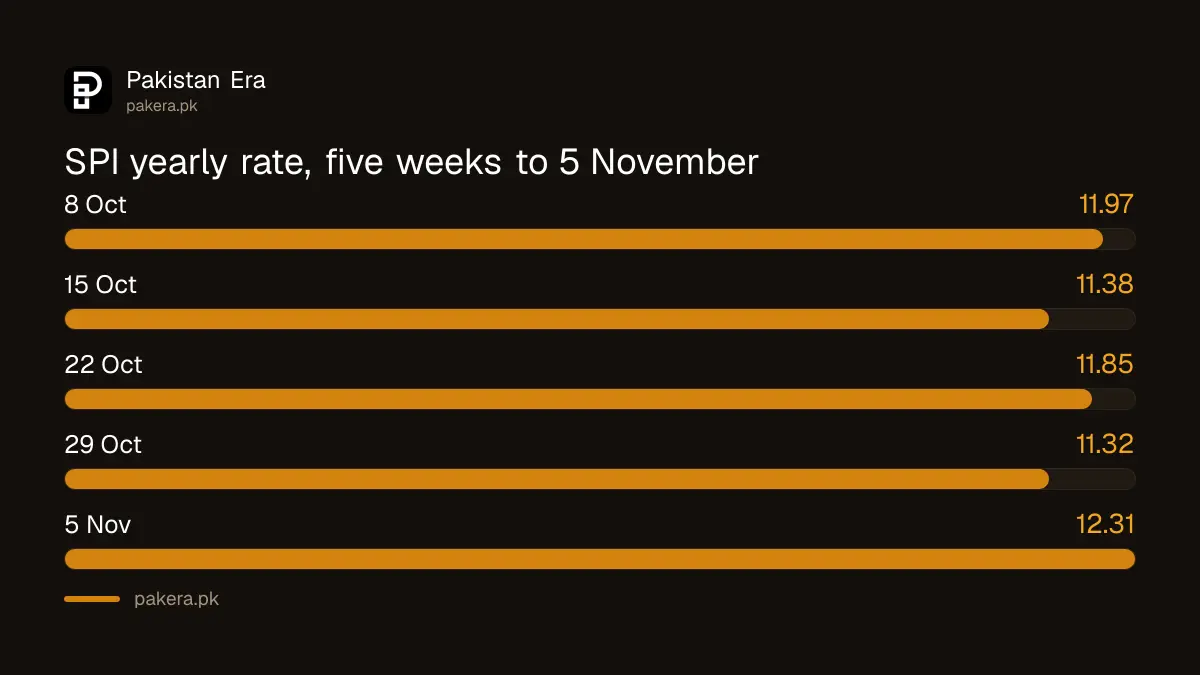
The yearly rate rose to 12.31%, the highest in the last ten weeks of PBS data. A week earlier it was 11.32%. The SPI tracks 51 everyday items in 50 markets across 17 cities, so it is the quickest official read of what a household pays. We read the PBS release, its executive summary and the full city price annex on 6 November 2026. Below are the items that moved, what each income group faced, and where tomatoes cost the most.
The SPI rose 0.29% in the week to 5 November 2026
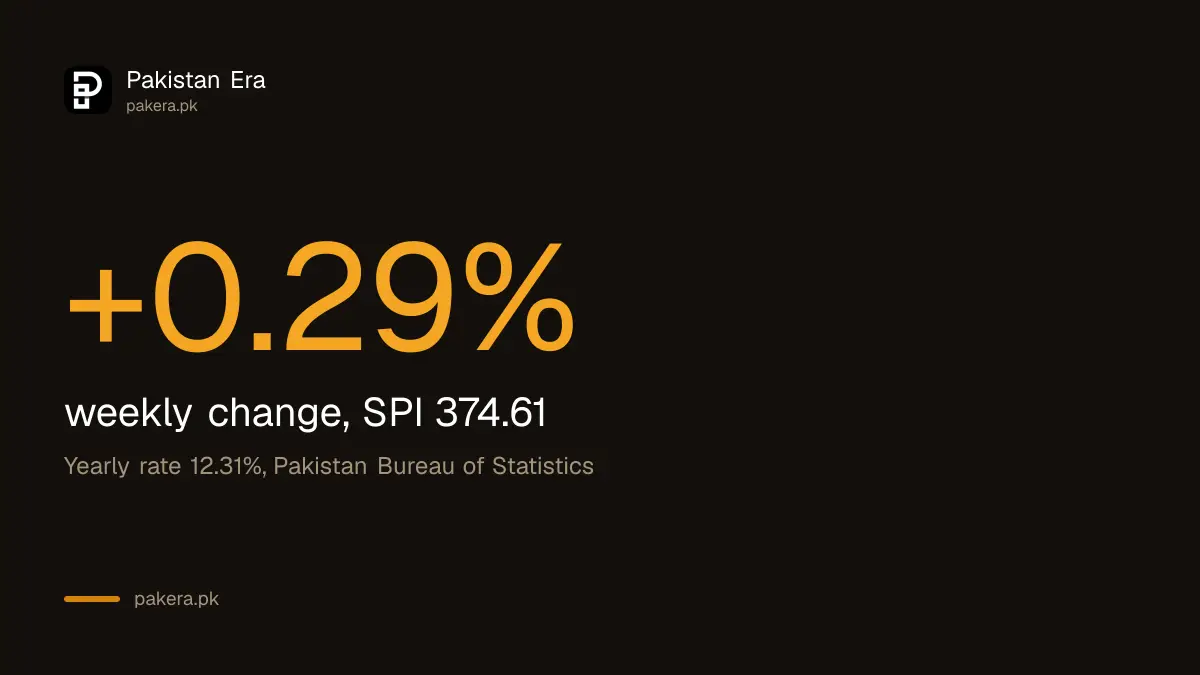
The combined SPI stood at 374.61 for the week ended 5 November 2026, up 0.29% from 373.51 on 29 October. Against the same week of 2025, when it was 333.55, prices were 12.31% higher. Of the 51 items, 21 rose, 10 fell and 20 did not change.
Last week the index fell 0.35%, so this week took back most of that fall. The bigger change is in the yearly rate. It had stayed between 11.32% and 11.97% for six weeks. Now it is 12.31%. Last week's details are in our 29 October SPI report, and every week of 2026 is listed in the SPI list for 2026.
Tomatoes rose 54.18% while petrol fell 4.20%
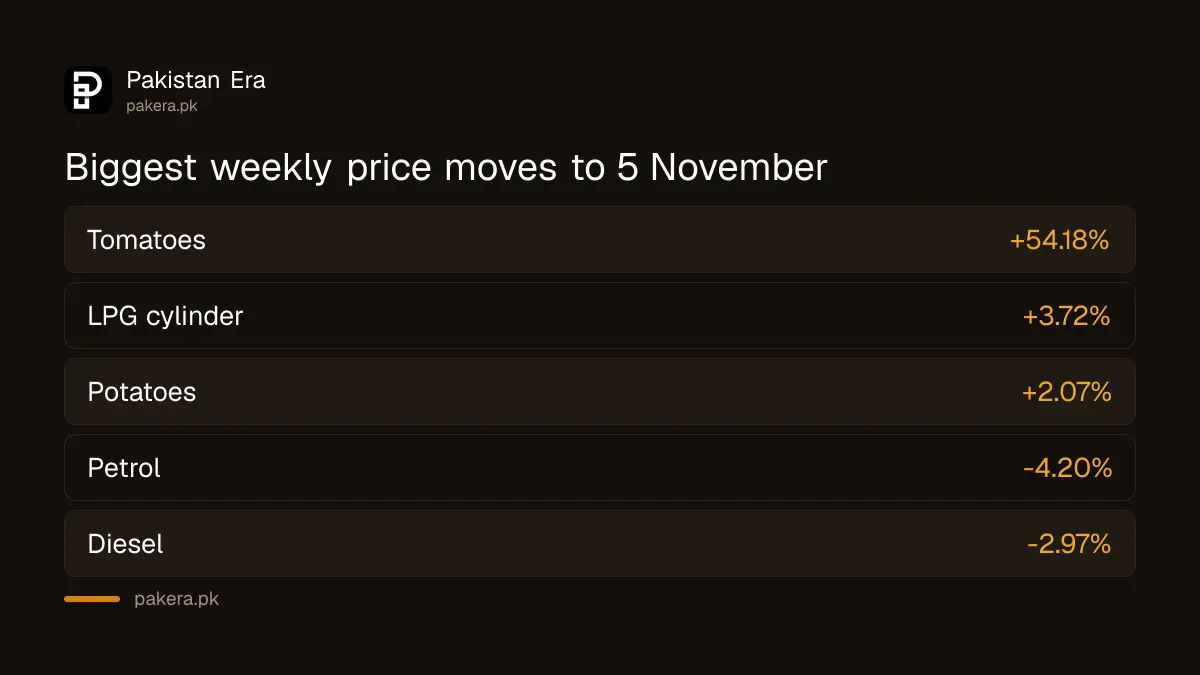
Tomatoes rose 54.18% in one week, from Rs 125.70 to Rs 193.81 a kilo on the 17-city average. That follows a 34.91% rise the week before. LPG rose 3.72% and potatoes 2.07%. On the other side, petrol fell 4.20% and diesel 2.97%.
| Item | 29 October | 5 November | Weekly change |
|---|---|---|---|
| Tomatoes, 1 kg | Rs 125.70 | Rs 193.81 | +54.18% |
| LPG, 11.67 kg cylinder | Rs 6,264.79 | Rs 6,497.89 | +3.72% |
| Potatoes, 1 kg | Rs 51.09 | Rs 52.15 | +2.07% |
| Eggs, 1 dozen | Rs 254.51 | Rs 257.48 | +1.17% |
| Fresh milk, 1 litre | Rs 219.98 | Rs 221.05 | +0.49% |
| Petrol, per litre | Rs 380.18 | Rs 364.23 | -4.20% |
| Diesel, per litre | Rs 402.08 | Rs 390.13 | -2.97% |
| Live broiler chicken, 1 kg | Rs 431.15 | Rs 428.53 | -0.61% |
| Sugar, 1 kg | Rs 141.12 | Rs 140.55 | -0.40% |
| Flour, 20 kg bag | Rs 2,951.46 | Rs 2,941.34 | -0.34% |
These are national averages. Your own market can be well above or below them, and the gap is widest for vegetables. Compare prices for the same items city by city with the city price check.
Tomatoes alone added 0.49 points to the index
PBS's own impact column shows tomatoes added 0.49 points to the combined index this week. That is more than the whole 0.29% rise. Cheaper petrol took 0.39 points off. LPG added 0.10 and milk 0.11. Without the fall in petrol, the weekly rise would have been much bigger.
Impact figures matter because the weight of an item decides how much it moves the index. Tomatoes carry a weight of about 0.98% in the combined index. Petrol carries about 6.70%. Milk is the heaviest food item at about 18.39%, so even its small rise of 0.49% added about a tenth of a point.
The fuel fall in this week's SPI reflects the pump price that applied during the week, about Rs 362 a litre at the official price. A further cut to Rs 352.59 came on 6 November, after the survey week. That will show up in next week's SPI. The new price is in the 6 November petrol price.
The lowest income group saw the biggest rise, 0.86%
All five income groups saw prices rise this week, but the poorest saw the most. The group spending up to Rs 17,732 a month faced a 0.86% rise. The group spending above Rs 44,175 faced only 0.10%, because petrol, which fell, weighs more in its basket.
| Monthly spending group | SPI, 5 November | Weekly change | Yearly change |
|---|---|---|---|
| Up to Rs 17,732 | 361.00 | +0.86% | 10.15% |
| Rs 17,733 to Rs 22,888 | 363.32 | +0.70% | 11.72% |
| Rs 22,889 to Rs 29,517 | 383.89 | +0.52% | 10.33% |
| Rs 29,518 to Rs 44,175 | 370.77 | +0.40% | 10.68% |
| Above Rs 44,175 | 373.84 | +0.10% | 12.75% |
| Combined | 374.61 | +0.29% | 12.31% |
The lowest group's weekly rise was its biggest since the week to 3 September, when it rose 0.91%. Its yearly rate also jumped, from 8.07% to 10.15%. Tomatoes carry a weight of about 1.44% in its basket, half as much again as in the combined index. How PBS builds the groups is set out in our SPI income group explainer.
Tomatoes cost Rs 100 to Rs 280 a kilo across 17 cities
The PBS city table shows tomatoes quoted from Rs 100 to Rs 280 a kilo on 5 November. Islamabad had the highest city average at Rs 252.75, followed by Rawalpindi at Rs 252.34. Larkana had the lowest at Rs 106.27.
| City | Average tomato price, 1 kg |
|---|---|
| Islamabad | Rs 252.75 |
| Rawalpindi | Rs 252.34 |
| Karachi | Rs 233.35 |
| Lahore | Rs 231.73 |
| Peshawar | Rs 212.02 |
| Quetta | Rs 134.66 |
| Larkana | Rs 106.27 |
So a kilo in Islamabad cost more than twice what it cost in Larkana in the same week. If your market price is far above your city's average, a price control complaint to the district administration is the next step.
LPG is still 114.88% dearer than a year ago
Year on year, LPG is up 114.88%, tomatoes 78.89%, lowest-slab electricity 52.38%, diesel 39.27% and petrol 36.34%. Flour is 33.95% dearer and chicken 31.81%. Some staples are cheaper than a year ago: potatoes are down 37.24%, eggs 27.59% and sugar 25.03%.
The weekly SPI is a different measure from the monthly consumer price index (CPI), which is the official inflation rate. The CPI for October is in October 2026 inflation, and the gap between the two is explained in Pakistan's four inflation numbers. The LPG price set for November is in the November LPG price.
How to read the weekly SPI yourself
PBS posts the SPI every Friday on pbs.gov.pk, as a short executive summary and a full city price annex. The annex has city prices for every item. These steps take about five minutes.
- Open the PBS home page and find "Weekly Sensitive Price Indicator (SPI) for the week ended on" with Thursday's date.
- Open the release and download the executive summary PDF for the headline numbers.
- Read the first table: the "Combined" column is the national figure.
- For a single item, open the annex PDF and find it in the city table, with the lowest, average and highest price.
- Compare with the same week last year using the corresponding week column.
Common questions
What is the SPI inflation rate for the week ended 5 November 2026?
The SPI rose 0.29% in the week and stood 12.31% higher than a year earlier, PBS figures show.
Why did weekly inflation rise this week?
Tomatoes jumped 54.18% and added 0.49 points on their own. LPG, potatoes, eggs and milk also rose. Cheaper petrol and diesel pulled the index down by less.
What is the tomato price in Pakistan this week?
The 17-city average was Rs 193.81 a kilo on 5 November 2026, up from Rs 125.70 a week earlier. City averages ranged from Rs 106.27 in Larkana to Rs 252.75 in Islamabad.
Which income group was hit hardest?
The lowest group, spending up to Rs 17,732 a month, faced a 0.86% weekly rise. The top group faced 0.10%.
When is the next SPI release?
PBS normally publishes the next SPI on Friday 13 November 2026, for the week ending Thursday 12 November.
How we verified this
What we checked, where we read it, and what we could not confirm.
We read the PBS release for the week ended 5 November 2026 on 6 November 2026, with its executive summary and city price annex. Every price, weight and impact figure is from those files. The comparison with earlier weeks uses the ten-week table in the same release. The 6 November petrol price is from our own page, which read the government notification. The next release date is the usual PBS Friday pattern, not an announced date.
About the author

Senior Writer, Public Services and Technology
Shahid joined us in 2024 as an author. He is a senior contributor to Pakistan's leading technology websites. He writes detailed articles, mostly covering his expertise in the latest tech, mobiles, apps, gadgets, and step-by-step guides. His ideology is to help people understand the latest trends and explain complex methods through very easy-to-understand guides.