Check Pakistan's Consumer Loans at End September 2026: Rs 1.29 Trillion, Up 34% in a Year, House Loans Up 72%
SBP's September 2026 table shows consumer loans of Rs 1,293.7 billion, up 34.4% in a year: car loans Rs 407 billion, house loans up 72%. See the full split.
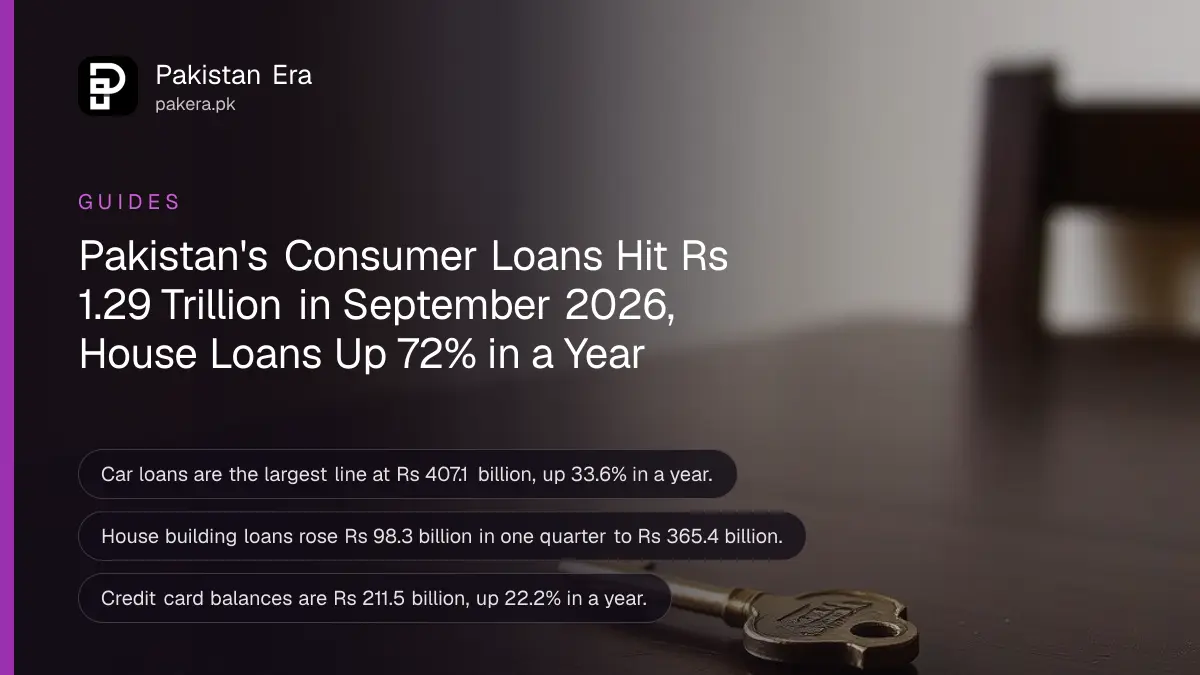
Short answer: Banks in Pakistan had Rs 1,293.7 billion of consumer loans outstanding at the end of September 2026, up 34.4 per cent from Rs 962.2 billion a year earlier and 13.0 per cent in the quarter, according to the State Bank of Pakistan's credit by borrowers table released on 16 October 2026. Car loans are the biggest line at Rs 407.1 billion, house loans grew fastest at 71.9 per cent in a year to Rs 365.4 billion, and credit card balances are Rs 211.5 billion.
The table is "Credit / Loans Classified by Borrowers", a monthly sheet on SBP's economic data page. We read the version with end September 2026 provisional figures on 19 October 2026. It is the first official look at what households borrowed in the quarter after SBP kept its policy rate at 11.5 per cent, and the numbers say they borrowed a lot.
Consumer loans reached Rs 1.29 trillion, a third more than a year ago
Consumer financing stood at Rs 1,293,695 million at end September 2026, against Rs 1,145,331 million at end June 2026 and Rs 962,217 million at end September 2025. That is growth of Rs 148.4 billion in three months and Rs 331.5 billion in twelve, the fastest annual rise in the series we have on file.
| Consumer financing, Rs million | Sep 2025 | Jun 2026 | Sep 2026 (provisional) | Change in a year |
|---|---|---|---|---|
| House building | 212,611 | 267,094 | 365,443 | +71.9% |
| Transport, mainly cars | 304,705 | 381,687 | 407,118 | +33.6% |
| Credit cards | 173,006 | 204,708 | 211,475 | +22.2% |
| Consumer durables | 8,901 | 8,952 | 9,117 | +2.4% |
| Personal loans | 262,994 | 282,890 | 300,543 | +14.3% |
| Other | 530 | 663 | 1,134 | +114% |
| Total consumer financing | 962,217 | 1,145,331 | 1,293,695 | +34.4% |
The percentages are our arithmetic from SBP's million rupee figures. Consumer loans are 8.9 per cent of all credit to the non government sector, which was Rs 14,496.7 billion, and a small slice of total credit of Rs 50,612.7 billion, most of which is lending to the government.
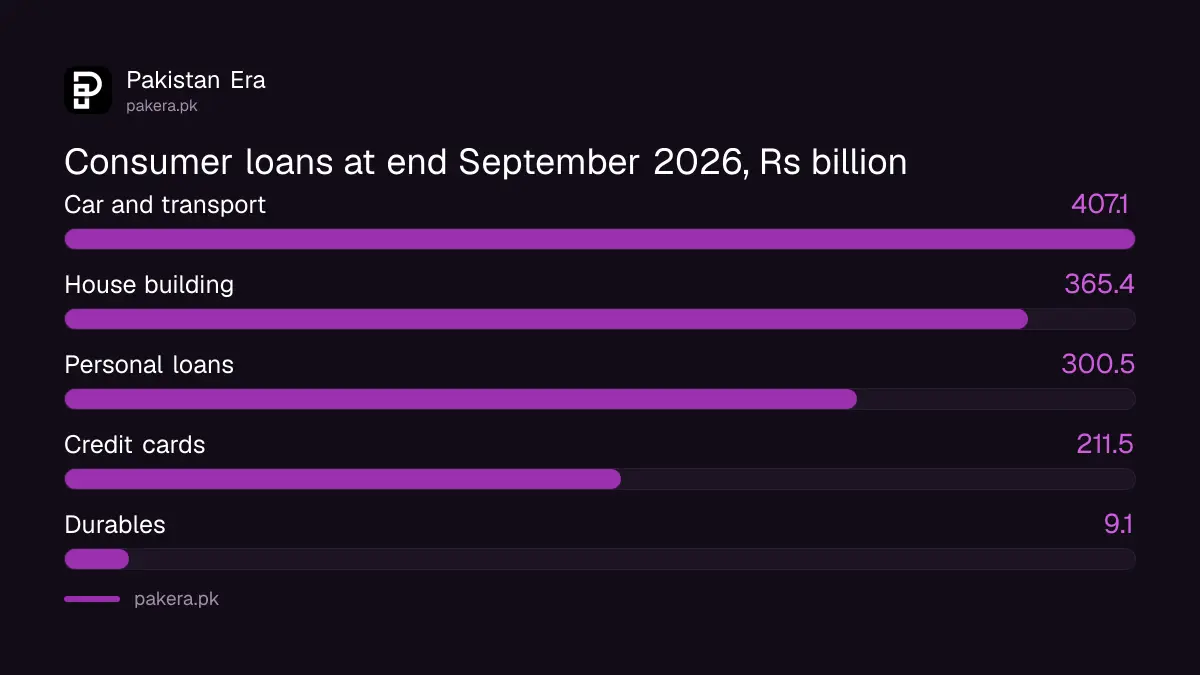
House loans grew 72 per cent in a year and 37 per cent in one quarter
House building loans to consumers were Rs 365.4 billion at end September 2026, up from Rs 267.1 billion in June and Rs 212.6 billion a year earlier. The quarter alone added Rs 98.3 billion, which is more than the whole previous year added. No other consumer line moved like this.
The timing matches the government's Apna Ghar housing scheme, which the finance minister said had financed Rs 60 billion against Rs 340 billion of approvals, in our report on Apna Ghar's financing so far. SBP's table does not label the scheme, so we cannot say how much of the Rs 98 billion is Apna Ghar, but it is the obvious candidate. The scheme's steps are in our guide to applying for an Apna Ghar loan.
There is a second house building line in the same table, for bank employees, at Rs 346.0 billion. Staff loans sit under "personal" lending rather than consumer financing, and they are almost as large as the public's house loans. Add the two and banks have Rs 711.5 billion of housing credit out to individuals.
Car loans are the largest consumer line at Rs 407 billion, but growth is slowing
Transport loans, which SBP labels "for transport i.e. purchase of car etc", were Rs 407.1 billion at end September, up 33.6 per cent in a year but only 6.7 per cent in the quarter. The quarter added Rs 25.4 billion, less than a third of what house loans added.
The slowdown fits the monthly pattern in our car financing report for August 2026. The stock keeps rising because repayments on a five year loan are slow, but new lending is not accelerating the way housing is. Rates are the reason: a car loan is priced off KIBOR, and with the policy rate held at 11.5 per cent on 14 September, monthly instalments have not fallen since the summer.
Bank employees hold a further Rs 87.7 billion of transport loans, up from Rs 70.3 billion a year ago.
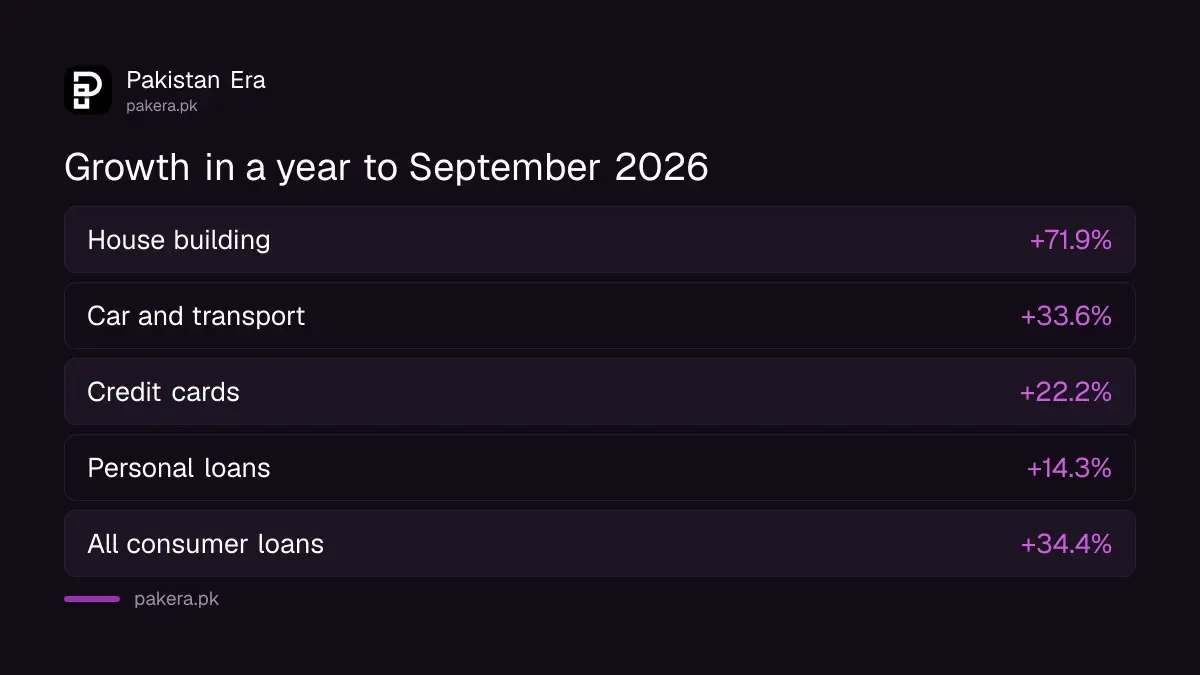
Credit card balances are Rs 211 billion and personal loans Rs 301 billion
Credit card debt outstanding was Rs 211.5 billion at end September 2026, up 22.2 per cent in a year and 3.3 per cent in the quarter. Personal loans were Rs 300.5 billion, up 14.3 per cent in a year and 6.2 per cent in the quarter. Consumer durables financing is tiny at Rs 9.1 billion and barely moved.
Card balances are the figure to watch for stress, because they carry the highest rates. The 22 per cent rise is slower than the 47 per cent jump in the number of cards SBP reported for FY26, which means the average balance per card fell. The fees and rates on the main cards are compared in our page on the best credit cards in Pakistan, and the cost of carrying a balance is why instalment plans look cheaper.
Personal loans grew steadily rather than sharply. The market rates for them are in our comparison of personal loans from Pakistani banks. Note that SBP's "personal loans" line is unsecured consumer lending, distinct from the "personal" heading that covers bank staff.
How to read SBP's credit by borrowers table yourself
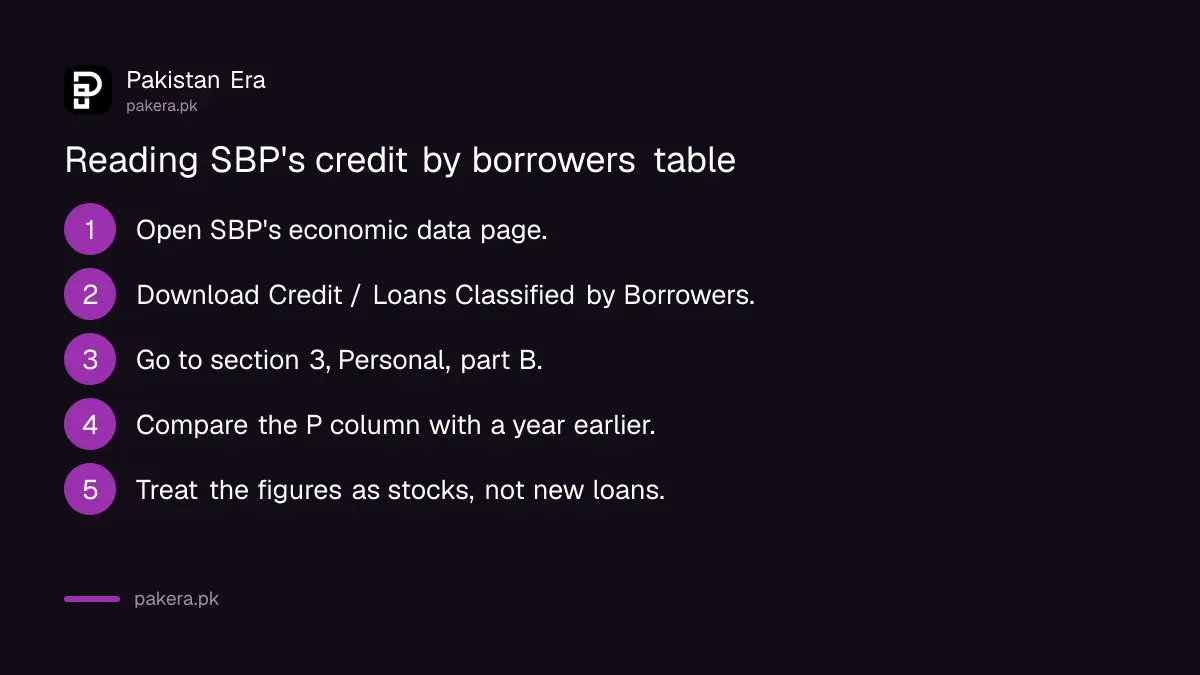
The table is a PDF on SBP's economic data page under Credit / Loans Classified by Borrowers, updated monthly with a provisional figure marked P. Section 3, Personal, near the end, splits into A, bank employees, and B, consumer financing, with the six consumer lines under B.
- Open SBP's economic data page and find "Credit / Loans Classified by Borrowers" in the monetary and financial statistics list.
- Download the PDF. The columns are June and September of last year, June of this year, and the latest month marked P for provisional.
- Scroll to "3. PERSONAL" and read "B. Consumer Financing" and its lines 1 to 5.
- Compare the latest month with the same month last year for growth, and with the previous quarter for momentum.
- Remember the figures are stocks outstanding, not new loans made in the month.
For the longer view, the annual breakdown of where consumer loans went is in our page on consumer loans in the Economic Survey 2025-26, and what banks actually charge on new loans is in bank lending and deposit rates for August 2026.
Common questions about Pakistan's consumer loans in September 2026
How much consumer debt do Pakistani banks hold?
Rs 1,293.7 billion at end September 2026, provisional, per SBP's credit by borrowers table released 16 October 2026. That is up 34.4 per cent from Rs 962.2 billion a year earlier.
Which consumer loan is the biggest?
Car and other transport loans, at Rs 407.1 billion. House building is second at Rs 365.4 billion, then personal loans at Rs 300.5 billion and credit cards at Rs 211.5 billion.
Why did house loans jump so much?
SBP's table does not say. The Rs 98.3 billion rise in one quarter coincides with the Apna Ghar scheme's disbursements, which the finance minister put at Rs 60 billion, so the scheme is the likely driver but not a confirmed one.
Does the table include Apna Ghar loans separately?
No. All consumer house loans sit in one line. Bank employees' house loans are in a separate line under "personal".
Are these new loans or total loans?
Total loans outstanding at the end of the month. Growth is new lending minus repayments.
When is the next release?
SBP updates the table monthly on its economic data page. The October 2026 figures should appear in the second half of November.
How we verified this
What we checked, where we read it, and what we could not confirm.
Last checked 19 October 2026. All figures are from the State Bank of Pakistan's table "Credit / Loans Classified by Borrowers", outstanding position at end September 2026, provisional, which we downloaded as a PDF from SBP's economic data page, where it is dated 16 October 2026. Growth rates and shares are our own arithmetic. The Apna Ghar financing figure is from the finance minister's statement reported on our linked page and is not in SBP's table. We could not verify how much of the house loan increase is Apna Ghar, because SBP does not break it out.
About the author

Public Services and Education Journalist
Fajr Riaz is a journalist and content writer at Pakistan Era, based in Lahore. She covers the questions people meet in everyday life in Pakistan: how a public service works, what a change in the rules means, and where to find a reliable answer.