Check Where Pakistan's Consumer Loans Went: Cars Rs 68.7 Billion, Credit Cards Rs 39 Billion
Pakistan household borrowing rose Rs 146.2 billion in July to March 2025-26, up 16%. See the split across cars, cards, homes and personal loans. Read more.
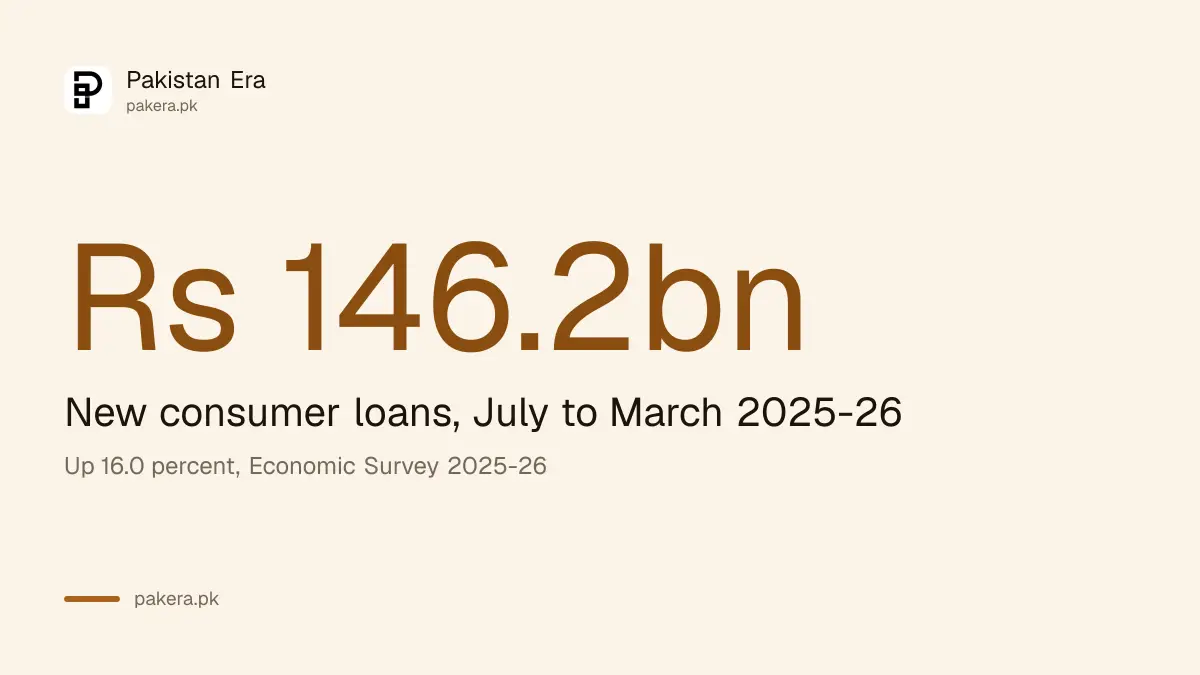
Short answer: Pakistanis borrowed Rs 146.2 billion more for personal spending in July to March 2025-26, up 16.0 percent. Car loans took Rs 68.7 billion, credit cards Rs 39.0 billion, house building Rs 20.5 billion and personal loans Rs 17.5 billion. The Finance Division's Economic Survey 2025-26 reports it, using State Bank data.
Banks have spent years lending mostly to the government and to companies. In the first nine months of 2025-26, ordinary households borrowed twice as much as the year before. That affects you whether you borrow or not, because it shows what the banks are selling.
We read the Money and Credit chapter of the Economic Survey 2025-26 on 14 October 2026. The table in that chapter is hard to read in its PDF form. We matched each row to the text and checked that the parts add up to the total, and we say where the text and table differ.
Household borrowing doubled to Rs 146.2 billion
Consumer financing increased by Rs 146.2 billion, or 16.0 percent, in July to March 2025-26. A year earlier it rose by Rs 71.4 billion, or 8.9 percent. The Survey says demand revived because of a better policy environment, lower financing costs and government support for housing.
Consumer financing means loans to people for their own use, not for a business. The Survey counts five kinds: house building, cars, credit cards, consumer durables and personal loans.
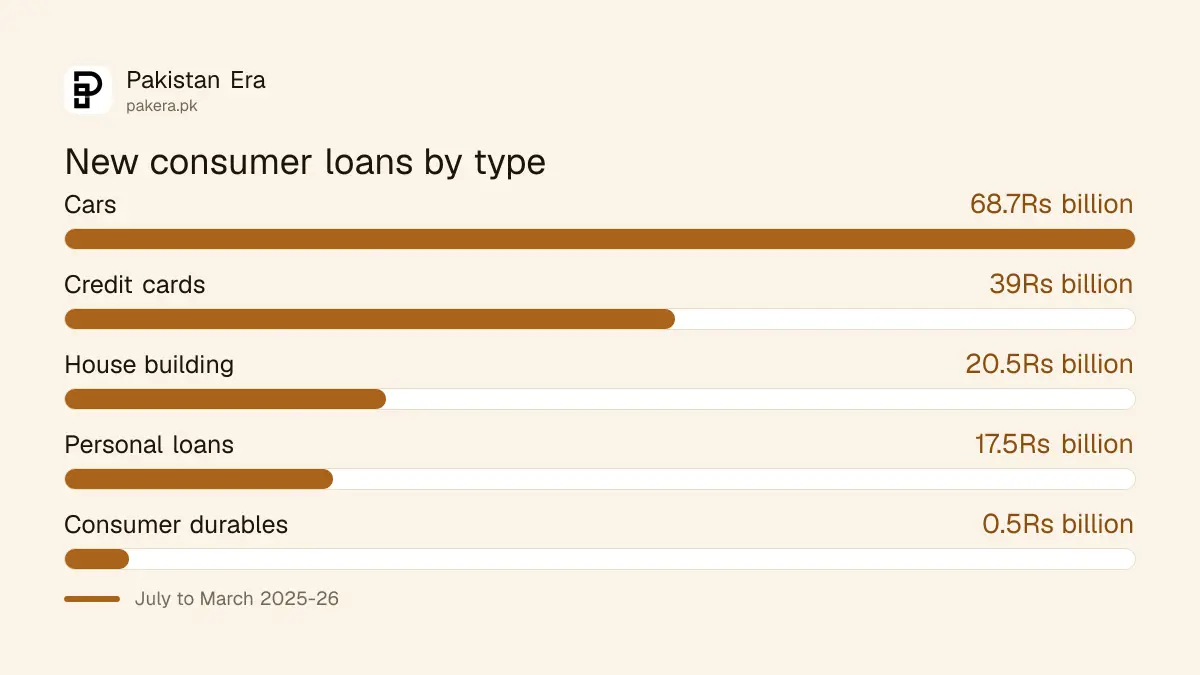
The five parts add up. House building Rs 20.5 billion, cars Rs 68.7 billion, cards Rs 39.0 billion, durables Rs 0.5 billion and personal loans Rs 17.5 billion come to Rs 146.2 billion.
Car loans took almost half the new lending
Car loans grew by Rs 68.7 billion, up 24.9 percent, against 11.7 percent a year earlier. That is 47 percent of all new household lending, by our own calculation. The Survey says auto loans traditionally hold the largest share of consumer credit in Pakistan.
Credit cards grew 24.6 percent, to Rs 39.0 billion in the table. The Survey text says Rs 38.9 billion, so the two differ by Rs 0.1 billion. A year earlier cards grew 15.0 percent.
| Loan type | New lending, July to March 2025-26 | Growth |
|---|---|---|
| Cars | Rs 68.7 billion | 24.9 percent |
| Credit cards | Rs 39.0 billion | 24.6 percent |
| House building | Rs 20.5 billion | 9.9 percent |
| Personal loans | Rs 17.5 billion | 6.7 percent |
| Consumer durables | Rs 0.5 billion | 5.6 percent |
If you are thinking of a car loan, work out what you can afford first. Our worked example of which car you can afford on your salary uses simple numbers.
Personal loans slowed while house loans came back
Personal loans added Rs 17.5 billion, down from Rs 29.1 billion a year earlier, and growth slowed from 12.2 to 6.7 percent. House building went the other way. It added Rs 20.5 billion, after households repaid Rs 4.1 billion more than they borrowed the year before.
The Survey links the housing recovery to government schemes. The Mera Ghar Mera Ashiana markup subsidy scheme of 2025 provided housing finance up to Rs 3.5 million. In April 2026 the "Wazir-e-Azam Apna Ghar Program, Ghar Ho Tu Apna" widened it and raised the loan limit up to Rs 10 million.
Our guides cover both sides. See how to apply for the Apna Ghar housing loan and what home loans to build a house offer.
Check the cost before you borrow
Higher national borrowing does not make your own loan cheaper or safer. Before you sign for a car, a card or a personal loan, check the rate, the fees and the monthly instalment against your income. Compare lenders, and do not borrow because credit is easy.
- Write down your monthly income and fixed costs.
- Ask each bank for the markup rate, the processing fee and the total you will repay.
- Compare the offers side by side. Start with our table of personal loans from 8 banks.
- For a card, check fees and instalment plans in the credit card comparison.
- Check how a change in the State Bank's rate would change your payment. Read what the policy rate does to your loan instalment.
Rates matter most for floating loans. Watch the KIBOR rate and the date of the next State Bank decision, set out in our note on the 26 October monetary policy meeting.
What the Survey does not tell you
The chapter reports flows and growth, not interest rates, defaults or who borrowed. It does not say how much of the card growth is unpaid balances. It covers only nine months. It also shows that lending rose, but it cannot tell you whether households can afford it.
Treat the numbers as a signal that banks are lending to people again. They are not a signal to borrow.
Questions about consumer loans
How much did consumer lending grow in 2025-26?
It rose by Rs 146.2 billion, or 16.0 percent, in July to March 2025-26, against Rs 71.4 billion a year earlier.
Which loan type grew most?
Car loans added the most, Rs 68.7 billion, and grew 24.9 percent.
Did credit card lending rise?
Yes. Credit cards grew 24.6 percent, to about Rs 39 billion, up from 15.0 percent growth a year earlier.
Why did house loans rise?
The Survey points to government housing finance schemes, including a markup subsidy scheme and the Apna Ghar program with a limit of up to Rs 10 million.
Did personal loans grow too?
Yes, but slower. They added Rs 17.5 billion and grew 6.7 percent, down from Rs 29.1 billion and 12.2 percent.
How we verified this
What we checked, where we read it, and what we could not confirm.
Last checked on 14 October 2026, Pakistan time. We read the Money and Credit chapter of the Finance Division's Economic Survey 2025-26, which credits the State Bank of Pakistan for the data. The PDF table was jumbled, so we matched rows by their totals. We did not check State Bank's own data, and the credit card figure is Rs 38.9 billion in the text and Rs 39.0 billion in the table.
About the author

Public Services and Education Journalist
Fajr Riaz is a journalist and content writer at Pakistan Era, based in Lahore. She covers the questions people meet in everyday life in Pakistan: how a public service works, what a change in the rules means, and where to find a reliable answer.