Check Farm Power in Pakistan: 986,998 Tractors and 912,327 Solar Tubewells
The 2024 Agricultural Census counted 986,998 tractors and 912,327 solar tubewells in Pakistan. See the count by province and what powers each pump. Read more.
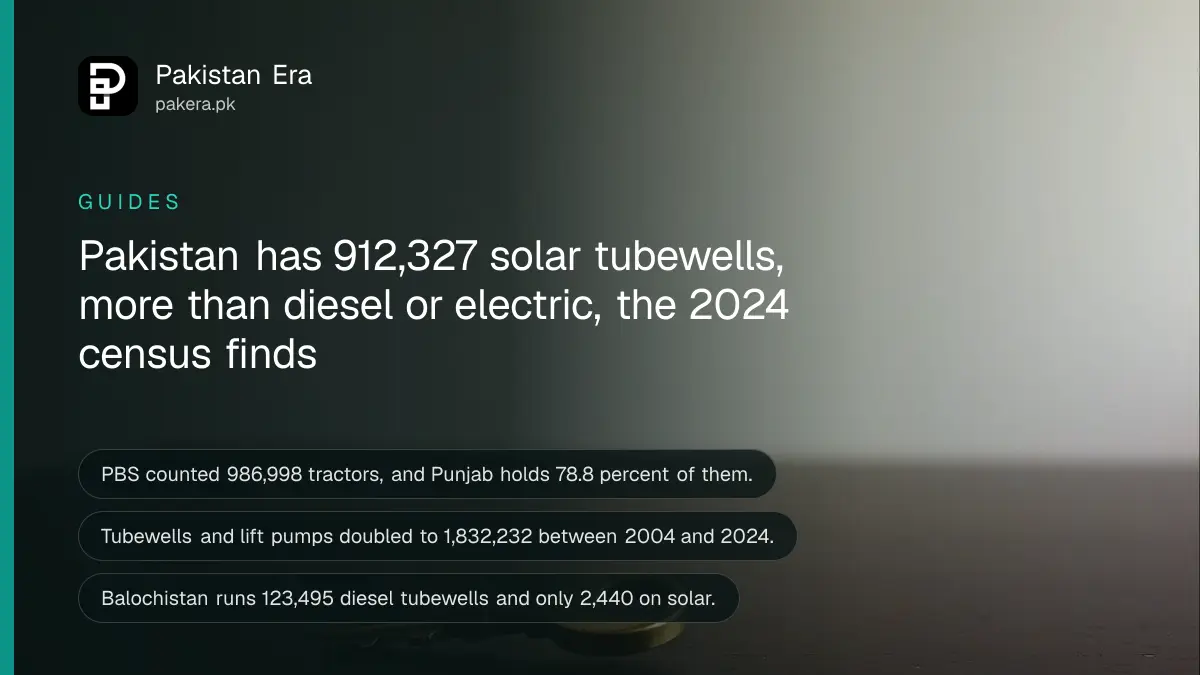
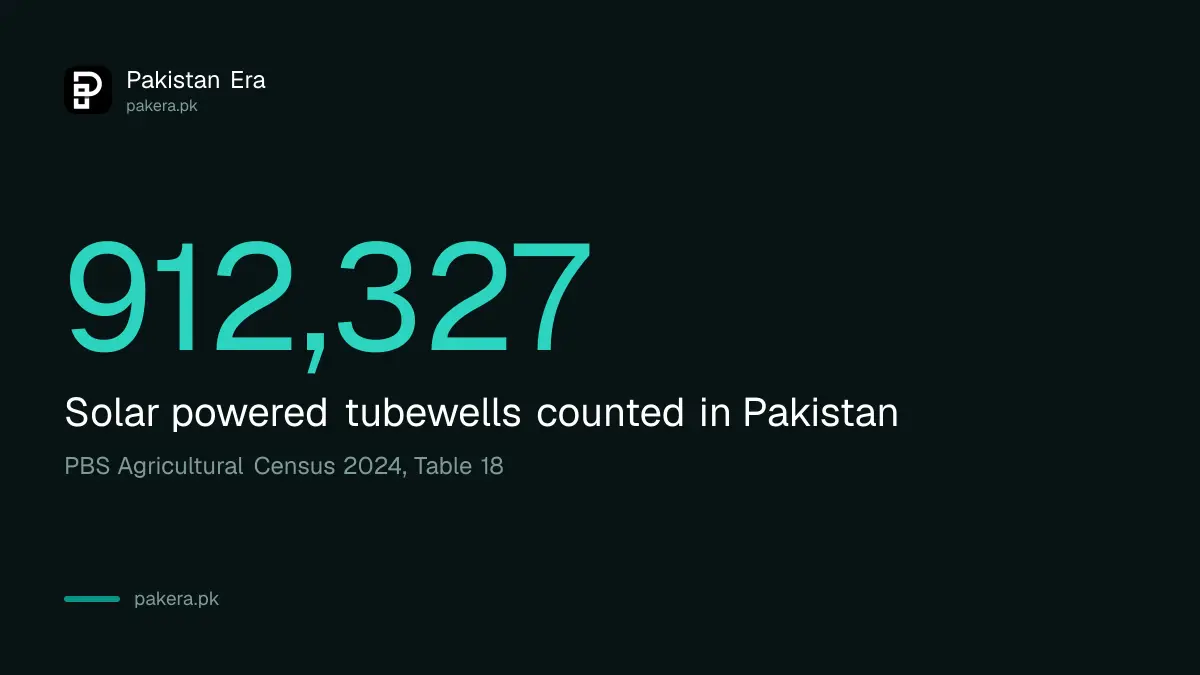
Short answer: The 2024 Agricultural Census counted 986,998 tractors and 912,327 solar powered tubewells in Pakistan. Solar is now the most common power source for tubewells, ahead of diesel at 513,552 and electricity at 396,488. Punjab holds 78.8 percent of all tractors.
A farmer who hears the hum of a solar pump at dawn is seeing a quiet change. For the first time, the Pakistan Bureau of Statistics (PBS) has counted it. The census listed every tractor, tubewell and lift pump on the farms it visited, and it recorded what powers them.
We opened the PBS National Report of the 7th Agricultural Census 2024 (June 2026) on 14 October 2026 and read its machinery findings, Tables 15 to 18 in the main findings. Farm counts come from its Table 1.0. Ratios we calculated are marked "our sum".
Pakistan has 986,998 tractors, up 146 percent since 2004
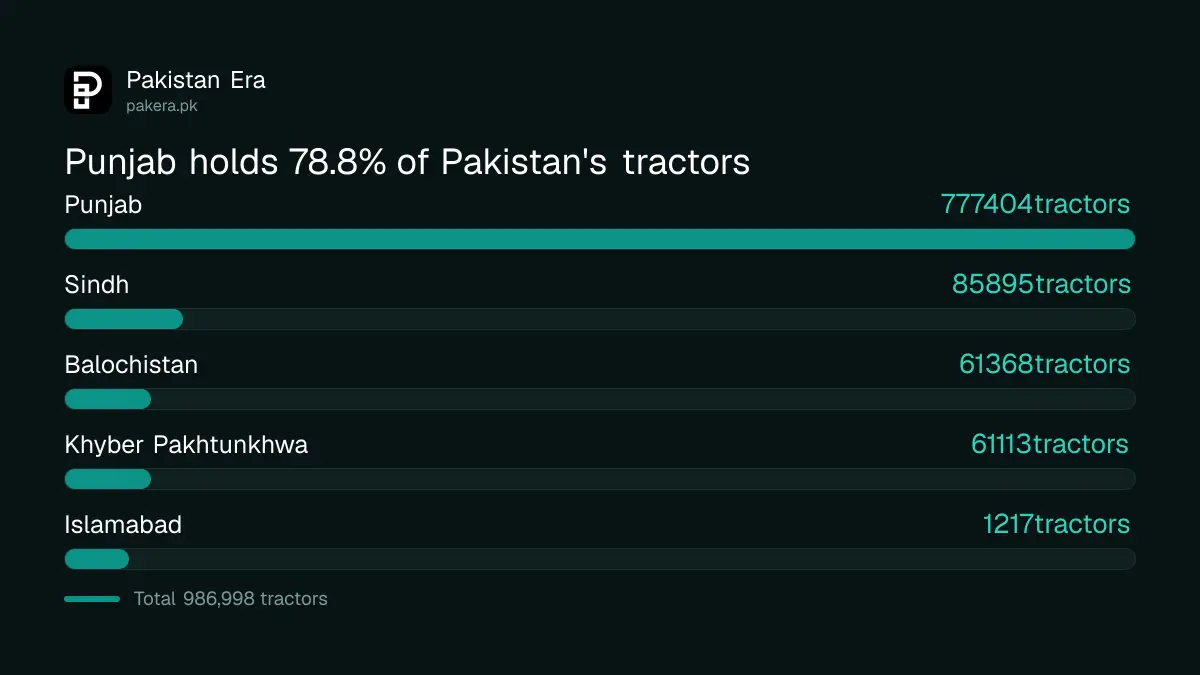
PBS counted 986,998 tractors, bulldozers and combine harvesters in 2024. The last machinery census in 2004 counted 401,663, so the number rose 146 percent in 20 years. In 1994 it was 252,861. Individuals own 778,501 of them, and 207,092 are owned jointly.
Co-operative societies own only 1,404 tractors. That is a small share. Ownership is mostly by individuals and partners. Sharing a tractor with a relative is the normal way to get one.
| Province | Tractors | Share | Farms for each tractor (our sum) |
|---|---|---|---|
| Punjab | 777,404 | 78.8% | 6.5 |
| Sindh | 85,895 | 8.7% | 21.3 |
| Balochistan | 61,368 | 6.2% | 10.3 |
| Khyber Pakhtunkhwa | 61,113 | 6.2% | 58.5 |
| Pakistan | 986,998 | 100% | 11.3 |
Balochistan's count rose 564 percent between 2004 and 2024, the fastest of any province. In Khyber Pakhtunkhwa, one tractor serves about 58 farms, and most holdings there are small. The average farm there is only 2.5 acres.
Solar is now the main power for tubewells
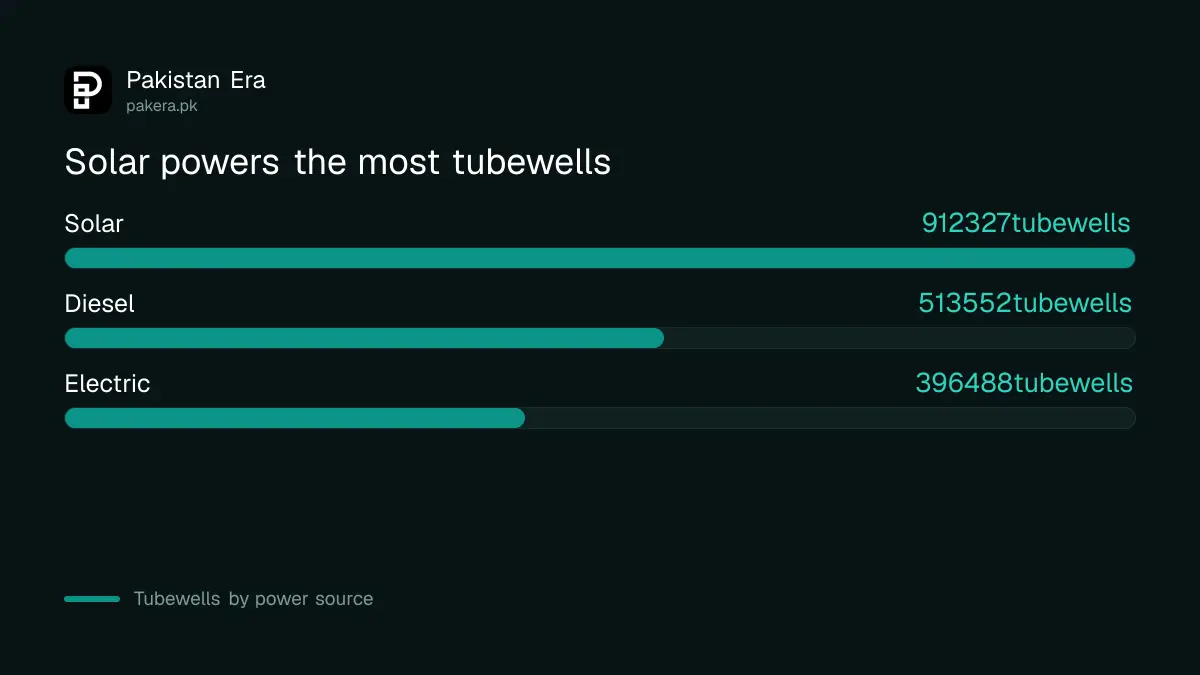
Of the tubewells listed by power source, 912,327 run on solar, 513,552 on diesel and 396,488 on electricity. Solar is about half of all tubewells (our sum). Lift pumps follow the same pattern, with 47,538 on solar out of 75,885 (our sum).
A tubewell is a mechanical pump that lifts water from under the ground. Lift pumps raise water from a canal or a river. Both feed the field. Solar has no fuel cost once the panels are bought, while diesel and grid power are billed by use.
PBS prints the table but not the reasons. The table columns also do not add exactly to the headline of 1,832,232 tubewells and lift pumps, so we quote each figure as printed and do not add them to the headline.
Punjab has gone solar, and Balochistan still runs on diesel
In Punjab, 862,238 of its tubewells run on solar, about 56 percent (our sum). Sindh is at 53 percent. In Balochistan, 123,495 tubewells run on diesel, about 81 percent, and only 2,440 run on solar, under 2 percent (our sum).
| Province | Electric | Solar | Diesel |
|---|---|---|---|
| Punjab | 350,213 | 862,238 | 331,059 |
| Sindh | 7,050 | 36,246 | 25,017 |
| Khyber Pakhtunkhwa | 12,082 | 10,851 | 33,834 |
| Balochistan | 26,813 | 2,440 | 123,495 |
Balochistan's tubewell count rose 623 percent since 2004, to 151,394, so most of its pumps burn diesel, and their running cost follows the fuel price. Punjab runs a subsidy for solar pumps: see how to apply for the Punjab solar tube well subsidy.
Farmers in the other provinces can start by asking for a grid connection. The steps for one are in getting a tubewell electricity connection.
Tubewells and lift pumps have doubled since 2004
The census counted 1,832,232 tubewells and lift pumps, up 97 percent from 931,048 in 2004. Punjab has 1,541,999 of them, 84 percent (our sum). PBS calls the 20-year rise a record since independence and a quiet cause of better crop output.
More pumps mean more water drawn from underground. The census does not measure how much water is drawn or whether aquifers are falling. It only counts machines. Anyone who relies on a pump should still ask a local agriculture office about water levels in the area.
New machines also mean new costs. Subsidy lists change often. Read which Punjab farm machinery subsidy fits you in 2026-27 and how to apply for the Green Tractor scheme before you buy.
Check what your own farm needs before you buy
Use these national numbers as a reference, not as advice. A farm of 5 acres may not need its own tractor if a neighbour owns one. The steps below help you compare costs before you commit to a purchase.
- Write down your acreage and number of plots.
- Ask neighbours who own a tractor what they charge per acre to plough.
- Compare that fee over one year with the monthly cost of owning one.
- For a tubewell, get a quote for solar, grid power and diesel, and ask for the running cost of each.
- Ask your district agriculture office whether a subsidy covers your choice, and keep the written reply.
For small plots, hiring may cost less than owning. Drip systems are another way to save water. See the Punjab drip irrigation subsidy. Tunnel farming is still rare, used by only 58,626 farms, about 0.5 percent of the total (our sum).
Common questions
How many tractors are there in Pakistan?
PBS counted 986,998 tractors, bulldozers and combine harvesters in the Agricultural Census 2024.
Which province has the most tractors?
Punjab, with 777,404, which is 78.8 percent of the national count.
How many tubewells in Pakistan run on solar?
PBS counted 912,327 solar tubewells and 47,538 solar lift pumps. Solar is the most common power source for tubewells.
Why is Balochistan's solar share so low?
The census does not say. It shows only that 123,495 of its tubewells run on diesel and 2,440 on solar.
Does the census say how much water is pumped?
No. It counts machines and their power source, not water use.
How much did tubewell numbers rise?
They rose from 931,048 in 2004 to 1,832,232 in 2024, a 97 percent rise.
How we verified this
What we checked, where we read it, and what we could not confirm.
Last checked on 14 October 2026, Pakistan time. We read the PBS "Agricultural Census 2024, National Report" (PDF dated June 2026), linked from the PBS Agricultural Census page. Tables 15 to 18 hold the tractor and pump counts. Table 1.0 holds farm counts used for our ratios, and Table 6.19 holds tunnel farming. PBS warns that rounding may stop columns from adding. We did not test any pump or compare prices.
About the author

Senior Writer, Public Services and Technology
Shahid joined us in 2024 as an author. He is a senior contributor to Pakistan's leading technology websites. He writes detailed articles, mostly covering his expertise in the latest tech, mobiles, apps, gadgets, and step-by-step guides. His ideology is to help people understand the latest trends and explain complex methods through very easy-to-understand guides.