Check Your YouTube Channel for Inauthentic Content in Pakistan: AI Templates and Mass-Produced Videos
YouTube can end earnings for repetitive or mass-produced videos, including AI templates. See what is allowed and how Pakistani creators can test their channel.
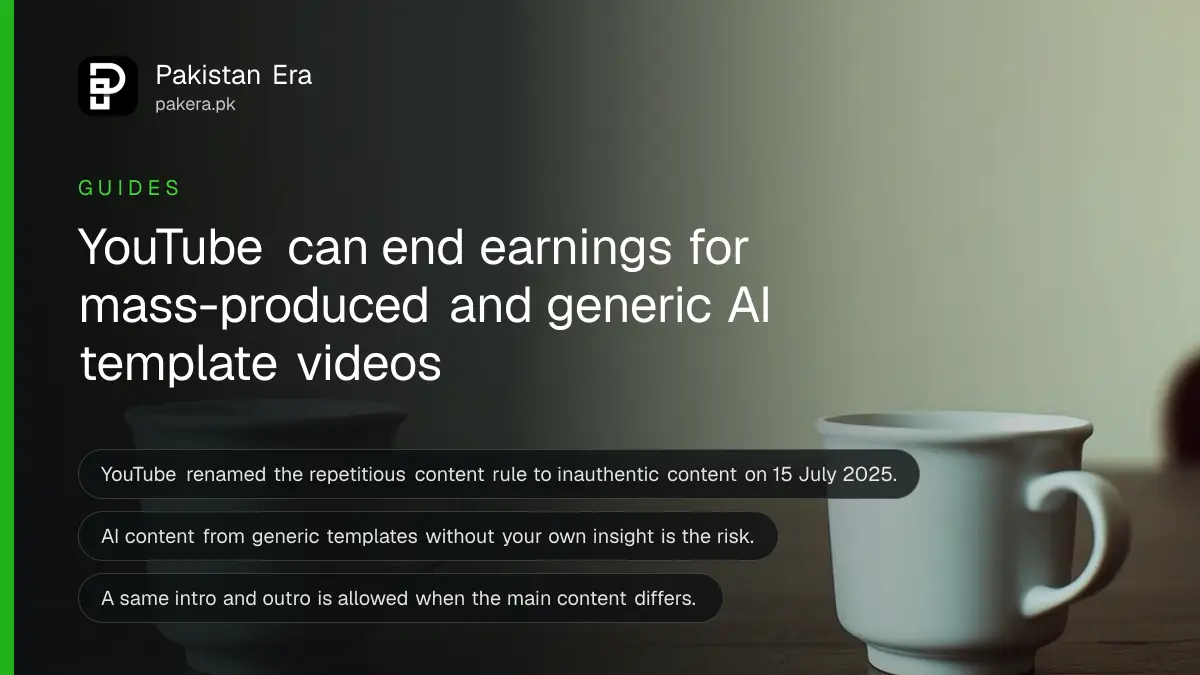
Short answer: YouTube can stop a channel from earning if its videos are repetitive or mass produced, including AI videos built on generic templates. The rule is called inauthentic content. To stay safe, make each video different in substance and add your own insight, voice or footage.
Picture a channel in Faisalabad that posts a new AI-voiced "top 10 facts" video every hour. Same layout, same script shape, new topic. It looks like a business. YouTube's policy describes exactly this pattern as a risk to earning.
We read YouTube's channel monetisation policies page on 12 October 2026. The rule was renamed from "repetitious content" to "inauthentic content" on 15 July 2025, to make clear what the policy targets. Below is what the page says and how to test your own channel.
YouTube says repetitive or mass-produced content can lose monetisation
The policy says content that is repetitive or mass produced, rather than original and authentic, is not eligible to earn. The consequence is that monetisation can be suspended, or the channel can be removed from the YouTube Partner Program.
This is a rule about earning. It is separate from the recommendation change that cut reach for re-uploaded Shorts, which we explain in the note on YouTube Shorts and original content. You can break one without the other.
What is allowed and what is not
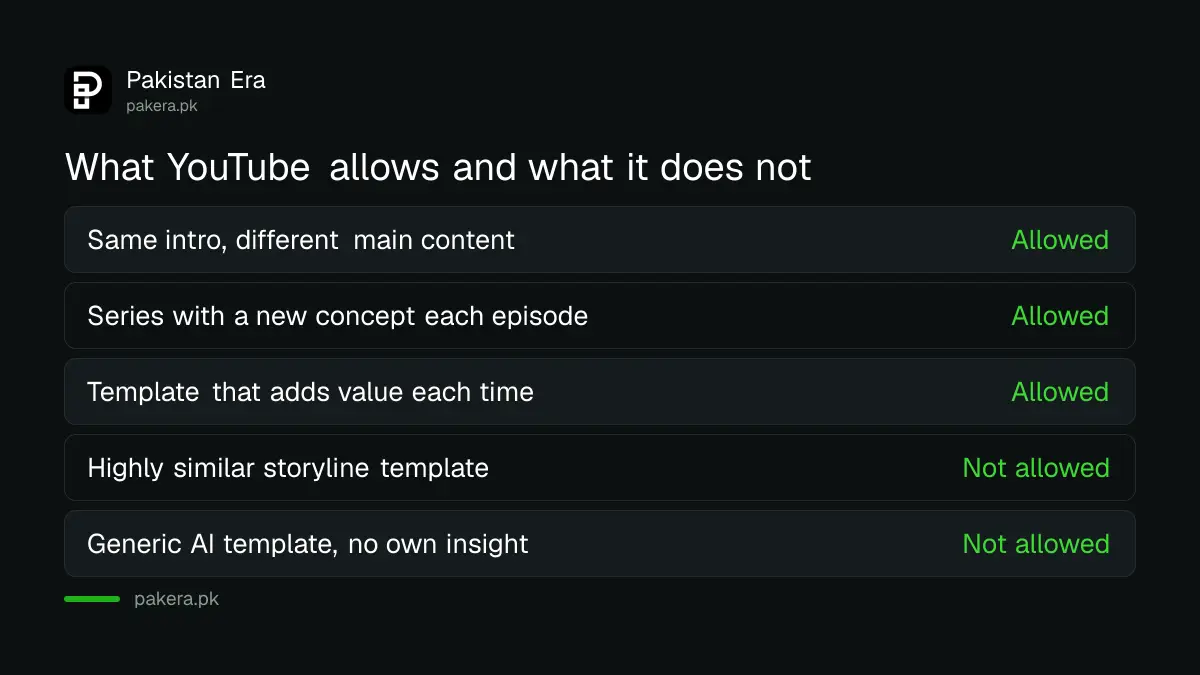
YouTube gives examples of both. A same intro and outro is fine when the bulk of the video is different. A series with a distinct storyline, focus or concept per episode is fine. Templates are fine when each video delivers its own value.
| Pattern | What YouTube's page says |
|---|---|
| Same intro and outro, different main content | Allowed |
| Series where each episode has its own storyline or concept | Allowed |
| Template where each video gives creative, educational or other value | Allowed |
| Similar or repetitive content with low educational value | Not allowed |
| A highly similar storyline template across many videos | Not allowed |
| AI content from generic templates without the creator's own insight | Not allowed |
AI is not banned, but a generic AI template is a risk
The page does not say that AI content cannot earn. It says AI-generated content made from generic or unoriginal templates, with no original and authentic insight from the creator, falls on the wrong side. The test is whether you added a real view, fact or experience.
A Pakistani tutor who uses AI to tidy a script, then records their own voice and adds their own worked examples, is adding insight. A channel that feeds a topic list into a tool and uploads whatever comes out is not.
Our own check of Google's rules on AI-written content reaches the same place for websites: value comes from what a person adds.
Faceless channels deserve a plain word here. A channel without a face can be fully authentic. What matters is whether each video carries a reason to exist: a researched fact, a local example, a real test or a clear point of view. Local knowledge is the easiest thing for a Pakistani creator to add, because a generic template cannot know the price in your market or the rule in your province.
Test your channel in five steps
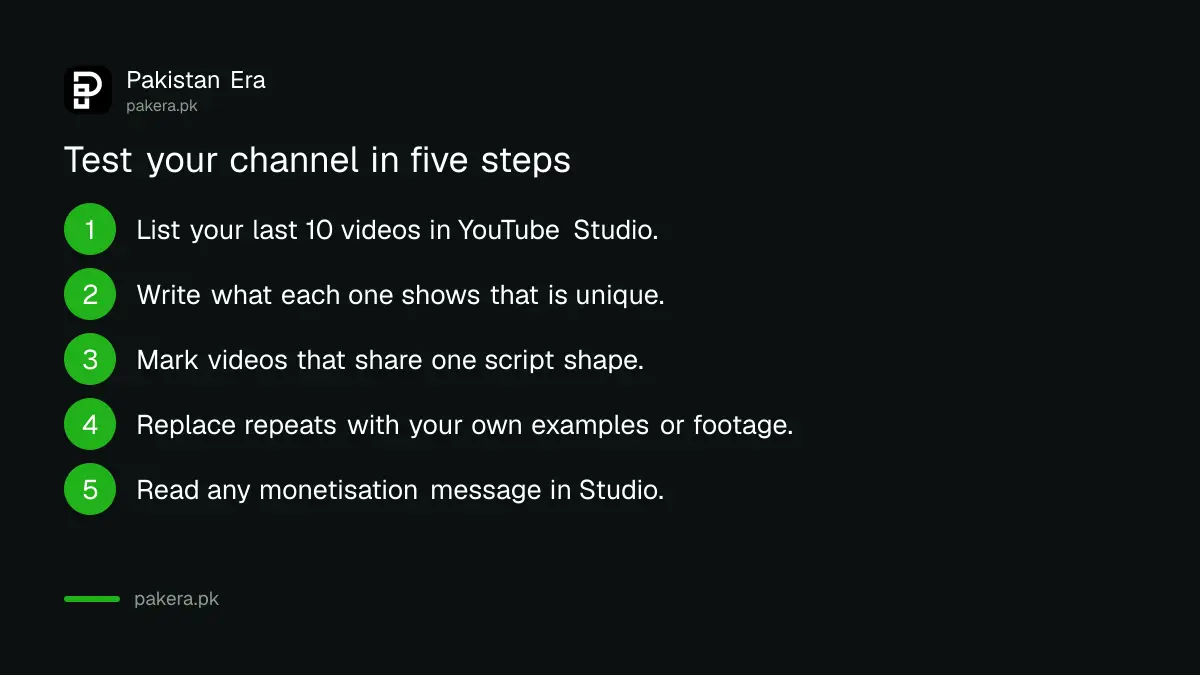
Pick ten of your recent videos and put them side by side. If you could swap the topic and keep everything else, the videos are probably too alike. Fix that before you apply for monetisation or after you receive a warning.
- Open YouTube Studio and list your last 10 videos.
- Write down in one line what each video teaches or shows that is unique.
- Mark any two videos that share the same script shape, visuals and voice.
- Rewrite or replace the repeated ones with your own examples, footage or experience.
- Check Studio for monetisation messages and, if you have one, read it fully.
If you are not yet monetised, our guide to what YouTube actually pays in Pakistan helps you judge whether the effort is worth it. And keep income records, as declaring YouTube and TikTok income in your FBR return explains.
What to do if monetisation is suspended
Read the message in YouTube Studio. It names the policy and the reason. Fix the videos it refers to, then request a review through the option Studio gives you. Do not delete the whole channel in panic, and do not open a second channel to hide the problem.
A hacked or locked channel is a different problem with a different path, set out in how to recover a hacked YouTube channel.
Common questions
What is inauthentic content on YouTube?
It is content that is repetitive or mass produced instead of original and authentic. YouTube renamed the rule from repetitious content on 15 July 2025.
Can AI-made videos earn on YouTube?
The page does not ban them. AI content made with generic templates and no original insight from the creator is the risk.
Does using the same intro in every video break the rule?
No. YouTube's page says the same intro and outro are fine when the bulk of the content is different.
What happens if my channel breaks the rule?
Monetisation can be suspended, or the channel can be removed from the YouTube Partner Program, per the page we read.
Is this the same as the Shorts reach change?
No. The Shorts change is about recommendations. This policy is about whether a channel can earn.
How do I appeal?
Use the review option shown in the monetisation message in YouTube Studio. Fix the videos first, because a review of an unchanged channel will usually give the same result.
How we verified this
What we checked, where we read it, and what we could not confirm.
We read YouTube's channel monetisation policies on 12 October 2026. YouTube changes policy wording, so read the live page before you rely on any detail here.
About the author

Technology Journalist & Multimedia Producer
Ahmad Ali is a technology journalist and multimedia producer at Pakistan Era, joining the team in October 2026. He covers consumer technology and digital life for Pakistani readers, combining research with hands-on product testing.