Claim Compensation for a False Complaint After Acquittal in Pakistan: Section 250
Acquitted by a Magistrate in Pakistan? Section 250 lets the court order a false and frivolous complainant to pay up to Rs 25,000. See the steps and limits.
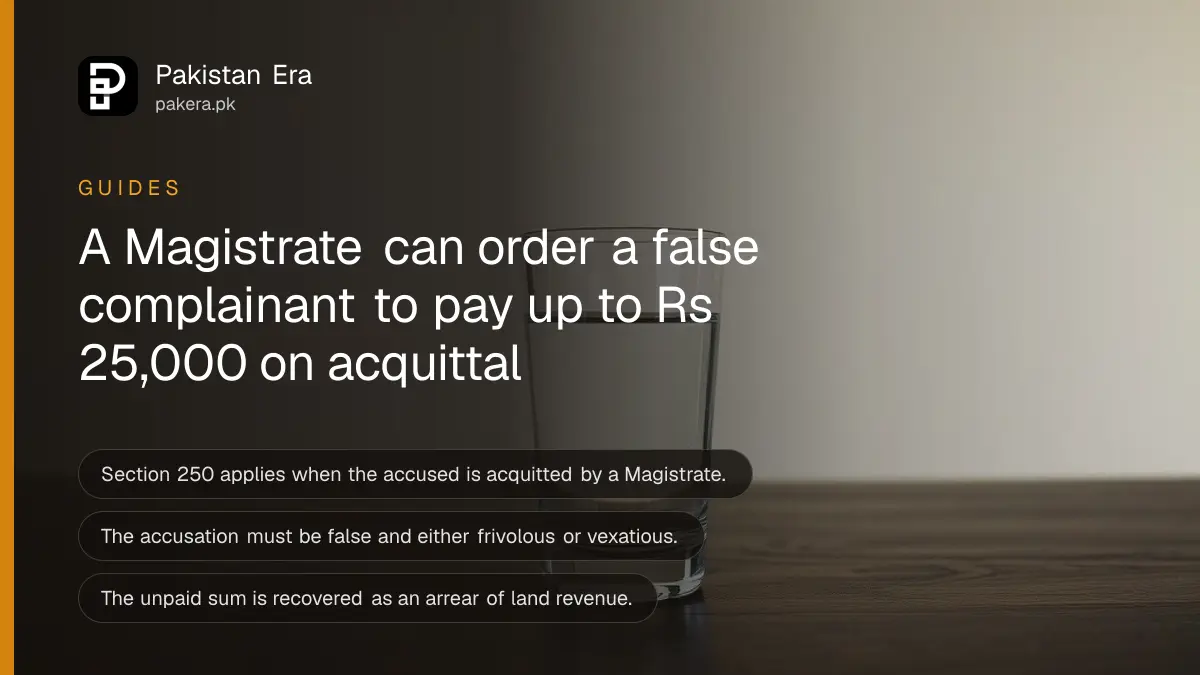
Short answer: If a Magistrate acquits you and finds the accusation false and either frivolous or vexatious, section 250 of the Code of Criminal Procedure lets the Magistrate order the complainant to pay you compensation. In the text we read, the limit is Rs 25,000 for most Magistrates.
Being cleared by a court is a relief, but the case may have cost you months and fees. Section 250 gives a small remedy. It will not repay all your losses. It is still worth knowing before the judgment is read.
We read the Code of Criminal Procedure on the Pakistan Code website on 14 October 2026. The text was last amended on 16 February 2017, so we cannot say whether the amounts have changed since.
Section 250 applies when a Magistrate acquits the accused
Section 250(1) applies when a case began on a complaint or on police information and a Magistrate tries and acquits the accused. The Magistrate must also think the accusation was false and either frivolous or vexatious.
Keep every receipt for lawyer fees, travel and lost wages, because the Magistrate may ask what the case cost you. False means untrue. Frivolous means without any real basis. Vexatious means brought to annoy or harass. The law needs the accusation to be false and also frivolous or vexatious, so a weak case that was honestly brought does not qualify.
The power is the Magistrate's. He may call on the complainant at the time of the acquittal, if the complainant is present. If not, he can issue a summons for the complainant to appear and show cause.
The Magistrate must hear the complainant first
The Magistrate must record and consider whatever cause the complainant shows. If he is satisfied that the accusation was false and frivolous or vexatious, he can direct compensation, giving reasons in writing. The complainant gets a fair hearing before any order.
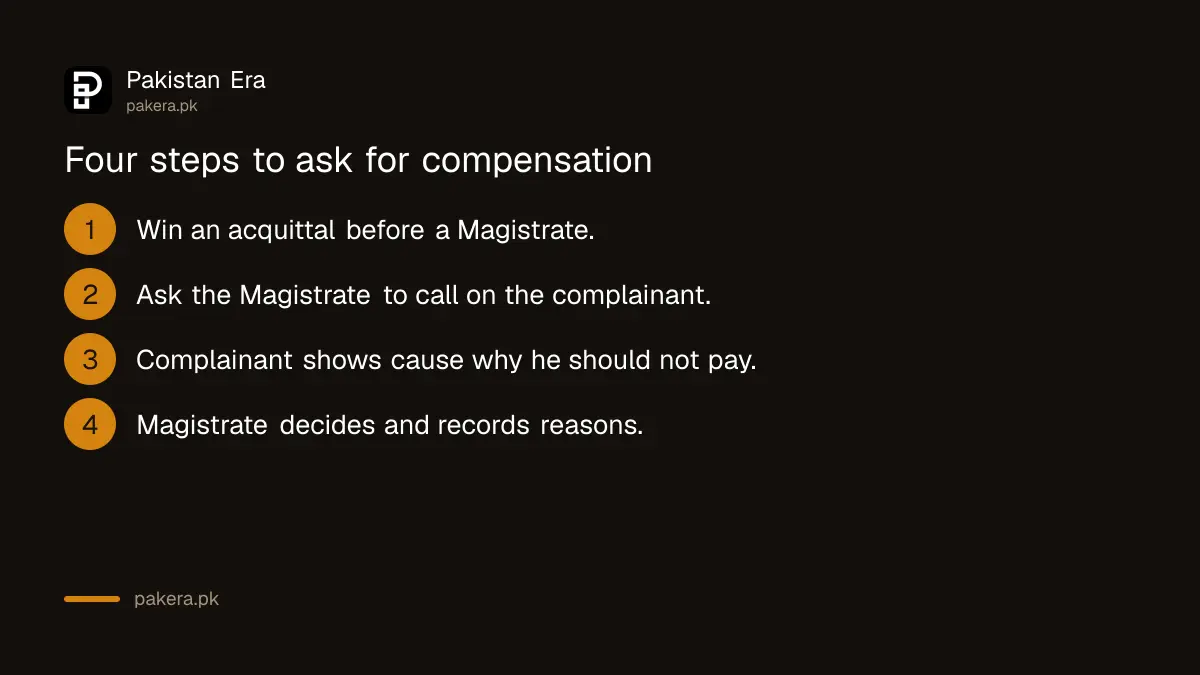
- Tell your lawyer before the final hearing that you want to ask for compensation.
- After the acquittal, ask the Magistrate to call on the complainant to show cause.
- If the complainant is absent, ask the court to issue a summons to him.
- Attend the hearing with proof of what the case cost you.
- Ask for the order in writing, with the reasons.
If you were wrongly accused and arrested, see your rights when you are arrested in Pakistan and how to get bail.
The amount is capped and is recovered like a land revenue arrear
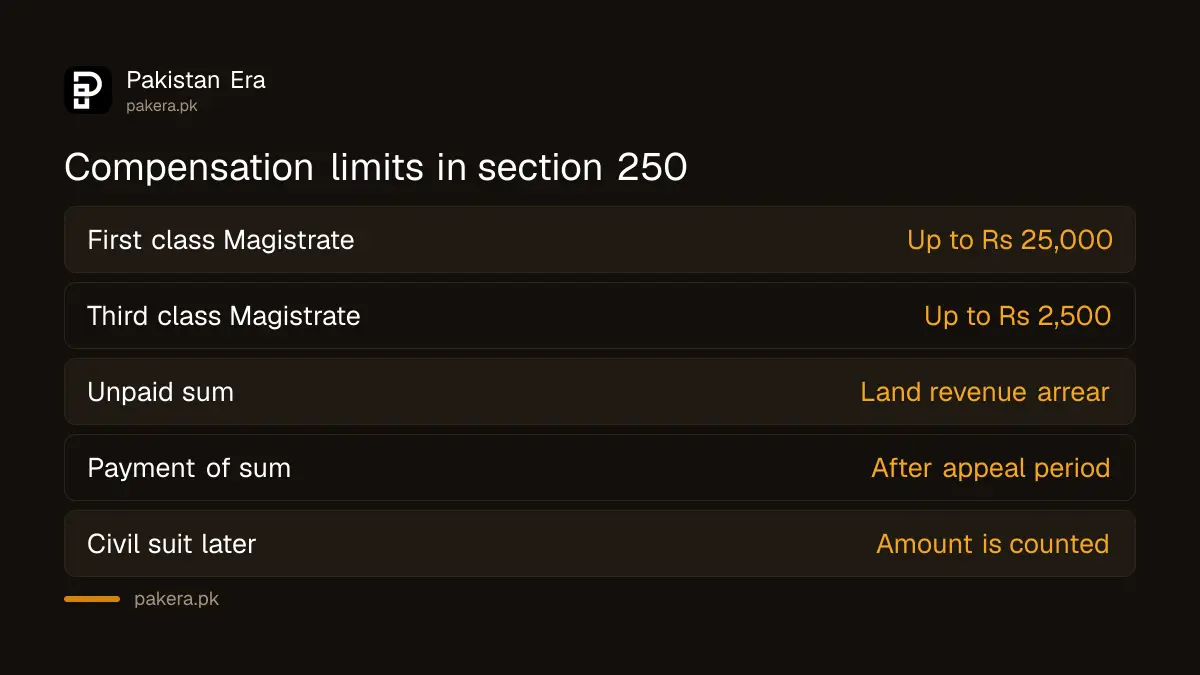
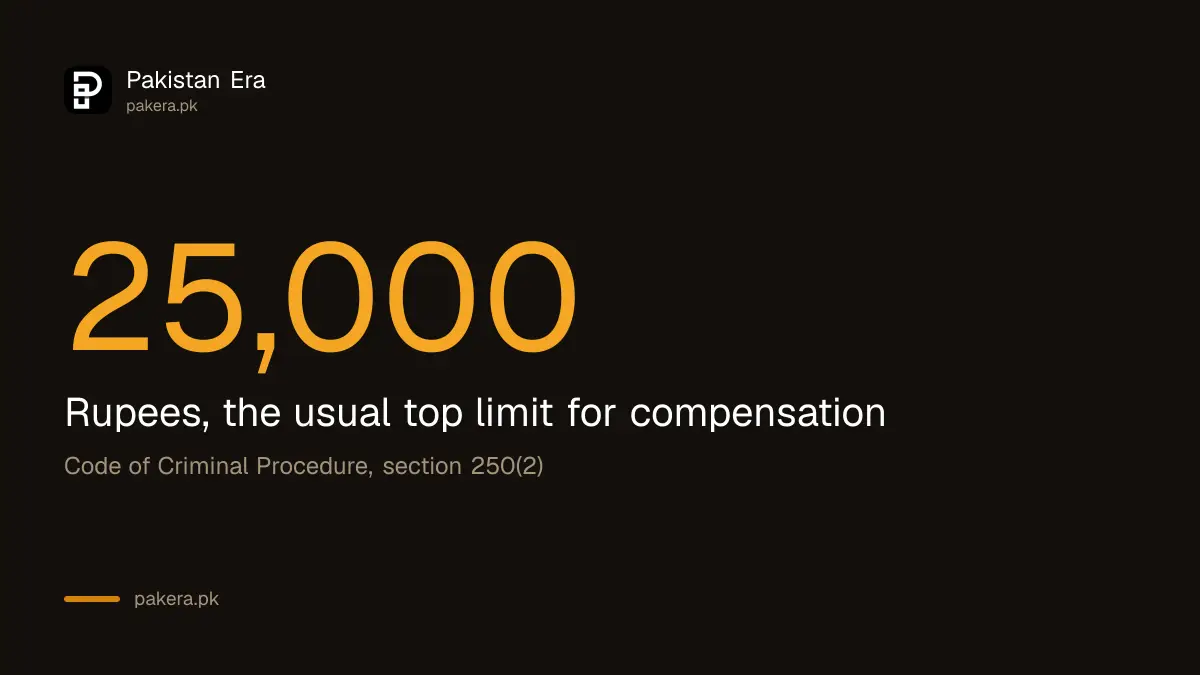
Section 250(2) says the compensation cannot be more than Rs 25,000, or Rs 2,500 if the Magistrate is of the third class. An unpaid sum is recoverable as an arrear of land revenue, and imprisonment follows the Pakistan Penal Code rules.
| Point | What section 250 says |
|---|---|
| Top limit | Rs 25,000, or Rs 2,500 for a third class Magistrate |
| Recovery | As an arrear of land revenue |
| When it can be paid | After the appeal period, or one month if no appeal lies |
| Other liability | The complainant is not excused from civil or criminal liability |
| Later civil suit | The amount paid is counted in damages |
The complainant can appeal in some cases. Under section 250(3), if a second or third class Magistrate ordered the payment, or any Magistrate ordered more than fifty rupees, the complainant may appeal as if convicted. The money is held until that time ends.
A civil claim or a defamation notice may be a further step
Section 250(2C) says paying compensation does not free the complainant from other civil or criminal liability. The sum you receive is counted if you later win damages in a civil suit over the same matter.
If the false claim also hurt your name, see how to send a defamation notice in Pakistan over a false post. That route has its own rules and time limits.
If you want to end a case without a trial, a compromise may be possible for some offences. Read how to settle a criminal case by compromise.
Be realistic about the sum. Rs 25,000 will not cover a long trial, and the Magistrate has no duty to award it. It still sends a message that a false case has a cost, and it is cheap to ask for on the day of the acquittal. A lawyer should check whether your case was tried by a Magistrate and not a Court of Session, because section 250 speaks of offences triable by a Magistrate. If you need one, see how to get a free lawyer in Punjab.
Common questions
Can I get compensation for a false FIR in Pakistan?
Under section 250, a Magistrate who acquits you can order the complainant to pay it if the accusation was false and frivolous or vexatious.
How much can the Magistrate award?
In the text we read, up to Rs 25,000, or Rs 2,500 from a third class Magistrate.
Is compensation automatic after acquittal?
No. The Magistrate must find the accusation false and either frivolous or vexatious, and hear the complainant first.
What if the complainant does not pay?
The sum is recoverable as an arrear of land revenue, and imprisonment is possible under the Penal Code rules.
Can I still sue for damages?
Yes. Section 250(2C) says the order does not remove civil liability, and the amount paid is counted in a later civil suit.
How we verified this
What we checked, where we read it, and what we could not confirm.
Last checked on 14 October 2026, Pakistan time. We read the Code of Criminal Procedure, 1898 on the Pakistan Code, section 250. We could not confirm whether the Rs 25,000 limit changed after 2017 or how often Magistrates use this power. Ask a lawyer before you apply. This page explains the law and is not legal advice.
About the author

Public Services and Education Journalist
Fajr Riaz is a journalist and content writer at Pakistan Era, based in Lahore. She covers the questions people meet in everyday life in Pakistan: how a public service works, what a change in the rules means, and where to find a reliable answer.