How to Recover Money on a Promissory Note or Hundi in Pakistan: Order 37 Summary Suit
An Order 37 summary suit can recover money on a promissory note, hundi or bill of exchange in Pakistan. See the steps, the leave rule and the time limit to sue.
Short answer: A summary suit under Order 37 of the Code of Civil Procedure lets a lender sue on a bill of exchange, hundi or promissory note by a faster route. The debtor cannot defend unless the court gives leave. If leave is not given, the claim is treated as admitted and a decree follows.
Many people lend money against a signed note and then wait years for a normal civil trial. Order 37 is the faster route in the law. It does not fit every loan. It fits a debt that is written on an instrument.
We read the Code of Civil Procedure and the Limitation Act on the Pakistan Code website on 14 October 2026. We did not read the Negotiable Instruments Act or any court fee schedule.
Order 37 covers suits on bills, hundis and promissory notes
Order 37 rule 2 says suits on bills of exchange, hundis or promissory notes may be filed by a plaint in the prescribed form, if the plaintiff wishes. It applies to the High Court, the District Court and courts the High Court notifies.
A promissory note is a written promise to pay a fixed sum. A hundi is a traditional written order to pay money. A bill of exchange is an order to pay. A cheque is also a kind of bill of exchange, but we did not read the Act that says so, so ask a lawyer whether your court will take a cheque claim under Order 37.
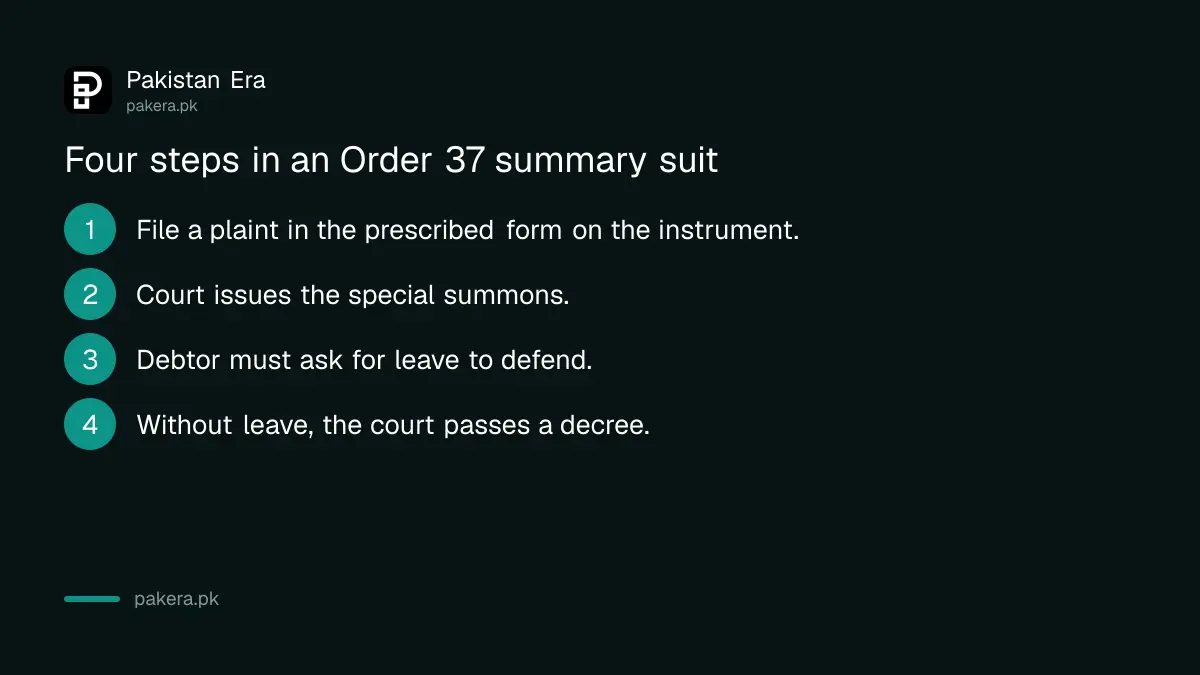
- Keep the original instrument. The court may order it deposited with a court officer.
- Ask a lawyer to draft the plaint in the prescribed form and file it in the right court.
- The court issues a summons in the special form.
- The defendant must apply for leave to appear and defend.
- If leave is not given, the plaintiff asks for the decree.
The debtor cannot defend without the court's leave
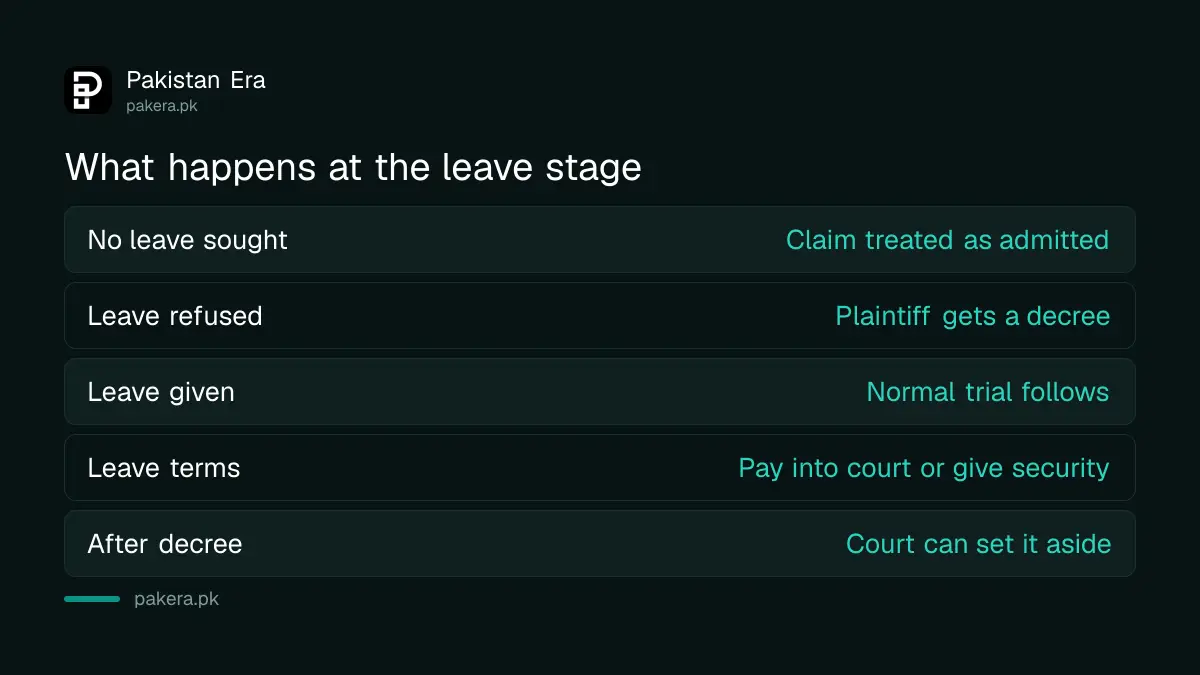
Rule 2(2) says that when the plaint and summons are in the special forms, the defendant must not defend unless a judge gives leave. Without leave, the plaint's allegations are treated as admitted and the plaintiff gets a decree.
The decree is for the principal sum, interest up to the day the suit was filed or the sum named in the summons, whichever is less, later interest as the court orders, and costs. Rule 2(3) says a decree under this rule may be executed forthwith.
| Stage | Rule | What the law says |
|---|---|---|
| Special summons | 2 | Defendant cannot defend without leave |
| No leave sought or given | 2(2) | Allegations deemed admitted, decree follows |
| Decree passed | 2(3) | Can be executed forthwith |
| Leave application | 3 | Court gives leave on affidavits disclosing sufficient facts |
| Decree already passed | 4 | Court may set aside in special circumstances |
Leave to defend needs real facts, not a bare denial
Rule 3 says the court gives leave when the defendant's affidavits disclose facts that would make the holder prove consideration, or other facts the court thinks sufficient. Leave may be unconditional, or may require money paid into court or security.
Consideration means what was given in return for the promise, such as the money lent. If the debtor says he never received it, he must say so with facts in an affidavit. A plain denial is not enough.
The text we read does not give a number of days for the leave application, so we cannot tell you the deadline. Section 5 of the Limitation Act applies to leave applications, so a late application can be explained. Rule 4 also lets the court set aside a decree in special circumstances.
If you are the debtor, treat the summons as urgent and see a lawyer at once. You may qualify for a free lawyer in Punjab.
Sue within three years for most bills and notes
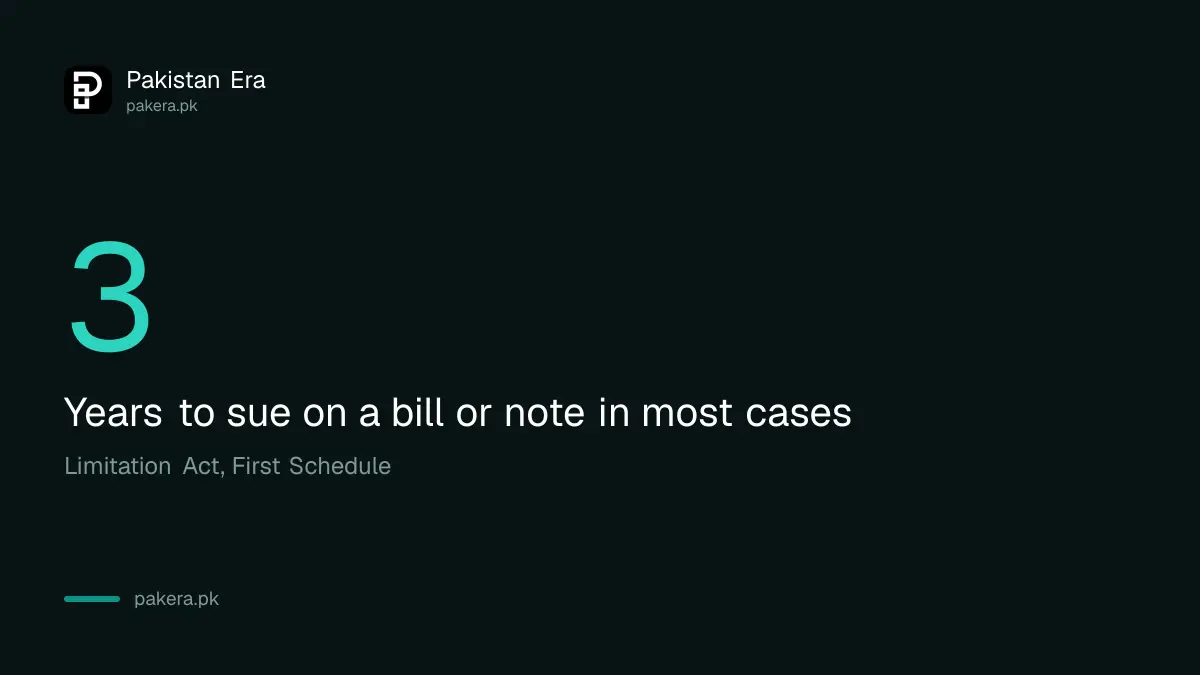
The Limitation Act sets three years for most suits on bills of exchange and promissory notes. The start date depends on the kind of instrument, such as when it falls due, is presented or the fixed time ends. Do not wait.
For a note payable at a fixed time, the first term of default is a common start. For a bill, it may be the date it falls due. Because the start differs, ask your lawyer to name the exact date for your paper before the third year ends.
For the bounced cheque route, which is a criminal case, read what to do when a cheque bounces in Pakistan. For a plain debt with no instrument, Order 37 may not apply, and an ordinary civil suit is the usual route.
It is wise to write the loan details on proper paper. See how to write a cheque correctly and how crossed cheques and account payee marks protect the payee.
Common questions
What is an Order 37 summary suit?
It is a faster civil suit on a bill of exchange, hundi or promissory note, where the defendant must get leave to defend.
Can the debtor fight the claim?
Only if the court gives leave to appear and defend. Without leave, the claim is treated as admitted.
Does it cover cheques?
A cheque is a type of bill of exchange, but we did not confirm how each court treats it. Ask your lawyer.
What can the court award?
The principal sum, interest as the rule sets, later interest the court orders, and costs.
How long do I have to sue?
Three years for most bills and notes, counted from a date that depends on the instrument.
How we verified this
What we checked, where we read it, and what we could not confirm.
Last checked on 14 October 2026, Pakistan time. We read the Code of Civil Procedure, 1908 on the Pakistan Code and the Limitation Act, 1908. We did not read the Negotiable Instruments Act, court fees or any judgment, and the text we read gave no number of days for the leave application. Ask a lawyer before you file. This page explains the law and is not legal advice.
About the author

Senior Writer, Public Services and Technology
Shahid joined us in 2024 as an author. He is a senior contributor to Pakistan's leading technology websites. He writes detailed articles, mostly covering his expertise in the latest tech, mobiles, apps, gadgets, and step-by-step guides. His ideology is to help people understand the latest trends and explain complex methods through very easy-to-understand guides.