How to Sit the HSSC Second Annual Exam 2026 in Punjab
Failed an HSSC paper in Punjab? You repeat only that paper. Rechecking closes in 15 to 20 days, and no board has notified the second annual 2026 schedule yet.
If you failed a paper in the HSSC Part 2 result declared this morning, you sit that paper again in the second annual examination. You repeat only the failed papers, not the whole year.
Update, 10 October 2026: BISE Lahore is moving four inter subjects to On-Screen Marking, with examiner training from 12 to 31 October 2026. Read the update.
The date you need first is not the exam date. It is the rechecking deadline, which runs from today. BISE Multan gives you 15 days. BISE Gujranwala gives you 20 days. Gujranwala's own challan system prices rechecking at Rs 1,500 per answer book.
The second annual schedule was not out on result day, when we checked nine Punjab board sites. It is out now. BISE Rawalpindi, Faisalabad and Sargodha have notified that the exam starts on 3 November 2026, with single fee forms open until 6 October. The fees and late fee dates are in the Punjab inter second annual exam 2026 schedule.
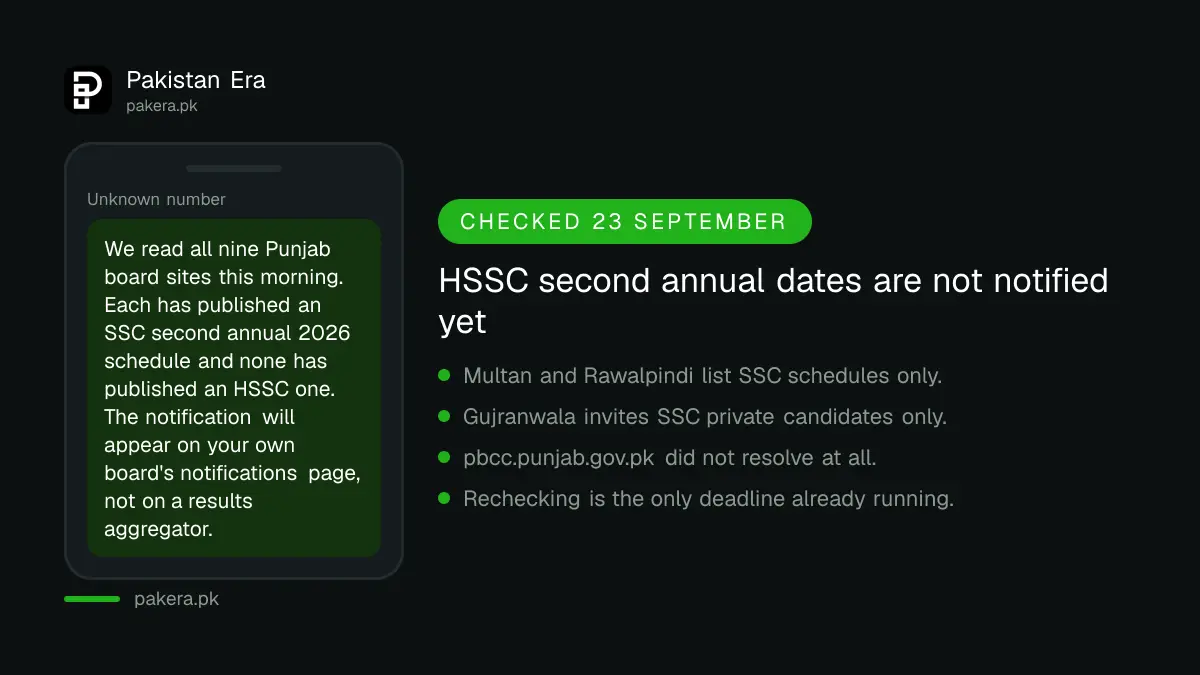
Punjab boards notified the HSSC second annual schedule after result day
No Punjab board had published HSSC second annual 2026 dates or fees on 23 September 2026. By 25 September, Rawalpindi, Faisalabad and Sargodha had, with the exam starting on 3 November. Each board has issued its SSC second annual schedule, and nothing for intermediate. The notification will appear on your own board's news or notifications page.
We read the board sites between 09:00 and 09:30 PKT on 23 September. BISE Multan's notification list carries "Notification Regarding Admission Schedule of SSC 2nd Annual Examination 2026" dated August and "Notification Regarding DateSheet of SSC 2nd Annual Examination 2026" dated 21 September. Both are matric. Nothing for HSSC.
BISE Rawalpindi's download panel offers "Admission And Fee Schedule For SSC 2nd Annual 2026" and no intermediate equivalent. BISE Gujranwala's homepage invites private candidates to apply for the SSC second annual 2026 and, again, offers nothing for the twelfth class.
That pattern is consistent, and it fits the calendar. The matric result came in August, so the matric supplementary paperwork is months ahead of the intermediate one. The Punjab matric second annual exam opened its forms on 7 August and starts on 6 October. Intermediate is roughly seven weeks behind that.
So watch your board's notifications page, not a WhatsApp forward. Boards publish these as scanned notifications signed by the Secretary or the Controller of Examinations, and they go up on the board's own domain first.
Rechecking closes before the resit form even opens
Rechecking is the one deadline already running, and it is short. BISE Multan's press release for today's result gives candidates 15 days from publication. BISE Gujranwala's homepage states 20 days. Miss it and the marks stand, whatever the resit does later.
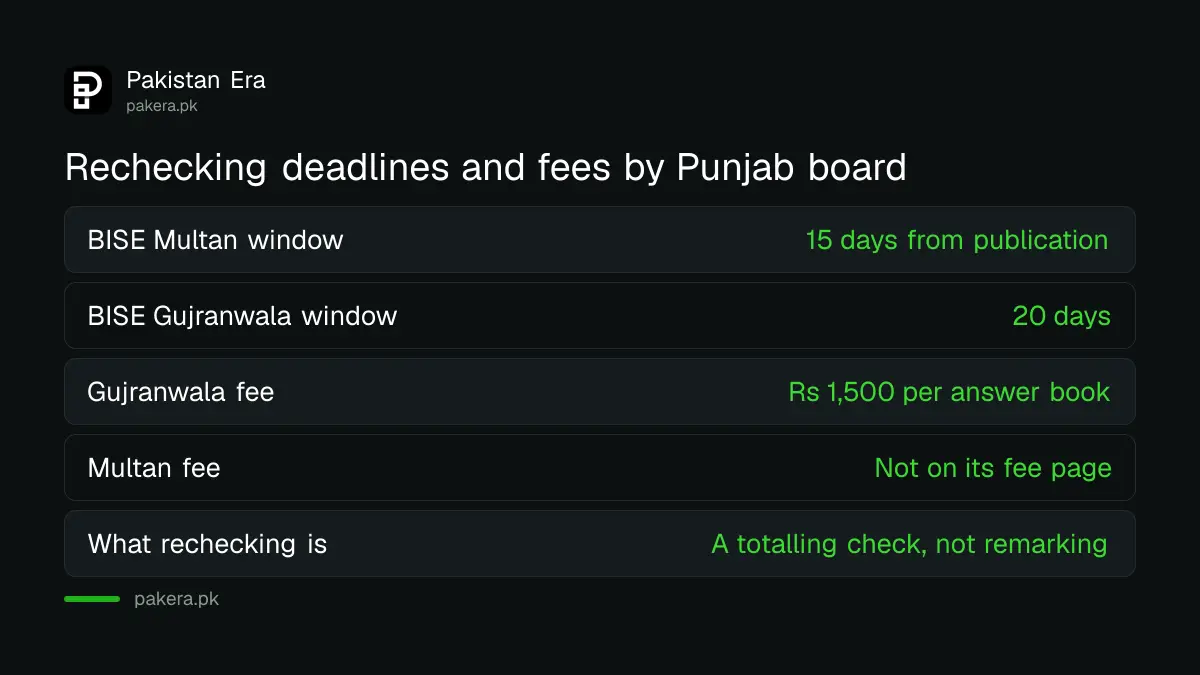
| Board | Rechecking window | Fee we could read |
|---|---|---|
| BISE Multan | 15 days from result publication | Not published on the fee page |
| BISE Gujranwala | 20 days | Rs 1,500 per answer book |
| BISE Rawalpindi | Portal live, window not stated on it | Not published on the portal |
| Other six boards | Not readable on 23 September | Not readable on 23 September |
The Multan figure comes from its own press release, number 131/ACI dated 21 September 2026, which also confirms the result time of 10:00 am today. It tells candidates to apply online within 15 days, pay the prescribed fee, and then deliver the hard copy of the application and the challan to the board office.
The Gujranwala figure comes from the board's live challan system, which lists "Rechecking of each Answer Book" at Rs 1,500 under its rechecking fee category. Per answer book matters. Three papers is three fees. What rechecking actually checks is narrower than most students expect, and it is worth knowing before you pay for three.
Rechecking is not remarking. The board confirms the totalling, checks that no part was left unmarked, and returns the paper. It is not a fresh examiner forming a fresh opinion.
Apply for both if you are in any doubt. A pending recheck is not a reason to skip the second annual form when that schedule lands, because if the recheck changes nothing you will have lost the cheap deadline as well.
You repeat only the papers you failed
A candidate who failed one paper sits one paper. The passed papers carry over at the marks you already earned, and you do not re-sit them. Punjab board rules describe this as appearing "in his failing subjects only", and the admission form asks you to name those papers.
Getting that list wrong is a real and expensive mistake. If you write full papers of Part 1 and Part 2 on the form when you only needed one subject, the boards charge to fix it. BISE Multan prices a change of option in intermediate at Rs 2,500 and a change of subject for a private candidate at Rs 2,000. BISE Gujranwala charges Rs 2,900 to change a subject before the exam and Rs 2,400 after the return form.
So read the result statement itself rather than going by what somebody told you on the phone. If you are still trying to open the result at all, the board by board method is in checking board results online, and this morning's HSSC Part 2 result has the direct links.
Punjab fee ladders rise in three steps, then by the day
Punjab boards publish a fee schedule with a single fee date, a double fee date and a triple fee date, and the rate differs by group. We have not read an HSSC 2026 fee table, because none is published yet, so treat the shape below as the pattern and confirm the rupees when your board notifies.
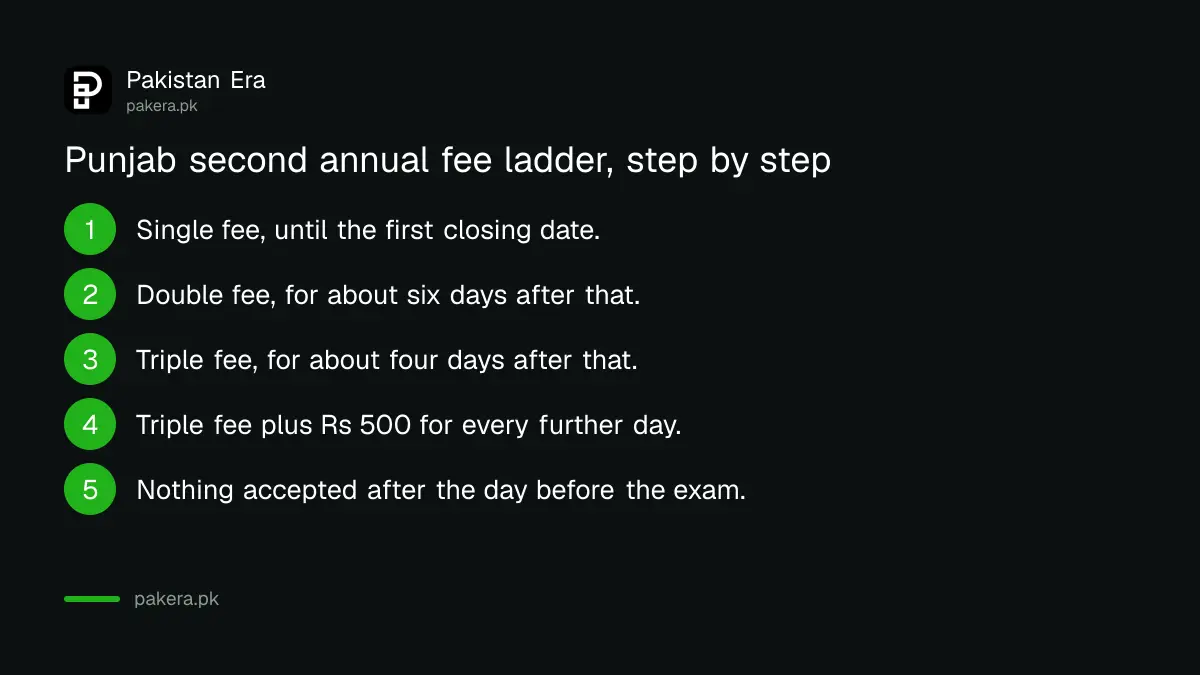
BISE Multan's SSC second annual notification, DSF/327 dated 5 August 2026, sets out four steps rather than three. Single fee to 19 August, double fee to 25 August, triple fee to 29 August, then triple fee plus Rs 500 per day up to one day before the exam. The last rung is the one people do not know exists.
The same notification splits rates by candidate type and by group, with science plus practical costing more than arts. It also tells affiliated institutions that they may not charge students above the board's own rate, and routes payment through HBL Konnect rather than a private account.
Two fee exemptions exist and almost nobody claims them. BISE Rawalpindi publishes a notification on fee waiver for disabled candidates and a separate one exempting prisoners from the examination fee. Both sit on the board's own downloads panel.
A second annual pass gives the same certificate, on a later calendar
The certificate is the same document. Punjab boards do not issue a separate class of pass, and their own fee lists name one item for both routes, "Inter Certificate Fee Annual/Supply". What differs is when the result reaches you, and that is what decides your admission year.
- The exam is not scheduled yet. Until a board notifies the date, nobody can tell you when your result lands.
- Most Punjab intakes are already running. The Online College Admissions System for public colleges has been open since August and reported more than 115,000 applications by 31 August.
- Universities admit on a result you hold at the time of applying. A pending second annual paper is not a held result, whatever the eventual certificate says.
- Some doors were still open today. The University of the Punjab's admission portal was still advertising a third admission test when we read it on 23 September.
- Ask the university, in writing. Policies on provisional admission differ by institution and by programme, and a counter clerk's opinion is not a policy.
We are not going to tell you the year is safe. For most students with a failed paper today, admission moves to the next cycle, and the honest planning assumption is that it does. Where a university publishes a later deadline or a provisional route, take it in writing before you count on it. If you have already paid a semester fee on a provisional admission, how much of it comes back falls with every week you wait.
One thing worth checking on the OCAS homepage: the closing dates printed there on 23 September still read 2021. Confirm any college deadline with the college.
Improvement of marks is a separate application with separate rules
Students who passed but want a better score apply for improvement of marks, not for the second annual as a failed candidate. Punjab board rules give one opportunity, as a private candidate, within two years of passing, in the same subjects or group.
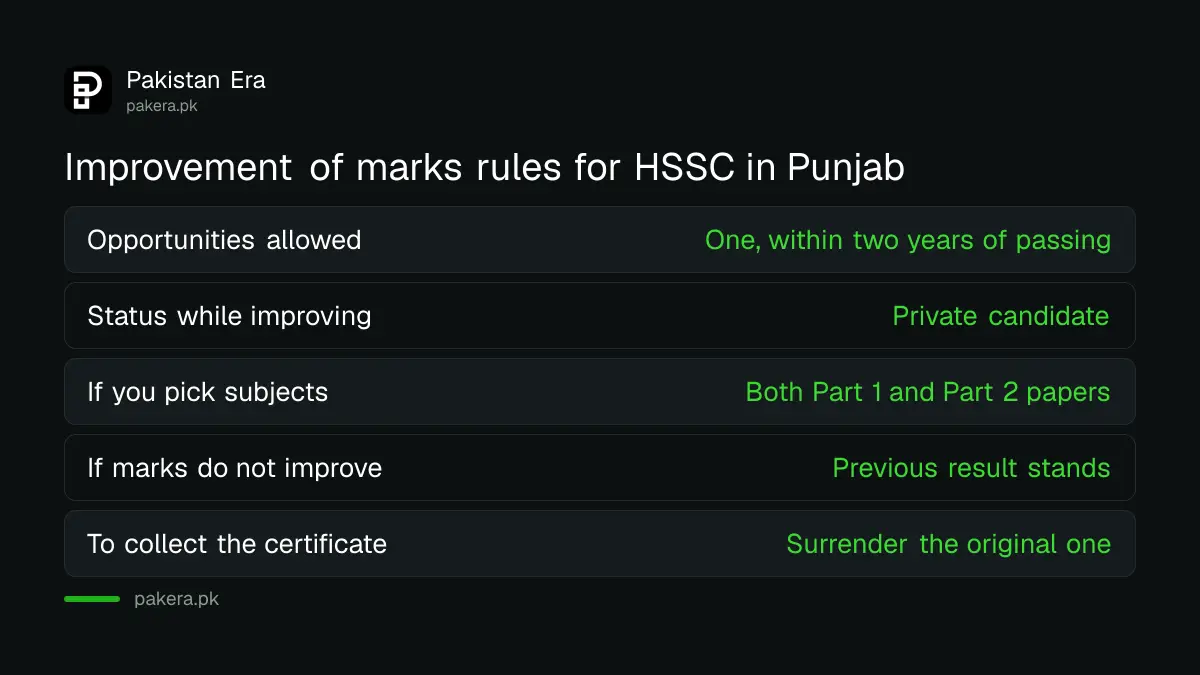
You choose the scale. Whole examination, one part, or named subjects. Choose subjects and you are bound to sit both the Part 1 and the Part 2 paper of each subject you name. Where a paper has theory and practical, the improvement is judged on the combined total after you clear each component.
If you do not improve, nothing is lost on paper. The previous result stands, subject by subject. Improve in one subject and not another, and the improved subject is updated while the rest keep the old marks.
One rule changed this year and it is in your favour. A PBCC decision dated 18 February 2026, adopted by BISE Multan in its 385th meeting on 5 May 2026 and notified on 11 May, changes what happens when an improvement candidate is absent for a paper. The old rule declared the whole attempt "Marks not Improved". The amended rule shifts your previous marks into the absent paper and declares the result "Marks Improved".
Two practical points. Passing an additional subject removes your right to improve marks afterwards. And to collect the improved certificate you must surrender the original one.
Failing candidates from older sessions got two extra chances
Punjab raised the maximum number of HSSC examination chances from four to six for a specific group. Candidates from the intermediate annual 2024 Part 2 examination who were declared "Failed as a whole" after four chances, and whose last chance was the second annual 2025, now have two more.
BISE Multan set this out in a press release dated 4 June 2026, citing its own notification number BISE-MLT(OIM)2026/53 dated 11 May 2026. For that group, the HSSC second annual 2026 is the final chance.
Using the extra chances is not automatic. The board asks for a written application, restores or revises your last result, and charges an option change fee of Rs 2,500 before you may sit the failed subjects. Multan lists 061-9210027 for the Assistant Controller (Inter) on that release.
If this describes you, act on it this week rather than when the schedule appears. Restoring a result takes office time that a deadline will not give back.
What we could not read on result day
Board sites behaved badly this morning, so here is exactly what we could and could not open, with the status codes we saw between 09:00 and 09:30 PKT on 23 September 2026.
biselahore.com answered 200 but served a results only page of under 5 KB, with no notifications, no fee page and no downloads. bisesargodha.edu.pk answered 200 with a 648 byte page. bisesahiwal.edu.pk redirected to its results subdomain. web.bisemultan.edu.pk redirected its homepage to results, though every inner page loaded normally, which is how we read the notifications and the fee structure.
pbcc.punjab.gov.pk did not resolve at all. The Punjab Boards Committee of Chairmen is the body whose decisions the boards adopt, so its absence matters more than a slow homepage. BISE Rawalpindi's HSSC admission portal at hsscadm.biserawalpindi.edu.pk returned 404 on both its regular and private paths. Result day traffic does this every year, and we have logged it before in our test of Punjab board result sites.
One more gap worth naming. BISE Multan's own FAQ says the examination fee rates for SSC and HSSC, annual and supply, are on the Fee Structure menu. We read that page in full. It lists correction, duplicate, verification and change of option fees, and it does not carry the examination fee at all. That is why no HSSC resit figure appears anywhere above.
Other provinces publish on their own calendar. The KP second annual dates were out in August, which is not a guide to what Punjab will do for intermediate.
Common questions
When is the HSSC second annual exam 2026 in Punjab?
It starts on 3 November 2026. BISE Rawalpindi, Faisalabad and Sargodha notified this after the result, and single fee forms close on 6 October 2026.
Do I have to repeat every subject if I failed one paper?
No. You sit only the papers you failed. Your passed papers keep the marks you already earned, and the admission form asks you to name the failed subjects.
How much does rechecking cost after the HSSC result?
BISE Gujranwala charges Rs 1,500 for each answer book, per its own challan system. Other Punjab boards set their own rate, so check yours before paying anything.
How long do I have to apply for rechecking?
BISE Multan allows 15 days from result publication and BISE Gujranwala states 20 days. The windows are not identical, so use your own board's figure rather than a friend's.
Can I still get university admission this year after a second annual pass?
Usually not in Punjab. Most intakes are already running and universities admit on a result you hold when you apply. Ask your chosen university in writing before assuming otherwise.
What is the difference between improvement of marks and the second annual?
Improvement is for students who passed and want a higher score, with one opportunity inside two years. The second annual is for clearing papers you failed.
Where will the HSSC second annual fee schedule be published?
On your own board's notifications or downloads page, as a signed notification with a fee table. The three step ladder of single, double and triple fee is the usual Punjab format.
Result day is heavy in a lot of households, and the paperwork above is easier to do than the conversation at home. If that part is the harder one, there is practical help in what we wrote on exam result pressure.
About the author

Public Services and Education Journalist
Fajr Riaz is a journalist and content writer at Pakistan Era, based in Lahore. She covers the questions people meet in everyday life in Pakistan: how a public service works, what a change in the rules means, and where to find a reliable answer.