Is Your Mobile Internet Speed Normal in Pakistan? PTA's Q2 2026 Average Is 18.9 Mbps on 4G
PTA's Q2 2026 report puts the national mobile download average at 18.9 Mbps on 4G and 127.74 Mbps on 5G. Test your own speed in 5 steps and compare it fairly.
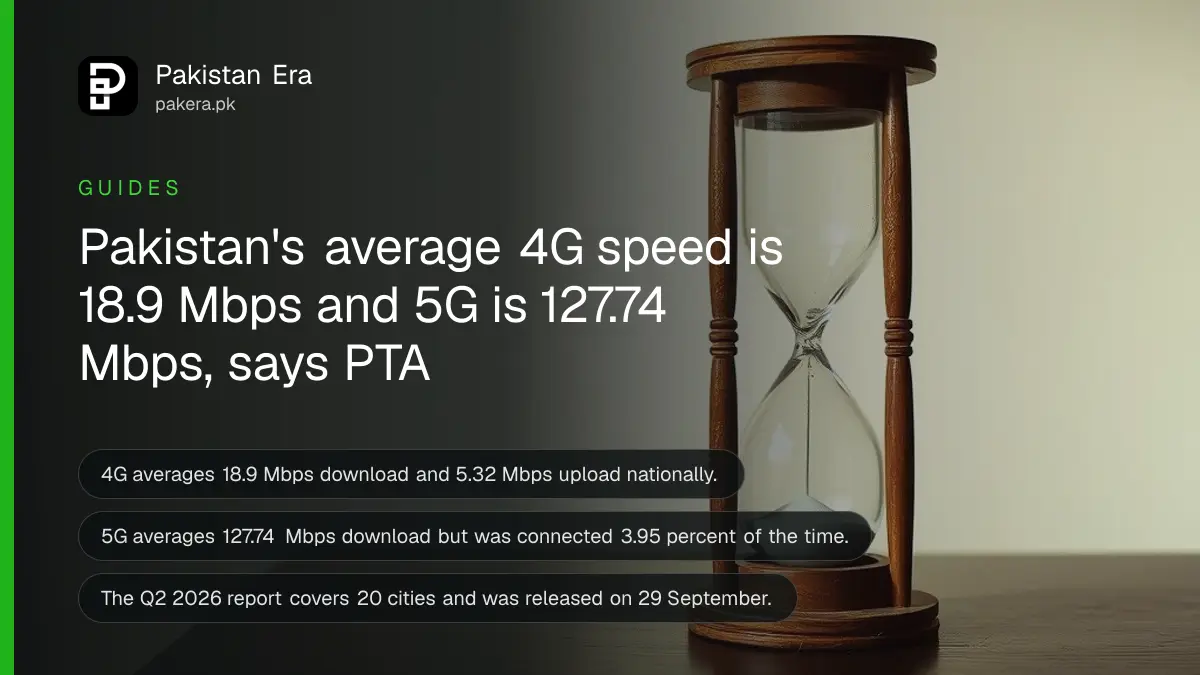
Short answer: PTA's report for April to June 2026 puts the national average mobile download speed at 18.9 Mbps on 4G and 127.74 Mbps on 5G. Upload averages 5.32 Mbps on 4G. If your 4G test reads near 19 Mbps, your speed is normal for Pakistan. A result far below it, at several hours of the day, is worth a complaint.
You run a speed test, see 6 Mbps and wonder if the network is cheating you. Before you complain, you need one number to compare against. PTA has now published it.
We downloaded PTA's Mobile Network Experience Benchmarking Report for Q2 2026 on 12 October 2026 and read the national section in full. PTA released it on 29 September 2026, and it was prepared with the measurement company Opensignal.
The national averages are 18.9 Mbps on 4G and 127.74 on 5G
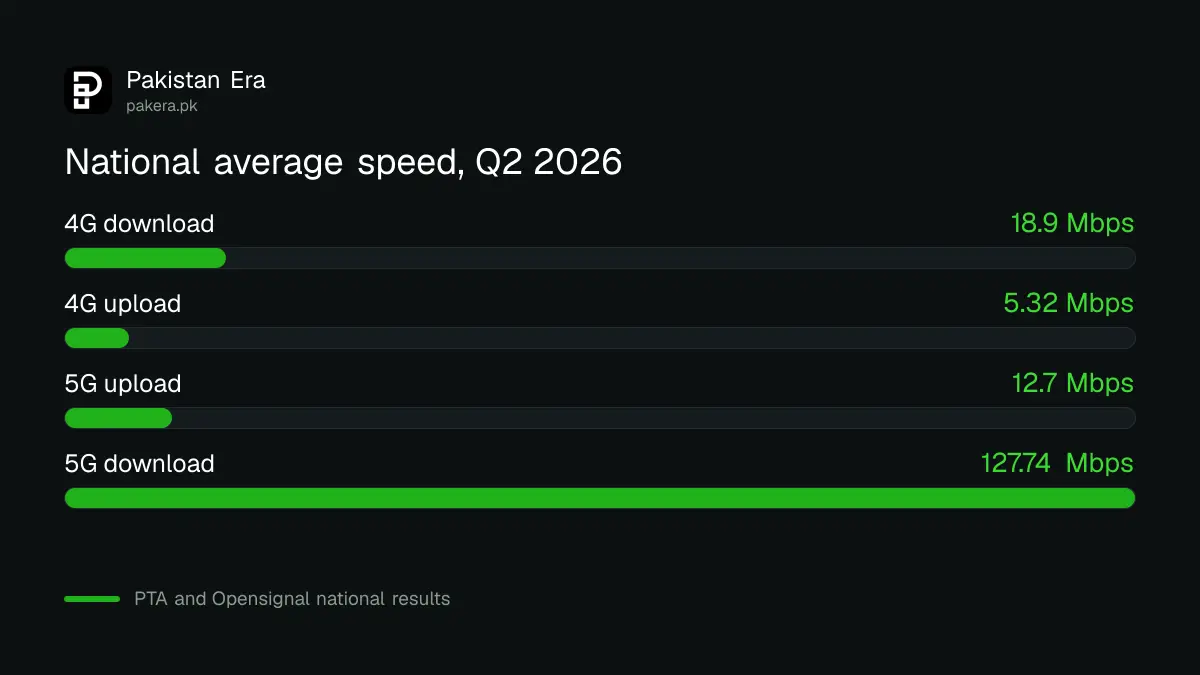
PTA's national results give separate figures for 4G and 5G. On 4G, all devices average 18.9 Mbps download and 5.32 Mbps upload. On 5G, they average 127.74 Mbps download and 12.7 Mbps upload. Phones with high-end hardware did better on 4G, at 31.3 Mbps.
| Measure (national, Q2 2026) | 4G | 5G |
|---|---|---|
| Download speed, all devices | 18.9 Mbps | 127.74 Mbps |
| Download speed, high-end devices | 31.3 Mbps | Not given |
| Upload speed | 5.32 Mbps | 12.7 Mbps |
| Video experience (out of 100) | 37.53 | 67.33 |
| Games experience (out of 100) | 43.85 | 62.05 |
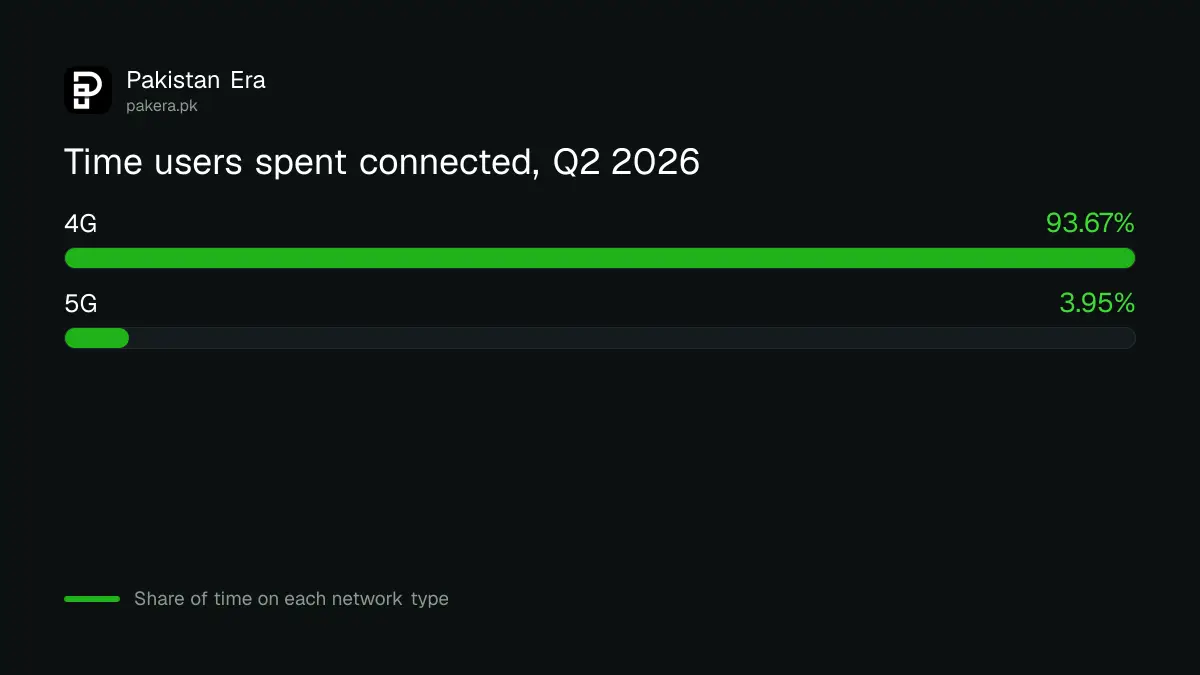
| Time connected to the network | 93.67% | 3.95% |
How PTA and Opensignal measured it
The speeds come from real smartphone users, not from a drive test. Opensignal collected samples through the day, indoors and outdoors, at busy and quiet hours, over 90 days. The report says it left out customers of virtual operators and roaming users.
Each device counts once, and extreme highs and lows are removed. That makes the figure a typical user's experience. It does not tell you the best your SIM can do. A person standing next to a tower at 3 am will beat it, and a person on the fifth floor of a concrete building will fall below it.
PTA's own text warns that these results differ from its quality of service reports, since this one measures user experience and not network performance. For the drive-test results see PTA's 2026 test of 11 Pakistani cities.
5G is real but still thin
5G was connected only 3.95 percent of the time for users in the sample. PTA's report says 5G deployment is at an early stage with limited coverage and a small user base, so those results are indicative only.
So the 127.74 Mbps figure tells you what 5G can do when you are on it, not what most people get. To see where it exists, read 5G coverage in Pakistan and check your phone with our 5G phone check. On 4G, the connection was present 93.67 percent of the time.
How to test your own speed fairly
Test the same spot at three different hours and compare the average with 18.9 Mbps. One low result at 8 pm tells you about congestion. Three low results at the same place, on 4G with full bars, tell you about the network.
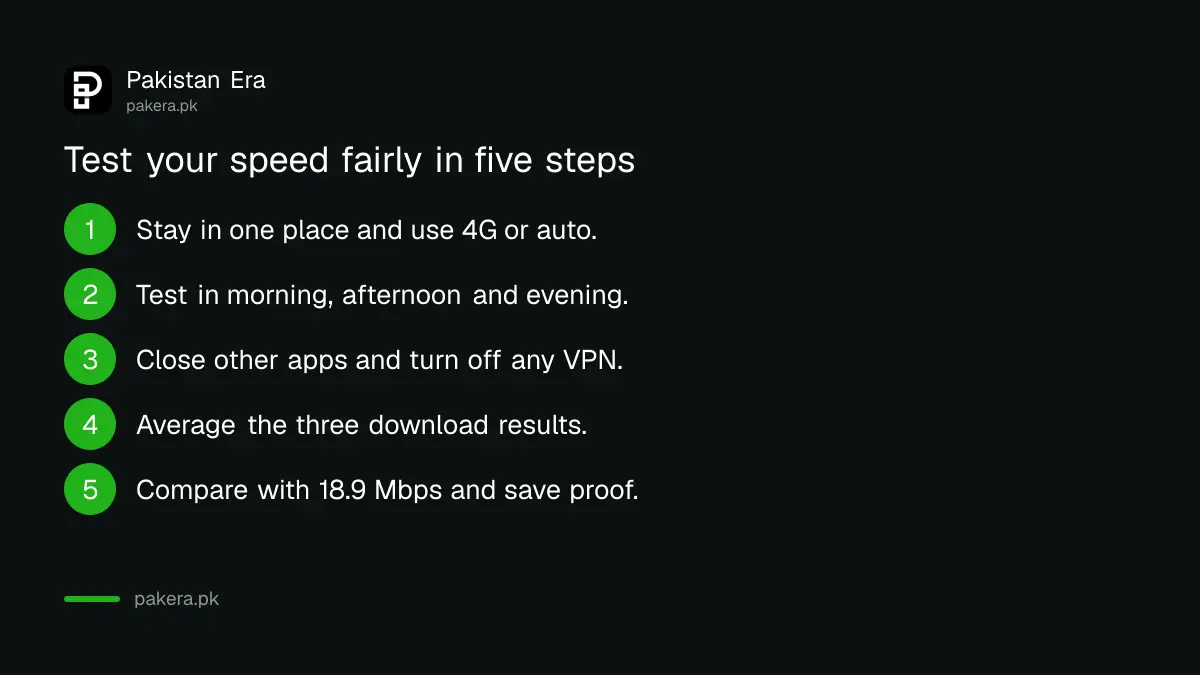
- Stay in one place and set your phone to 4G or auto, with VoLTE on if your SIM supports it.
- Run a speed test in the morning, mid-afternoon and evening, and write down each download and upload number.
- Close other apps and turn off any VPN while you test.
- Take the average of the three downloads and compare it with 18.9 Mbps on 4G.
- If your average sits far below it at the same place, save screenshots with the time and place.
Operator-specific tests are in our guides to checking Jazz internet speed, Zong speed and Telenor speed. First confirm that your SIM really is on 4G with our 4G and VoLTE check.
If your speed is far below normal
An average is not a legal minimum. The quality standards PTA enforces are set out in its 2021 regulations. Read what call, SMS and data quality your network must give before you quote a figure to an operator.
Complain to your operator first and keep the complaint number. If the fault stays, file with PTA. Our guide on complaining to PTA about slow or dead internet lists what to attach. Your screenshots, times and place are the proof that counts.
Common questions
What is a normal 4G speed in Pakistan?
PTA's Q2 2026 report puts the national average at 18.9 Mbps download and 5.32 Mbps upload on 4G. That is an average across many users, so single tests vary a lot.
What is the average 5G speed in Pakistan?
The same report gives 127.74 Mbps download and 12.7 Mbps upload on 5G. PTA calls these indicative because 5G is at an early stage.
Is a speed below 18.9 Mbps a fault?
Not by itself. The figure is an average, so many users sit below it. Repeated low results in the same place at different hours point to a network problem.
Who made the measurements?
PTA published the report with Opensignal, a company that measures network experience from real phones. The samples covered 90 days in the second quarter of 2026.
Does this report rank the networks?
It gives results by operator and for 20 cities, which you can read in the PDF on PTA's website. This guide sticks to the national figures, which we could read without doubt.
Why does the speed differ from PTA's drive tests?
PTA says Opensignal measures what users feel, while its quality survey measures network performance with controlled drive tests. The two methods give different numbers.
How we verified this
What we checked, where we read it, and what we could not confirm.
Last checked on 12 October 2026. Figures are from PTA's Mobile Network Experience Benchmarking Report, Q2 2026, and its press release of 29 September 2026, both on PTA's QoS survey page. We did not read operator-by-operator or city tables because the operator labels in the PDF are logos that did not extract as text. We ran no speed tests of our own.
About the author

Technology Journalist & Multimedia Producer
Ahmad Ali is a technology journalist and multimedia producer at Pakistan Era, joining the team in October 2026. He covers consumer technology and digital life for Pakistani readers, combining research with hands-on product testing.