Prevent Naegleria Brain Infection in Pakistan: NIH Advice on Warm Water, Pools and Your Nose
NIH says the brain-eating amoeba Naegleria enters through the nose from warm fresh water and kills in 3 to 7 days. Learn the signs and how to prevent it.
Short answer: The National Institutes of Health (NIH) says Naegleria fowleri, called the brain-eating amoeba, infects people when water carrying it goes up the nose. It is rare but almost always fatal. The best defence is chlorine. Keep your head above warm fresh water, do not dive in, and keep unchlorinated water out of your nose.
Every summer, a Karachi family learns that a child with a headache and a fever has an infection almost nobody has heard of. Within days it is over. The doctors say the cause was water.
We read the NIH Islamabad advisory on primary amoebic meningoencephalitis (PAM), also called Naegleriasis, on 14 October 2026. It is dated 10 June 2024, written for health authorities and water bodies, and mentions that deaths have been reported from Karachi hospitals every summer since 2008. It is not a new alert, and we found no newer one. Warm weather has not fully left Pakistan, and the advice is simple to follow.
Naegleria enters through the nose and reaches the brain
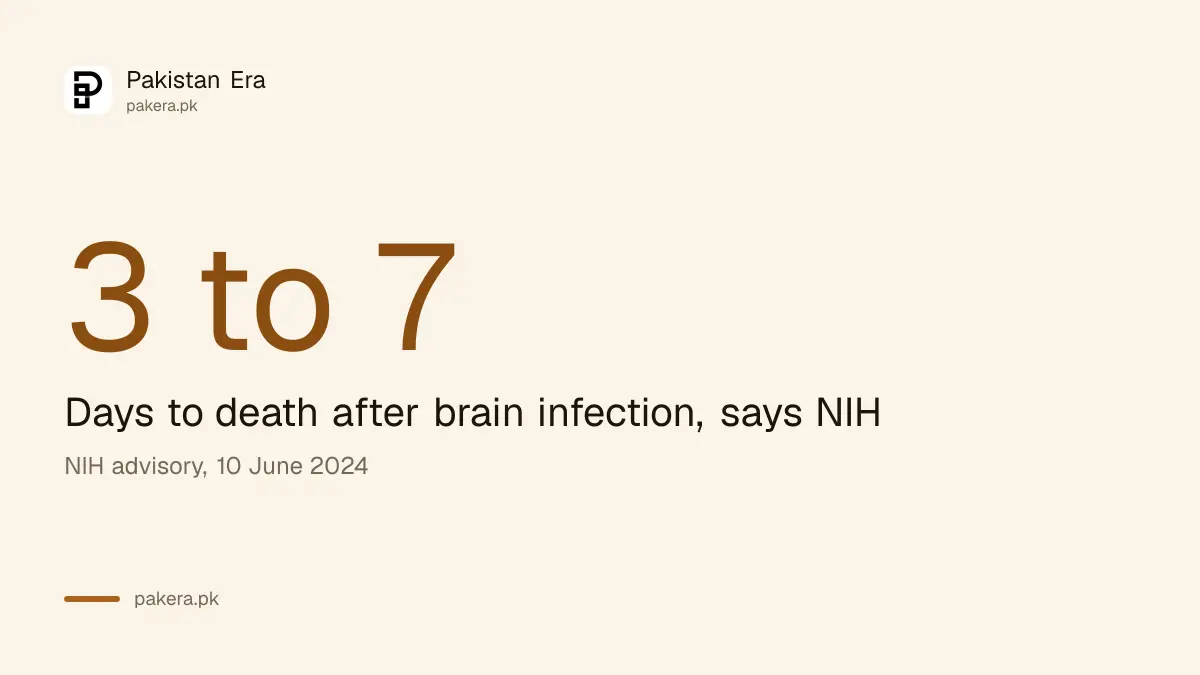
NIH says infection happens when water with Naegleria fowleri goes up the nose and the amoeba travels along the smell nerve to the brain. It causes swelling, bleeding and tissue death, and leads to death in 3 to 7 days.
The amoeba is a single-celled organism that loves heat. NIH says it lives in warm fresh water such as lakes, rivers and hot springs, and even in soil. It is most often found in the hot summer months. A growing share of cases are linked to drinking water systems that are poorly chlorinated.
The advisory describes only the nose route. It says nothing about swallowing water or spread between people, so we make no claim either way.
Symptoms look like meningitis and start within 2 to 15 days
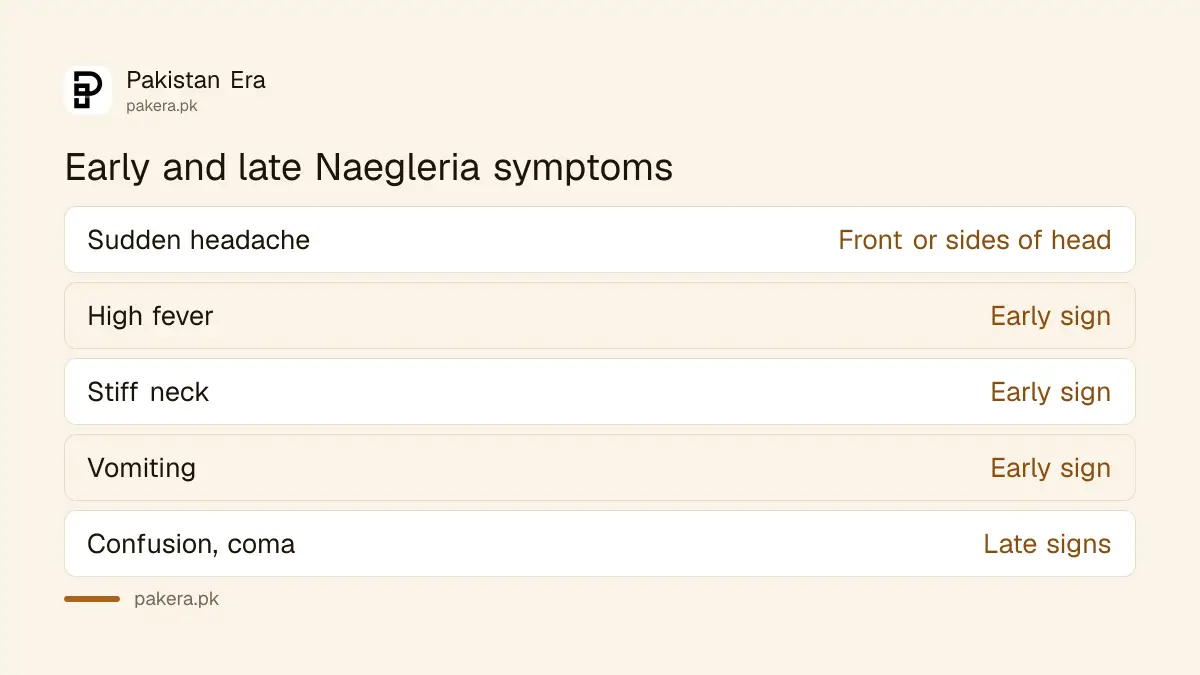
NIH says the incubation period is 2 to 15 days, with a median of 7. Early signs are a sudden headache, high fever, stiff neck, vomiting and irritability. Later signs are confusion, hallucinations and coma, and death within 3 to 8 days.
The advisory says about 75 percent of cases are diagnosed only after the patient has died. The disease is rare and hard to spot early, so doctors may think of ordinary meningitis first. If a person has such symptoms after contact with warm fresh water, tell the doctor about the water at once.
The advisory says suspected cases must be reported to health authorities. A rapid diagnosis and intensive supportive care may raise the chance of survival. It names a three-drug combination used in a few documented cases, but it does not claim a cure.
Chlorine is the best defence in pools and pipes
NIH says Naegleria fowleri cannot survive in clean, cool, chlorinated water. Chlorine kills it and is the most effective way to disinfect swimming pools and piped water systems. Pools, spas and water tanks that are poorly kept, under-chlorinated or unchlorinated are the risk.
That puts a duty on water utilities, pool owners and building managers. The advisory asks them to design, clean and manage pipes and storage tanks to reduce sediment and stagnant water, because both can shelter the amoeba and use up the chlorine.
At home, you cannot test chlorine by eye. See how to test your home drinking water at a PCRWR lab. In Karachi, a poor water supply can be reported through a KW&SC complaint.
Five habits cut your own risk
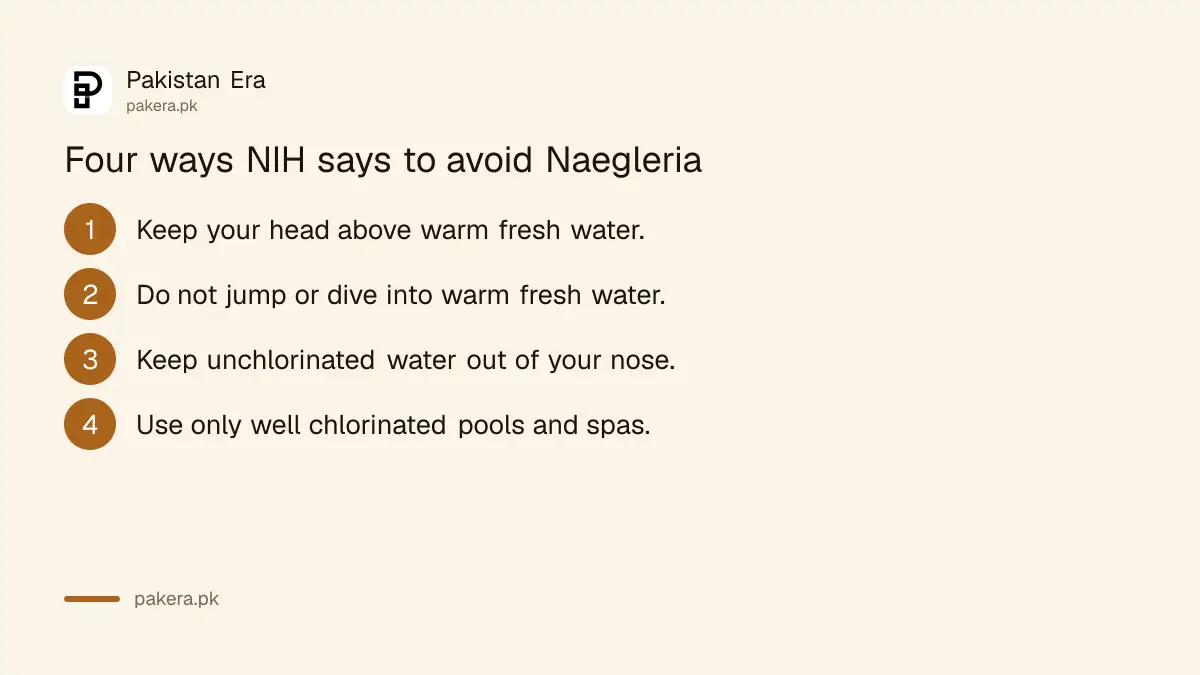
NIH advises people to avoid diving into warm fresh water, keep their heads above water in warm pools, clean small wading pools daily, use chlorinated pools, and keep unchlorinated water out of the nose when bathing or washing the face.
| Situation | What NIH advises |
|---|---|
| Warm fresh water, such as a pond or canal | Do not jump or dive in |
| Spa or warm pool | Keep your head above water |
| Small wading pool | Empty and clean it daily |
| Unchlorinated bath or shower water | Do not let it go up the nose |
| Nasal rinsing | Never with possibly contaminated water |
- Do not jump or dive into warm fresh water, such as a pond or canal.
- Keep your head above water in warm pools and spas.
- Empty and clean children's small wading pools every day.
- Swim only in pools that are properly chlorinated and well kept.
- If the water is not chlorinated, do not let it go up your nose in the shower or when washing your face.
- Never use possibly contaminated water for nasal rinsing or washing the nose.
The last point matters for anyone who uses a nose-rinse kit. The advisory does not mention wudu. Its rule is general: do not let unchlorinated water go up the nose. If you are unsure about your tank water, ask your doctor or a water testing lab.
Treat a headache and fever after water contact as urgent
NIH says early diagnosis and intensive care may improve survival, so do not wait. After contact with warm fresh water, a sudden headache, fever, stiff neck or vomiting means a hospital visit. Tell the doctors about the water.
Do not give home remedies and wait. The advisory says time matters. For the numbers to call, see emergency helpline numbers in Pakistan.
The same hot, poorly treated water that breeds Naegleria can also carry other germs. See how to spot cholera and what NIH says to do and why some bottled water brands are on an unsafe list.
Common questions
What is Naegleria fowleri?
It is a free-living amoeba found in warm fresh water and soil. NIH calls it the brain-eating amoeba, and it causes a rare, almost always fatal brain infection.
Can I catch Naegleria from drinking water?
NIH describes infection through the nose, not by swallowing. It says more cases are being linked to drinking water systems, so keep tank and pipe water out of the nose.
How soon do symptoms start?
NIH says the incubation period is 2 to 15 days, with a median of 7. Illness then runs fast and can end in death in 3 to 8 days.
Is there a cure for Naegleria infection?
NIH says rapid diagnosis and intensive supportive care may raise the chance of survival, and names a drug combination used in a few cases. It does not claim a cure.
Does chlorine kill the amoeba?
Yes. NIH says chlorine kills Naegleria fowleri and is the most effective way to disinfect swimming pools and piped water systems.
How we verified this
What we checked, where we read it, and what we could not confirm.
Last checked on 14 October 2026, Pakistan time. We read the NIH advisories page and the NIH Advisory for the Prevention and Control of Primary Amebic Meningoencephalitis (PAM)/Naegleriasis, No. F.1-22/Advisory/CDC/2024, dated 10 June 2024. It is a scanned PDF, so we read pages 1 and 2 as images and could not read page 3. We found no newer NIH advisory on this disease, and we did not check current case numbers.
About the author

Public Services and Education Journalist
Fajr Riaz is a journalist and content writer at Pakistan Era, based in Lahore. She covers the questions people meet in everyday life in Pakistan: how a public service works, what a change in the rules means, and where to find a reliable answer.