Stop Dengue Mosquitoes at Home in Pakistan: NIH's Weekly Checklist for Water, Containers and Screens
NIH says to cover, empty and clean home water containers weekly to stop dengue mosquitoes. Use this room by room checklist for Pakistan homes and shops today.
Short answer: The NIH dengue advisory says to cover, empty and clean domestic water storage containers every week, remove standing water in coolers, flowerpots, tyres and drains, and fit mesh screens on windows. The Aedes mosquito that spreads dengue breeds in small pools of water. Do the weekly check on the same day each week and make it a family job.
Walk around your home and count the places where water sits still. A bucket under the tap. The tray under a flowerpot. A cooler that stopped working in September. Each one can raise a batch of dengue mosquitoes in about a week.
We read the National Institutes of Health (NIH) Islamabad advisory for the prevention and control of dengue fever on 14 October 2026. It is dated 3 March 2025, so it is not new, and it is written mainly for health departments. We have taken out what a household can do. We could not find a newer dengue advisory on the NIH page.
Dengue is spread by mosquitoes that breed in clean standing water
NIH says dengue spreads through Aedes aegypti and Aedes albopictus mosquitoes, which live in towns and cities. Cases appear from April to June and rise most after the monsoon, between September and November, in warm and humid weather.
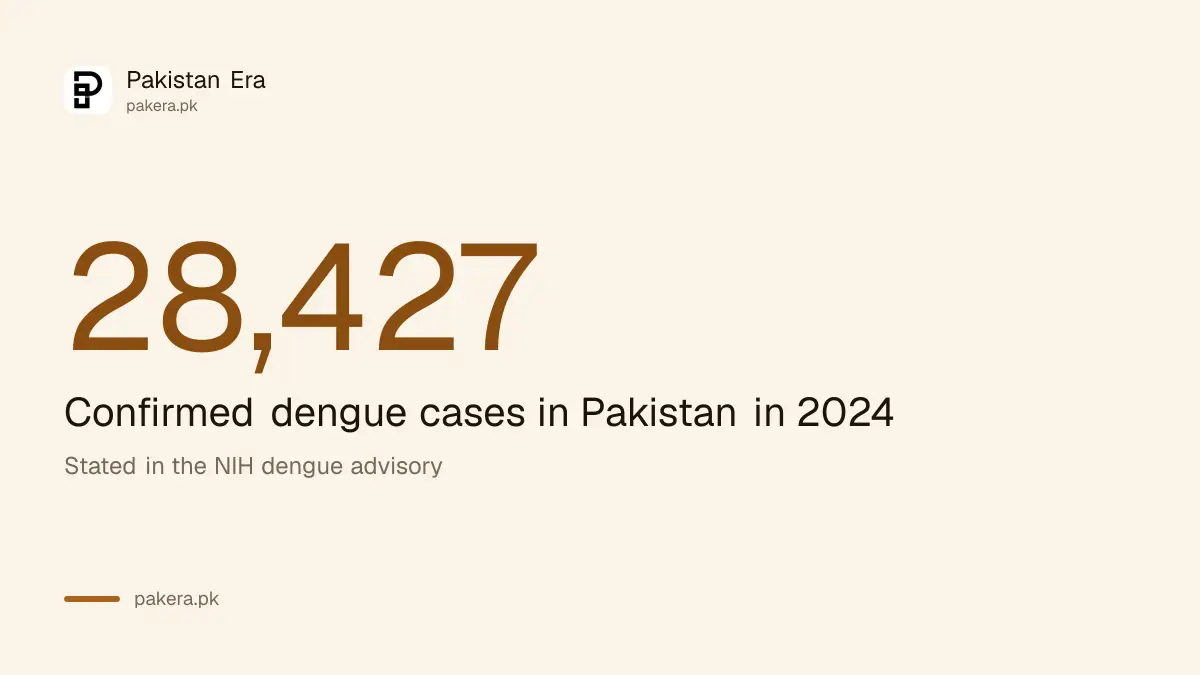
The numbers explain the worry. NIH reports 21,016 confirmed cases in 2023 and 28,427 in 2024 across Pakistan. It names poor water storage, unplanned urban growth and crowded living as risk factors.
For the signs of the illness, see the dengue warning signs that mean go to hospital. For where cases are rising now, see the dengue cases in Islamabad and Khyber Pakhtunkhwa.
A weekly water check removes the breeding spots
NIH says to cover, empty and clean domestic water storage containers on a weekly basis, and to remove standing water where mosquitoes can lay eggs. Choose one day each week so the habit sticks, and repeat it at home, at work and at your shop.
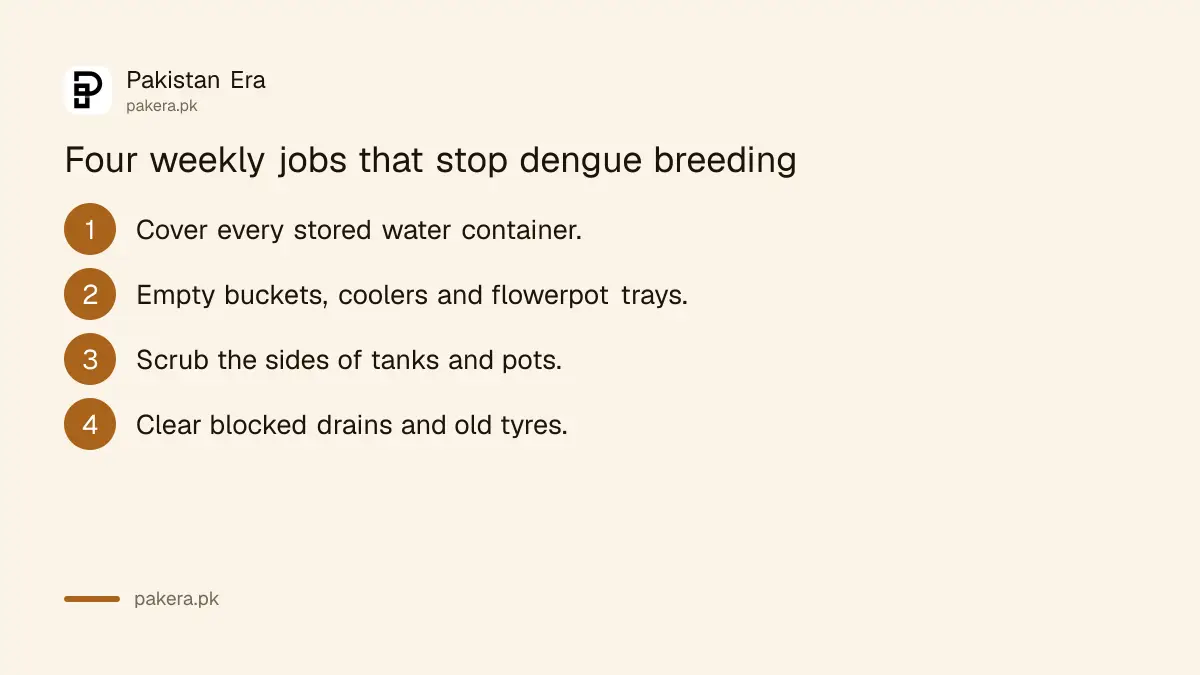
- Cover every stored water container with a tight lid or cloth.
- Empty buckets, drums, bird pots and flowerpot trays, then refill with fresh water only if you need it.
- Scrub the inner sides of tanks and pots with a brush.
- Remove or flip tyres, cans, bottles and broken appliances that can hold rain.
- Clear clogged drains and rooftop gutters.
- Check the cooler, the fountain and the water tank cover.
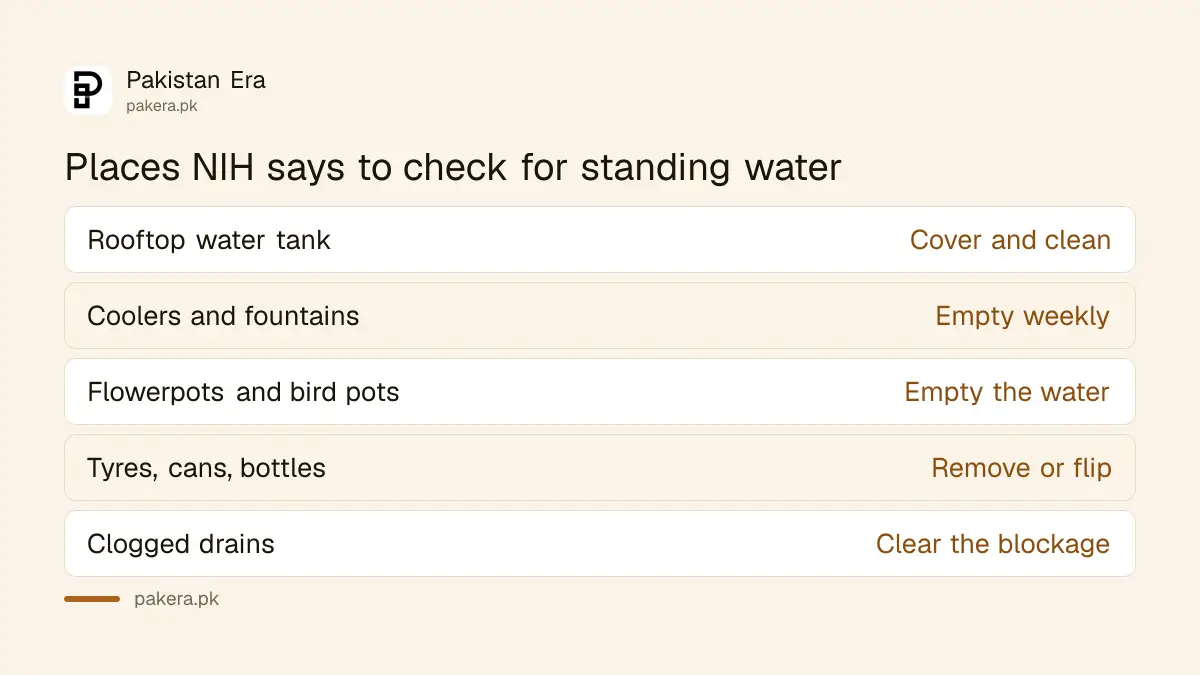
That list follows the advisory's own examples: rooftop water tanks, fountains, coolers, flowerpots, bird drinking pots, underground tanks, ponds, tyres, cans and bottles, buckets, discarded appliances and clogged drains.
Shops, schools and workplaces are named hotspots
NIH names hospitals, junkyards, graveyards, nurseries, schools, universities, tyre shops, basements, parks, hotels, building sites, mosques, swimming pools, factories and offices as places that need checks. If you run one of these, apply the same weekly routine to your site.
| Place | What to check |
|---|---|
| Tyre shop or junkyard | Stacked tyres and scrap that hold rain |
| Basement or building site | Pooled water in pits and under floors |
| School or office | Coolers, planters and rooftop tanks |
| Nursery or park | Pot trays, fountains and ponds |
| Mosque or hotel | Storage tanks and cisterns |
If you find larvae or standing water that you cannot fix yourself, see how to report dengue larvae or standing water in Punjab.
Personal protection works alongside the water check
NIH lists long sleeved clothes, repellent lotion or spray, mosquito coils, bed nets when sleeping outdoors and mesh screens on windows. It also advises home isolation for patients with mild illness, and a hospital visit if danger signs appear.
Aedes mosquitoes bite mostly in daylight, so protection is not only for the night. Wear light, long sleeved clothes in the morning and late afternoon. Put a screen on any window that stays open.
Keep a patient with mild illness indoors under a net or screen. A mosquito that bites a sick person can pass the virus to the next person it bites. Go to hospital if there is severe belly pain, repeated vomiting, bleeding or confusion. See when a dengue patient must be admitted in Punjab.
Spraying and fogging are not a substitute for cleaning
NIH says breeding sites should be removed by mechanical means first, with chemicals only where that is not possible. Fogging is for emergencies and only after an entomologist has assessed mosquito density. Do not rely on a fogging truck instead of your weekly check.
The advisory also says to use WHO approved insecticides as the manufacturer directs, and to spray the home of a confirmed patient and the surrounding homes. Those jobs belong to health teams. As a household, your job is the water.
There is no dengue vaccine you can rely on in Pakistan today. Our page on the dengue vaccine in Pakistan explains the position, which is why prevention matters.
Common questions
How often should I empty water containers to stop dengue?
NIH says to cover, empty and clean domestic water storage containers weekly. Do it on the same day each week so it becomes a habit.
Which mosquito spreads dengue?
NIH names Aedes aegypti and Aedes albopictus. Both breed in small pools of standing water in towns and cities.
When do dengue cases rise in Pakistan?
NIH says cases start to be reported from April to June and rise most after the monsoon, between September and November.
Is fogging enough to stop dengue?
No. NIH says breeding sites should be removed first and fogging is for emergencies, after the mosquito density has been assessed.
Should a dengue patient stay at home?
NIH advises home isolation for mild illness and a hospital visit if danger signs develop, such as severe belly pain, persistent vomiting or bleeding.
How we verified this
What we checked, where we read it, and what we could not confirm.
Last checked on 14 October 2026, Pakistan time. We read the NIH advisories page and the NIH Advisory for the Prevention and Control of Dengue Fever (No. F.1-22/Adv/CDC/2025, 3 March 2025) linked from it. The advisory is a scanned PDF, so we read it page by page as images. It is aimed at health departments, and the household steps here are our reading of its vector control and personal protection sections. We found no newer NIH dengue advisory.
About the author

Tax, Bills and Technology Writer
Ali Akhtar is a young and curious voice here at Pakistan Era. He is currently pursuing his A-Levels and has a growing interest in Pakistan’s changing industrial landscape and educational trends. Ali likes to write in a way that helps him explain and explore the world around him. His writing reflects the perspective of the new generation navigating the evolving trends of Pakistan where technology, youth innovation, and shifting opportunities are reshaping the country’s future.