Your Bank Cannot Raise a Fixed Loan Rate in Pakistan: SBP Rules on Early Repayment
SBP rules say a bank may not raise a fixed loan rate or a floating margin, and may charge only its actual cost to repay early. See what to ask before you sign.
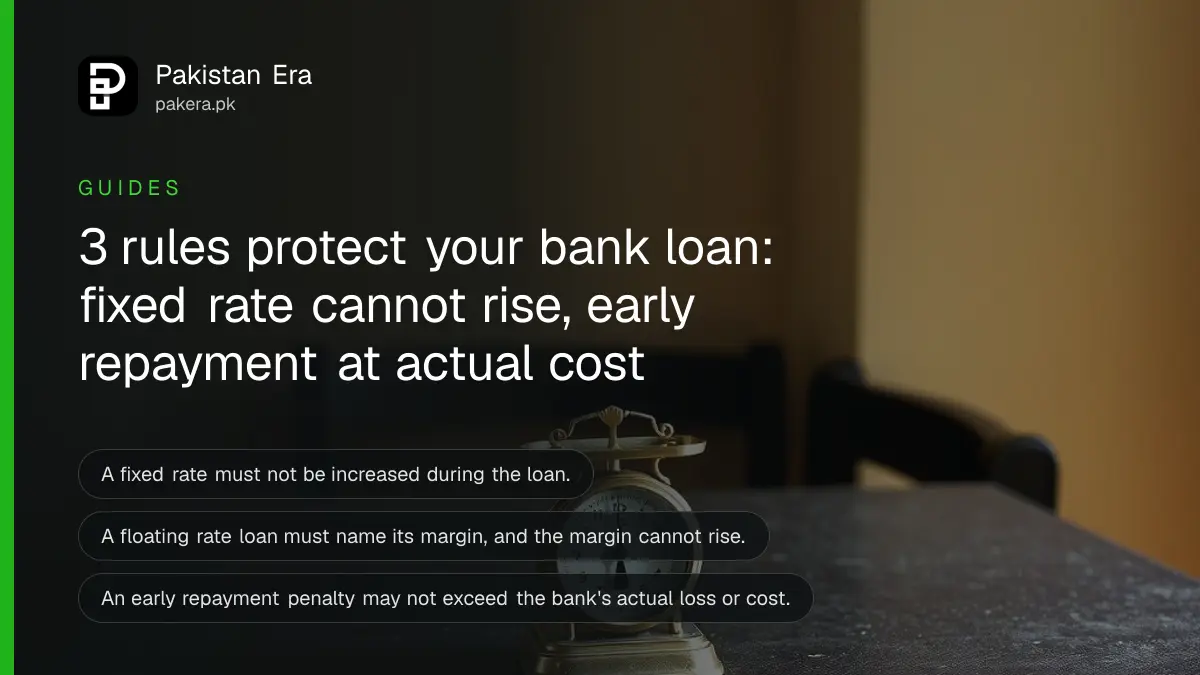
Short answer: Under SBP's conduct framework, a bank in Pakistan may not raise the rate on a fixed rate loan during its term, and may not raise the margin on a floating rate loan. You may repay early. The bank can charge a penalty only up to its actual loss or cost, and your payments go first to your most expensive loan.
Picture a borrower who takes a car loan at a fixed rate and, two years later, gets a letter that the rate "has been revised". He assumes the bank is allowed to do this because the bank wrote to him. The State Bank of Pakistan (SBP) says, in its own framework, that a bank may not.
We read SBP's Business Conduct and Fair Treatment of Consumers Regulatory Framework on 12 October 2026. It comes with BPRD Circular No. 04 of 2025, dated 17 October 2025. This guide uses sections 3.2.3.1 and 3.2.3.2, on financing and repayment. We have not read any single bank's loan contract, so check your own papers against the rules below.
A fixed rate cannot be raised and a floating margin cannot be raised
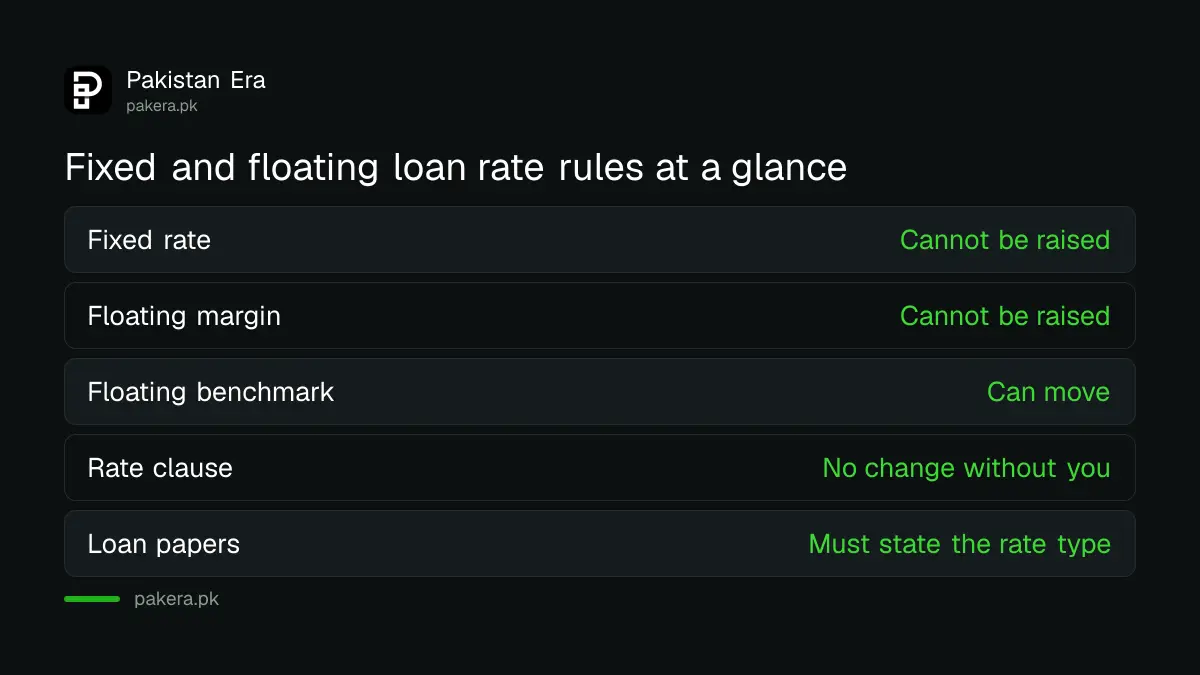
The framework says loan papers must state whether the rate is fixed, floating or both. A fixed rate must not rise during the loan. A floating rate loan must name its margin over the benchmark, such as KIBOR, and the bank may not increase that margin.
It also says the financing agreement shall not contain a clause that lets the bank change the rate on its own. So "rate may be revised at the bank's discretion" is a clause SBP says banks should not put in a consumer loan.
A floating rate still moves, because the benchmark moves. Our guide on what the policy rate does to your loan EMI explains how that works. The margin is the part the bank must leave alone.
| Loan type | What can change | What the bank may not change |
|---|---|---|
| Fixed rate | Nothing in the rate | The rate, for the whole loan |
| Floating rate | The benchmark, such as KIBOR | The margin over the benchmark |
| Any consumer loan | Nothing, unless you agree | A clause that lets the bank change the rate alone |
You may repay early and the penalty is capped at the bank's actual cost
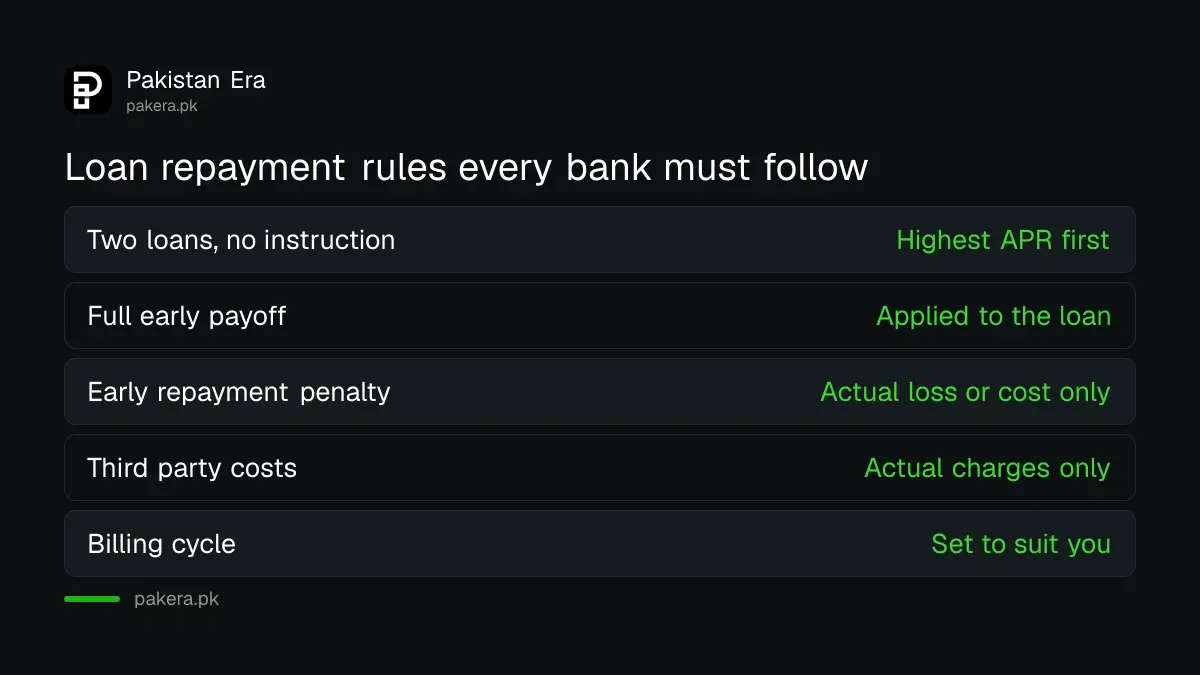
The framework gives you the right to pay early. A bank may charge a penalty for early repayment, but the penalty must not be more than the actual loss or cost to the bank. It cannot be a flat figure chosen to discourage you.
Ask the bank for a settlement letter that shows the outstanding principal, the early payment charge and how the charge was worked out. If the figure looks like a percentage of the whole loan, ask for the cost it is meant to cover.
The same rule covers third-party services. A bank may recover only the actual charges it paid for things such as repossession of a vehicle, valuing a property or buying credit reports. A flat "valuation fee" that is higher than the valuer's bill breaks it.
Your payments must go to the costliest loan first
If you hold several facilities with one bank, and you give no instruction, the bank must apply your payment first to the loan with the highest annual percentage rate (APR). Even where you give an instruction that costs you more, the bank must guide you and not take advantage.
The framework also asks banks to set up controls so that a payment is booked the way you meant it. If you pay off the whole balance early, the bank must apply the money to the loan and not park it against future instalments. It also asks banks to set the billing cycle to suit you, for example a salary date.
Before you sign, the framework expects the bank to talk with you and make sure you understand the main terms. A repayment schedule must show the outstanding principal after each instalment, so ask for it.
What to ask for before you sign or pay
Ask for the key facts statement, the repayment schedule, and the schedule of charges. Check the rate type, the margin, the early repayment charge and the late payment charge. Do not sign a page that has blank fields.
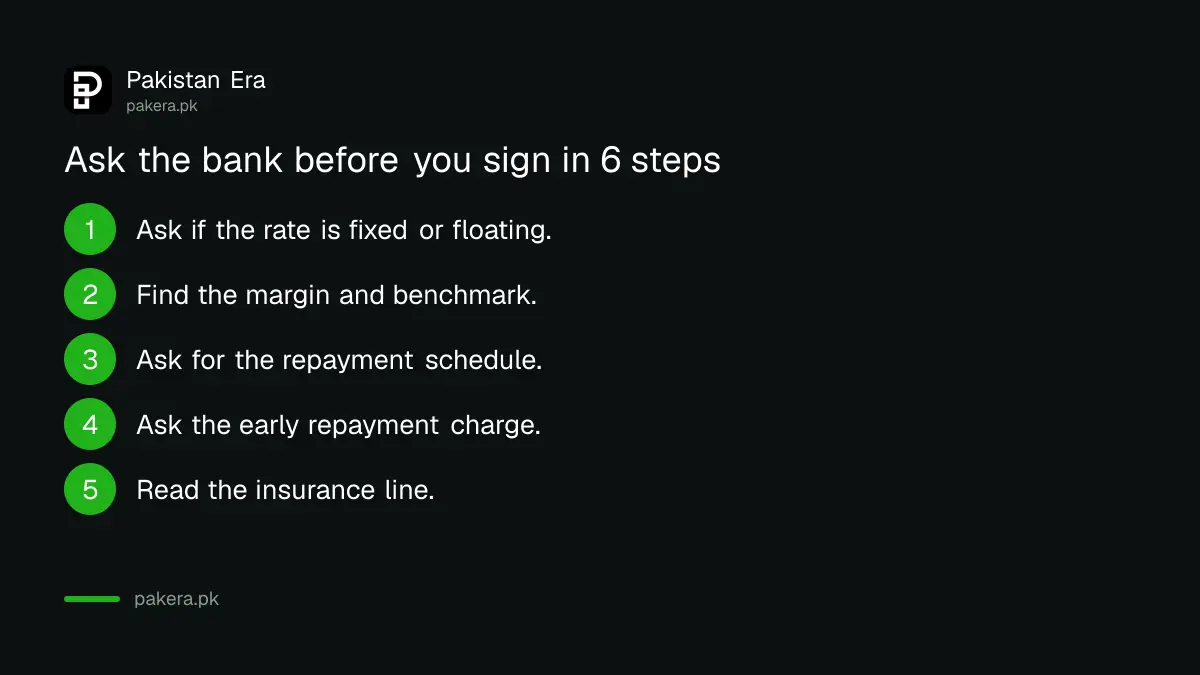
- Ask whether the rate is fixed, floating or mixed, and find that word in the contract.
- For a floating rate, find the benchmark and the margin, and ask the bank to confirm in writing that the margin is fixed.
- Ask for the repayment schedule that shows the outstanding principal after each instalment.
- Ask what the early repayment charge is, and how the bank calculates its "actual cost".
- Read the insurance line. The framework says cover should rise with the value of the asset.
- Keep a copy of every page and the signed acknowledgement.
For rates and limits by bank, our comparisons of personal loans and car financing are a place to begin. The home loan eligibility guide covers housing finance.
If your bank breaks the rule
Write to the bank's complaint unit, quote the section, and ask for a correction in writing. The bank must acknowledge within 48 hours and, for a repayment or settlement dispute, normally reply in 7 working days. Then escalate to the Banking Mohtasib or SBP.
A bank that delays relief must compensate you for the period of delay, according to the framework. If it refuses your complaint it must tell you why, in writing. Our guides on the Banking Mohtasib and the SBP Sunwai portal show both routes.
Common questions
Can a bank raise the rate on my fixed rate loan?
No. SBP's framework says that in fixed rate financing the rate shall not be increased during the tenor of the loan.
Can a bank raise the margin on my floating rate loan?
No. The margin over the benchmark must be named in the loan papers, and the bank may not increase it during the loan. The benchmark itself can move.
Can I repay my loan early in Pakistan?
Yes. The framework gives you the right to pay early. The bank may charge a penalty, but not more than its actual loss or cost.
Can a bank charge any fee it likes for valuation or repossession?
No. The bank may recover only the actual charges it paid for third-party services such as repossession, valuation and credit reports.
Which loan does my payment clear first if I have two?
If you give no instruction, the bank must apply it first to the loan with the higher APR, and must warn you if your own instruction would cost you more.
Does the bank have to give me a repayment schedule?
Yes. The framework says the bank must prepare a schedule that shows the outstanding principal after each instalment. For card plans, our comparison of credit card instalment plans shows the charges banks publish.
How we verified this
What we checked, where we read it, and what we could not confirm.
We read BPRD Circular No. 04 of 2025 and the framework on 12 October 2026, sections 3.2.3.1, 3.2.3.2 and 5.1.1.5. We did not read any bank's own loan contract. The framework's rules apply to banks and development finance institutions, and it can be amended.
About the author

Technology Journalist & Multimedia Producer
Ahmad Ali is a technology journalist and multimedia producer at Pakistan Era, joining the team in October 2026. He covers consumer technology and digital life for Pakistani readers, combining research with hands-on product testing.