Check FBISE's New Beautician and Chef Trades for 2026-27: What Schools Need First
FBISE notified Beautician and Cosmetology for SSC-I and HSSC-I and Professional Cooking and Chef for HSSC-I. See what schools need first and where papers are.
Short answer: FBISE notified two new trades on 10 August 2026. Beautician and Cosmetology starts at SSC-I and HSSC-I. Professional Cooking and Chef starts at HSSC-I. Both begin in Academic Session 2026-27, but only where a school has qualified teachers with a BS or equivalent degree in the subject.
A parent in Islamabad hears that the board now offers cooking and beauty courses. The first question is simple: can my child take one this year? The answer depends on the school, not on the board alone.
We read the FBISE notification and its Matric Tech page on 14 October 2026. The board is the Federal Board of Intermediate and Secondary Education. This piece is about FBISE-affiliated schools and colleges only. Punjab, Sindh and other provincial boards have their own lists.
FBISE added two new trades in August 2026
Notification No. 1-10/FBISE/RES/245 is dated 10 August 2026. It says the National Curriculum Council developed curricula for Beautician and Cosmetology at SSC-I and HSSC-I, and for Professional Cooking and Chef at HSSC-I. All three stand implemented from Academic Session 2026-27.
SSC-I means the first year of matric, usually class 9. HSSC-I means the first year of intermediate, usually class 11. The notification builds on earlier notices from the National Curriculum Council dated 7 October 2025 and from FBISE dated 13 October 2025, both about the Inclusive Scheme of Studies 2024.
Each trade starts at a set level
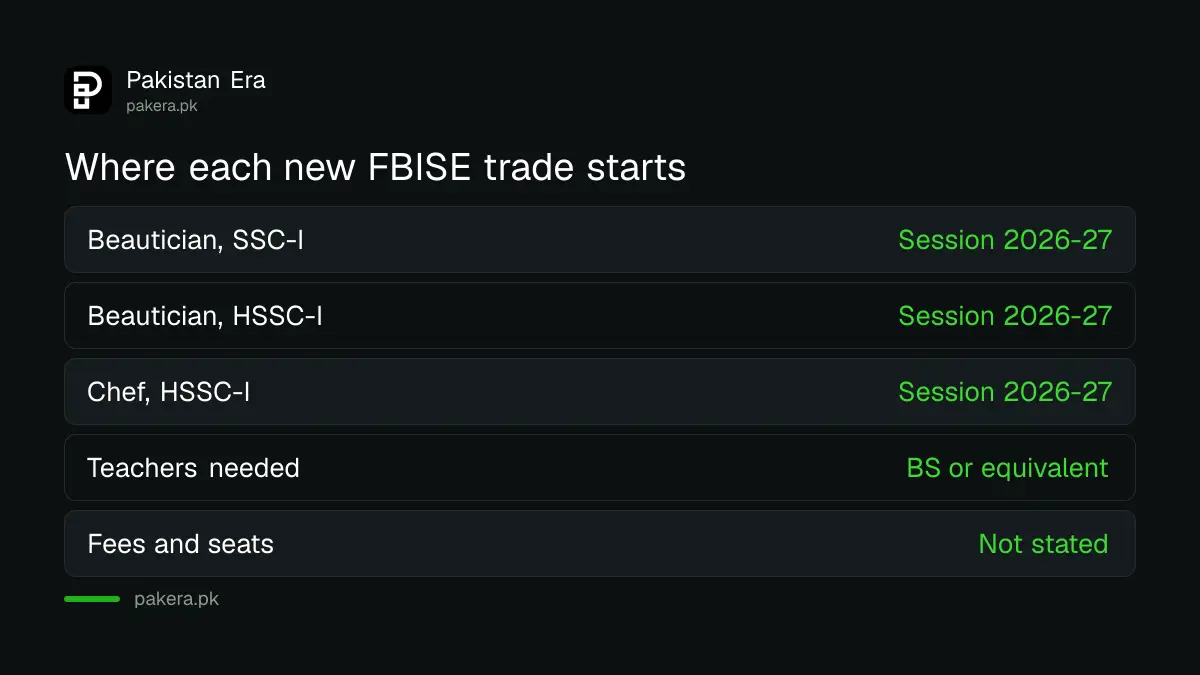
Beautician and Cosmetology can be taken at two levels: SSC-I and HSSC-I. Professional Cooking and Chef is notified at HSSC-I only. A student in class 9 therefore sees only the beauty trade as new, and a student in class 11 sees both.
| Trade | Level in the notification | Starts |
|---|---|---|
| Beautician and Cosmetology | SSC-I | Session 2026-27 |
| Beautician and Cosmetology | HSSC-I | Session 2026-27 |
| Professional Cooking and Chef | HSSC-I | Session 2026-27 |
One thing to watch: the FBISE Matric Tech page already lists a Professional Cooking and Chef trade under the 2022-23 curriculum. The August notice is about the new HSSC-I curriculum. Ask the school which version it is offering before you pay.
Schools must have qualified teachers first
The notification says that before these programmes start, schools must make sure they have qualified teachers, meaning a BS or equivalent degree in the relevant subject. A school without such a teacher should not offer the trade. That is the rule parents can quote.
The notice went to the heads of all FBISE-affiliated institutions, including federal directorate schools, cantonment and garrison schools, Army Public Schools, Fauji Foundation, OPF and several private groups. It also asked the affiliation department to give special attention to the first paragraph.
We could not find a list of schools that have been cleared to teach the new trades. FBISE publishes lists of affiliated Matric Tech institutes on its technical education page, so check there, and ask the principal in writing.
Model papers and practical manuals are already out
FBISE says it has developed model question papers for the theory and assessment manuals for the practicals of both trades. They sit on the board's Matric Tech page. A student can read the paper style now, before choosing the trade.
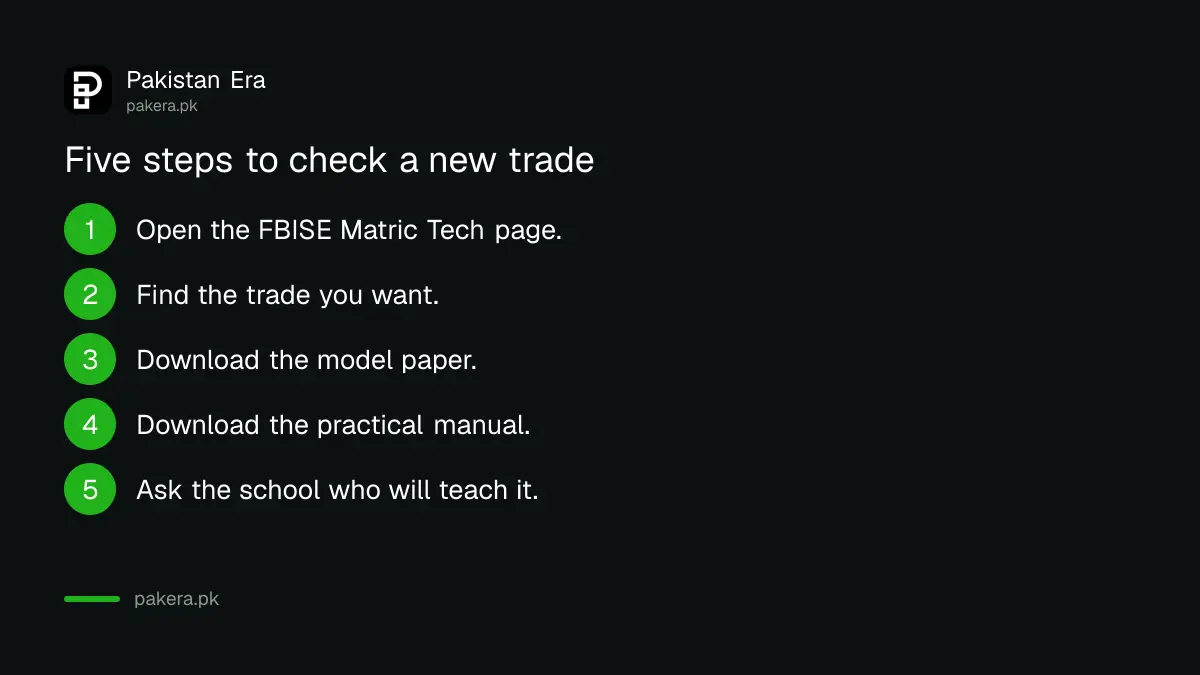
- Open the FBISE technical education page for Matric Tech.
- Find Beautician and Cosmetology or Professional Cooking and Chef.
- Download the model question paper for the theory part.
- Download the assessment manual to see how the practical is marked.
- Take both to the school and ask who will teach and examine the practical.
Matric Tech students also study Functional Urdu, Functional English and Functional Mathematics as compulsory subjects, according to the same page. The trade comes on top of those.
What the notification does not say
The notification does not state fees, seat numbers, exam dates or admission deadlines for the new trades. It also does not say how many schools will offer them in the first year. Treat any figure on social media as unconfirmed until FBISE or your school shows it in writing.
If your child wants a skill route without changing boards, compare it with the other options. The technical education routes in Pakistan lead to different certificates, and some people prefer a short course through a NAVTTC skill certificate without classes. In Punjab, many choose a TEVTA course instead.
Class 11 students on the FBISE route should also watch the registration date. See the Class 11 registration deadline of 30 October before choosing a group. The board is also changing paper style in five core subjects, covered in the 50 percent MCQ pattern.
Common questions
Which FBISE trades are new for 2026-27?
Beautician and Cosmetology at SSC-I and HSSC-I, and Professional Cooking and Chef at HSSC-I. FBISE notified them on 10 August 2026.
Can every FBISE school offer them?
No. The notification says qualified teachers with a BS or equivalent degree in the subject must be ensured first.
Is there a fee for the new trades?
The notification gives no fee. Ask FBISE or your school, and get the answer in writing.
Where are the model papers?
FBISE says they are on its Matric Tech page, along with the practical assessment manuals.
Does this apply to Punjab or Sindh boards?
No. The notification is addressed to institutions affiliated with FBISE at SSC and HSSC levels.
How we verified this
What we checked, where we read it, and what we could not confirm.
Last checked on 14 October 2026, Pakistan time. We read FBISE Notification No. 1-10/FBISE/RES/245 dated 10 August 2026 and the board's Matric Tech page. We did not find fees, seats or a list of approved schools, and we did not see the model papers themselves. Confirm with your institution before you enrol.
About the author

Public Services and Education Journalist
Fajr Riaz is a journalist and content writer at Pakistan Era, based in Lahore. She covers the questions people meet in everyday life in Pakistan: how a public service works, what a change in the rules means, and where to find a reliable answer.