Hormuz Ship Traffic Stays at 12% of Normal: What It Means for Pakistan's Petrol
Ships crossing Hormuz are reported at 12% of normal. See how OGRA's seven day average carries that to Pakistan's petrol at Rs 398.30, and what is at risk.
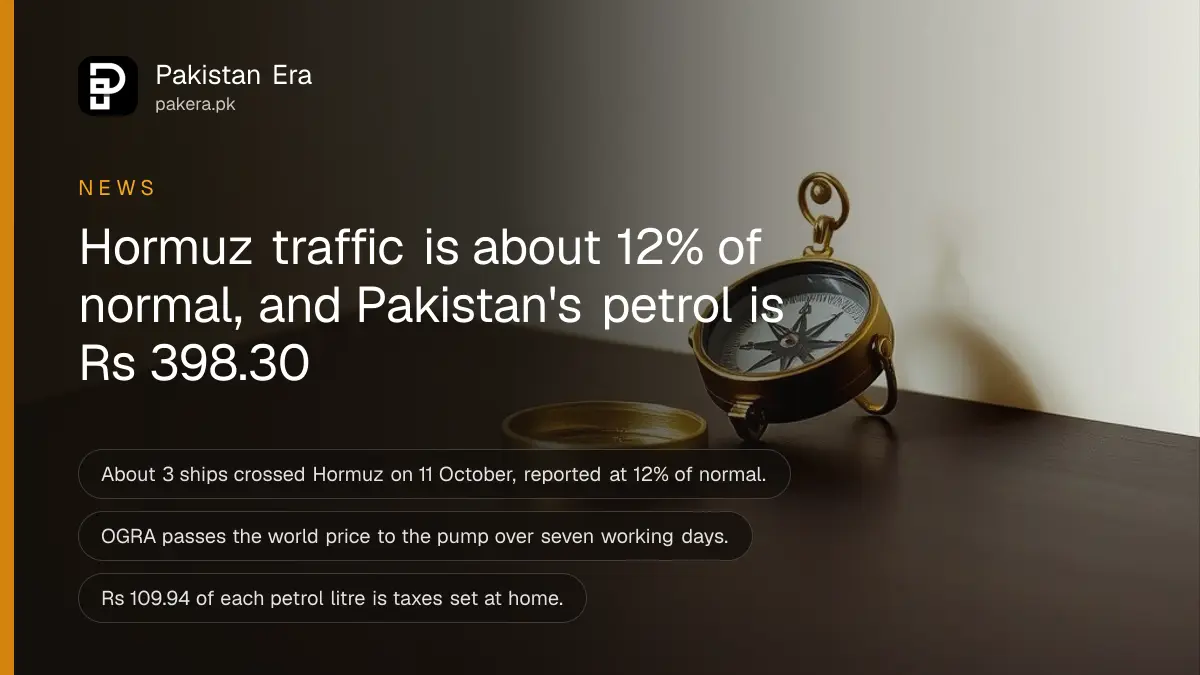
Short answer: Ship traffic through the Strait of Hormuz is reported at about 12 per cent of normal, with more tankers hit on 10 and 11 October 2026. Pakistan's petrol price is Rs 398.30 a litre on OGRA's sheet for 10 October. The sheet averages world prices over seven working days, so a shock abroad reaches your pump slowly.
The Strait of Hormuz is a narrow sea lane between Iran and Oman. A large part of the world's oil and gas passes through it, and Pakistan buys much of its fuel and gas from the Gulf. When ships stop moving there, Pakistan feels it in its fuel bill, its power plants and its gas supply.
We read the Oil and Gas Regulatory Authority (OGRA) petrol sheet effective 10 October 2026 on 12 October. We also read the Karachi Port Trust shipping pages on the same day. The Hormuz ship counts come from a public tracking site, so we mark them as reported.
Hormuz traffic is reported at about 12 per cent of normal
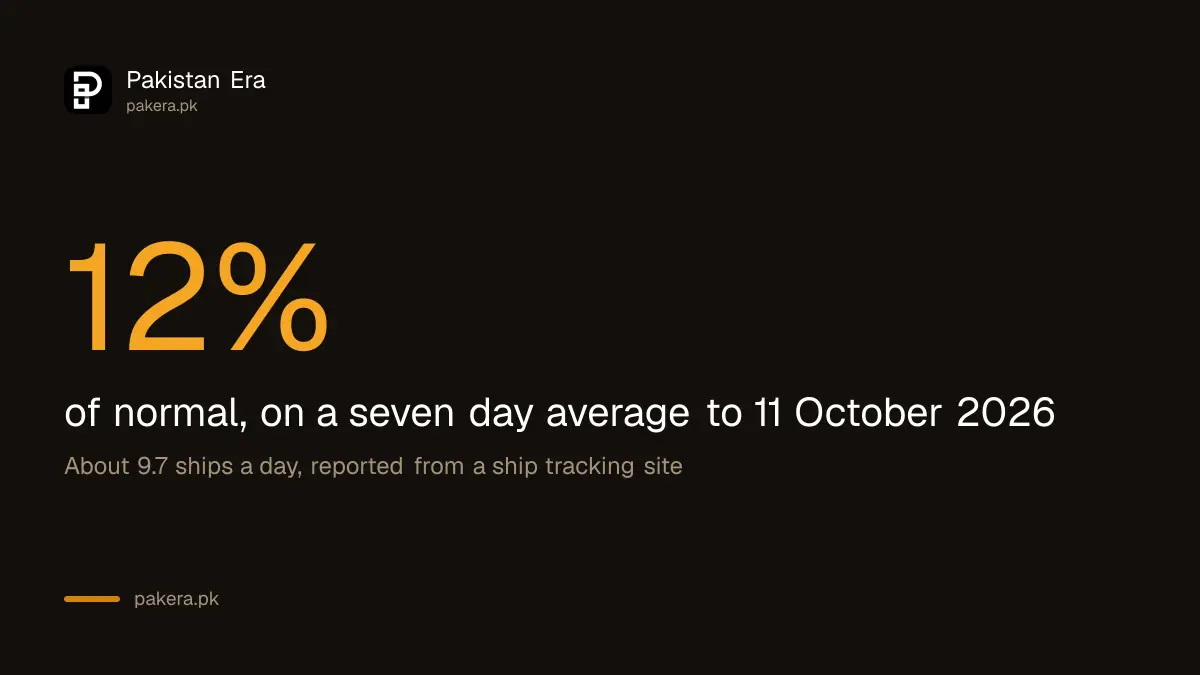
Reports on 11 October say three commercial ships crossed the strait that day. The seven day average was 9.7 ships a day, about 12 per cent of normal. A tanker was hit by an unknown projectile on 10 October and a second on 11 October.
The same reports say Iran called the United States' reply to its seven conditions "insufficient". That means no deal to reopen the lane is close. Crew pay shows the strain: tanker captains are reported to be offered up to 100,000 dollars a month to make the crossing.
| Item | What is reported | Date |
|---|---|---|
| Ships crossing | 3 in one day | 11 October |
| Seven day average | 9.7 a day, about 12% of normal | To 11 October |
| Tankers hit | One on each day | 10 and 11 October |
| Brent crude at Friday's close | About 104.72 dollars a barrel | 9 October |
Pakistan's petrol price follows world prices with a seven day delay
OGRA's sheet uses a seven working day rolling average of the Gulf petrol price. Its own note says the full impact of a change in the daily international price is passed on in seven working days. A jump on Monday can still be arriving at the pump next week.
On the sheet for 10 October, the Gulf petrol price averaged 133.48 dollars a barrel. A premium of 16.12 dollars is added, and the rupee is taken at 277.19 to the dollar. The result is petrol landed at Karachi at Rs 261.11 a litre, before levies, margins and the exchange adjustment.
Our fuller account of that method is in how Pakistan sets the petrol price every day, and the lag is why petrol does not fall the day oil falls.
Rs 109.94 of each petrol litre is set at home
Hormuz explains only part of the pump price. On OGRA's sheet, the petroleum levy is Rs 80 and the climate support levy is Rs 5, and customs duty adds Rs 24.94. That is Rs 109.94 a litre of taxes before any shipping story begins.
So a rise of 5 dollars in the Gulf price does not mean a rise of 5 dollars at the pump. Only the landed cost moves with the world price. The taxes and margins stay put unless the government changes them. The daily record of those moves is on the 10 October petrol price page.
Gas and power carry the bigger risk than petrol
Petrol is the visible price, but power and gas are the bigger exposure. Pakistan has imported most of its liquefied natural gas from Qatar, and that gas must pass through Hormuz. Reports say Iran approved Qatari tankers using a northern coastal route, but that is not a normal flow.
Our earlier pieces show the effect: Pakistan burning more coal because a shipping route stopped working, and RLNG costing more than at any point since imports began. LPG buyers should also watch the monthly rate in the October LPG price.
Crude is still arriving at Karachi, as far as we can see
The Karachi Port Trust page showed 18 vessels on port on 12 October, and none waiting off the port. A crude oil tanker, M.T. Lahore, carrying 73,000 tonnes for Pakistan National Shipping Corporation, was at the Oil Pier from 11 October. We cannot tell where it loaded.
That is a small sign, not proof of supply. One tanker on one day says nothing about stocks. To see arrivals for yourself, use the steps in how to check a ship's arrival on the Karachi Port Trust site.
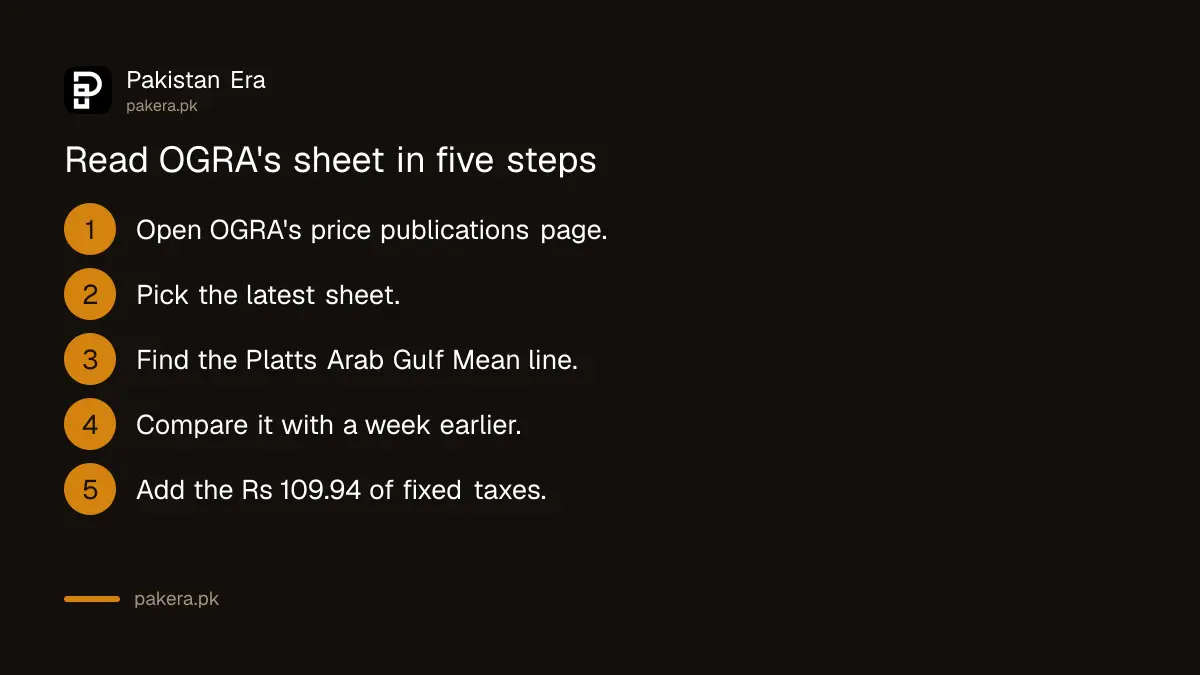
- Open OGRA's price publications page and pick the latest sheet.
- Find the line for the Platts Arab Gulf Mean average, in dollars a barrel.
- Compare it with the sheet a week earlier, not with yesterday.
- Look at the rupee rate on the same line, because it moves the price too.
- Add the fixed levies to see how much of the price is domestic.
Common questions
Is the Strait of Hormuz closed?
Reports describe it as almost closed to normal traffic. About three ships crossed on 11 October and the seven day average is about 12 per cent of normal, so it is open only in a very limited way.
Will petrol go up because of Hormuz?
It can, but with a delay. OGRA's sheet averages the Gulf price over seven working days, so a move in world prices shows up at the pump over about a week.
What is the petrol price in Pakistan today?
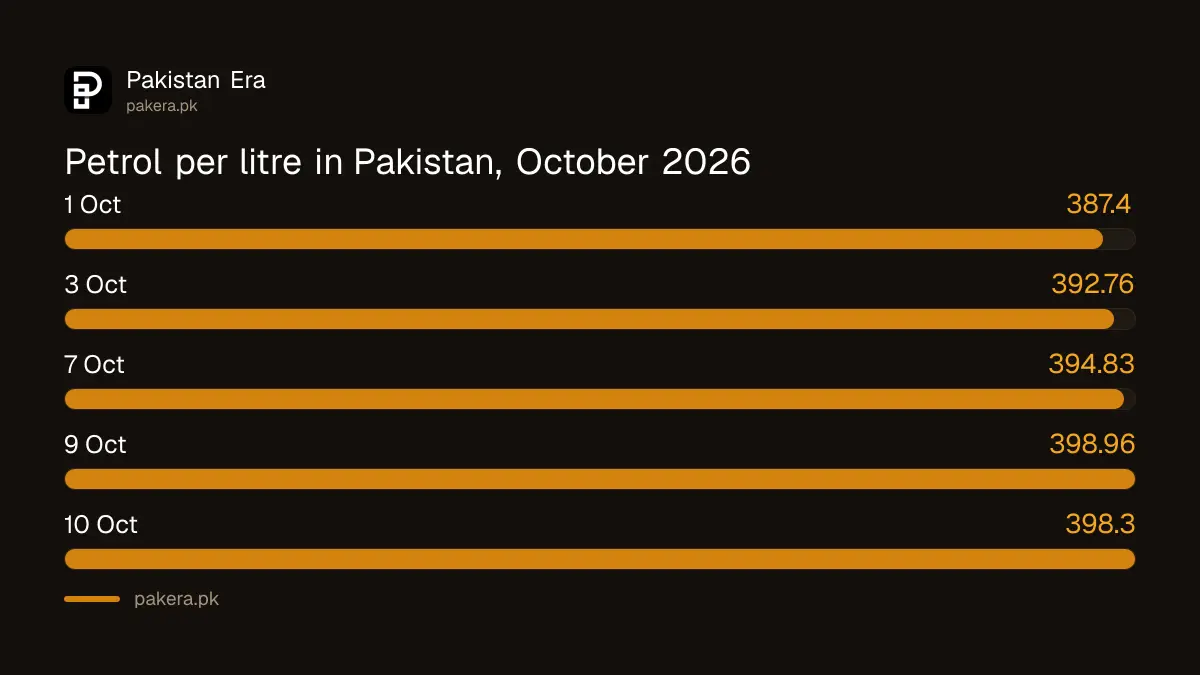
On OGRA's sheet effective 10 October 2026, petrol is Rs 398.30 a litre. Check the latest sheet, because the price can change on any working day.
Does Pakistan have enough fuel?
We could not find an official stock figure on 12 October 2026. We saw a crude tanker at Karachi's Oil Pier, but one ship does not show national stocks.
Why is gas more at risk than petrol?
Pakistan's imported LNG comes mostly from Qatar through Hormuz. Petrol can come from several suppliers, while LNG has fewer routes.
How we verified this
What we checked, where we read it, and what we could not confirm.
Last checked 12 October 2026. The petrol figures are from OGRA's price sheet effective 10 October 2026, read at OGRA's price publications. The port details are from the Karachi Port Trust ships on port page. Ship counts, the Brent price and the tanker strikes are reported, because we could not read them on an official page. We found no official Pakistani fuel stock figure.
About the author

Global Affairs & Political Economy Writer
Muhammad Hatim is a book lover who started writing because he enjoys it. At Pakistan Era he writes about international relations, geopolitics and the global economy, with a particular interest in South Asia and the forces behind current events.